Friday, 3 July 2015

A Few Portraits of Handel


 A Few Portraits of Handel.

Handel attributed to Thornhill (doubtful whether by Thornhill or of Handel)


Handel by Phillip Mercier (1689 -1760).

127 x 101.6cms
Viscount Fitzharris.
Copy in Handel Haus Museum, Halle Germany.

Given by Handel to Thomas Harris Lawyer of Lincolns Inn in 1748 who also owned a plaster bust of Handel by Roubiliac. Thomas Harris was a long term friend of Handel and witnessed his wills.
 By descent from Harris's nephew, the first Earl of Malmsbury to the Viscount Fitzharris


Once thought to be by Hudson but this portrait has been downgraded to possibly by
Francis van der Myn (1719 - 83).
77 x 64.3 cms.
Royal Society of Musicians


 Balthasar Denner c. 1726 - 28.

National Portrait Gallery.

74.9 × 62.6 cm
__________________________________________________


Thomas Hudson, 1756. The 'Gopsall Hall' portrait painted for Charles Jennens.
Jennens had an enormous influence on Handel’s life and work. As librettist for the oratorios Saul and Belshazzar, he provided the composer with words that inspired some of his most challenging and exciting music.


Oil on canvas, 94 x 57 ½ in. (2388 x 1461 mm); pale brownish-blue eyes, bushy dark brown eyebrows, protruding lower lip, blue shadow on upper lip, cheek and chin, fresh complexion, white wig parted in the centre; white lace cravat and wrist ruffles, grey velvet suit with gold lace edging, waistcoat unbuttoned, black tricorn hat under left arm, his right hand clasps the top of a stout gold-headed cane; a tall chair backed with blue velvet, a table, left, with an open book lettered MESSIAH, black curtain behind drawn back from an opening, left, reveals a stone balustrade with foliage beyond and a pale blue sky with low pink cloud.

Signed and dated on the stone step, bottom left: T. Hudson Pinxt:/1756; a stencil 632 FS is on the stretcher.

This is the second Hudson type, presumably commissioned by Charles Jennens c.1756. A small whole length sketch is in the Royal collection (Millar, 556) and copies  include a head and shoulders, Royal collection (Millar, 558), a head in the Fitzwilliam attributed to Grisoni and NPG 8 The sketch might have been part of the Smith bequest to George III but since it was apparently only recorded in 1876, this cannot be confirmed.

Hudson certainly made two portraits of Handel. In April 1750 he offered the Foundling Hospital a portrait for which the composer had agreed to sit  but none is known to have been acquired in Handel's lifetime,  and nothing more was heard of this. The first and better known type can be dated from an engraving by Andrew Miller (CS 927) lettered Thos. Hudson Pinxit London 1747, published in Dublin, 1749. An impression was known to Breun but there is no example in the British Museum. A rare early state of the engraving by Faber junior is dated 1748 (CS 51) but the original has not been identified with certainty. A three-quarter length given to Oxford University by Samuel Howard before 1778  does not appear to be from Hudson's hand. A more convincing oil corresponding closely to Faber's engraving entered the Staats und Universitäts-Bibliotek, Hamburg in 1883. Reputedly bought by, or sent to, Handel's family in Halle, it was acquired through the composer's biographer Chrysander for a public collection. It appears to be inscribed, or possibly signed and dated, 1747 or 1749. According to Dr Burmeister, of the Hamburg Bibliotek, the last figure is '9' whereas the photograph seems to read T Hudson Pinxit 1747 . The head looks very good although the treatment of the coat is unusually hard for Hudson.
(Kerslake)


_____________________________________________________________________


Portrait of Handel by Thomas Hudson

Royal Collection, currently with the Handel House Museum, Brook Street, Mayfair London.


At NPG since 1858 after Thomas Hudson,
Purchased Graves, Pall Mall.

Oil on canvas, 48 7/8 x 39 7/8 in. (1242 x 1013 mm); as NPG 3970  the wig greyer, his right hand gloved and holding the other glove, also the head of a cane. A stencil 121, possibly the remains of a larger figure, in black, on the top stretcher bar.

The picture appears to be an early, somewhat coarse, copy of NPG 3970 rather than a canvas produced in the studio under Hudson's supervision. Kerslake.
_________________________________


Handel c. 1737 by Georg Andreas Wolfgang the younger of Augsburg who visited London in 1737


Portrait of Handel by Thomas Hudson 1748.
121 x 100.5cms.
Signed on the left of the table leg - T Hudson Pinxit 1749.
Staats und Univeritatsbibliothek, Hamburg

Believed to have been taken to Germany in 1750 and given to his relatives in Halle on his last visit to Germany in 1750.

One of two portraits by Hudson the most fashionable portrait painter of the day who also painted the portraits of Handel's fellow Opera  associates Senesino, Pepusch, in the 1730's Susannah Cibber in 1749, John Beard in 1743, and Charles Jennens in 1747. Hudson was also an Opera enthusiast, fellow art collector they both had an interest in old masters. Hudson owned the terracotta model of Handel for Roubiac's statue at Vauxhall.


 Handel by Hudso engraved by Faber 1749.


Miniature of Handel by Dresden miniaturist, Christain Friedrich Zinke (1683 -1767), Height 1 inch.
Exhibited at the Masterpiece fair, London 2014 by Dealer Elle Shushan from Philadelphia


Joseph Goupy (1680 -1770). The Harmonious Boar after 1743.
39.4 x 32.4 cms.
given to Fitzwilliam Museum, Cambridge, 1919.

Probably the picture in Goupy sale, Mr Hobbs 23 March 1765 lot 39. An Hog Playing on an Organ, with various Embelishments,, all emblematical; noted by Horace Walpole.
Puttick and Simpson, 29 Jan 1858, lot 201, by Edward F Rimboult.

Either the cause or result of a contretemps between Goupy and Handel.

This version dated 1754


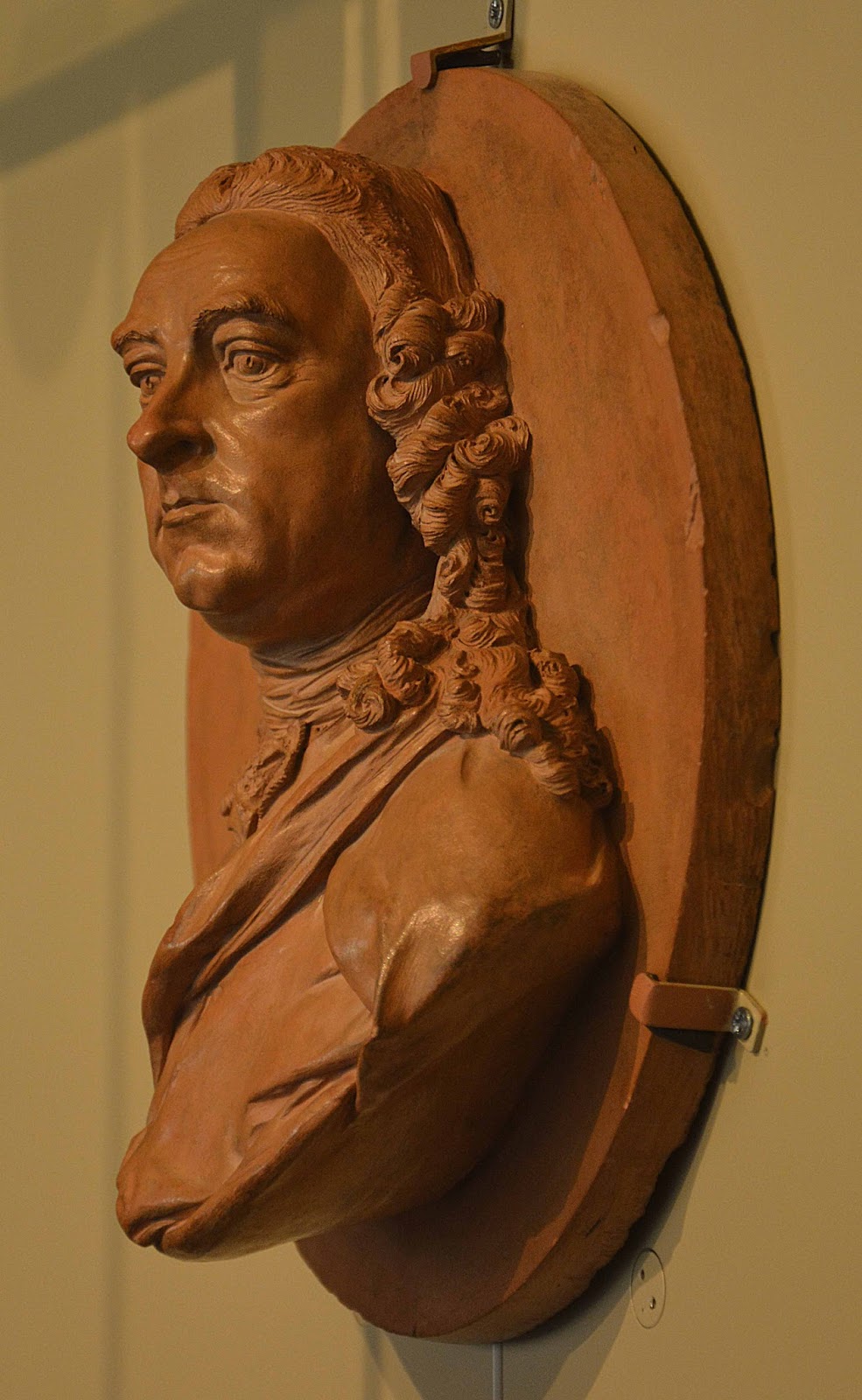
The Roubiliac Terracotta Relief of Handel at the Victoria and Albert Museum


Terracotta Relief of Handel by Louis Francois Roubiliac.
Victoria and Albert Museum.
 

28.6cms in diameter.
 
Purchased from Peel and Humphris, Bond Street, London, 1961.
Hildburgh Bequest.


Tuesday, 30 June 2015

The so called Handel Life Mask


Photographic Comparisons of the so called Life Mask with other versions of the Plaster Busts of Handel and some notes pertaining.

This blog entry edited and updated 6 Oct 2020.


The earliest mention I can find of a life (or death mask) appeared in the weekly magazine The Mirror of 19 July 1834. 


Much has been made of this reference and other versions of the "life masks", particularly by David Wilson in the British Arts Journal, Vol. X no. 1; David Coke in the Sculpture Journal, Vol.16.2; and at the Ruth Rendall unveiling at the Handel House at 25 Brook Street, Mayfair, London in 2009 and then in subsequent Handel House publications.


My own belief is that none of these authors have had the opportunity to inspect the other versions of the Roubiliac Handel busts (the Grimsthorpe terracotta or the Gloucester Cathedral plaster) at close quarters and to make comparisons and that the so called "Life mask" is a cast of a version of the bareheaded and late generation and much over painted Roubiliac plaster bust of Handel.


They also appear to have been unaware of the marble version of this bust (by Heaven Inspired) sold by Sotheby's Lot 179, 9 July 2015.


It is a shame that these authors have made assertions which havn't been verified and that the facts have become skewed and then repeated by a series of "Chinese whispers".


Given that Malcolm Baker must have been aware of the marble version of this bust in an article by David Wilson, ''By Heaven Inspired': A marble bust of Handel by Roubiliac rediscovered', The British Art Journal, vol. X, no. 1, 2009, pp. 14-29. it is a shame that no mention of it appeared in his work "The Marble Index" published in 2014.


 The three quarter life size plaster bust of Handel now with the Handel Haus Museum in Halle, Germany on the left compared with a plaster mask.

For much more on this recently discovered and unpublished plaster bust of Handel see -


For a slightly different version of this plaster bust of this bust but showing the waistcoat embroidered and a turned socle with eared support ( much used by Shout of Holorn see - 

http://bathartandarchitecture.blogspot.com/2015/03/

 
The illustration of the mask on the cover of the Sculpture Journal above was reproduced the wrong way around.


Another comparison photograph of the three quarter life size bust at Halle on the right with  another of the so called life masks. 

The photograph above on the left is of the so called life mask of Handel as used in the Exhibition catalogue Handel, A Celebration of his life and Times, 1685 - 1759, ed. Jacob Simon. NPG, 1986.


Photograph of the so called life mask of Handel taken at the Handel House Museum in London in 2009.


As above.


_________________


Above the Gloucester Cathedral Plaster bust of Handel, on the left compared with the so called life mask. This to me is obvious proof that the "life mask" has been taken from a much over painted plaster cast of the Roubiliac bust of Handel. 

It is plain to see that the "life mask" has lost the definition that is easily discernible on the Gloucester Cathedral Plaster.

Comparison of the eyes is instructive.

It should also be noted that the prominent mole on his right hand cheek (proper) clearly visible in the Foundling Museum terracotta and the 1738 engraving by Houbraken is missing!
 
If it were a life mask the eyes hair and eyebrows would have to have been reworked after a mould was taken of the sitters face
 
Were it really a life mask, even with the obvious over painting, which this mask has undergone, the detailing of the facial features would be much clearer. The detail of the hair on these two faces is obviously very close as are the eyes and eyebrows.
 
There would also be deterioration of the plaster piece mould after each pull. It is difficult to be sure how many times a piece mould could be used - probably less than twenty.
 
Since the first mention of any life or death mask was in the Mirror of 19 July 1834 it is my belief that this mask was produced deliberately to deceive the gullible with the intention of parting them with their money - this seems to have worked up until now, that is if anybody actually reads this.
 
I would welcome any comments.


George Frederick Handel.

Showing the mole on his right proper cheek - this is also visible on the Foundling Hospital Roubiliac terracotta of Handel.

Line Engraving.

by Jacobus Houbraken. 

after Hubert-François Gravelot (né Bourguignon).

 1738.


35.25 x 22.22 cms.
 

Image above courtesey National Galleries of Scotland


Above The Handel House Mask compared with the Grimsthorpe terracotta. 


The Handel House Mask.


Another Photograph of the Handel House Mask.


Photograph from the National Portrait Gallery of the so called life mask of Handel as used in the Exhibition catalogue Handel, A Celebration of his life and Times, 1685 -1759, ed. Jacob Simon. NPG, 1986.


My favourite photograph of a so called life mask (with David Coke from the Times 26 June 1992).
 

_________________


  The David Coke life mask compared with the Gloucester Cathedral.

_________________

For a detailed look at the Gloucester Cathdral plaster bust of Handel see my blog post - 


For an in depth look at the Roubiliac terracotta of Handel at Grimsthorpe see -

http://bathartandarchitecture.blogspot.com/2015/06/comparison-photographs-of-sothebys.html

For a set of photographs at Getty images of the so called life mask at the Handel House Museum, Brook Street, London with a laughable pitch to make one purchase these expensive photographs see -


For the marble version of these busts see -


Possibly this marble bust is the ‘remarkable fine bust of [Handel], exquisitely modell’d by Roubiliac’ in a sale of 1766.

Possibly lot 35 on the second day (21 February) of the John Blackwood sale at Christie’s in 1778, ‘Roubiliac, marble busto of Handel, on a pedestal’.

In the Collection of Alfred Morrison (1821-97), at Fonthill House, Wiltshire, and 16 Carlton House Terrace, London, from c. 1860- 1897;
By descent to his widow, 16 Carlton House Terrace, London;

Prior to its sale at Christie's in 1900, the present bust was recorded in Morrison's collection in the 1890 Handel entry in the Dictionary of National Biography, there described as being by Roubiliac; the attribution is likely to have been given by the then Director of the National Portrait Gallery, Sir George Scharf, who was very familiar with Roubiliac's work (info from Sotheby's catalogue.


Morrison sale, Christie's London, 10 February 1900, lot 107;

Acquired by S. T. Gooden (later,  Hazlitt, Gooden & Fox) London, on commission for one Charles Eley, probably the Chairman of Eley Brothers, the well-known manufacturer of firearms cartridges.

Early 21st Century -rediscovered in Belgium by a London dealer.


The Grimsthorpe bust from their website.


_____________


The Roubiliac Busts of Handel - the so called life mask type.

Grimsthorpe - Morrison/ Sotheby's.
Handl Haus, Halle - Gloucester Cathedral


Sunday, 28 June 2015

Plaster Cast of the Head from the Handel Monument in Westminster Abbey and the Modellos for the Monument.


The Plaster cast of the head of Handel from the Monument by Roubiliac in Westminster Abbey.


Cast by D. Brucciani. Mid - late 19th Century, in the Fitzwilliam Museum, Cambridge.

The current authorities at Westminster Abbey do not allow photography in the Cathedral Church.

In their need to monetise their holdings - photographs of the sculpture can be purchased from them.

This of course means that they are expensive and old fashioned.


They would do well to read their bibles. Matthew 21: 12 - 17. etc etc.


Height 52 cms.

Given to the Fitzwilliam in 1906.


Below is another Brucciani cast of the same subject with rather unsympathetic magnolia repaint, at the Royal Academy of Music - there is another in the British Library.


Another version of the Westminster Abbey Head of Handel by Brucciani at the Royal Academy of Music.

These busts appear to have been taken directly from the Handel Monument in Westminster Abbey and whilst obviously related to the Roubiliac portrait busts of Handel it is also very close to the head of the Vauxhall Statue of 1738 now in the V and A.

I believe that all of the Roubiliac sculptures of Handel were originally derived from sittings - or a life mask taken in about 1736 /37 before the creation of the Vauxhall statue and Royal Collection marble and the terracotta versions of the bust with the hat of 1737/8.

Given the changes in his appearance after this time when he put on a great deal of weight, which does not show in any of these sculptural portraits I believe that Roubiliac used an earlier bust or busts in order to create the monument in Westminster Abbey.


also for company history and much more of interest on plaster casts in the 19th century see -


The Westminster Abbey Handel Monument by Roubiliac.


________________________


Model for the Westminster Abbey Monument by Roubiliac in the Ashmolean Museum, Oxford.

98 cms tall.

Given by James Wyatt to Oxford University in 1848.


Slightly higher resolution photograph of the Ashmolean terracotta modello for the Handel monument by Roubiliac. 

_________________________________________________________


Black and White photograph of the modello at the Foundling Hospital Museum noted to have been  recently discovered in Bath, in Early Georgian Portraits by Kerslake. NPG. 1977.


 Photographs of the Modello taken in very poor light at the Foundling Hospital Museum.
12 - 15" tall approximately.

.............................

Flaxman Senior and a Cast of Handel 1764.

It is possible that there were plaster copies made of the Roubiliac model for the monument although none have come to light so far. John Flaxman senior, father of the more famous sculptor offered casts from the original mould of the monument in The Gazetteer and London Advertiser of 13 January 1764. probably lot 61 on the 2nd day of the sale of the contents of the Roubiliac Studio in St Martins Lane, 13 May 1762.

John Flaxman I (1726 -1803) at New Street Covent Garden from 1763, 

He was at King Street, Covent Garden from 1773 -76.

In 1776 he moved 420 The Strand (opposite Durham Yard).

In 1792 he bought several moulds formerly belonging to John Cheere, He is believed to have been employed by both Scheemakers and Roubiliac. (see Dict. of Sculptors in Britain....).


 Above - snippet from The Gazetteer and London Advertiser of 13 January 1764.