


................................
Aeneas and Anchises - the Lead Group at the Royal Palace of Queluz, Portugal.
Photographs taken by the Author.


For the restoration of this group and the Rape of the Sabines at Rupert Harris's Studio in East London see -
The remains of early paint schemes were found on the
sculpture's surface. Samples were taken for analysis, which revealed that the
sculpture had received at least six paint treatments up until the early 20th
century. These schemes were all of light grey/stone colours. The red colour so
visible now on one of the sculptures is the remains of a coat of red iron oxide
primer, applied prior to a 19th century application of stone-coloured paint.
Several parts of the sculpture were found to be missing, or damaged beyond repair. Moulds were taken from the group at Wrest Park, and the missing pieces were cast in lead and attached to the sculpture.
Damaged areas were then repaired by lead burning and a new stainless steel armature inserted to support the sculpture and the base area.
........................
Made during the artist's stay at the Académie de France in Rome from 1697, transported to France in 1715 to adorn the garden of the Château de Marly, the work now kept in the Louvre Museum.
From a wax sketch entrusted by Girardon to Lepautre in April 1696, during the latter's visit to Paris.
Wax model by Lepautre, completed at the French Academy in Rome, in November 1696.
Large plaster model completed July 1697. Terracotta completed December 1697.
Marble block issued September 17, 1697. Marble started October 1697.
Third clay model, December 1697. Return to France of the sculptor, February 1701. Sent from Rome in April 1715 and placed unfinished in the park of Marly in August 1715.
Completed with the help of Jacques Bousseau, in 1716. Placed in the Tuileries Garden, west of the circular basin in 1717.
It should be noted the Bousseau was closely connected with Louis Francois Roubiliac - when Joseph Highmore was in Paris in 1734.
Roubiliac provided a letter of introduction to Jaques
Bousseau for the English painter Joseph Highmore (1692 - 1780) who was visiting
Paris in 1734.
For Highmore in France see - https://www.journal18.org/issue2/an-englishman-in-paris-joseph-highmore-at-the-academie-royale/

.........................
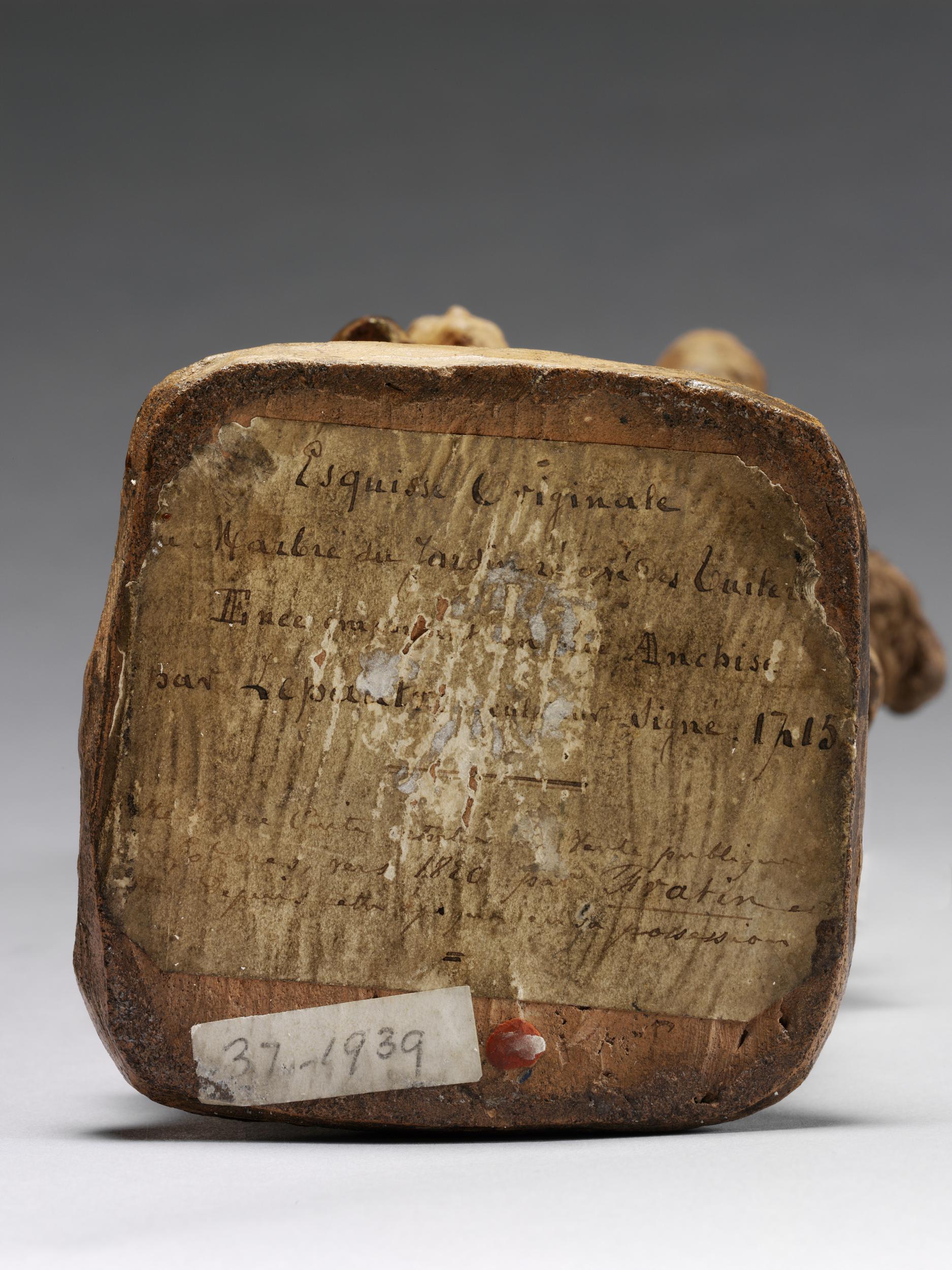
The V and A Terracotta inscribed P. le Pautre, 1715.
Height: 25.6cm Width: 14cm (maximum) Depth: 10.5cm (maximum).
A terracotta model in reduction of the original marble work is now kept in the Victoria and Albert Museum in London. In the 18th century, Lepautre himself had kept a copy in his workshop and Lalive de Jully, the famous introducer of Louis XV's ambassadors, also had another.
Purchased by the John Webb Trust in 1939.


....................
In book two of Virgil's epic poem The Aeneid (29-19 BC), the
Trojan hero Aeneas escapes from the burning city of Troy and its Greek invaders
with his family. Here the artist shows them making their way through a
classical corridor. Aeneas carries his elderly father, Anchises, entrusted with
holding their household gods. Aeneas holds the hand of his son, Ascanius, and
his wife Creusa follows behind. Creusa's separation from the group alludes to
her fate: she will fall behind and not survive their flight.
Print made by: Agostino Carracci, After: Federico Barocci,
Published by: Donato Rasciotti, 1595.
https://www.britishmuseum.org/collection/object/P_V-8-186
for a preparatory drawing for the lost painting see
https://www.clevelandart.org/art/1960.26


...............................
Rondel at the Soane Museum.
Probably John Bacon.


William Cheere d. 1767? appears to have been the son of John Cheere's first wife, Theodosia Maria, who died in 1767 ‘of a broken heart for the death of her father and only son’ (GM 1767, 280).
He supplied sculpture to George Washington for Mount Vernon in response to Washington's order, which gave directions not only for the subject matter but also as to size, which was determined by his indented placement for these objects.
Washington wrote:
'Directions for the Busts / 4--one of Alexr the Great--another of Julius Caesar-anr
of Chs 12 Sweeden & a 4th of the King of Prussia. / N.B.--these are not to
exceed 15 Inchs in highth nor 10 in width for brokn Pedimt. / 2 other Busts of
Prince Eugene & the Duke of Marlborh-somewhat smallr. 2 Wild Beast-not to
exceed 12 Inch in highth nor 18 in lenght. Sundry Small Ornaments for Chimy
piece'.
In 1760 he received a shipment costing £12 11s 4d which
contained 'A Groupe of Aeneas carrying his Father out of Troy with 4 Statues
viz - his Father Anchises, his wife, Creusa, himself and his son Ascanius,
[neatly] finished and bronzed with Copper. /Two Groupes, with two Statues each
of Bachus & Flora finisht neat, & bronzd w' Coper £2.2 each / Two
Ornamented Vases with Faces & festoons of Grape & Vine Leaves &c
finished Neat & bronzd w' Coppr The above for ye Chimney Piece-/ Two Lyons
after the Antique Lyon's in Italy finished neat & bronzd with Copper £1.5
each. An invoice of William Cheere, dated March 1760 relates to these works.
The tradesman from whom the pieces were purchased sent directions as to how they were to be placed, adding to the above invoice the note: 'this is ye best Ornaments I could possibly make for the Chimney Piece', adding 'of all the wild Beasts as coud be made there is none thought better than the Lyons.' His instructions for displaying the other figures stated that 'the manner of placing them on ye Chimney piece shd be thus. A Group of Flora - Vase - Aeneas - Vase - Group of Bacchus'. He went on to add that: There is no Busts of Alexander ye Great [none at all of Charles 12th of Sweden] Jullius Caesar, King of Prussia, Prince Eugene nor Duke of Marlborough of the Size desired; and to make models would be very Expensive - at least 4 Guineas each.
but I can make Busts exactly to the Size wrote for [15 Inches] also very good
ones at the rate of 16s. Each of Homer, Virgil, Horace, Cicero, Plato,
Aristottle, Seneca, Galens, Vestall, Virgin Faustina, Chaucer, Spencer,
Johnson, Shakespear, Beaumont, Fletcher, Milton, Prior, Pope, Congreve, Swift,
Addison, Dryden, Locke, Newton'.
The figural groupings and vases were intended to ornament a
mantepiece, but the busts may have been for broken segmental overdoors or for
mounting on brackets.
John Davis.
Literary References: Abbot 1988, 355; Vincent 1988, 169
