Charles Clay (d.1740).
The Mechanical Musical Clocks.
With Sculptural embellishments by Rysbrack and Roubiliac, Paintings by Amigoni and music by Handel.
Also including here
are some notes on clocks made by John and his son George Pyke and Henry
Bridge's Microcosm clock movement.
Edited and updated 13 Dec. 2022.
Amigoni (Amiconi) Venetian painter worked in London from
1730 - 1739.
Originally from Stockton, Yorkshire Charles Clay trained as
a machine watchmaker.
First noted when he petitioned parliament for a patent for a
musical repeating watch or clock - unfortunately the Quaker Daniel Quare who
had produced a similar mechanism at the same time opposed Clay's application
and was supported by the Company of Clock Makers.
Although there was prolonged litigation (at the considerable
cost of £73 -17s - 11d) to the Company from February 1716 until the latter
months of 1717, Quare was finally successful and Clay's petition for a patent
was refused.
He was established in near St Mary le Strand by at least
1720, where he remained until his death 20 years later. By 1723 he was
appointed Clockmaker to His Majesty's Board of Works, a post he held for the
remainder of his life. In 1731 he supplied the clock over the gateway at St
James's Palace.
The 'Temple of the
Four Great Monarchies of the World' was put on display shortly after his death;
the clock had been completed by John Pyke, a clock and watch maker of Bedford
Row who had been apprenticed in 1710 and admitted to the Freedom of the
Clockmakers' Company in 1720.
__________________________
A List of the Mechanical Musical Clocks by Charles Clay.
1. Museum of the Royal Palace, Beijing, signed and dated
1730. The organ still in place.
2. Royal Palace, Naples. Signed twice 'Cha: Clay London' and
Cha: Clay / Fecit 1730 '. The organ still in place.
3. Birmingham Museum and Art Gallery, 'Being the first made
in perfection N ° 1 Cha: Clay London Fecit'. dated 1735 - Organ still in place.
4. The 'Braamcamp' / Braamkamp clock - c. 1736 - 40 - the organ is still in place.
Since the writing of this post a new blog post has appeared
regarding the restoration of this clock, see
https://lookingthroughartblog.wordpress.com/2018/11/22/georg-friedrich-handel-and-the-braamcamp-clock/.
5. Castleton House, Celbridge, Ireland.
6. Windsor Castle, Berkshire, GB. - Organ still in place.
https://www.rct.uk/collection/30037/clock-organ-and-mahogany-case-c-1740
7. Board Room, Treasury Buildings, London.
8. Kensington Palace, Temple of the Four Great Monarchies,
London, 1740, completed by John Pyke. The Plinth is a modern replacement.
......................................................
Also considered here is a mechanical music clock by Charles
Pyke now at Temple Newsam House. Leeds, dated 1765.
_________________________________________________
The Clay Musical Clock at Beijing.

The Beijing Clay Musical Clock.
Signed and dated 1730.
Low resolution photograph.
Museum of the Royal Palace, Beijing.
_____________________________
The Clay Musical Clock at Naples.
in the Royal Palace, Naples.
Signed Cha: Clay London and Cha:Clay / Fecit 1730.
It is believed English-born Prime Minister of the Neapolitan Kingdom, Sir John Acton (1736–1810), bequeathed the clock to Maria Carolina, Queen of Naples between 1779 and 1798.
The dial plate features a near identical relief to the Beijing Apollo clock (see above).
________________________________
The Charles Clay Musical Clock at Birmingham Museum.
Birmingham Museum and Art Gallery.
7' 7" tall overall.
A small weight driven pipe organ is housed inside and is operated by a tune barrel, which
is engraved as follows, ‘Being the first/made in perfection/N: 1 Cha: Clay London Fecit.’
The small dial is exactly the same as those on the Beijing and Naples Clocks (see above).
Signed and Dated 1735.
Acquired from the collection of Lord Burnham at the sale of the contents of Hall Barn House, Buckinghamshire in September 1969.
The original repertoire still remains engraved on the scroll, which is held by the gilt bronze
winged figure that surmounts the case.
The right arm of the figure was used to select
the tune.
The scroll reads: Sonata/Traveste /Aria/Gavotta/Traveste/Arieta/Arieta/
Traveste/Praelude.5
Evidence suggests that the original music shown on the scroll was
written by Handel.
________________________________________
The Gerret Braamkamp Musical Clock by Charles Clay.
2.5 metres tall.
from the collection of Gerret Braamkamp (1699 - 1771).
c. 1736 - 40.
Signed C. Clay on the dial. and Cha. Clay London on the Cylinder.
The Clock prior to conservation by Rijksmuseum Conservation Department.
....................................
Sold at the Sotheby's Robert de Balkany Sale 2016 to the Museum Speelklok. Utrecht.
For a short video from the museum see
---------------------------------------
....................
For the story of its restoration by the Rijksmuseum Conservation Department see
The clock prior to conservation.
-------------------------------------------------
From the Sotheby Catalogue.
Provenance -
Acquired by Gerret Braamcamp ( 1699-1771 ), merchant in
Amsterdam, owner of a shipping company, merchant of wood and collector. Clay's
clock should have been one of the first works of art to be acquired by
Braamcamp, which began collecting in 1735. Subsequently, his collection at
Sweedenryck became renowned.
When he died, his collection was sold at auction; the clock
is purchased for 3700 fl. by one of his three brothers, Rutger Braamcamp ( born
1706 ). Then, on the death of the latter, she passed to her nephews, the sons
of her brother Hermann ( born in 1709 ) established in Portugal.
Subsequently,
Clay's masterpiece was successively in the hands of Donna Maria Ignacio de
Almeida in Castelo Branca and Infanta, Donna Maria Isabel ( died in 1876 ),
sister of Dom Miguel, King of Portugal, who keeps him at the palace of S.
Domingos de Benefica in Lisbon.
After the death of Infanta, the clock became
the property of collector Antonio Augusto Carvalho Monteiro ( 1848-1920 ),
owner of the most complicated watch in the world at the time, the Leroy 01.
From Carvalho Monteiro, it passed through several hands to Pedro Felner da
Costa who sold it to Christie’s London on November 8, 1972, lot 88.
Purchased from Christies by London Dealer Frank Partridge, the clock later passes to Robert de Balkany.
....................................
Below from an unknown sale catalogue post 1904.
which perhaps refers to this clock or the Hall Barn Clock now with Birmingham Museum.

Literature -
Jean François de Bastide, The Temple of the Arts or the
Cabinet of Mr. Braamcamp, Amsterdam 1766.
William Barclay Squire, ‘ Handel’s clock music ’, The
Musical Quarterly, v 1919, 538-52.
Croft Murray, ‘ The Ingenious Mr Clay ’, Country Life,
December 1948, 1378-80.
Clara Bille, From Temple der Kunst of het Kabinet van den
Heer Braamkamp, Amsterdam 1961, 81-86.
Jan Jaap Haspels, Automatic Musical Instruments, Utrecht
1987, pp. 182-87.
Pieter Dirksen & Jan Jaap Haspels ( eds ), George
Frideric Handel: Twenty pieces for a musical Clock (that. 1738 ), Utrecht 1987.
[ Exposure catalog ]. Royal Musical Machines, Speelklok
Museum, Utrecht, Zutphen 2006, N ° 41.
Massimo di Sandro, Macchine Musicali al tempo di Händel, un
oologio di Charles Clay nel Palazzo Reale di Napoli, Florence 2012.
Brittany Cox in The Furniture History Society Newsletter,
cxc May 2013.
Tessa Murdoch, ‘ Time’s Melody, Apollo, November 2013,
78-85.
..............................
Gerrit Braamcamp, Distiller, timber merchant, shipbuilder and art collector.
Frontispiece to Le Temple des Arts ou Le Cabinet de M Braamcamp by M. de Bastide.
Amsterdam 1766.
Engraving Reinier Vinkeles after Jacob Xavery.
213 x 153 mm.
for the remarkable collection of Gerrit Braamcamp see -
________________________________________
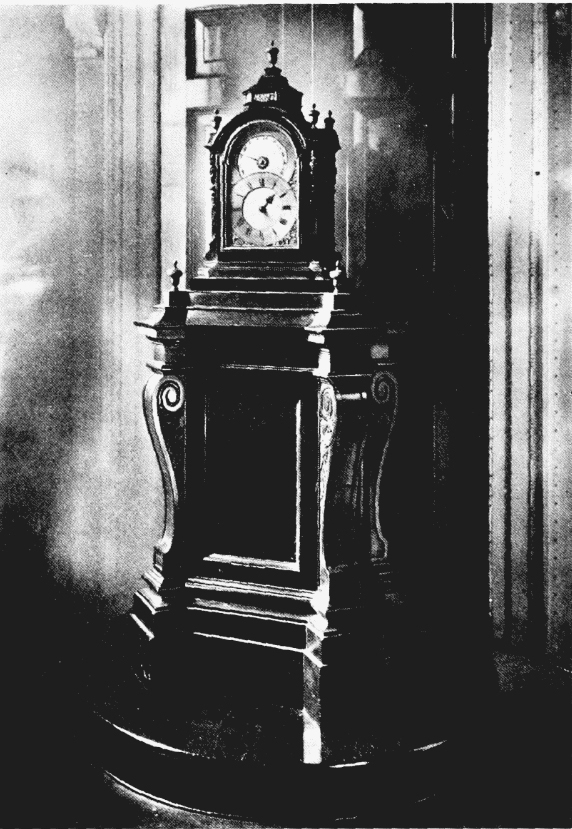
Clay Astronomical Clock in the Board Room Treasury Buildings, Whitehall, Westminster.
The Board Room designed by William Kent 1735.
Currently the best photograph I can locate!
"This clock is "evidently the one referred to in
an entry of 6th November, 1740, in the Treasury Minute Book: 'Mr. Lowther is to
pay out of the King's money in his hands a sum not exceeding £160 for the great
clock and all its furniture set up in the Lords' room here, to Mrs, Clay, widow
of Mr. Clay who made the same…' A further entry of 4th May, 1742, records a
petition from Mrs. Clay for an allowance for keeping in order the Treasury
clock in their Lordships' room, which was made by her husband. The Secretaries
to the Treasury were to agree with her as to a payment for this service, which
they did at £4 per annum." (The Treasury, by Sir Thos. L. Heath, pp.
227–8.)"
Extract and Photograph from British History Online, Survey
of London 1931. Plate 23.
see -
http://www.british-history.ac.uk/survey-london/vol14/pt3/pp23-36#h3-0003
Treasury Building, 1814.
__________________________________
Castletown House, Celbridge, County Kildare, Ireland.
The Clock is 98 tall cms x 81 cms wide.
Provenance -
Believed to have been taken to Castletown by and Katherine
Conolly, nee Conyngham (d.1752), the wife of the Speaker of the Irish house of
Commons William Connolly (1662 - 1729)
William Conolly was at the time the richest man in Ireland
Recorded in an inventory in the Grand Entrance and Inner
Hall in 1893/4
by descent to Major William Francis Conolly-Carew
Purchased by Desmond Guiness in 1966.
Desmond Guiness had purchased the house in 1967 from a Major
Wilson who had bought the house and its collection in 1965.
Bought by the Castletown Foundation in 1975.
The chimes not currently functioning.
Information from Castletown Decorative Arts pub 2011.
Office of Public Works Ireland.
Very kindly supplied by Celine of the Guides reception at
Castletown.
......................................................
In November 1743, Clay's widow advertised 'a most
magnificent and curious MUSICAL MACHINE, CALL'D The temple of the four Grand
Monarchies of the World (viz. the Assyrian, the Persian, the Grecian and the
Roman) founded by Ninus, Cyrus the Great, Alexander the Great and Augustus
Caesar. The Musick was composed by Geminiani, Handel and Corelli: and properly
adapted to the machine by Mr Geminiani. It performs not only in Concert, but
alternatively on several Instruments, in a most surprising manner, exceeding
the Performance of the best Hands. Note. The Inside Work may be seen by those
who desire it.'
This clock was
finished by John Pyke, clockmaker to Frederick, Prince of Wales, and its
elaborate case included reliefs in silver, based on models by Rysbrack and
bronzes representing the seated figures of the four Grand Monarchies modelled
by the French London-based sculptor Louis Francois Roubiliac (1702-62). The
clock was surmounted by Roubiliac's figures of Hercules and Atlas supporting
the globe .
In December 1743 it was available to view at John Pyke's
premises at the corner of Brownlow Street, facing Bedford Row near Gray's Inn.
It apparently cost more than £4,500
The case was a 'noble Structure, a regular Piece of
Architecture in the Corinthian Order ... made of fine Ebony, with Mouldings of
Brass; its Columns and Entablatures are also of Brass adorn'd with Modilions,
Capitals, Bases and other ornaments of Silver in the most elegant Taste. It is
supported with a Pedestal of circular Form, made of Curious Wood, with Brass
Mouldings, and adorn'd with other Ornaments of Brass, upon which it turns round
at Pleasure for the greater Conveniency of the Spectators'.
This clock was also later acquired for Augusta, widow of
Frederick, Prince of Wales.
The long delay between the completion of the clock and its
acquisition for the Royal Collection explains Clay's frustration with the
challenge of marketing his musical creations.
Three days before his death, he 'order'd a Musical Machine,
which had cost him about 20 Years Time, and upwards of £2000 to bring to
perfection, to be beat to Pieces, and entirely destroy'd to prevent the Expense
of the Time and Money of any one who should attempt to finish it after his
death'.
It seems unlikely that Mrs Clay carried out her husband's
death-bed wishes.
In November 1743, Clay's widow advertised 'a most
magnificent and curious MUSICAL MACHINE, CALL'D The temple of the four Grand
Monarchies of the World (viz. the Assyrian, the Persian, the Grecian and the
Roman) founded by Ninus, Cyrus the Great, Alexander the Great and Augustus
Caesar. The Musick was composed by Geminiani, Handel and Corelli: and properly
adapted to the machine by Mr Geminiani. It performs not only in Concert, but
alternatively on several Instruments, in a most surprising manner, exceeding
the Performance of the best Hands. Note. The Inside Work may be seen by those
who desire it.'
This clock was
finished by John Pyke, clockmaker to Frederick, Prince of Wales, and its
elaborate case included reliefs in silver, based on models by Rysbrack and
bronzes representing the seated figures of the four Grand Monarchies modelled
by the French London-based sculptor Louis Francois Roubiliac (1702-62). The
clock was surmounted by Roubiliac's figures of Hercules and Atlas supporting
the globe .
In December 1743 it was available to view at John Pyke's
premises at the corner of Brownlow Street, facing Bedford Row near Gray's Inn.
It apparently cost more than £4,500
The case was a 'noble Structure, a regular Piece of
Architecture in the Corinthian Order ... made of fine Ebony, with Mouldings of
Brass; its Columns and Entablatures are also of Brass adorn'd with Modilions,
Capitals, Bases and other ornaments of Silver in the most elegant Taste. It is
supported with a Pedestal of circular Form, made of Curious Wood, with Brass
Mouldings, and adorn'd with other Ornaments of Brass, upon which it turns round
at Pleasure for the greater Conveniency of the Spectators'.
This clock was also later acquired for Augusta, widow of
Frederick, Prince of Wales.
The long delay between the completion of the clock and its
acquisition for the Royal Collection explains Clay's frustration with the
challenge of marketing his musical creations.
Three days before his death, he 'order'd a Musical Machine,
which had cost him about 20 Years Time, and upwards of £2000 to bring to
perfection, to be beat to Pieces, and entirely destroy'd to prevent the Expense
of the Time and Money of any one who should attempt to finish it after his
dIt seems unlikely that Mrs Clay carried out her husb
Above Clipping from The Daily Advertiser, 14 January, 1744.
-----------------------------------------------
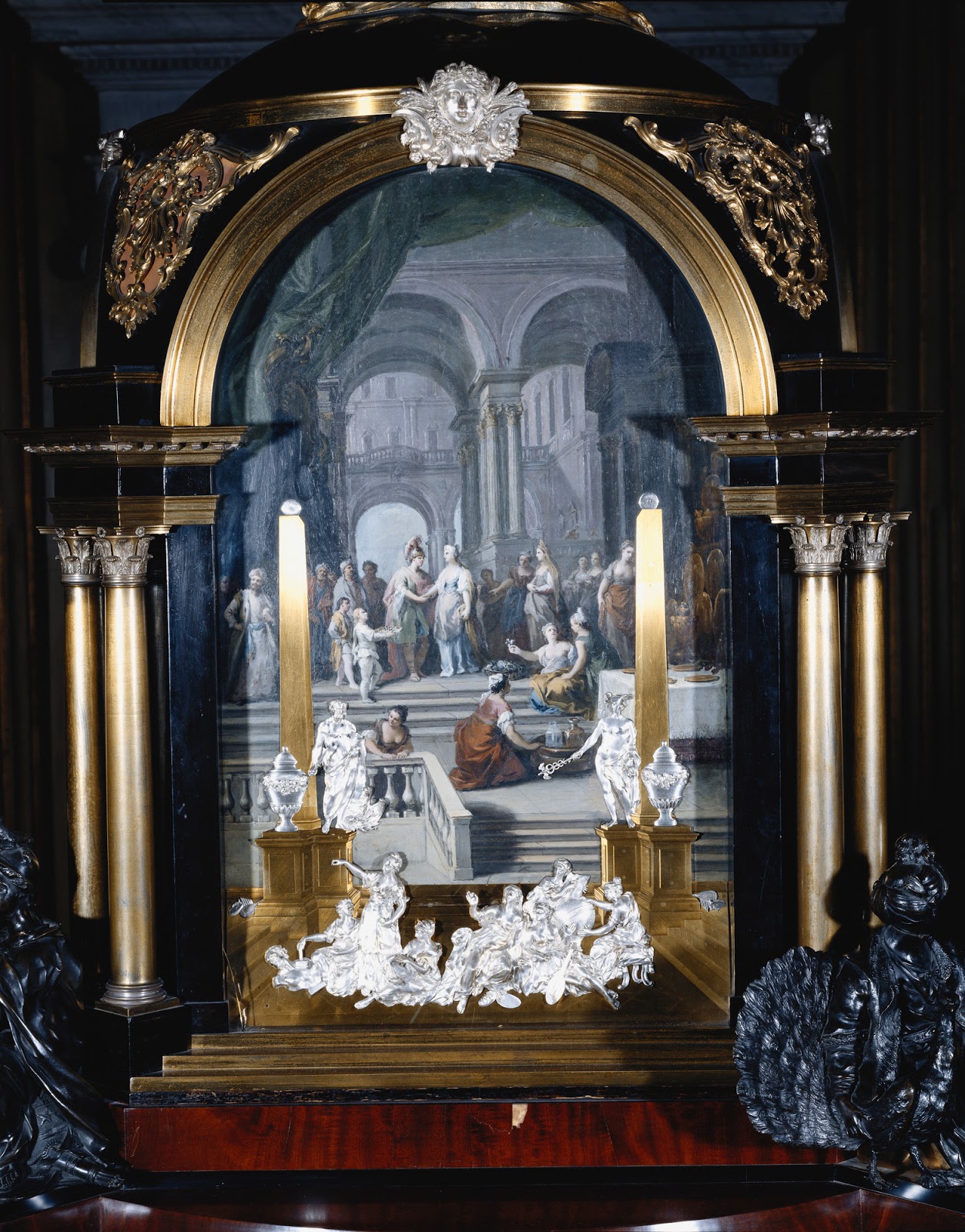
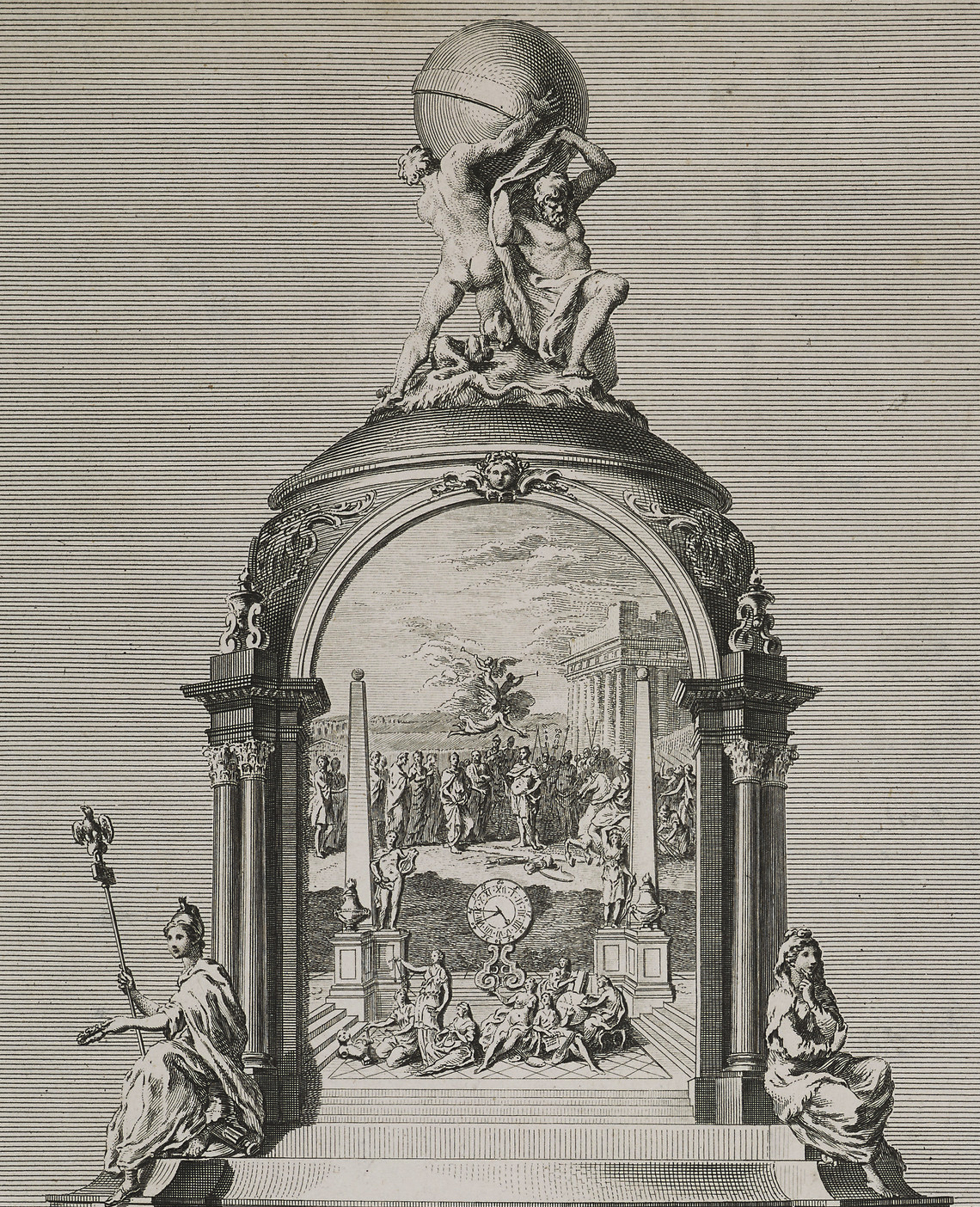
The Temple of the Four Grand Monarchies of the World.
1740
A Charles Clay Musical Clock.
Commenced by Charles Clay and completed by John Pyke.
in the Rotunda at Kensington Palace.
Acquired by Princess Augusta after 1743.
https://www.royalcollection.org.uk/collection/search#/54/collection/1418/floor-standing-clock
Excerpt below from Tessa Murdoch, Apollo, November 2013
https://www.thefreelibrary.com/Time's+melody.-a0351262546
Bronze mounts by Louis Francois Roubiliac.
All photographs above from the Royal Collection.
The text below is lifted in its entirety from the Royal Collection website for which I can make no apologies. I coudn't do better. I have only created the paragraphs to make this information slightly more digestible.
see - https://www.royalcollection.org.uk/collection/search#/54/collection/1418/floor-standing-clock
A large square and elaborately decorated musical
clock, the four dials painted with allegorical scenes - by Amigoni - and
applied silver bas-reliefs - by Rysbrack - and a bronze group with Atlas - by
Roubilliac - at the top and corners with applied double columns and four bronze
sculptures representing four of the monarchies of the world at the base of the
clock.
The four faces represent the foundation of the four
great empires of antiquity - Assyria, Persia, Greece and Rome.
The creator
of the clock, Charles Clay, came from Flockton in the West Riding of Yorkshire.
First known when, in 1716, he petitioned the King for a Patent in respect of a
repeating device for pocket watches. The application was ultimately
unsuccessful following the opposition of the Clockmakers' Company - at a cost
to the Company of the not inconsiderable sum of £74 17s. 11d. He arrived in
London c. 1720 and set up in premises near St. Mary-le-Strand Church and by
1723 had been appointed Clockmaker to His Majesty's Board of Works in which
capacity, in 1731, he made a clock for the gatehouse at St. James's Palace.
The 'Temple of the Four Great Monarchies of the
World' was put on display shortly after his death; the clock had been completed
by John Pyke, a clock and watch maker of Bedford Row who had been apprenticed
in 1710 and admitted to the Freedom of the Clockmakers' Company in 1720.
A newspaper cutting of 31 December 1743 describes
the clock 'A DESCRIPTION of a most magnificent and curious MUSICAL MACHINE,
CALL'D The temple of the four Grand Monarchies of the World (viz. the Assyrian,
the Persian, the Grecian, and the Roman) which were founded by Ninus, Cyrus the
Great, Alexander the Great, and Augustus Caesar. Begun by the late ingenious MR
CHARLES GRAY, and finish'd y Mr PYKE, Clock and Watchmaker, in Bedford-Row,
London. The whole having cost upwards of 45000l. and is to be seen every day at
the corner of Brownlow Street facing Bedford-Row, near Gray's inn, London, from
ten 0'Clock in the Morning till Seven in the Evening..........
'The Musick
consists of an agreeable Variety of Pieces, composed by the three great Masters
Geminiani, Handel and Corelli; and properly adapted to the machine by mr
Geminiani. It performs not only in Concert, but alternatively on several
Instruments, in a most surprising manner, exceeding the Performance of the best
Hands.'
The advetisement continues with a description of the
four faces:
'This Temple has four front avenues leading into it,
through which you may see the Subjects relating to each Monarchy finely
represented in Historical Painting. By Signor Amiconi.
'At the entrance of each Avenue is represented in
Sculpture the Genii of the Arts and Sciences as Paintings, Sculpture, Geometry,
Musick, Architecture, Arithmetick, and Astronomy, all which Sciences have been
used in the building and adorning this Fabrick. They are made of Silver in Alto
Relievo, by Mr. Rysbrack and are reposing on a Piece of Architecture in Basso
Relievo, made of Brass, in true Perspective; by the Obelisks on which stand
eight Deities in Silver, in their respective Attitudes, as having some Allusion
to the Subjects of each Piece of Painting. These represent some remarkable
Passage in the Lives of the before mentioned famous Founders of these memorable
Monarchies.
'The first Piece of Painting represents Ninus
setting up his Father's image and using it to be worshipped, making it an awful
Asylum for all Sort of Malefactors and granting every Petition made to it,
which proved the Beginning of Idolotary. The presiding Deities are Cybele and
Saturn; Cybele represents the Earth and is call'd the Mother of all Gods; and
Saturn, said to be the same with Noah, was the Ancestor of Nimrod, or Belus,
who was the Father of Ninus.
'The second
Piece represents the Tragic Death of Cyrus, the Founder of the Persian
Monarchy, by Thomyris, Queen of the Massigetes, a Nation of the Scythians, who
having laid in Ambush for him and slain him, cut off his head and before her
Attendance putting it into a Tub of Blood, said, Cyrus, now take thy fill of
Blood, which thou has always thirsted afters. The Deities that preside here are
Mars and Venus. Mars was particularly ador'd by the Scythians, who build him a
Temple of Iron; and Venus was adored by the Persians under the Title of Venus
Coelestis.
'The third
Piece is the Marriage of Alexander the Great, at Susa, with Statira, the
Daughter of Darius. This Hero put an End of the Persian Monarchy, and
established the Grecian. The Presiding Gods are Jupiter and Mercury; the former
alludes to Alexander's pretending to descend from Jupiter Ammon, the other to
the dexterous Genius of the Greeks, who excelled all other Nations at that Time
in most kinds of Knowledge and Learning.
''The fourth Piece represents Augustus Ceasar giving
Peace to Rome by the Deaths of Brutus and Cassius and the Overthrow of Mark
Anthony, after which Augustus was peaceably acknowledge Emperor by the whole
Roman People. Here are the images of Apollo and Diana; Apollo's Temple there
being one of the riches and beautifullest of all Antiquity.' The original
movement, including a musical mechanism, and stand missing.
..........................................................................
Scan of a drawing by Nathaniel Smith, c. 1759.
from an Excellent Article by the estimable David Wilson entitled -
New Information from the society of Arts: Roubiliac's Model of Hercules and Atlas and Nathaniel Smith's model of St Andrew after Duquesnoy - in the Sculpture Journal volume 16.2 (2007).
____________________
Clipping from The Daily Advertiser, 31 Dec, 1743.
____________________________
Reference above to a Clay Clock in the General Advertiser 6 April, 1744,
for Auction at Aaron Lambe's Great Auction Room in Pall Mall.
Presumably it did not sell and was included in the next auction.
.............................
Clipping from the Daily Advertiser 25 April 1744
____________________________
Panel from a Clock by Charles Clay.
Victoria and Albert Museum.
c. 1739 - 40.
Perhaps from a clock under construction in his workshop when he died.
The Intriguing Gilt Bronze Panel Apollo with Time and Harmony acquired by the Victoria and Albert Museum in 2009.
NB. Similarities with the Birmingham, Beijing and Naples clock faces (see above).
________________________________
Another remarkable clock the mechanism devised by Charles Clay.
Acquired by either Frederick, Prince of Wales, c. 1743-50, or by Augusta, Princess of Wales, 1759.
The piece makes its focal point a rock-crystal casket by the Augsburg goldsmith Melchior Baumgartner (1621 - 86) whose inscription (in German) is found on a panel inside the lid ‘I Master Melchior Baumgartner have made this casket in Augsburg and covered it with silver in the year 1664’.
Also incorporated in the casket are forty panels of rock crystal, engraved with land- and sea-scapes – with the six principal panels of canted rectangular form and bevelled edges. The panels depict figures and houses in landscapes, while each side panel depicts a shipping scene, one during a calm, the other during a storm. The panels are divided by rock crystal columns with Corinthian capitals in silver-gilt.
Almost all remaining areas are decorated by exquisite applied enamelled and silver-gilt mounts of fruiting swags and floral trails. At each angle in a shell-headed niche is a gilt bronze figure of a Greek goddess. Below the casket is a stepped pedestal containing both a clock and organ, which plays ten melodies, all but two of which correspond to settings composed by Handel.
The early history of the Augsburg casket is unknown, although Baumgartner is known to have supplied similarly elaborate pieces to the Bavarian and Brunswick courts .
This clock is first noted in a London newspaper advertisement of 27 August 1743, in which Sarah Clay, widow of Charles Clay, announced the exhibition at Cecil Street, off the Strand, of ‘the most curious and valuable piece of clock work left by her late husband’ The Temple and Oracle of Apollo, and charging 1s per person to view.
The entire ensemble is described in splendid language as it appears today (less the group of St George & the Dragon and the eponymous Apollo figure, now lost). This announcement suggests that it was through the agency of the maker / entrepreneur Charles Clay (or his widow’s) that the casket, clock-work and organ were assembled into its present, spectacular form.
This description above adapted from the Royal Collection website
https://www.royalcollection.org.uk/collection/search#/53/collection/30037/clock-organ-and-mahogany-case-c-1740
______________________________
The Mechanical Musical Clock.
at Temple Newsam House. Leeds, dated 1765.
John Pyke (-1762) and his son George Pyke (d. 1777).
Bedford Row, London.
The Mechanical Musical Clock.
dated 1765.
at Temple Newsam House. Leeds.
Barrell repinned in 1817.
The clock arrived at Temple Newsam in 1954.
Provenance Kitson Clarke family Leeds.
from the Collection of the Duke of Buckingham, Stowe.
believed to have been in the collection of Marie Antoinette.
Pyke was apprenticed in 1710 and admitted to the Freedom of the Clockmakers’ Company in 1720 and died in 1762.
Restored and conserved at West Dean College in 2014. They provided meticulous commentary of the process on their website -
...................................................
An advertisement displaying the extent of his ability in
Lloyd’s Evening Post 19–22 March 1779, is quoted here in full:
To be SOLD by AUCTION,
By Mr. RIDGEWAY,
On the Premises, by Order of the Executriz, on Tuesday the
23rd Inst. at Eleven o’Clock,
The STOCK of ORGANS, HARPSICHORDS, CLOCKS &c. the
Property of Mr. GEORGE PYKE, deceased. (Late Organ-Builder to his Majesty, and
esteemed the first Mechanic in that Branch of any in the Kingdom). At his late
House, the upper End of Bedford-row, Holborn.
Compromising a large Finger Organ, with a Swell; a ditto
with Finger Keys, which plays the Barrels by Hand; Machine and Hand Organs,
upright and other Harpsichords, an Organ clock, and several others
&c &c.
To be Viewed two Days preceding the Sale, when Catalogues
may be had on the Premises; and at Mr. Ridgeway’s, Fenchurch Street.
........................................
Bibliography.
1. William, Barclay Squire, Handel’s Clock Music. Musical
Quarterly, 1919, pp. 528–42.
2. Webb, M. I. (1954), Michael Rysbrack, Sculptor, Country
Life: Limited, London, pp. 137–38.
3. Roberts, Hugh, ‘So Beautiful a Style’, Country Life, 23
November 1995, pp. 58–59.
4. Murray, E. Croft, ‘The Ingenious Mr Clay’, Country Life,
31 December 1948, pp. 1378–80.
5. Croft, E. Murray, ‘Musical Clocks by Charles Clay’,
Country Life, 21 April 1950, pp. 1112–13.
6. ‘Treasures from the Forbidden City’, Speelklok Museum,
Utrecht, 2010, Catalogue No. 1, pp. 82–89.
7. Dawe, Donovan, ‘The Mysterious Pyke, Organ Builder’,
Musical Times, January 1974, pp. 68–70.
________________________________
Another remarkable Astronomical Clock by Charles Clay.
Victoria and Albert Museum.
https://collections.vam.ac.uk/item/O1323186/royal-mantel-clock-clay-charles/
In 1736, a bill from the Huguenot jeweller Peter Dutens to
Frederick, Prince of Wales for an eight day clock which shows the signs of the
zodiac and the rising of the sun, reveals the close connections between the
jewellers' and clockmakers' trades. The clock dial plate was drawn in London by
Clay and was enamelled white and blue with the days and months and signs of the
zodiac. The clock mechanism was imported from Paris, and Dutens supplied 'a
Gold Sun chased' and the 'side Frizes to the Case & Glass'.
Offices of the Duchy of Cornwall: The Accounts of Frederick,
Prince of Wales, Vol. VI.
..................................................
The Huguenot jeweller Peter Dutens, of Leicester Fields supplied Frederick, Prince of
Wales with
a clock for £61. 2s in 1736.
'For a Clock Case bought at Paris £11. 11.0.
Charges coming over with commission £ 2. 2.0.
The Dial Plate Enamel'd White & Blue with the Days & Months & Signs of the Zodiack £21. 0.0.
Paid Mr. Charles Clay Vizt.
For a Drawing for a Clock Dial Plate £ 1. 5.0.
For a Gold Sun chased £ 4. 4.0.
For making side Frizes to the Case & Glass £ 2. 2.0.
For an Eight day Clock that goes with a Chain to shew the signs of the Zodiack with Rising
of the Sun etc £18.18.0.
Information here from - Huguenot Artists Designers and Craftsmen in Great Britain and Ireland, 1680-1760 - Tessa Violet Murdoch
Thesis submitted for the degree of Doctor of Philosophy
see - https://core.ac.uk/download/pdf/30695656.pdf
All photographs above courtesy Victoria and Albert Museum.
_______________________________
Pinchbeck's Musical Clock.
Clipping from The Daily Post, Classified Ads, 1 April 1729.
____________________________________
Pinchbeck Daily Journal. 16 April 1729.
_________________________
Henry Bridge's Microcosm.
or the World in Miniature.
The movement of another mechanical musical clock called the Micocosm by Henry Bridges survives - without the organ or case.
This movement was discovered in a replacement case in Paris in 1920 and purchased by the BM in 1958.
Above A reconstruction of the Bridges' Microcosm.
Perhaps rather fanciful - There is a contemporary engraving listed by the British Museum.
not currently available online.
A Succinct DESCRIPTION OF THAT Elaborate PILE OF ART, called the MICROCOSM"
This work pub 1767 is available at the Wellcome Library.
A Succinct DESCRIPTION OF THAT Elaborate PILE OF ART, called
the MICROCOSM With a Short Account of the SOLAR SYSTEM, third edition with
additions, Coventry, MDCCLXIII".The clock consisted of a large edifice in
the form of a Roman temple, ten feet high and six feet wide (305 x 183 cm). A
number of levels displayed representations of the nine Muses on Parnassus,
Orpheus charming the wild beasts in the forest, a grove with birds flying and
singing, a clock with both the Ptolemaic and Copernican celestial systems and a
landscape with a prospect of the Ocean and ships sailing. The foreground was
animated with coaches, carts, chaises, people, birds and dogs. Finally, there
was a busy carpenter's yard. An organ, harpsichord, spinet, flute and whistle
with thoroughbass accompaniment played eight melodies:"At length all the
various Parts of this Machine are at once presented to the Spectator's View in
Motion, when upwards of one thousand two Hundred Wheels and Pinions move all
together; And during the whole Performance, it plays several fine Pieces of
Music on the Organ, in a very elegant Manner; and the Organ is likewise
provided with a Set of Keys, so that Ladies or Gentlemen may, themselves
perform on the Organ what Pieces of Music they best like."
Note, the Business will be carried on by Mrs. Pyke, widow of the deceased, and Mr. Holland his
late Apprentice and Nephew, who return their grateful, Thanks to the Nobility and Gentry for their past Favours, and solicit the Continuance of them, to merit which the utmost
Attention will be given.
...................................
I am taking the liberty of posting the pages relevant to Pinchbeck, Bridges etc. from The Shows of London by Richard D. Altick, pub. 1978, rather than transcribe it - an excellent work which should be purchased by anyone with an interest in entertainment in London in the 18th century.
___________________________
The Temple of Arts and Sciences.
Clipping from the Daily Advertiser 26 April, 1744.