4,
The
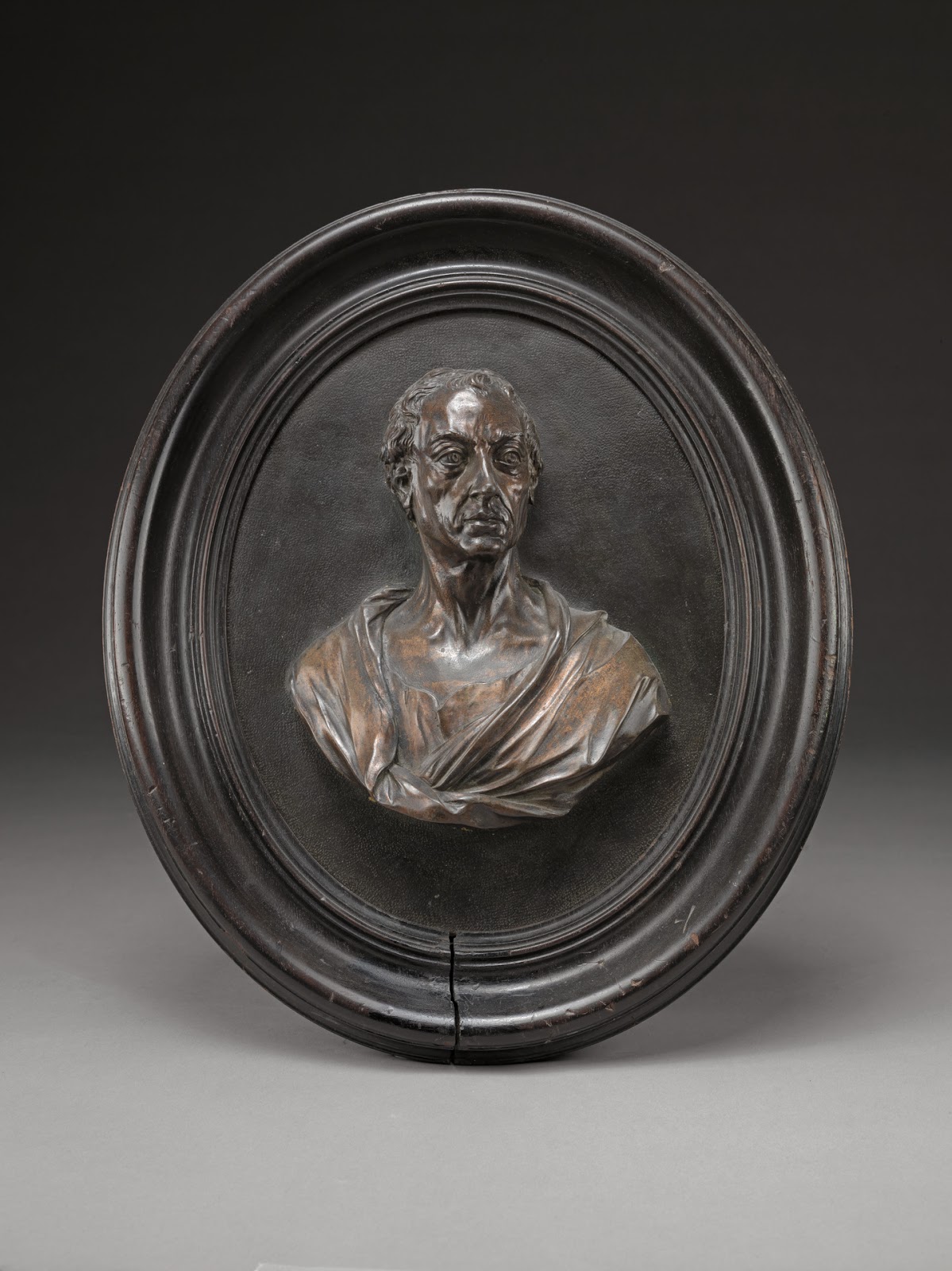
Milton / Fitzwilliam Bust of Alexander Pope by Roubiliac
and a Bronze bust of Pope of the same Pattern sold at Sotheby's London in 2007.
Marble,
14 ins.Eyes cut, Undraped , Square veined, black marble socle, Earl
Fitzwilliam Collection, Milton,
Peterborough.
Inscribed
on the back. A. Pope Ae is 52, L.F.Roubiliac, Sc it, ad vivum 1740.
Now confirmed as the bust of Pope originally at Kenwood, belonging to
Lord Mansfield.
Inscribed
on front edge - Uni
Aequus Virtuti Atque ejus Amicus.
See
Wimsatt 59.1 page 237.
These notes are the results of information supplied to me by the Archives at the Estate Office, Scone Palace, family seat of the Earl of Mansfield in 2002.
A
bust of Pope at Kenwood is mentioned in Lysons “ Environs of
London” 1795, as being ‘in the Breakfast Palour’.
This
bust was not sold
in 1922 sale. The
contents of
Kenwood
were sold in 1922,
by C.B. King & Co. Sale catalogue at English Heritage, Saville
House, Saville Row. London W1.
Lyson,
(Environs
of London, 1795) mentions
the bust of Lord Mansfield by Nollekins in the
Library, he
mentions another bust of Mansfield when young by Rysbrack in the
hall,
(now at Scone Palace but without socle) and also one of Sir Isaac
Newton and the Homer.
Pope
was friend and mentor of William Murray, the First Earl of Mansfield,
(1705-93).
Family
seat Scone Palace,
(Lord Stormont).
Estate office,
Scone Palace,
Perth, where inventories for Kenwood are held.
Roubiliac
also carved a Marble portrait bust of Lady Elizabeth Finch, Lady
Mansfield, (daughter of 2nd Earl of Nottingham and 7th Earl of
Winchilsea) delivered in 1748, which is at Kenwood today. The
socle of
this bust (black with gold veining) matches the Milton / Fitzwilliam
bust of Pope
There
is a bust of Lord
Mansfield,
by Joseph Nollekins
R.A. (1737 - 1823), ( sold in the 1922 sale and now returned,) at
Kenwood with the family motto ‘Uni
Aequus Virtuti’
(faithful to
virtue alone), carved beneath the drapery. (Noted as being at Kenwood
in the Morning Herald in 1781).
It
is perhaps not a
co-incidence that the Milton / Fitzwilliam Bust of Pope has carved beneath it ‘Uni
Aequus Virtuti Atque ejus Amicus’.
A quotation from Horace.
There
is also a full length portrait of Mansfield at the National Portrait
Gallery. By John Singleton Copley exhibited at the R.A.in 1783, in which,
pictured on the door case
behind him is a bust
of Pope, undraped and
with the back
cut away as the
bust at Milton. It would seem most likely that this is the bust from
Kenwood rather than the Temple Newsam version which has a solid back?
The
copies by Nollekins of the Roubiliac bust of Pope are all of the type
at Milton with undraped shoulders.
The cutting of the individual locks of hair also closely conform.
See
later entries detailing Nollekins busts of Pope at the Metropolitan
Museum, New York, The Bedford Museum version and the version found in
Ireland recently (May 2000) with its companion bust of Sterne.
It
would seem most likely that for his busts of Pope,
Nollekins would have had access to the Milton Bust through Lord
Mansfield,
and made copies of it, although the Nollekins version are also very
close to the Barber type.
Mansfield acquired Kenwood
in 1754 from John Stuart, 3rd Earl of Bute,
his Political Master. Mansfields town house at Bloomsbury Square
along with his library and most of his personal papers was burnt down
in the ‘No - Popery’ Gordon Riots of 6 June 1780.
The bust of Pope was therefor probably at Kenwood before 1780.
There are inventories for
Kenwood available at Scone Palace and whilst the information is not
very detailed, it gives a some idea of the portrait sculpture in the
house from the end of the eighteenth century until the sale of the
contents of the house in 1922.
Mansfield appears not to
have been a collector of antiquities like so many of his
contemporaries.
Alexander Pope
bequeathed to him a marble bust of Homer
with square socle in dark marble, which Pope believed to be by
Bernini, ( now at Scone Palace, the
replacement now at Kenwood is by Joseph
Wilton), he also left him a stone bust of Isaac Newton by Guelfi
(also now at Scone).
Pope also left his busts
of Milton, Spenser, Shakespeare and Dryden all by Scheemakers and
given to him by Frederick, Prince of Wales, to
the
1st Lord Lyttleton
of Hagley Hall.
The Kenwood House Inventories.
Information supplied by
the Archives at the Estate Office, Scone Palace, family seat of the
Earl of Mansfield in 2002.
1796. Inventory-
The Great Hall, 4 white
marble busts on black pedestals over the doors.
(see illustration Lord Mansfield by
Copley Singleton N.P.G.).
The lumber room over the
Portico. 2 Cases containing Popes belongings.
Perhaps bust of Pope by
Roubiliac, bust of young Mansfield by Rysbrack, bust of lady
Mansfield by Roubiliac, and bust of older Mansfield by Nollekins
1841. Inventory-
Breakfast Room, Marble
figure on oval plinth,
6 large busts on
bookcases.
1898. Inventory-
Breakfast Room.
Marble bust of a gentleman on a black pedestal, and another bust of a
gentleman and 4 plaster busts.
Library - marble
bust of a youth (visible in photographs in Country Life, 22 Nov.
1913) on marble plinth, and a marble bust of a gentleman on a
scaglioli pedestal.
1905. Inventory -
Breakfast room, 6 plaster busts on bookcases.
1910. In the Great Room or
Library no.
285 a White marble bust of a
gentleman.
Conclusion: Not a
great deal of care seems to have been taken with these inventories,
but the four busts with black pedestals (socles) mentioned in 1795
are almost certainly -
1. Bust of Pope by
Roubiliac (now at Milton?).
2. Bust of young Lord
Mansfield by Rysbrack. (Now at Scone Palace, inscribed, 1743, W.
Murray).
Lady Mansfield by Roubiliac.
Note Black and Gold Marble Socle.
3. Bust of Lady Mansfield
by Roubiliac, (now back at Kenwood).
____________________
Lord Mansfield by Nollekins 1779 inscribed Uni Aequus Virtuti.
that translates as 'Faithful Unto Virtue Alone'. The motto is taken from Horace's Satires.
Noted at Kenwood in the Morning Herald. 1781.
Black and Gold Marble Socle.
4. Bust of Lord Mansfield
by Nollekins ( now back at Kenwood)
1,3,4, still retain their
veined black marble socles. Socle of No.
2
has disappeared.
See also Photographs in
Country Life, 22 November 1913.
There is a rather tenuous
connection between the Fitzwilliams and William Murray. Mary Finch
the wife of Thomas Watson Wentworth, first Marquis of Rockingham,
(d.1750) whose estates were inherited by the Fitzwilliams, was the
sister of Elizabeth Finch the wife of William Murray, Lord
Mansfield.
Exhibited
Museum of London, The Quiet Conquest.( The Huguenots 1685 - 1985, T.
Murdoch ed. 1985).
Exhibited
London Royal Academy Winter 1955-56. English Taste in the Eighteenth
Century. No 139.
_______________________________
A bronze version of this bust was sold at Sotheby's 6 July 2007, Lot 136. Sold £66,000.
Reputedly the Plowden-Wardlaw family at Castle Craigie, Ayrshire; by descent to Margaret Spurway, née Plowden - Wardlaw; by descent to the present owner.
This could be a bust by Roubiliac but it could also be by Nollekins who made at least two marble versions paired with Lawrence Sterne. One pair in the Metropolitan Museum, New York.
The Metropolitan Museum bust of Pope by Joseph Nollekins
after the Milton/Mansfield Roubiliac bust.
The Hughenden Manor Plaster Bust of Pope
The Hughenden Roubiliac Plaster bust of Pope.
Either taken from the Milton Mansfield Marble (which seems most likely) or from an original terracotta now disappeared.
_____________________________