Saturday, 30 November 2024

Cavaceppi and the Eared Socle, with a side serving of Vincenzo Pacetti and some drawings of the Antique Busts in the Townley Collection by John Brown.


 Bartolomeo Cavaceppi (1716 - 99), and his use of the eared socle.

Including a few notes on Vincenzo Pacetti.

This post was prompted by researches into Nollekens 

Some Notes and images.

I cannot pretend any real expertise on the subject of Cavaceppi. any opinions expressed are my own - this is just a collection of notes and images added in a sort of stream of consciousness fashion as an aide memoire.


Part of the reason for posting is to illustrate the way that Cavaceppi influenced English sculptors who came to Rome to make the grand tour and to learn the techniques of the Italians! such as Joseph Nollekens (in Rome 1761 - 70) Wilton (in Rome 1749 -55) and Thomas Banks (in Rome 1772 - 9) others who came and stayed such as Christopher Hewetson, Francis Harwood (in Rome 1752 - 83), John Deare (in Rome 1786 - 98).

Post under Construction.

Cavaceppi’s Raccolta - is a sort of Catalogue of his restoration works but also a very effective piece of advertising.

The Raccolta is available online.

Volume 1, dated 1768, Vol II, dated 1769 and Vol III. dated 1772.

Bound together and available online at - https://archive.org/details/gri_33125009338969/page/n5/mode/2up


Vol I . is available also online - https://objects.auxiliary.idai.world/Tei-Viewer/cgi-bin/teiviewer.php?manifest=BOOK-810357

.......................


The Petworth House Bust of  Emperor Decimus Clodius Septimius Albinus.

Height 310 mm.

Marble sculpture bust, Emperor Decimus Clodius Septimius Albinus (c.AD 150-197). A portrait bust of a bearded man turned slightly to the right, with a broad face, high forehead, prominent eyes and thick curly hair.


Provenance -

Collected by Charles, 2nd Earl of Egremont, thence by descent, until the death in 1952 of the 3rd Lord Leconfield, who had given Petworth to the National Trust in 1947, and whose nephew and heir, John Wyndham, 6th Lord Leconfield and 1st Lord Egremont (1920-72), arranged for the acceptance of the major portion of the collections at Petworth in lieu of death duties (the first ever such arrangement) in 1956 by H.M. Treasury.

Very Poor Image courtesy National Trust below. Who made the decision at the NT to publish such poor images and why??

https://www.nationaltrustcollections.org.uk/object/486343

.


......

The Bust of Cato

Formerly with Tomasso Brothers of Leeds and London.

A Restored Antique Bust from the Workshop of Cavaceppi.

Previously with London and Leeds Dealers Tomasso Brothers.

https://www.tomasso.art/artworkdetail/850418/19408/roman-c-50-b-c-c-50-a-d-head-of-a-man

NB. The open eared support on the socle. Included here to illustrate the typical Cavaceppi Socle.

This bust is illustrated in the Raccolta, no 15.

Provenance -

Bartolomeo Cavaceppi (c. 1716-1799), Rome, Italy From whom purchased by Hans Jürge I, Prince of Anhalt-Dessau (1748-1811), 1766

By descent at Schloss Wörlitz and then Schloss Mosigkau, Saxony-Anhalt, Germany

Dessau-Wörlitz Cultural Foundation (est. 1918), Germany, inv. no. II-1216, until returned to the heirs of the Anhalt-Dessau family in 2007.


The bust above is illustrated in the Raccolta, no 15.


.....................................


..........................


.........................


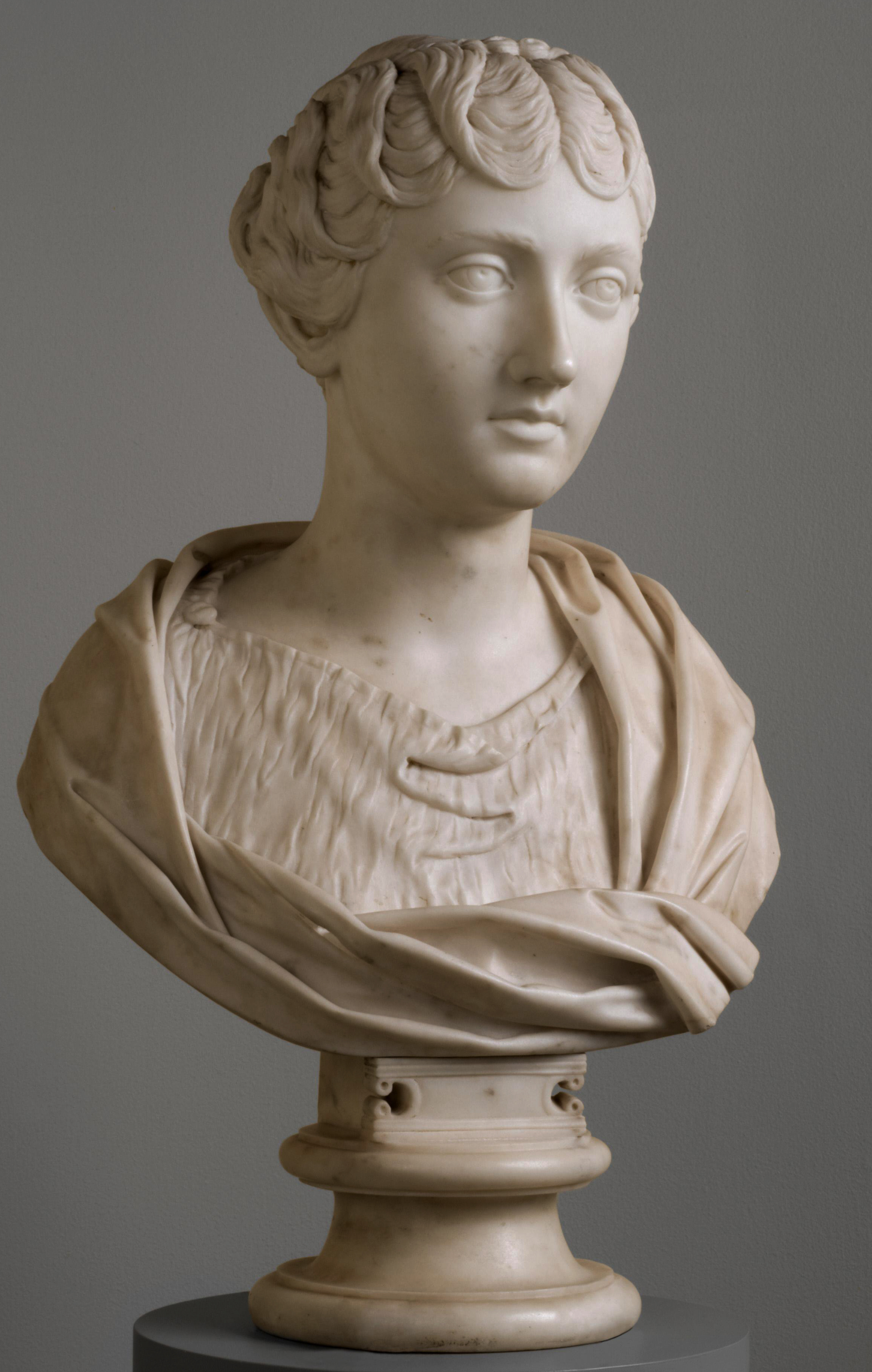
The Philadelphia Museum Plautilla.


.........................


The Busts of Caracalla.

Several antique busts have survived and it has been reproduced numerous times.

The Getty Caracalla.

Emperor Lucius Septimius Bassianus (April 4, 188 – April 8, 217), commonly known as Caracalla, who ruled from 211 to 217.

There are three different versions depicting the emperor Caracalla, the best known is the one that belonged to Cardinal Farnese, listed in the inventory of his collection in 1568, and is now preserved in the National Museum of Naples.

.....................

A bust of Caracalla is included in the 1769 edition of Kennedy's Guide to Wilton House.


......................

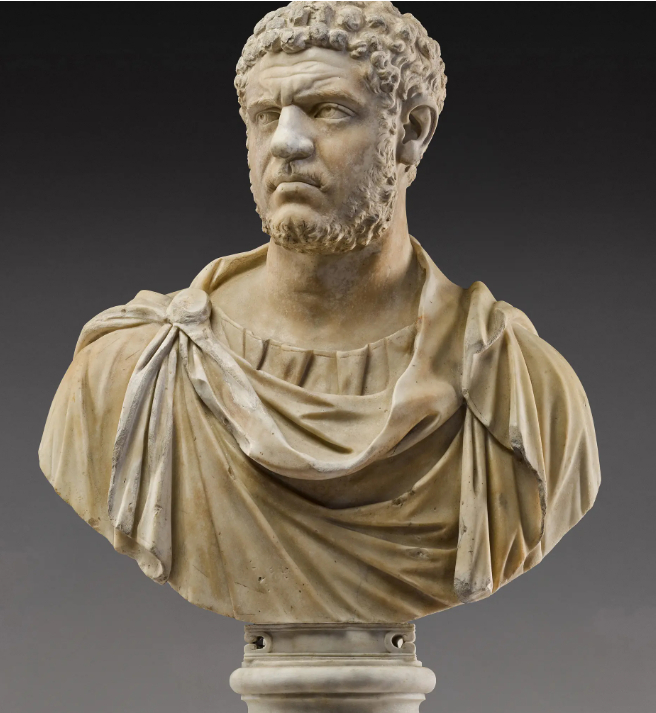
The Brocklesby Park Caracalla.

Shown here to illustrate the Cavaceppi type eared support to the socle.

Sothebys's Lot 19. 3 July 2024.

https://www.sothebys.com/en/auction-catalogue/2024/master-sculpture-from-four-millennia-L24264/caracalla-a-rediscovered-bust-a-re-examined-rule

Extracts from the Sotheby's catalogue.


The head of the present bust is a replica of the emperor’s first portrait type, which is known in numerous ancient (and modern) replicas. However, in contrast to most replicas of this type, the head of the present one is not turned to the left, but to the right. Another replica of Caracalla’s first portrait type with the head turned to the right is in the Musei Capitolini in Rome: Fittschen and Zanker cit., p. 109, no. 93, pl. 114 (arachne.dainst.org/entity/1097287).

This bust of Caracalla has been kept away from public view at Brocklesby Park for at least a century. Consequently, it has not been studied in person by a scholar since Michaelis visited Brocklesby in the 1870s and published his findings in Ancient Marbles in Great Britain (1882). Michaelis never doubted the bust’s antiquity, but scholars since then - who have made their judgments only from images rather than in-person inspection - have designated it as a modern replica of the 18th century.

More recent scholarship has shown that the bust was once in the collection of Charles Townley, where it was described as ancient and originating from Naples. Townley, whose collection was to form the nucleus of the British Museum, bought it from Thomas Jenkins. Both men were eminent connoisseurs of ancient sculpture in their own right, close to the source in Jenkins' case, and probably better attuned to the authenticity of ancient marbles than we are today.


This bust if it is ancient would therefor appear to be the bust copied and adapted in reverse by Cavaceppi now at the Getty Museum.

The eared socle has similarities with those of Nollekens see my next post.


Is this a restoration by Nollekens for Cavaceppi?


..........................


For another classical example see

https://www.bonhams.com/auction/16853/lot/224/a-roman-marble-bust-of-the-emperor-caracalla/

..............................


 The Emperor  Commodus./

White Marble 70.5 cms 

Attributed to Cavaceppi (C. 1716-1799).

From the Kagan Collection

Lot 57 10 June 2022.Christie's.

https://www.christies.com/en/lot/lot-6377696

not great resolution but sufficient for my purposes. showing  the very similar detail of where the bust meets the eared support on the socle.


....................................


Catalogued as "A Late 18th Century Gentleman in a Toga"?!

Height 82.1 cms

Christie's, Lot 62 - 4 December 2018. Sold for £4,375.

https://www.christies.com/en/lot/lot-6178335?ldp_breadcrumb=back

What am I missing here?? Does this mean that it is suggested as a fake?

To my eye this is obviously an antique bust which has been restored in the 18th Century - possibly in the workshop of Cavaceppi. The surface has been weathered unsurprisingly, but an obvious pointer to its age is the use of iron pins to fix the missing elements - if it were later then bronze pins would have been used.


...........................

The Sotheby's New York Bust of Zeus or Asklepios.

I don't think that Cavaceppi or his contemporary Vincenzo Pacetti were above providing copies - the Sotheby's New York bust of Zeus or Asklepios is perhaps an example.


Provenance.

Sotheby's say that this head was "reproduced in terracotta, plaster, and marble in 1784 in Rome by the antiquarian and restorer Vincenzo Pacetti (1746-1820), who may have owned it himself at the time".

The art dealer Louis Meier, 23 Cecil Court, London, 1940s.

The portrait photographer Angus McBean (1904-1990), Flemings Hall, Bedingfield, Suffolk, acquired from the above in 1948

David Ball, Guildhall, Debenham, by inheritance.

Peter Hone, London, acquired from the above circa 2000.


https://www.sothebys.com/en/auctions/ecatalogue/2015/antiquities-n09362/lot.34.html


The form of the socle is typical of Cavaceppi's work and here suggested as a Cavaceppi replacement. 


.......................

Pair of Monumental Plaster Busts.

The busts are modelled after Roman emperor portraits that were found in Hadrian’s Villa in Tivoli, dated to circa 120 A.D. One bust portrays Lucius Verus (161–169) and the other Antoninus Pius (138-161).

Sotheby's 5 July 2022. Lot 246.

Approx. 94 cms

https://www.sothebys.com/en/buy/auction/2022/old-master-sculpture-early-jewels/pair-of-busts-of-the-roman-emperors-lucius-verus


.....................

The British Museum Townley Marble Bust of Lucius Verus.

‘A Bust of Lucius Verus with the military coat, covered with the Paludamentum; formerly in the Mattei Villa, and is engraved in the Museum Matteianum’ (TY 12/3, library 25).

Bought from Hamilton for £70 (TY 8/4; TY 10/2, fo. 25r; TY 10/3, fo.29; ST 1, fo. 17r).


.............................

A Group of Drawings in the British Museum attributed to Vincenzo Pacetti by Ian Jenkins.


................................

For Good Measure here is a a Relief Self Portrait of Vincenzo Pacetti

https://catalogo.beniculturali.it/detail/HistoricOrArtisticProperty/1200865348


..........................

John Brown (1752 - 1787).

Alert readers of this blog might have come across John Brown before. When I was researching the Vandewall / Seward Bust of Alexander Pope. This is a good opportunity to expand on the works of John Brown

The Pope engraving with title and references both Rysbrack and the owner William Seward


The Busts of Homer and Pope.

Stipple Engraving of the bust in the possession of William Seward of Alexander Pope by Roubiliac dated 1788, drawn by John Brown and engraved by Marino Bovi.

 Published by Mrs Brown at Mr Middleton's, 162 Strand. Feb 1788.


https://www.britishmuseum.org/collection/object/P_Q-1-126

 Proposals for engraving busts of Homer and Pope (?1787)

Proposals for Publishing by Subscription , Two several Engravings of the Busts of Homer and his Translator Alexander Pope.

 The Drawings are already finished by Mr. Brown, No. 162, in the Strand. That of HOMER, from the Original Bust, dug up near Baiae in the  Year 1780, and now in the possession of Charles Townly, Esq. │

 That of Alexander Pope, from the fine Original Bust by Rysbrack, (this was a case of mistaken identity the bust had been carved by L.F.Roubiliac.  in the possession of William Seward, Esq. │


One of the Engravings, the Homer, will be executed by  F. Bartollozi. R.A.  The other of Pope, by Mr. BOVI, Pupil to Bartolozzi.

The Price to Subscribers will be TEN and SIXPENCE.

The Prints to be delivered on or before the 30th of January 1788, and in the order they are

 Subscriptions  taken in by Mr. Alderman Boydell;

Mess. WHITE and SON, Fleet Street; 

Mr. RICHARDSON, Strand;

Mess. ROBSON and Co. New Bond Street;

Mess.PAYNE, Mews-Gate; 

Mr. CADELL, Strand;

Mr. TORRE, Print Seller, Pall-Mall;

Mr. EDWARDS, Bookseller, Pall-Mall;

and at Mrs. BROWN’S at Mr. MIDDLETON’S,  No. 162, Strand [?1797].


 info above from - https://downloads.utorontopress.com/pdf/The_Edwardses_of_Halifax-Appendices_as_revised.pdf

.....................

John Brown was born around 1752, in Edinburgh, Scotland, the son of a watchmaker. He studied in Edinburgh at the Trustees' Academy. Around 1769 he traveled to Rome, where he became a pupil of Alexander Runciman. They became firm friends.

For the next eleven years he lived in Rome. In Italy and Sicily he made sketches of the ruins of ancient buildings for his Scottish patrons, William Townley and Sir William Young,[1] and sent drawings to the Royal Academy.

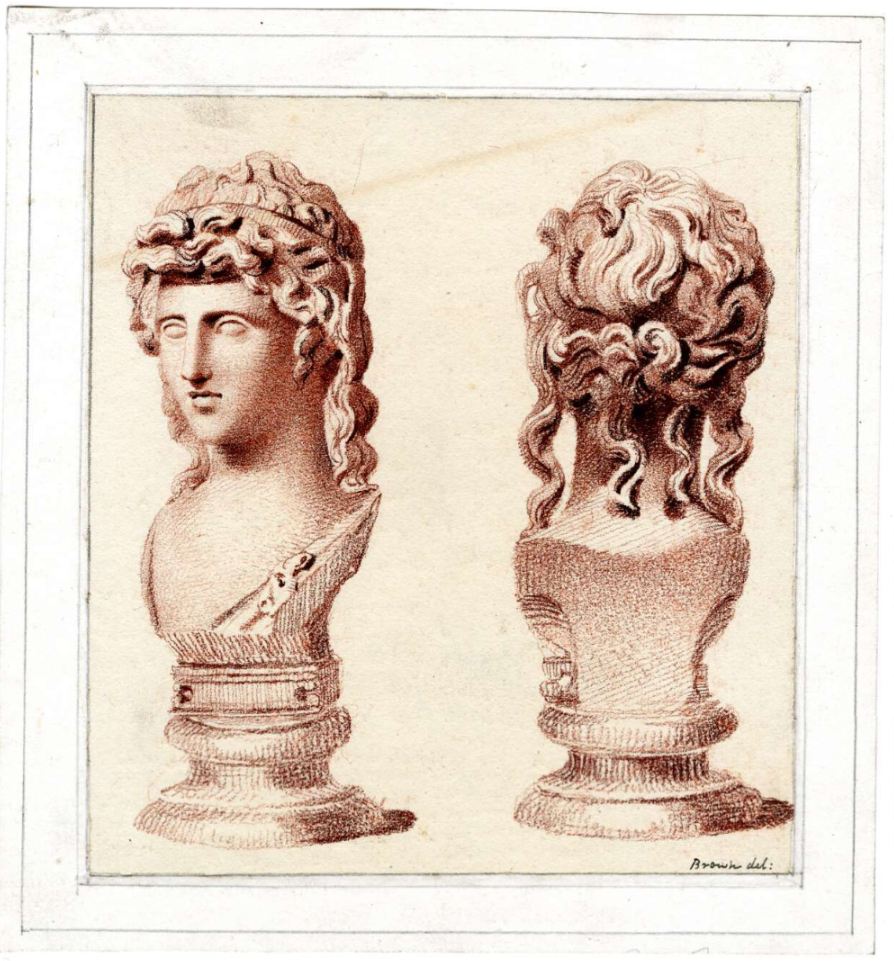
John Brown's Drawings etc. of objects in the Townley Collection.

 - The Drawings at the British Museum.


..................................

Caracalla.


Wednesday, 27 November 2024

Plaster Busts at the Foundling Hospital.


Post under construction.

 The Plaster Busts of Caracalla and Marcus Aurelius.

in The Court Room at the Foundling Hospital.

On carved wooden Brackets.

Anonymous Casts.

Here suggested as perhaps supplied by Louis Francois Roubiliac.

First suggested by Mrs Katherine Esdaile in her monograph - Life and Works of Louis Francois Roubiliac, published Oxford 1928. Page 141 and note 3.

This book is no longer regarded as a totally reliable resource.

................

The Roubiliac Sale of May 1762.

The third day  

Under the heading Antique busts etc in Plaster 14 busts in all - lots 36 -49.

Lot 46 was Marcus Aurelius and Lot 49 was a bust of Caracalla.


She states that a number of Artists at a meeting at the Turks Head on 7 December 1760, had agreed to appear on the 5 November in the following year ...........among those signing the paper recording the promise were Reynolds, Wilson and Roubiliac.

She goes on to say that the busts were presented on the same day and that they bore his signature and the date 7 November 1760. She had contacted the secretary Mr RW Nichols who had had the busts taken down and inspected but stated that any inscription had been obscured by the repeated coats of paint - (not unusual given that it was easier to repaint this type of object rather than laboriously clean them - a fate of many plaster objects and their surroundings from the 18th century). My Italics.

In the ambiguous footnote she says " I have most unfortunately omitted to give my authority - an 18th century one - for my note: Foundling Hospital. Plaster Busts of M Aurelius and Caracalla L.F.R. Dec 7th 1760.

She then states that "The historian of the Foundling Hospital however states that the busts were presented by Richard Dalton (Print seller art dealer - in 1754? ) but though this would exclude Roubiliac from the list of donors of works of art to the Hospital they may have been his work. (this does not exclude John Cheere either) my Italics!.


The Court Room was the most elaborate interior in the Foundling Hospital and was used for meetings of the court of governors. It is richly decorated in an amalgam of the Palladian and the Rococo: almost all the wall decorations including the marble fireplace and over mantle frame, the picture frames and adjacent plaster decoration are in the Palladian style with occasional rococo detailing, while the plasterwork ceiling, given by William Wilton, is in a much more free-flowing rococo.


Much of the carved work in the Court Room appears to have been supplied by the leading cabinet-maker, William Hallett senior (c.1707-81) of Great Newport Street, Long Acre. Literally just around the corner from the Roubiliac workshop.

Hallett was a very significant figure in the cabinet-making world and had built up sufficient funds to make purchases at the demolition sale of the Duke of Chandos's great Edgware mansion of Canons in 1747 and then construct himself a new house on the site. 

While his son continued in business for a period, his grandson led the life of a gentleman and was painted in 1786 with his wife in the double portrait, The Morning Walk, by Thomas Gainsborough in the National Gallery.


William Hallett's charges included £3.15s on 12 November 1745 for 'an Oval Glass in a Carv'd Frame' (presumably the frame between the windows in the Court Room, with an egg-and-dart cabochon moulding surrounded by scrolling foliage and rocaille work), £5.10s on 16 December 1746 for 'Carving 4 Frees's over Doors' (the oak-leaf-and-acorn door friezes, tied with ribbons) and £3.10s in March 1747 for '2 Carved Bracketts to set Bustoes on' (now supporting busts of Caracalla and Marcus Aurelius). He also charged £11.4s on 15 November 1746 for '8 Carved Oval Frames for Pictures'.


This reference might suggest that the brackets were prepared in 1747 to take existing busts or busts in preparation.


...................


A couple more really rather poor images from the Art UK website.


....................................

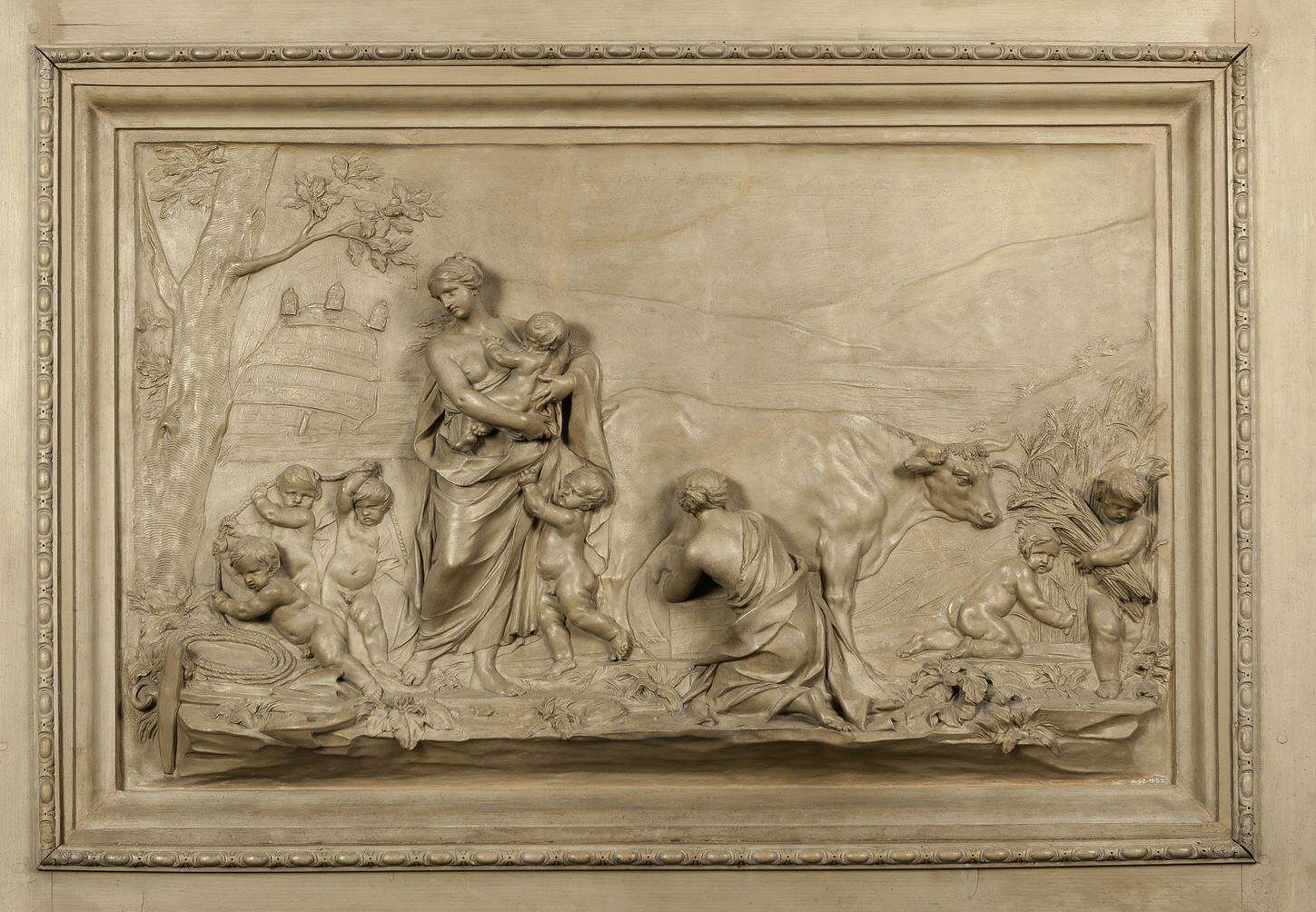
The Rysbrack Overmantle with Marble Relief.

The subject matter is appropriate -it depicts an allegorical figure of Charity carrying a child.

 Rysbrack was one of a number of artists with close connections with the charity and was elected a Governor and Guardian of the hospital in 1745.


....................


The Model for Rysbrack Overmantle in the Foundling Hospital.

Victoria and Albert Museum.


................................

For a very useful introduction to the history of the Foundling Hospital see -


The following passages are lifted from the Grub Street Project


The King was graciously pleased to grant his royal charter for establishing this hospital, which was dated the 17th of October, 1739.

By 1745 the first wing of the hospital had been built.


this On the 29th of March 1749, the Governors at a general court being informed of the increase of benefactions to this charity, of the number of the children, and the expediency of keeping the boys separate from the girls, gave directions for building the other wing of the hospital, and the whole design has been since compleated. These wings are directly opposite to each other, and are built in a plain but regular, substantial, and convenient manner, of brick, with handsome piazzas. It is well suited to the purpose, and as fine as hospitals should be. On the farthest end is placed the chapel, which is joined to the wings by an arch on each side, and is very elegant within. Before the hospital is a large piece of ground, on each side whereof is a colonade of great length, which also extends towards the gates, that are double, with a massy pier between, so that coaches may pass and repass at the same time; and on each side is a door to admit those on foot. The large area between this outer gate and the hospital is adorned with grass plats, gravel walks, and lamps erected upon handsome posts: besides which there are two handsome gardens. The print shews the hospital in two different views.


In erecting these buildings particular care was taken to render them neat and substantial, without any costly decorations; but the first wing of the hospital was scarcely inhabited, when several eminent masters in painting, carving, and other of the polite arts, were pleased to contribute many elegant ornaments, which are placed in the hospital as monuments of the charity and abilities of these great masters.


In the court room are placed four capital pictures, taken from sacred history, the subjects of which are suitable to the place for which they were designed.


The first, which is painted by Mr. Hayman, is taken from Exodus ii. 8, 9. “The maid went and called the child’s mother, and Pharaoh’s daughter said unto her, Take this child away and nurse it for me, and I will give you wages.”


The following verse is the subject of the next picture, done by Mr. Hogarth, viz. “And the child grew up, and she brought him to Pharaoh’s daughter, and he became her son, and she called his name Moses.”


The third picture is the history of Ishmael, painted by Mr. Highmore, the subject of which is taken from Gen. xxi. 17. “And the angel of the Lord called to Hagar out of heaven, and said to her, What aileth thee, Hagar? Fear not, for God hath heard the voice of the lad where he is.”


The fourth picture is painted by Mr. Wills, and is taken from Luke xviii. 16. 329“Jesus said, Suffer little children to come unto me, and forbid them not, for of such is the kingdom of heaven.”


On each side of these pictures are placed small drawings in circular frames of the most considerable hospitals in and about London, done by Mr. Haytley, Mr. Wilson, Mr. Whale, and Mr. Gainsborough.


Over the chimney is placed a very curious bas relief, done by Mr. Rysbrack, and presented by him, representing children employed in husbandry and navigation; to which employments those in the hospital are destined.


The other ornaments of the room were given by several ingenious workmen, who had been employed in building the hospital, and were willing to contribute to adorn it. The stucco work was given by Mr. William Wilton; the marble chimney piece, by Mr. Deval; the table with its frame curiously carved, by Mr. John Saunderson; and the glass by Mr. Hallet.


In the other rooms of the hospital are the pictures of several of the governors and benefactors, viz. Mr. Thomas Coram, by Mr. Hogarth; Mr. 330Milner and Mr. Jacobson, by Mr. Hudson; Dr. Mead, by Mr. Ramsey; and Mr. Emerson, by Mr. Highmore. In the dining room is a large and beautiful sea piece of the English fleet in the Downs by Mr. Monamy; and over the chimney in another room is Mr. Hogarth’s original painting of the march to Finchley.


In the chapel the altar piece is finely painted by a fine Italian painter, representing the wisemen making their offerings to the infant Jesus, who is held in his mother’s arms. And here we ought not to forget the fine organ presented by Mr. Handel, who has even made this of great benefit to the hospital, and from the most benevolent views, has enriched the foundation by a new revenue raised from the powers of harmony, and has had a sacred oratorio performed several times in the year, to crowded audiences, in which he himself played upon the organ gratis.


Great Queen Street in the long 18th Century.


Great Queen Street, Holborn - Some Notes.

post in preparation.

https://www.mirrorservice.org/sites/ftp.ibiblio.org/pub/docs/books/gutenberg/7/2/1/4/72144/72144-h/72144-h.htm#Page_34


John Vanderbank's workshop, where this tapestry was woven, was the leading English tapestry manufactory in the late 17th century. Vanderbank was Yeoman Arras-maker to the Great Wardrobe, supplying the royal family from his premises in Great Queen Street, Covent Garden, London, from 1689 until his death in 1717.


........................

The Corner of Gt Queen Street and Little Queen Street.


Covent Garden and the Seven Acres in Long Acre.

Early History.

The Bedford Estates


The garden of the Convent of St. Peter, Westminster, consisted of about 40 acres between St. Martin's Lane and 'Aldewichstrate' (now Drury Lane).  

The boundary is roughly defined by Drury Lane, Floral Street, St. Martin's Lane and a line drawn south of Chandos Place, Maiden Lane, Exeter Street and thence via Aldwych back to Drury Lane. 

It was marked by an earth or mud wall, the top of which was thatched with straw. (fn. 4) There was at least one gate on the east side,  probably where Aldwych now meets Drury Lane, near the east end of White Hart Yard (see Plate 7), and it is likely that another gate stood where later (Little) Chandos Street entered St. Martin's Lane.


Text above and image below adapted from -

https://www.british-history.ac.uk/survey-london/vol36/pp19-21


...............................


Tuesday, 26 November 2024

The Nightingale Monument, Westminster Abbey.


post in preparation.

 The Nightingale Monument, Westminster Abbey.

c. 1760/1

Louis Francois Roubiliac (d 1762).

Some images and notes -


In St Michael's chapel, off the north transept of Westminster Abbey, is the monument commemorating Lady Elizabeth Nightingale and her husband. 

She was born in 1704, the eldest of three daughters of Washington Shirley, Earl Ferrers and Viscount Tamworth (d.1729) and his wife Mary. 

Her sisters were Selina, Countess of Huntingdon (d.1791 aged 83) and Mary, Viscountess Kilmorey (died 1784).


On 24th June 1725 Elizabeth married Joseph Gascoigne (1695-1752), son of the Reverend Joseph Gascoigne, Vicar of Enfield in Middlesex. He assumed the surname of Nightingale on becoming heir to his kinsman Sir Robert Nightingale. 

Of their three sons, Washington, Joseph and Robert, only Washington survived his father but then only by two years. Elizabeth died on 17th August 1731 following a premature birth caused by the shock of a violent flash of lightning. This child, also called Elizabeth, survived and later married Wilmot Vaughan, 1st Earl of Lisburne and died (also in childbirth) in 1755.

The monument was not erected until 1761, and gives an incorrect date of death for Lady Nightingale. The inscription reads:


Here rest the ashes of JOSEPH GASCOIGNE NIGHTINGALE of Mamhead in the county of Devon Esqr., who died July the 20th 1752 aged 56. And of Lady ELIZABETH his wife, daughter and coheir of WASHINGTON Earl Ferrers; who died August the 17th 1734 aged 27. Their only son WASHINGTON GASCOIGNE NIGHTINGALE Esqr. deceas'd, in memory of their virtues, did by his last will order this monument to be erected.


Sunday, 24 November 2024

Lady Katherine Bertie Monument, Oxnead, Norfolk.


The Monument to Lady Katherine Bertie of Lindsey (Paston).

1636. 

Church of St Michael, Oxnead, Norfolk.

Nicholas Stone (1586 - 1647) of Long Acre, Covent Garden.


Commissioned by her husband Sir William Paston (created 1st Baronet Paston of Oxnead in 1641).

 Stone had begun work at Oxnead Hall for Sir William in 1631. Restored by the Pilgrim’s Trust, under the supervision of Stanley Wearing, 1956-57.

The shape of the socle support used here is interesting - this type was later developed and used frequently albeit on a smaller scale by Henry Cheere in the 18th century - the use of different styles of socles used both on church monuments and secular portrait busts is a subject that has not been broached previously and would reward study - I have in my posts looked at the use of signature socles on the busts by Roubiliac, John Cheere, Joseph Nollekens and Joseph Wilton in the 18th century.

For much more on Stone see the article by Adam White - https://georgiangroup.org.uk/wp-content/uploads/2021/12/GGS_1986_Symposium_04_White_0001.pdf


https://bathartandarchitecture.blogspot.com/2018/11/john-vandestein-at-queens-college.html

https://bathartandarchitecture.blogspot.com/2018/11/william-peyto-peto-by-nicholas-stone.html

http://english18thcenturyportraitsculpture.blogspot.com/2017/09/hendrick-de-keyser-and-his.html

http://english18thcenturyportraitsculpture.blogspot.com/2020/06/the-three-busts-of-sir-thomas-bodley-at.html

http://english18thcenturyportraitsculpture.blogspot.com/2017/10/bust-of-sir-thomas-bodley-some.html


The Sculptor Nicholas Stone (1586 - 1647). 

 Nicholas Stone at what is now 17 Longacre, Covent Garden.

Some notes - not exhaustive.


Nicholas Stone (d. 1647) Sculptor had his residence and workshop on the west corner of Rose Street where it meets Long Acre -

The most important years of his career are exceptionally well-documented due to the existence of his note- and account-books for the period 1631-42, which list over 80 monuments and numerous other commissions

 Nicholas Stone, sculptor, architect and mason. His house—rented from the Crown at £10 a year—must have been a large one, as Vertue mentions that John Stone, the author of Enchiridion, was hidden in it for "above a twelvemonth, without the knowledge of his father."6 Another son, Henry, best known as "Old Stone," was described on his monument in St. Martin's Church as "of Long Acre.

 Caius Gabriel Cibber (1630–1700), sculptor, the son of a cabinet-maker to Frederick III, the Danish king. He arrived in England around 1655, and became journeyman and then foreman to John Stone, John Stone, son of the late master mason to Charles I.

 When Stone suffered a seizure in 1660, Cibber ran his workshop in Long Acre. He became sculptor to Charles II on 20 June 1667. With his wife Jane Colley (c.1646–1697) of Glaston in Rutland, Cibber had three children: poet laureate and playwright Colley Cibber (1671–1757), Veronica, and Lewis.

 Among other works, Cibber is known for his figures of Melancholy Madness and Raving Madness (1680) which adorned the gateway in front of Bethlehem Hospital.

 The house was inherited by his eldest son the painter Henry Stone who died on 24 August 1653.

 A Mr Stone was still at this address in 1673 ( Lacys Map - 1673).

 Later part of the Stone's property became the Bird in Hand.

 https://www.british-history.ac.uk/survey-london/vol36/pp266-270


In 1635 and 1636 the fourth Earl of Bedford granted in fee farm several sites between Long Acre and Hart Street  later renamed Floral Street (so far as can be judged, excluding those on which building had taken place recently) and thus abrogated control over their subsequent development.

 One such development attracted the attention of the Privy Council in 1638 and was referred to Inigo Jones. The property concerned was the 'handsomely plainted' garden between Long Acre and New Street (now New Row).

 After being granted in fee farm in 1635 it had changed hands and been parcelled out. Several persons were concerned (including Richard Harris, a Covent Garden chapelwarden, and Nicholas Stone, master mason of the King's Works) but John Ward, citizen and girdler, was singled out by the Privy Council. According to Inigo Jones, Ward had designed to make a communication from Long Acre towards Covent Garden by means of an alley about 9 feet wide extending south (to be called White Rose Street), which was to open into a second alley extending east, about 18 feet wide (to be called Red Rose Street), and, if possible, to continue the second alley southwards over ground which did not belong to him.

 Jones thought that Ward would not be able to buy the land which he needed, and complained about 'the pestering of such places with Allyes of meane houses having but one way into them, and no other to goe out', and the Privy Council, 'disliking the desine', ordered Ward 'to disist'. (fn. 26) However, the northern and east-west arms of what is now Rose Street had already been built, and were allowed to remain.

 The scheme was finally completed in 1640, by Richard Harris, who had bought the land he needed from Ward in the previous year. Harris's development required the collusion of the Earl of Bedford, who 'did condiscend' that Harris should build the southern arm of Rose Street to connect with the recently opened New Street. It evidently proved an ill speculation for Harris, who in 1647 was complaining that he had entered into it 'most unfortunately … with two Thousand pounds Losse, to the utter ruyne and undoeing of [him], his wife and Children'. (fn. 29) The contorted remains of Rose Street still survive as a monument to speculators' folly, and the ineptness of Charles I's Privy Council.

 Nicholas Stone the sculptor occupied a piece of land on the east of White Rose Street on which stood a two-storey brick house, one timber and one brick 'workhouse'. In 1636 he obtained a grant of this property in fee farm. Three years later he contracted with Richard Harris for a piece of ground between his house and the alley called White Rose Street where he agreed to build a house over the passage entrance with a 'faire and lardge stone Arche of Twelve foote in height and Eleaven foote in widenes'.


 It appears that he did build it, for his descendant, John Stone, described as a stone-cutter, was in possession of a messuage called 'the Arch house' in 'Whitecrosse' (i.e., White Rose) Street in 1661.

 Other masons who occupied houses in Long Acre in c. 1624 were Baernert Janson (Barnard Johnson) and James White, tombmakers, and John Medhurst.


Friday, 22 November 2024

The Roubiliac Sale Catalogue - with a list of Missing Roubiliac Portrait Busts.


The Roubiliac and the Missing Busts - The Posthumous Sale Catalogue.

on 12 May 1762 and the following 3 days.

The Sale held by Abraham Langford of the Piazza Covent Garden.

At the premises of Louis Francois Roubiliac at the top  end of St Martin's Lane.

 Westminster on the East side.


..........................
 
The Missing Portrait Busts.


Day 1.

Lot 13. Mr Wildey. Plaster Bust.

Lot 16.  A Gentleman. Plaster Bust.

Lot 44. Mrs Nightingale. Mould in plaster.


Described and listed as Heads

Lot 77. Lord Shannon. Terracotta Head. Possibly related to the monument at Walton on Thames.

Lot 78. Lady Shannon. Terracotta Head. Ditto see my post - 

http://bathartandarchitecture.blogspot.com/2020/08/richard-boyle-viscount-shannon-monument.html

 Lot 79. Mrs Lyon. Terracotta Head.

 ........................................


Day 2.

Lot 7. Dr Bradbury. Plaster Bust.

 Lot 12. Mr Carter Statuary. Plaster Bust.

 Lot 15, Captain McKenzies son. Plaster Bust.

 Lot 17. Mr Floyd. Plaster Bust.

 Lot 18. Mr Floyd. Plaster Bust.

 Lot 20. Mr Capel Plaster Bust or perhaps a relief. (Edward Capell {1713-81} known from engravings by Bartalozzi and at the BM).


Lot 76. A Gentleman. Terracotta Bust.

 Lot 81. A Gentleman Terracotta Bust.

 Lot 77. ---- Capel. Terracotta, Bust  (known from engravings by Bartalozzi and Anker Smith at the BM).

 Lot 85. Mr Nightingale and his Lady, Terracotta Busts.

A Peter Nightingale (d, 1763) was a lead merchant! of Lea and Ashover Derbyshire. 

Could these be the models for the pair of lead busts traditionally believed to be Mr and Mrs Salmon in the V and A?

Given that there were 6 of these busts in the sale it is odd that none have come to light 


 Day 3.

 Lot 19, Councillor Floyd. Plaster Bust.

 Lot 4. Britannia - Plaster.

 Lot 6. Mr Floyde - Plaster.

 Lot 28. Two Plaster busts of Mr Nightingale and his Lady. (The Mould for Mrs Nightingale was Lot 44, Day 1). See my suggestion for Lot 85 on the previous day.

 Lot 29. Ditto.

The identity of these Nightingales remains to be discovered, perhaps those on Roubiliac's Nightingale monument in Westminster Abbey although the "Salmon busts do not resemble the Nightingales on the monument.


Lot 73. A Lady. Marble bust.


.........................................


The Nightingale Monument.


In St Michael's chapel, off the north transept of Westminster Abbey, is the commemorating Lady Elizabeth Nightingale and her husband. She was born in 1704, the eldest of three daughters of Washington Shirley, Earl Ferrers and Viscount Tamworth (d.1729) and his wife Mary. 

Her sisters were Selina, Countess of Huntingdon (d.1791 aged 83) and Mary, Viscountess Kilmorey (died 1784).


On 24th June 1725 Elizabeth married Joseph Gascoigne (1695-1752), son of the Reverend Joseph Gascoigne, Vicar of Enfield in Middlesex. He assumed the surname of Nightingale on becoming heir to his kinsman Sir Robert Nightingale. Of their three sons, Washington, Joseph and Robert, only Washington survived his father but then only by two years. Elizabeth died on 17th August 1731 following a premature birth caused by the shock of a violent flash of lightning. This child, also called Elizabeth, survived and later married Wilmot Vaughan, 1st Earl of Lisburne and died (also in childbirth) in 1755.

...............................

Vie et ouvrages de L. F. Roubillac, sculpteur lyonnais 1685-1762 / Le Roy de Sainte-Croix


https://gallica.bnf.fr/ark:/12148/bpt6k6572528r/f2.item.r=%22St%20Martin's%20Lane%22.zoom