Saturday, 25 May 2024

Nollekens Sale


The Joseph Nollekens Sale Catalogue.

3 July 1823.

With some notes

Post in preparation.


Lot 43, A sitting figure by Scheemakers.

Possibly the V and A terracotta.

Height 41.9 cms

This is the model for an allegorical figure on the monument to the 2nd Lord Raymond (d. 1756) in the church of St Lawrence, Abbots Langley, Hertfordshire.

Provenance -

Bought Christie's, London, 11 December 1984, lot no. 20, sold to Cyril Humphris for £432. Purchased for £1000 from Cyril Humphris, London, 1985.


Lot 79 Marble Bust of Pope after Roubiliac
and a Marble Bust of Lawrence Sterne.

Perhaps those now at the Metropolitan Museum, New York.

This pair are unrecorded before 1937, when they belonged to Lord Hore-Belisha, minister of war in the Chamberlain cabinet.


...........................


Another pair of these Nollekens busts of Pope and Sterne were sold by Mealley's Auctioneers in Ireland. Lot 487. 28 March. 2000.


This pair of busts were resold at Sotheby's London in Autumn, 2000.


see my previous post -

https://english18thcenturyportraitsculpture.blogspot.com/2020/06/alexander-pope-not-by-roubiliac-higgins.html


Lot 119. - Nollekens by Abbott.

with the bust of Charles James Fox

NPG.


Note - Lot 100 - Head of Laocoon by Joseph Wilton. dated 1758.
Victoria and Albert Museum.

Purchased by Dr Hildburgh F.S.A. from the dealer Arthur Einstein for £12 at an unknown date. Given by Dr. Hildburgh in 1949. No previous provenance.

Images etc from -

https://collections.vam.ac.uk/item/O127050/laocoon-bust-wilton-joseph-ra/


..........................................


Saturday, 11 May 2024

Portraits of Van Dyck and Rubens by Erasmus Quellinus.


 The Double Portrait Grisaille of Van Dyck and Rubens by Erasmus Quellinus.

                                                           Update.

This double portrait was formerly attributed to Abraham van Diepenbeeck (1599-1675).

This painting has now been returned to Chatsworth after an absence of more than 40 years.

This post has been prompted by the recent article in the online "The Art Newspaper"

see - https://www.artnews.com/art-news/news/painting-stolen-chatsworth-house-45-years-ago-discovered-regional-french-auction-house-1234688797/


I first published this painting in my blog on 8th November 2015.

https://bathartandarchitecture.blogspot.com/2015/11/the-rysbrack-statuettes-of-rubens-van_8.html


This was part of an ongoing, in depth project researching the Statuettes of Rubens, van Dyck and du Quesnoy sculpted in London by Michael Rysbrack in 1747 which I had posted in a series of 32 on line illustrated essays. see - etc.

https://bathartandarchitecture.blogspot.com/2015_11_03_archive.html

The painting was stolen in a smash and grab raid from the Towner Art Gallery in Eastbourne on 26 May 1979 where it had been on loan for an exhibition which focused on the works of Anthony van Dyck.


I was contacted by Dr Bert Schepers, Senior researcher and editor Corpus Rubenianum Ludwig Burchard Centrum Rubenianum vzw | Kolveniersstraat 20 | B–2000 Antwerp on 27 November 2020

 Bert Schepers had seen the painting on line and had discovered the theft alert in my blog post of 8 November 2015.

Bert Schepers was Senior researcher and editor at Corpus Rubenianum, Ludwig Burchard Centrum Rubenianum vzw | Kolveniersstraat 20 | B–2000 Antwerp, Belgium.


The grisaille was being offered by Hôtel des Ventes de Toulon in their 12th December 2020 sale:

 https://www.interencheres.com/meubles-objets-art/vente-de-prestige-282460/lot-25861224.html

Screen shot below.


Above is the screen shot of the on line sale catalogue taken by Dr Bert Schepers and sent by e mail to myself and the Curatorial department at Chatsworth on 27th November 2020.


As I was, at the time involved in a serious on going house restoration project, once I was sure that the Curatorial staff at Chatsworth had been informed by Dr Bert Schepers of the sale in Toulon I put it aside and thought no more of it until I received the alert from the Art Newspaper 10 May this year.


............................


The Double Portraits of Van Dyck and Rubens formerly attributed to Abraham van Diepenbeeck (1599-1675).

But the engraving by Paulus Pontius in the Rijksmuseum makes it plain that the original was by Erasmus Quellinus. (see image of the engraving below).

Oil on wood panel -

Size approx. 12 x 17 inches.

© Devonshire Collection, Chatsworth.


Reproduced by permission of Chatsworth Settlement Trustees.

 I am extremely grateful to Diane Naylor, photo librarian at Chatsworth who provided me with this image.

 I would also like to thank Charles Noble, Curator of the Devonshire Collection for his communications and for his facilitating my obtaining this image.


It should be noted that although the original had been attributed in the past to van Diepenbeeck it was very obviously adapted for the engraving by Paulus Pontius from the original by Erasmus Quellin.

.................................


Peter Paul Rubens and  Anthony van Dyck.

The Engraving by Paulus Pontius (Paulus Du Pont).


After the original by Erasmus Quellinus (1607 - 78).

The Original Portraits by Sir Anthony van Dyck.

Line engraving, mid 17th century.

 347 mm x 448 mm.

Rijksmuseum.


The image above originally came from the Google Art Project in 2015.

..........................


Here below is the same engraving with titles from the Rijksmuseum website -

https://www.rijksmuseum.nl/en/collection/RP-P-OB-16.415


Size - height 355 mm × width 451 mm.

For many more  images by or after Erasmus Quellinus see - 

https://www.rijksmuseum.nl/en/search?p=1&ps=12&involvedMaker=Erasmus%20Quellinus%20(II)&st=Objects&ii=0

.................................


Another Grisaille by Erasmus Quellinus.


Queen Christina of Sweden (1626-1689). As Minerva.

 Grisaille, oil on board.

 245 x 190 mm.

 Monogramed EQ on the book beneath the owl.

 Erasmus Quellinus.

 Commissioned in 1649 by the Swedish Ambassador Le Blon.


The existence of this grisaille perhaps suggests that there was an original of the bust depicted. Possibly a lost work by his brother Artus Quellinus.


For the Images of Queen Christina see -

The Dissertation of Nathan Allan Popp, University of Iowa.

 He was not aware of the Grissaille above.

http://ir.uiowa.edu/cgi/viewcontent.cgi?article=1761&context=etd


For an excellent and very in depth study of Erasmus Quellinus see

Erasme Quellin, dans le sillage de Rubens. Musee de Flandre, Exhibition Catalogue. 2014.

In it there is a very interesting chapter written by Alain Jacobs - La Sculture dans L'ouevre Peint d' Erasme Quellin.


For a good overview of the career and networks of Erasmus Quellinus see -

https://en.wikipedia.org/wiki/Erasmus_Quellinus_the_Younger


...........................

Erasmus Quellinus.(1607 - 1678).


The Peter de Jode Engraving of the Erasmus Quellinus Self Portrait.

Rijksmuseum.


...........................


Self-portrait of Erasmus Quellinus with his wife Catherina de Hemelaer and son Jan Erasmus.

Cincinnati Art Museum.


Erasmus Quellinus the Younger or Erasmus Quellinus II (November 19, 1607 – November 11, 1678) was a Flemish painter, engraver, draughtsman and tapestry designer who worked in various genres including history, portrait, allegorical, battle and animal paintings. 

He was a pupil of Peter Paul Rubens and one of the closest collaborators of Rubens in the 1630s. 

Following Rubens' death in 1640 he became one of the most successful painters in Flanders.

He was the brother of sculptor Artus Quellinus (1609 - 68). I had the extraordinary good fortune of being involved in the purchase, research, restoration and sale in 2015 of a terracotta relief of Arion, a maquette for a large scale marble relief of Arion by Artus Quellinus now in the Detroit Institute of Art. 

The discovery of the engraving of the relief by brother Hubertus Quellinus (1619 -87) was instrumental in my identifying the terracotta relief. see -

https://www.jstor.org/stable/48569751

see also my post - https://bathartandarchitecture.blogspot.com/2015/09/terracotta-busts-by-jan-van-logteren.html

For more on Erasmus and Artus Quellinus see - https://www.rijksmuseum.nl/en/research/our-research/fine-and-decorative-arts/paintings-and-sculpture/quellinus-at-work


................................


Wednesday, 8 May 2024

Hewetson - 38 - Conclusions.


In preparation.

Hewetson - 39 - Conclusions.

Hewetson 37 - Attributed - The Portrait Bust of Prince Francis Xavier of Saxony (1730-1806).


Portrait Bust of Prince Francis Xavier of Saxony (1730-1806).

c. 1790.

White Marble.

Attributed to Christopher Hewetson.

The Tomasso Brothers Bust.

 https://winter2021.londonartweek.co.uk/artworks/portrait-bust-of-prince-francis-xavier-of-saxony-1730-1806/index.html


The following cut and pasted from the above website 


Probably Prince Francis Xavier of Saxony, Rome, Italy, and subsequently Dresden, Germany;

by descent to his daughter, Elisabeth Ursula Anna Cordula Xaveria, Duchess d'Esclignac (1768-1844);

by descent to her daughter, Marie Charlotte Xaverine, Baroness von Weissenbach (1788-1858);

by descent to her daughter, Johanna, Countess von Korff-Schmising Kerssenbrock (1829-1906);

by descent to her daughter, Maria Xaverina Louisa, Baroness de Weichs de Wenne, Castle Geijsteren, Limburg (1854-1927);

Certainly thence by family descent until 2014.

The present work corresponds closely in style and subject matter to the type of portrait bust Hewetson was renowned for. The sitter, Prince Francis Xavier of Saxony, was the second surviving son of Augustus III of Poland (1696-1763). From 1765 until 1768 he acted as Regent to his nephew, the infant Elector Frederick Augustus III of Saxony, performing in his name a formal renunciation of the Polish Crown in favour of Stanislaw Poniatowski, as was required by the treaty signed between Prussia and Russia on 11 April 1764. In the same period Francis Xavier secretly married Countess Maria Chiara Spinucci, former lady-in-waiting to his sister, the Dowager Electress Maria Antonia. The union was considered below his rank and only officialised some years later. After relinquishing his duties as Regent in 1768, the Prince moved his family to France - where in 1774 his younger sister's son became king as Louis XVI (1754-1793) - and lived there for twenty years under the assumed title of Count of Lusatia. The family fled the country at the beginning of the French Revolution and moved to Rome. The Countess died there in 1792 and some years later Francis Xavier left the Eternal City to return to his native Saxony, where he died in 1806. This places him in Rome towards the very end of the 1780s and early 1790s, when Hewetson had just completed a monumental bust of the philosopher Leibniz for the city of Hanover in Germany (1789-90), and a portrait of the German-Italian artist Giovanni Pichler (1792), now in the Protomoteca Capitolina in Rome. It is possible that the German element of both these commissions was the trait d'union between Francis Xavier of Saxony and Hewetson, but there is also another possibility.


In November 1793, Francis Xavier journeyed to Fermo for his wife's solemn burial. This planned visit had prompted the town's authorities, the Priori, to commission a pair of busts of the couple (see D. Silvagni, La Corte e Società Romana nei secoli XVIII e XIX, Rome, 1883, II, p. 228). Already in January 1793 they had asked their patron Cardinal Borgia to commission two portrait busts of Maria Chiara and Francis Xavier, to be exhibited in the Palazzo Priorale's main hall in time for the funeral. A nineteenth-century document states that the Cardinal entrusted the work to "Monti e Albicini", who are presumably to be identified with the Roman sculptors Giovanni Monti and Carlo Albacini. Unfortunately, the bust of the Prince did not please the Priori, who decided to hide it in a cupboard throughout Francis Xavier's stay in Fermo. They duly expressed their dissatisfaction to Borgia in a letter, noting the effigy looked nothing like the Prince and was also remarkably disproportionate in comparison with his wife's much better executed counterpart (for a full account of the Priori's commission, see Catani 2002). The unfortunate pair of busts are to this day in Fermo, in the town's Biblioteca, but it is possible that, following the Priori's complaints, Cardinal Borgia decided to commission another bust of the Prince, this time from an artist of unquestionable talent such as Hewetson. This the Priori must have refused to acquire, both because Francis Xavier would by then have left Fermo, and because of financial concerns (it appears the first pair of busts had cost them a considerable sum of money). In other words, there is a possibility that the present bust was originally executed by Hewetson for the Priori of Fermo, under the patronage of Cardinal Borgia, but ultimately given to the Prince instead. The portrait was inherited by the heirs of Maria Xaverina Louisa, Baroness de Weichs de Wenne (d. 1927) and her genealogy shows a direct matrilineal line down to one of the daughters of Francis Xavier of Saxony.


The composition perfectly represents the type of portrait that an aristocrat and statesman such as Francis Xavier would have appreciated, in the guise of a victorious Roman general yet with clearly recognizable facial features. There is no mistaking the sitter's identity, given the aquiline nose, strong brow, and pursed lips, which appear prominently in the painted portrait of the Prince by Maurice Quentin de La Tour now in the Musée Antoine Lecuyer, St-Quentin (fig. 1). In terms of the attribution, Hewetson's authorship is confirmed by the present bust's parallels with the sculptor's oeuvre. The shoulder-length bust format, with the head turning to one side, was a staple of Neoclassical portraiture and is often adopted by Hewetson. In addition, details such as the sitter's eyebrows and hair - described through meticulous, fluent modelling - and the manner in which the eyelids are outlined, are also typical of the Irish artist, as evidenced by comparison with his Pope Clement XIV now in the Victoria & Albert Museum (fig. 2), or his Anton Rafael Mengs in the Promoteca Capitolina (fig. 3). Similarly, the skin on Francis Xavier's face, with its wrinkled forehead and lined cheeks, shows an attention to the material quality of flesh, even its weight, that are also visible in the Clement XIV and Mengs. As scholar Malcolm Baker has noted, Hewetston's works betray a unique sensitivity in the depiction of facial phsyiognomy and, particularly, hair. A fascinating rediscovery, the present bust is therefore a major addition to the oeuvre of one of the foremost interpreters of Roman Neoclassicism.


We are grateful to Stefano Grandesso for suggesting the attribution to Christopher Hewetson.


Thursday, 7 March 2024

Hewetson 36 - The Busts remaining in the studio and the unidentified busts.


(Post in preparation).

 Christopher Hewetson.

(Part 36).

An Irish Sculptor in Italy - 

The busts remaining in the Hewetson Studio after his death and the unidentified busts.


The 1798 Inventory of the contents of Hewetson's Studio.

A list the busts remaining in the Hewetson Studio when he died and some notes.

Some of these busts were later completed by his longtime assistant Cristoforo Prosperi.

See my separate post for the works of Prosperi.

https://bathartandarchitecture.blogspot.com/2024/02/christopher-hewetson-irish-sculptor-in.html


The inventory was compiled under the supervision of two contemporary sculptors and restorers Vincenzo Pacetti (1746 - 1820)  and Carlo Albacini (1752 - 1783).

A good starting point for these important characters in the Hewetson story.

 - https://en.wikipedia.org/wiki/Vincenzo_Pacetti

https://fr.wikipedia.org/wiki/Carlo_Albacini

The studio contents list compiled from - 

Christopher Hewetson: Nuovi Documenti, Nuove Interprezioni. by Paolo Coen, 2012, in "Bollettino d'arte"

Will and Inventory of Christopher Hewetson (c1737–1798): Introduction - Ana María Suárez Huerta.The British Art Journal, Vol. 15, No. 2 (Winter 2014/15), pp. 3-17.


1. Milord Plymouth. (see also no 14 Milady Plymouth). Portrait painted by Batoni,

Un busto rapresentante il ritratto di Milord Plymouth si e trovatridotto ad un punto, che della sei parti ne sono state fatte quatro (fol 4333 V).

At the time of writing I think that it is possible that these two busts are the pair of busts at the Ashmolean,

see my post - https://bathartandarchitecture.blogspot.com/2024/02/catherine-viscountess-sudely-1739-1770.html

2. Syr John Thromostron. (Throgmorton).

"Altro busto rappresentante il ritratto di Syr John Throgmostron ridotto al punto, che delle sei parti ni sono state fatte quatro e mezza".

see - https://bathartandarchitecture.blogspot.com/2024/02/hewetson-in-rome-part-14-throckmorton.html


3. Lady Carneghi. Agnes Murray Elliot (1763 - 1860).

Visited Rome with her husband Sir David Carnegie, Baron Carnegie of Kinnaird 4th Baronet of Southeske (1753 - 1805).

The couple travelled in Italy between October 1791 and August 1792, They were in Rome by December 1791 whilst in Rome in the spring of 1792.

4. Milord Buerre. Altro busto rapresentante il ritratto di Milord Buerre, che si e ritrovato compito e terminato (Fol 434 r).

Huerta makes the case for Charles William Bury, Baron Tullamore, later Viscount Charleville He knew James Byers and was probably in Rome in 1789.

He was an antiquary and president of the Royal Hibernian Academy. He married Catherine Maria, née Dawson, the widow of James Tisdall, in 1798.


.........................

Image below National Library of Ireland.


5. Milord Harrington. Altro busto rappresentante il retrato di Milord Harrington ridotto al puntoche della sei parti Se ne sono fatte cinque.


A Mister Harrigton on Cavaliere Harrington was in Rome at this time and signed a document 16 January 1790 requesting a licence to export pictures (see Ingamells).


6. Syr John Marplerson. This is most likely Sir John Macpherson 1st Baronet (1745 - 1821).

Altro busto rappresentante il ritrato di Syr Jhon Marplerson ridotto al punto chelle sei parti. Se ne sono fatte cinque.

Sir John Macpherson 1st Baronet  (1745 - 1821) 


7. Milord La Touche.  This entry could refer to either David Digues la Touche (1729 - 1817) or his son John la Touche (1772 - 1838).

8. Lord Clifford.

9 & 10. Milord Wemmuster and Son.

11. Groipen.

12. Milord Brunuch.

13. Unidentified Milord.

14. Milady Plymouth (see no 1 above).


This List above compiled from - 

Christopher Hewetson: Nuovi Documenti, Nuove Interprezioni. by Paolo Coen, 2012, in "Bollettino d'arte"

Will and Inventory of Christopher Hewetson (c1737–1798): Introduction - Ana María Suárez Huerta.The British Art Journal, Vol. 15, No. 2 (Winter 2014/15), pp. 3-17.

.........................


Wednesday, 6 March 2024

Hewetson (Part 35) Leibnitz


(Post under construction)

 Gottfried Wilhelm von Leibnitz (1646 - 1716).

Hewetson.

inscribed - Christophorus  Hewetson  Hibcrnus  fecit Romae  MDCCLXXXIIII.

1789- 80.


Image below from Bildindex


Erected in Hanover (Leibnitz Haus).


Much mutilated.

Very low resolution photograph.


..............................

Gottfried Wilhelm von Leibnitz (1646 - 1716), 

Plaster bust.

Gottinngen University.

1790.

Height 85 cms.


https://sammlungen.uni-goettingen.de/objekt/record_kuniweb_1312150/

I suspect that this is an early cast - it has obviously been stripped of paint and it appears that the head has been off and glued back in place.


Hewetson (Part 34) The Tomasso Brothers Anonymous Bust.


 Christopher Hewetson (Part 34) 

 Anonymous Bust.

Formerly with Leeds and London Dealers Tomasso Brothers.

Christopher Hewetson.

Statuary Marble on a Nero Portero Socle

Inscribed Christ.r Hewetson Fec.t.

75 cms.

Undated.

Sotheby's 21 April 2021, Lot 148.

https://www.sothebys.com/en/buy/auction/2021/tomasso-the-more-a-thing-is-perfect/bust-of-a-gentleman


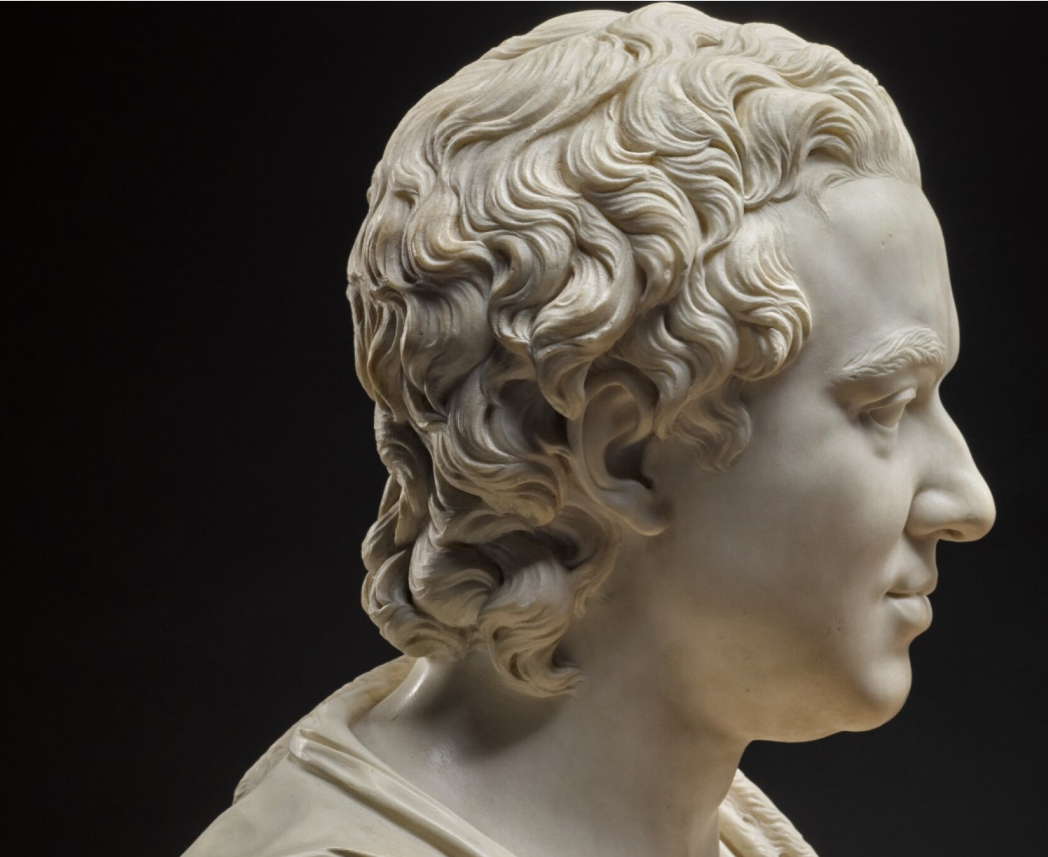
I am slightly suspicious of the inscription on this fine bust and suspect that it was carved after the death of Hewetson.


This is perhaps one of the 14 busts which had been paid for but were left unfinished in his studio at the time of his death and later completed by his long time and able assistant Cristoforo Prosperi.


....................................