Thursday, 7 January 2016

The Rysbrack Statuettes of Rubens, van Dyck and du Quesnoy, Part 31, Scheemakers Monument of Shakespeare and it Variants - Lifesize Plaster..


Post updated and edited 31 August 2024.

The Scheemakers Marble Statue of William Shakespeare.

The Monument in Poets Corner in Westminster Abbey and it Variants.

The Full Size Plaster Cast.

For much more on the Scheemakers Westminster Abbey Statue and its variants.

see my blog post -


The Statue is inscribed P. Scheemakers 1, MDCCXL, on a composition base, all raised on a separate wooden plinth, old damage to composition base. 

Maximum dimensions including plinth approximately 117cmcm wide, 56cm deep, 264cm high (46in wide, 22in deep, 103.5in high).

It had previously appeared at the Bonham's saleroom in London.

Provenance: This lot was removed from the Foreign Press Association, Carlton House Terrace, London where it stood in the entrance hall for some years. 

It was reputedly acquired from the Criterion Theatre at Piccadilly Circus. This sculpture is made from plaster and composition stone rather that painted metal as written in the catalogue.

The Union Club had taken over the two buildings in 1923 

The Foreign Press Association were at 10 and 11 Carlton House Terrace in the 1950's

As yet I have not received any confirmation of this provenance.

https://www.bonhams.com/auctions/16827/lot/63/


Up date - this cast came to the market in 2022 with London Dealer James Graham Stewart
when it was exhibited at the Masterpiece fair in London, and was subsequently sold. 


This post was created to examine and record a detailed history of the Scheemakers stone version at Wilton House. The pose of the Wilton Statue is very similar and it is carved in the round but the pedestal that he is leaning on is quite different from the Westminster monument.

.........................

It would appear that this a full size cast of the marble on Westminster the monument.

This suggests to me that the cast was taken of the marble before the statue left the Scheemakers workshop, possibly John Cheere who almost certainly provided the much reduced plaster from Kirkleatham Hall, now in York Museum. This was taken from a terracotta maquette signed and dated 1740 see the images below.

The marks of the sculptors tools used to model the original terracotta are plainly visible.

This also might suggest some sort of working relationship between Scheemakers and John Cheere whose workshop was close by at Stone Bridge, on what became Piccadilly, Hyde Park Corner.


It is always possible that the statue was taken down from the monument at some point in its history and a cast taken but the logistics of this make it appear very unlikely to me.

................

The Kirkleatham Plaster Statuette of Shakespeare, 

probably cast from the original terracotta maquette by Peter Scheemakers.

Signed and dated 1740.

Supplied to Chomley Turner (1685 - 1757) of Kirkleatham Hall, Yorkshire by John Cheere in 1749.

Supplied at the same time were a further 9 plaster statuettes and 9 plaster busts.

Height 19.5 inches.


Statuettes of Homer, Spenser, Pope, Milton, Inigo Jones, Newton, Locke, Rubens and Van Dyck (both after M Rysbrack).


Some of these busts were based on the work of contemporary sculptors, Peter Scheemakers (1691-1781), Michael Rysbrack (1694-1770), and Louis François Roubiliac (1695-1762); others were probably original creations by Cheere, based on engravings. 

The bust of Matthew Prior (1664-1721), poet and diplomat, derives from the marble bust by the French sculptor, Antoine Coysevox, which is on Rysbrack’s 1723 funerary monument to Prior in Westminster Abbey. 

The busts of Bacon and Dryden are loosely based on busts by Peter Scheemakers, while the very youthful looking one of Addison imitates an engraving by George Vertue of a painting by Kneller. 

The busts of Cicero and Horace were taken from casts of antique originals,

 The origin of the designs for the busts of Swift, Congreve, and Clark is uncertain. 


Henry Cheere supplied the full size statue of Chomley Turner for his Mausoleum at Kirkleatham. He is depicted in the same pose as the Craggs and later Shakespeare monuments at Westminster.


......................................


The Full Size Plaster Cast from the Westminster Monument.


A full size version of Scheemakers Statue of Shakespeare.
Plaster.

(Private Collection).


.....................


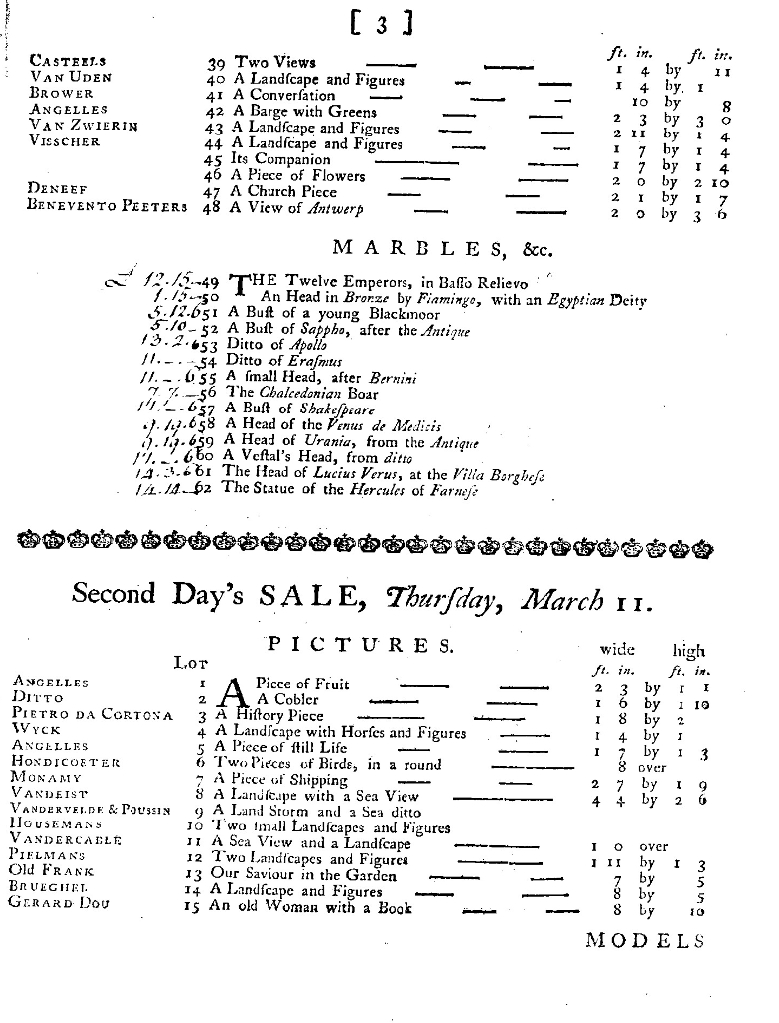
The Scheemakers Sale, 10th & 11th March 1756.

Under the heading Marbles etc.
.
 First Day, under the heading Marbles etc. Lot 57. Bust of Shakespeare. £14 0s 6d.


Second Day, Under the heading Marbles etc. Lot 59. Statue of Shakespeare.- s, £13 1s.

Images Courtesy Wellcome Library.


This might refer to the Plaster cast pictured here but it is possible that it refers to the marble statuette sold at Sotheby's New York. 20 Oct 2022, Lot 372. Illustrated below.


.........................

The Westminster Abbey Shakespeare Monument.


........................................


The Sotheby's Marble Statuette.

New York. 20 Oct 2022, Lot 372.

Catalogued as late 19th Century.

The Scheemakers Sale of 1756 on the Second Day, Under the heading Marbles etc. Lot 59. included a "Statue of Shakespeare", sold for £13 1s.


This might refer to the Plaster Cast pictured above, but it is more likely that it refers to the marble statuette sold at Sotheby's New York. 20 Oct 2022, Lot 372. Illustrated below.

Height: 24 1/4 in.; 61.6 cm width: 16 1/2 in.; 41.9 cm


There is no reason to describe this very fine work as late 19th century except for lazy cataloguing.

The sculptor would have had to have access to an original in order to reproduce it so closely.
It should also be noted that the back of the pedestal is much less truncated.


............................


Wednesday, 6 January 2016

The Rysbrack Statuettes of Rubens, van Dyck and du Quesnoy, Part 30, Scheemakers Monument of Shakespeare and it Variants.


Scheemakers Monument of Shakespeare and it Variants and afterlife.
How it relates to the Rysbrack Statuettes of Rubens, van Dyck and du Quesnoy.
 
For a great deal more on the 18th Century portrait Sculpture of Shakespeare see my parallel blog


The Kirkleatham Bronzed, Plaster Statuette of William Shakespeare,
after Peter Scheemakers
by John Cheere Supplied to Kirkleatham in 1749.
Height 19.5 inches.
 
Superb quality - almost certainly a first generation cast from an original terracotta.
Image Supplied Courtesy York Museums Trust.
 
__________________________


Shakespeare after Scheemakers
Musee de Beaux Arts Brussels, Belgium
Height 51.1 cms.
 
________________________________________________


Bronzed Plaster Statuette of Shakespeare after Scheemakers at Ham House
Probably by John Cheere,
Supplied along with two other statuettes of Milton and Spenser in 1759.
Height 20.5 inches.
Photograph courtesy National Trust.
 
________________________________________


Baddely Factory.
Staffordshire
late 18th Century.
Height 38 cms.
British Museum.
_______________________________


Shakespeare and Milton
by Wood and Caldwell.
 
____________________________________


Derby Porcelain
c. 1775.
British Museum.


Monday, 4 January 2016

The Rysbrack Statuettes of Rubens, van Dyck and du Quesnoy, Part 29, Scheemakers Statue of Shakespeare on the Monument in Westminster Abbey and it Variants and Afterlife.

 
The Statues of William Shakespeare

by and after Peter Scheemakers (1691 - 1781).

 
The next few blog entries will discuss the genesis and influence of the statue on the Shakespeare Monument at Westminster Abbey by Scheemakers and its variants - and the influence of the pose of the statue on the monument to Secretary James Craggs by Guelphi of 1722 also in Westminster Abbey.

for a brief biog. of Scheemakers see -


George Vertue wrote in praise of the sculptures in 1743, Rysbrack had 'lately since made three models in clay, being the representation of 3 most excellent artists (about 2 foot hi each figure) Rubens van Dyke and Fiamingo Quenoy all three his countrymen These three models for the invention being standing the gracefulness of the Actions the dispositions of their habit, attitudes, and natural likeness, is most excellent. Q[uestion] if any other Artist living could do better and more masterly execute them.’

George Vertue in his notebooks, goes on to say that Rysbrack's popularity had been eclipsed by that of Peter Scheemakers, after the completion in 1740 of the latters monument to Shakespeare in Westminster Abbey and that he was feeling 'the effects in the line of Busines' there is no suggestion that there was any financial motive rather that he had time on his hands and that 'these (statuettes) are the effect of leisure and study'.
 
Vertue continues - Rysbrack had found himself 'somewhat at leisure' owing to 'the great and unproportioned exhultation of that statue of Shakespeare erected in Westminster Abbey - done by Scheemakers'
 
The use of the van Dyck style costume should be noted and is an early example of its application on a monument. The pose of the statue is based on the monument to Secretary James Craggs, sculpted by Guelphi and designed by James Gibbs in 1727/8, also in Westminster Abbey.
 
I will write further on the statue of Craggs and its influence in posts in the very near future.


________________________________


Mezzotint of the Shakespeare Monument.

Engraved Andrew Miller, 1741.
 
_________________________________


Engraving by J Maurer.
dated 1742.
13 5/8 x 8 3/4 inches
Folger Shakespeare Library.


The Shakespeare Monument
By Peter Scheemakers
Westminster Abbey.
 Hubert Gravelot, 1744.
Engraving


Engraving

Claude du Bosc

Inscribed P.Scheemakers F. MDCCXL.
 
___________________________
 
 
_______________________________


_____________________________


Peter Scheemakers, Pieter Scheemaeckers II (16 January 1691 – 12 September 1781),
by Andreas Bernardus de Quertenmont (1750 - 1835).
1776,
oil on canvas,
62.9 ,m x 48.9 cm , 
National Portrait Gallery.
Behind is a model of his Shakespeare Monument in Westminster Abbey (see above).
____________________________________


The Lead Statue of Shakespeare after Scheemakers
by John Cheere.
Theatre Royal, Drury Lane.


Two more (rather poor quality) images above of the lead statue of Shakespeare at the Theatre Royal, Drury Lane.
__________________________
 
 
The Lead Statue of William Shakespeare.
John Cheere
Stratford on Avon Town Hall.
_________________________________


Stone Statue of William Shakespeare
by Peter Scheemakers
Wilton House.
___________________________________
 
 
Engraving
c.1770. 
Mr Garrick delivering his Ode, at Drury Lane Theatre,
on dedicating a building and erecting a statue, to Shakespeare.
NB The Statue is a version of the Westminster Abbey Monument.
105 x 170 mm. (cut to the image edges)
British Museum.
_______________________________________


 Engraving by John Lodge, 1769.
Mr Garrick delivering his Ode, at Drury Lane Theatre,
on dedicating a building and erecting a statue, to Shakespeare.
228 x 163 mm.
British Museum.
__________________________________
Scheemakers in the London Press, 1741 and 1748.
 

Scheemakers moves from Old Palace Yard Westminster to Vine Street, off Piccadilly.
London Daily Post, 22 December 1741.
 __________________________


London Evening Post 22 April 1748.
_________________________________
 
 
 "Shakespear's Jubilee / the 6th and 7th of September, / at Stratford upon Avon / This ticket admits one on the 6th to / The Oratorio / the Dedication Ode / the Ball / And to the Great Booth at the Fireworks / One Guinea".
A quote above the statue reads "We ne'er shall look upon his like again".
108 x 174 mm.
1769
British Museum.
 
__________________________________________
 
Portrait after Edward Francis Burney (1760 -1848) who exhibited at the Royal Academy from 1780 - 1803, after Scheemakers' memorial statue of Shakespeare in Westminster Abbey; full length standing, leaning with right elbow on a pile of books, pointing with left hand to an excerpt of Prospero's lines from the Tempest 'The Cloud [...] Leave not a wreck behind' on a paper beneath them, ankles crossed, looking towards the viewer, the books on a plinth decorated with busts of kings; St Peter standing on a lower plinth on the left, holding a scroll and pointing at his gospel (2, 3:13) : "Thy shall pass [...] righteousness"; illustration to an unidentified book.
    
Engraving with etching 246 x 200 mm.
British Museum.
 
_________________________________________


 Engraving by Caroline Watson after Robert Edge Pine.
c.1800.
Published for Irelands Mirror.
230 x 127mm
British Museum.
 
____________________________________________


Two burly, tough-looking sailors stand before Kent's monument to Shakespeare (r.). They read the inscription to which the figure of Shakespeare points: 'The Cloud Capt Towers, \ The Goreeous Palaces, . . . Leave not a Wreck [sic] behind' ['Tempest', IV. i]. One (l.), who wears his hat, in which is a tobacco-pipe, says: "Captain Towers!! who the Devil can this Capt Towers be? - Rot me if ever I heard of his Name or that of the Ship, did You Jack?" The other, who holds his hat, answers: "No, but I take it the Cloud must have belonged to the Mounseers, for you know that's what they call the place Boney lives at" [i.e. St. Cloud], Both hold heavy cudgels. 27 August 1804.
Engraving by Charles Williams
Pub. Forres, 1804.
Hand-coloured etching.
British Museum.