Thursday, 17 July 2025

Henry Cheere's Monument to Robert Davies in St Mary's Parish Church at Mold, Flintshire and other monuments in the church.


A series of notes and images.


The Monument was erected on the instructions of  his wife Ann Davies nee Brockholes, probably c. 1728/29, making it one of the earliest monuments designed and built by Henry Cheere. 

After his apprenticeship with Robert Hartshorne, Henry Cheere set up independently in St Margaret's Lane, Westminster in 1728 but worked in collaboration with Henry Scheemakers until 1733 when Scheemakers left England in 1733.

The pose here of the standing cross legged figure leaning against an urn is that first used by the Italian Guelfi (working in England c1718 - 1734) on the influential monument in Westminster Abbey to  James Craggs Secretary of State, put up c 1722 - designed by James Gibbs and superintended by Alexander Pope. 


The pose of the Guelfi Craggs statue was very influential on future monuments - the Westminster Abbey monument to Shakespeare by Scheemakers of 1740 being the prime example. 

It was used on the monument of 1746 to William and Elizabeth Powlett at St George's Church West Grinstead by Rysbrack,.

The statue of George Cooke of about 1749 formerly in the gardens of Belhamonds House, Middlesex and now in the Ashmolean.

The 1757 monument to Charles Polhill, St Bartholomew, Otford, Kent by Henry Cheere.

The 1761 to Cholmley Turner, at St Cuthberts, Kirkleatham, Cleveland also by Henry Cheere. 

The monument to Peregrine Bertie at Edenham by Henry Cheere of c 1741/42. 

The monument to Sir John Dutton at Sherborne, Glouc. by Rysbrack of  1749.

Duke odf Somerset in the Senate House, Cambridge Rysbrack of 1756.


For more on Guelfi and the derivation and use of this pose see - 

https://bathartandarchitecture.blogspot.com/2015/08/notes-on-giovanni-battista-guelfi-16912.html


https://bathartandarchitecture.blogspot.com/2016/01/the-rysbrack-statuettes-of-rubens-van_8.html


Robert Davies of Llanerch.


Robert Davies (1685/86 – 22 May 1728) was a Welsh antiquary and son of fellow antiquary, Robert Davies of Llanerch (d. 1710).


Davies was born on 1685/6 the son of Robert Davies and his wife, Letitia (née Vaughan). Davies matriculated from Brasenose College, Oxford University on 27 June 1702, aged 16. His father died on 8 July 1710, when his Llannerch and Gwysaney estates passed on to his son. The son of our Robert Davies another Robert became High Sheriff of Flintshire in 1744.

See - Usher, G. A. (1964). Gwysaney and Owston: A History of the Family of Davies-Cooke of Gwysaney, Flintshire and Owston, West Riding of Yorkshire.

The current church was erected c.1500 under the patronage of Margaret, Countess of Richmond and Derby, on the site of an Early Medieval church. It is one of the 'Stanley' series of churches which were rebuilt around this time. 

Later additions include the West Tower built 1768-73 which is attributed to Joseph Turner of Chester, and the Apsidal Chancel/general restoration of the church which was undertaken by G. G. Scott in 1856. The Church continues in use as a place of worship by the Church in Wales. 


.......................


The Guelfi Terracotta Posthumous Statuette of Craggs in the Soane Museum.

The face is in wax.

c. 1722.

Height 49 cms


.....................


Design for the Craggs Monument.

Victoria and Albert Museum?


__________________


The Wynn's of Tower (or Twr Broncoed), Nercwys,

The  Monuments in St Mary's Church, Mold.


The Monument to John Wynne of Tower, 

died 1737

Erected by his son William Wynne.


William Wynne d. 1776.

William Wynn instructed that the monument be carved in his lifetime.

The monument inscribed by Michael Rysbrack(1694 - 1770).

Notable for the very fire carving of the Cherub's heads.

St Mary's Church, Mold, Flintshire.


.......................

of tangential interest.

A Photograph of Tower (or Twr Broncoed) taken on 7th January 1856.

The image below from.

https://britishphotohistory.ning.com/profiles/blogs/unidentified-1856-british-photograph

It remains substantially unchanged.

The house (Listed Grade 1) is now a guest house and wedding venue.

see - https://tower.wales/contact-us/

The earliest part of the building, fortified tower house, is believed to date back to circa 1440-50. This

originally adjoined an open hall and the building has seen many structural changes over the centuries. A story perhaps apocryphal, of the Tower is the hanging of the former mayor of Chester in the 15th century. It is alleged that this man met his end in a kitchen in the house. 


................................


Again of tangential interest ref. St Mary's, Mold -

https://www.walesher1974.org/herumd.php?group=CPAT&level=3&docid=301447635

Wednesday, 16 July 2025

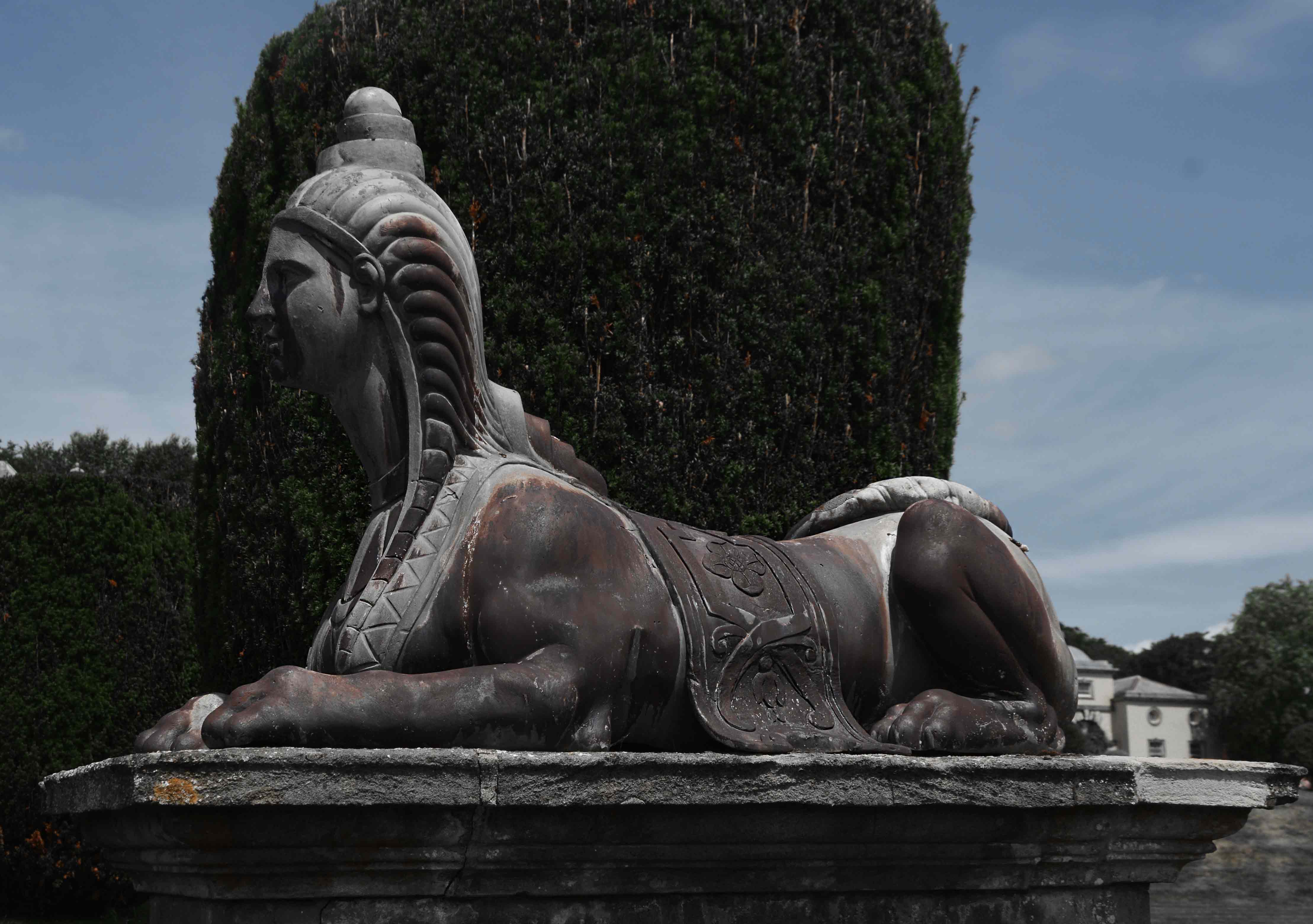
The Lead Statuary at Castle Hill, Devon Part 1


The Four Lead Sphinx.

John Cheere.

One of a set of four.

All four sphinx were cast from the same moulds.

There are remains of a white paint in the crevices which suggests that they were originally painted to appear like marble.

The tails are not handed but sweep across the backs in the same direction,

Photographed by the author July 2025.

It should be noted that these are not from the same model as the pair now at Anglesey Abbey, Cambridge.


Sir Hugh Fortescue (created Lord Clinton in 1721 and Earl of Clinton and Lord Fortescue in 1746), a leading Whig politician, inherited Castle Hill in 1719.


A programme of improvement, with a concentrated period of activity in the early 1730s coinciding with his resignation from political office included the remodelling of both house and grounds.


A new Palladian mansion was designed by Lord Burlington (1694-1753) with advice from the ninth Earl of Pembroke (1693-1749). 

The extent of Earl Clinton's landscape is recorded on field surveys (1763 and 1765), and views by John Wootton (about 1735-1740) and John Lange (1741).


Another Pair of lead shinx at Saltram - Sizes -1210 x 560 mm; 900 mm.

Two Sphinx supplied along with 2 gladiators for £45 3shilllings to Newhailes in 1740 (Newhailes Archives, Davis 1991). Stolen in 1949. 

It should be noted that several Chimneypieces at Newhailes appear to have been supplied by Henry Cheere.

see -

https://oldedinburghclub.org.uk/wp-content/uploads/2025/02/BOEC_NS14_2018_Joe_Rock_Design_and_Building_of_Newhailes_House.pdf


The Saltram Sphinx.


............................


The Chiswick House Lead Sphinx.

There appears to have been five sphinx at Chiswick - the pair on the gate piers at the front and three in the garden.


In 1749, two decades later, a lead sphinx cast after Guelphi’s model was produced by John Cheere (1709-87), England’s leading manufacturer of sculpture in lead (Davis 1991, pp. 95-101; Barnard and Clark 1995, p. 110). The Burlington accounts record a payment to Cheere in February 1749 for ‘a sphynx in Lead’, the cast installed in the gardens of Chiswick House with its stone counterparts by 1753 (they appear in ‘A View of the Back Front of the House and part of the Garden of the Earl of Burlington at Chiswick’ after John Donowell, etching, first issued 1753, re-issued 1760-66, RCIN 701784.g, Royal Collection Trust). All three remain at Chiswick to this day.


By 1742, Burlington had these Sphinxes moved onto pedestals and positioned on the North lawn near to the Exedra, and he commissioned a pair of lead ones for the forecourt gates from John Cheere. Seven years later Cheere produced a third lead Sphinx for the lawn to go next to the stone pair.

Casts of this sphinx were taken by Messrs Rupert Harris to replace the sphinx originally on the gate piers and removed to Green Park in 1897 to celebrate Queen Victoria's Diamond Jubilee.

 The Rupert Harris casts have now replaced the sphinx on the gate piers.


........................

View of Chiswick House.1729 - 31.

Showing the gate Piers with the Pair of Sphinx.

Pieter Andreas Rysbrack .

One of eight views commissioned by Lord Burlington.

This view is now at Chatsworth.


..............................

John Roque. 

1736.

British Museum


..............................

Chiswick House.

 1753.

After Donowell

Engraving - Printed for Henry Parker.


......................

There is another pair of these Sphinx on the gate piers at Temple Newsam House.


The Pair of lead sphinx on the gate piers at Temple Newsam House, nr Leeds.

Designed by Capability Brown and put up in 1768? 

Very old fashioned at the time post Rococo and way past the birth of Neo classicism of Adam Chambers et al.

The gates are below the stable block are copies of those designed by Lord Burlington for Chiswick, The gates were cast in 1768, and cost £47 and 5 shillings.

https://britishlistedbuildings.co.uk/101255952-sphinx-gates-pair-of-gate-piers-and-gates-approximately-137-metres-east-of-barn-temple-newsam-ward


....................


The Arundel /Easton Neston/ Ashmolean Sphinx.

Ancient Modern.

65 x 115 x 40 cm

Images courtesy Ashmolean Image Library.

https://images.ashmolean.org/search/?searchQuery=%20sphinx


......................

The Peter Tillemans (1684 - 1734) The Drawing of the Sphinx at Easton Neston, 1719.

Northamptonshire in the Early Eighteenth Century: The Drawings of Peter Tillemans and others.

From the Journal of Northamptonshire Record Society. Founded in December, 1920,Vol. XXXIX

For the two years ended 31 Dec.1994.


https://www.northamptonshirerecordsociety.org.uk/pdf/volume-39/vol-39-tillemans.pdf

The following paragraphs lifted from the NRS Journal


A Fabulous resource of early 18th century topographical drawings of Northamptonshire (highly recommended).

No titles on the drawings, but there are notes on the reverse of some. They all form part of a series of consecutive drawings of statuary of which the title-page bears the heading: Boughton near Kettering D. of Montagus Draught of the Bustos. In fact, only one sheet Plate 24 relates to Boughton (see ).

Date: July 1719 (see Notes below). 


The sheets in this series of drawings are numbered 1 to 47, although 35 is missing. The last sheet, no. 47 is that referred to above, showing busts under the arcade at Boughton House. The rest clearly show statuary which decorated the house and garden at Easton Neston. 

Several drawings show plinths carved with a coronet and linked Ls, denoting the tide of the owner of Easton Neston, Lord Lempster.

This collection of statuary has an interesting history. It originated with Thomas Howard, Earl of Arundel, who, in 1613, accompanied by his wife and the architect Inigo Jones, spent some eighteen months touring northern Italy. In Rome and elsewhere he acquired many of the items portrayed in these drawings.

Jones was the designer of a covered gallery for Arundel House in the Strand about 1615 to house the collection. Items were added until the middle of the century when it contained several hundred pieces. 

Lord Arundel's later years were beset by problems and he retired abroad, dying in Italy in 1646.

After the Civil War Arundel's grandson, who had no interest in the sculptures, was prevailed upon by the diarist John Evelyn to present the inscriptions to the University of Oxford in 1667. 

The items portrayed here remained in the gardens of Arundel House till 1691 when, for the price of £300, Sir Williarn Fermor purchased them. 

In 1692 they were taken to Easton Neston and there set up as decorations for the house and garden. In 1721 a note in Bridges' MSS records a visit on 18 July where he met "an Italian employed by the present Lord L in making perfect the statues maimed". This is a reference to Giovanni Battista Guelfi, a protege of the Earl of Burlington, who had brought him from Italy in 1718. 

The results of Guelfi's restoration of heads, arms and other appendages were not admired and George Dallaway, in his Anecdotes of the Arts 1800 describes them as "misconceived" and that he had "ruined the greater number of those he was permitted to touch".

George Vertue, an important antiquary of the arts in 18th century England, compiled in 1734 a Description of Easton Neston, which was published in 1758, and records the disposition of the sculptures.


By the time George Venue visited the gardens, Easton Neston had descended to Lord Lempster's son, Thomas, who was created Earl of Pomfret in 1721. When he died in 1753 his son George, who was encumbered by debts, decided to sell the sculptures.

With great foresight, his mother, Henrietta, Countess Pomfret, bought them in at the sale and in 1755 presented them to the University of Oxford, and they were- once more reunited with the marbles which had come to the University in 1667.

In the 1880s the whole collection was rehoused in the new galleries of what we know as the Ashmolean Museum. Guelfi's unfortunate restorations were removed, and there they remain to this day, variously known as "The Arundel Marbles" or "The Pomfret Marbles". In 1882 Adolf Michaelis' Ancient Marbles in Great Britain appeared and is still cited as the main authority for the Marbles.


The Peter Tillemans drawing of the Marble Sphinx at Easton Neston

Dated July 1719.


..........................


The Pair of  Lead Sphinx at West Wycombe.

765 x 590 mm; 1200 mm.

John Cheere.

Unfortunately there is no record of their purchase

The Design of  these Sphinx are derived from the Sphinx illustrated above but are much finer and more neo classical in their detailing.


..........................