An Anonymous 18th Century Lead Bust
in the Ashmolean Museum, Oxford.
Purchased 1933.


60.6 cm including socle (height)
14.5 cm socle (height)
An Anonymous 18th Century Lead Bust
in the Ashmolean Museum, Oxford.
Purchased 1933.
60.6 cm including socle (height)
14.5 cm socle (height)
Sappho, Antoninus Pius and other Plaster Statuary.
by John Cheere.
at Burton Constable House, Yorkshire.
The gilding is 19th century
This post under construction.
Sculpture on the East Riding Museum Database
_______________
The Great Hall.
As part of the overall decorative scheme, William acquired the plaster figures of Demosthenes and Hercules with Cerebus for the niches on either side of the fireplace.
These, and the plaster busts of the Roman emperor Marcus Aurelius Antoninus and the Greek poetess Sappho on the overmantel, are amongst a number of works supplied by the sculptor John Cheere (1709-87), who had initially submitted a series of sketches.
Unusually, the sketches also survive at Burton Constable.

H 67 x W 53 x D 20 cm
This item is in the Burton Constable Hall collections and is included on the East Ridings Museum Database database by kind permission of the Burton Constable Foundation.
In 1765, Cheere dispatched the ‘Busto of Sappho neat finished & pollish’d’ and packed in hay and straw for the journey from London to Hull.
A Greek poetess, Sappho was celebrated for her beauty and passion. Located in the Great Hall.

This item is in the Burton Constable Hall collections and is included on the database by kind permission of the Burton Constable Foundation. The reign of the Emperor Antoninus Pius was famed for its peace and orderly government and, as such, epitomised the political ideals of ancient Rome that were so revered during the 18th century.
Cheere’s source for the bust
may have been the marble bust of Antoninus Pius by Peter Scheemakers
(1691-1781) made for the Earl of Fitzwalter in 1733. Fitzwalter paid eight
guineas for his marble bust; William Constable paid a modest two guineas for
his plaster. Located in the Great Hall..
__________________________

This item is in the Burton Constable Hall collections and is included on their database by kind permission of the Burton Constable Foundation.
Cheere’s Flora is a copy of a Farnese Flora executed in marble for the Pantheon at Stourhead in Wiltshire by John Michael Rysbrack (1694-1770).
In turn, Rysbrack’s Flora derives from the colossal
Antique statue of Flora from the Farnese collection, at that time in Rome.
Located in the Staircase Hall.
Another is in the Maister House Hull on the Staircase - National Trust.
____________________________

This item is in the Burton Constable Hall collections and is included on their database by kind permission of the Burton Constable Foundation.
Cheere’s life-size statue of Livia Augusta, ‘finished in the best manner,’ cost ten guineas in 1765. Described as ‘the most powerful woman in the early Roman empire’, Livia was the wife of Augustus, the first Roman Emperor and the mother of Tiberius by her first husband, Tiberius Claudius Nero.
The statue of Livia Augusta at
Stourhead may have provided Cheere with a source for this work. Located in the
Staircase Hall.
_______________________

Sizes H 15 x W 29 x D 12 cm.


Photographs above from Art UK sculpture database website.

This item is in the Burton Constable Hall collections and is
included on their database by kind permission of the Burton Constable
Foundation. Cheere not only produced
the Lion and the Lioness as bronzed plaster figures but also marketed
full-scale lions in lead, fine examples of which can be seen at Castle Hill in
Devon. See the next record for the image of the Lioness.
__________________________

Flora.
Plaster Statuette John Cheere.
Signed Flora Cheere f.
H 57 x W 22 x D 16 cm.
Flora is in the Burton Constable Hall collections and is included on their database by kind permission of the Burton Constable Foundation. Flora was the goddess of flowers and spring.
Excellent photographs from the Art UK Sculpture database website:


The original bronzing plainly visible on the back.


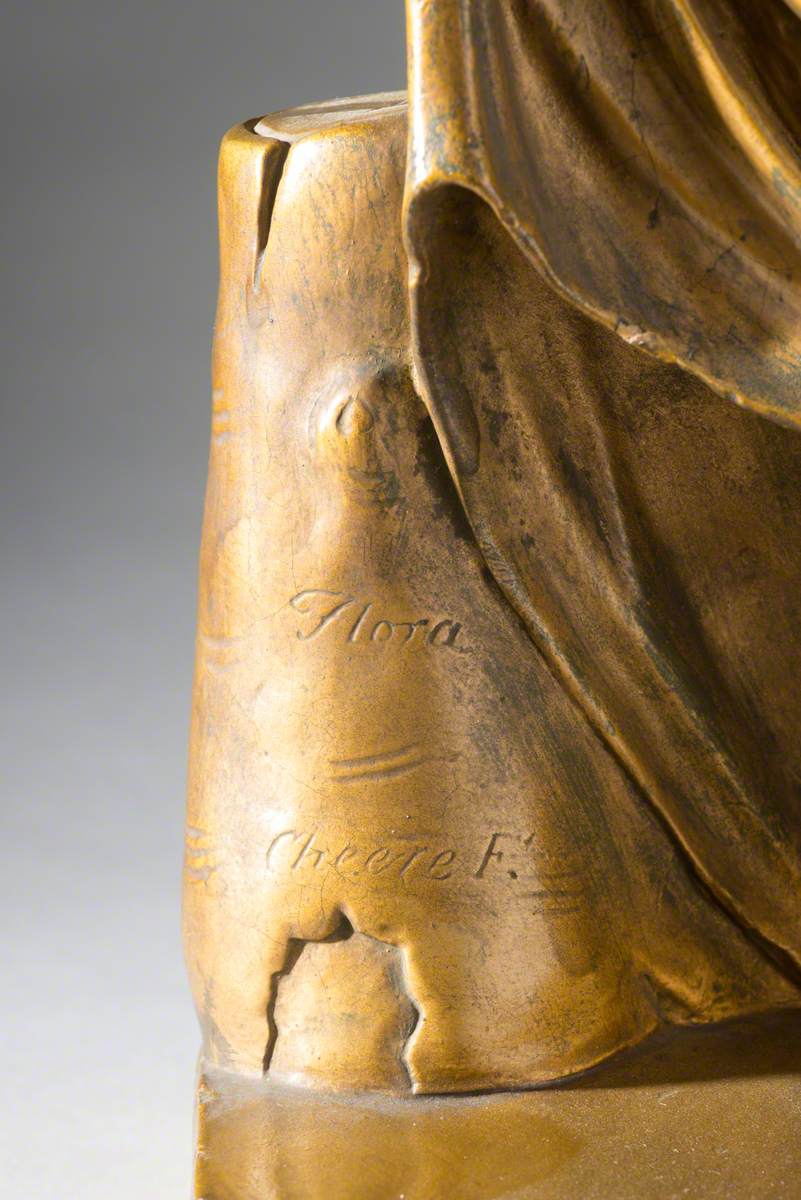
This bronzed statuette
of the Farnese Flora seems to be a copy after Rysbrack. In July 1763, Constable
settled his account ‘To Flora as pr Mr Cheere's Bill’ for £1 13s 6d. Located in
the Staircase Hall.
__________________________
Farnese Hercules.
Plaster Statuette.
John Cheere.
1762.
no size given.

This item is in the Burton Constable Hall collections and is
included on their database by kind permission of the Burton Constable
Foundation.
Ordered in 1762.
___________________________


These two photographs from Art Uk Sculpture database website.

Hercules and Cerberus.
John Cheere.
Plaster.
Located in the Great Hall.
This item is in the Burton Constable Hall collections and is included on their database by kind permission of the Burton Constable Foundation. During a bout of madness, inflicted by Juno, Hercules killed his own children and, as punishment, was forced to serve King Eurystheus of Argos and undertake twelve dangerous tasks (the Twelve Labours).
In this instance, Cheere alludes to his descent to the underworld where Hercules was forced to capture Cerberus - the monstrous, three-headed dog who guarded the entrance to Hades.
____________________________
Demosthenes by John Cheere.

This item is in the Burton Constable Hall collections and is included on this database by kind permission of the Burton Constable Foundation. John Cheere was possibly the first sculptor to popularise the art of ‘bronzing’ plaster figures in an attempt to imitate the translucent quality of bronze.
In their seminal work on John Cheere, Terry Friedman and Timothy Clifford present an account of the ‘bronzing’ technique:There are two sorts of compositions used for this purpose, the red and the yellow; the latter is made of the finest copper dust, and to the former is added a small quantity of red ochre, well pulverized. Both are applied with a varnish, and the work is dried over a chasing-dish as soon as bronzed. Located in the Great Hall.

Demosthenes.
John Cheere.
Plaster.
Size unknown presumed three quarter life size - to be confirmed.
This item is in the Burton Constable Hall collections and is included on this database by kind permission of the Burton Constable Foundation. William Constable (1721-91) initially ordered a bronzed statuette of Demosthenes (see below) and a sketch for a life-size plaster figure. Demosthenes was an Athenian statesman who was renowned for his eloquence in public speaking and his political integrity: the statue provides a fitting affirmation of Constable’s Enlightenment values. Furthermore, with its elaborate draperies and daring reach, it is an ambitious and decorative piece. Located in the Great Hall.
_______________________________


Enamelled Earthenware.
48.2cms.
Enoch Wood.
Victoria and Albert Museum.
another at the Fitzwilliam.
https://collections.vam.ac.uk/item/O230553/demosthenes-figure-wood-enoch/
The figure represents the Athenian orator Demosthenes
(324-322 BC). The relief on the side of the plinth shows Hermes, messenger of
the gods, who was associated with eloquence and reasoning, and this feature
therefore also alludes to Demosthenes' oratorial skill.
The attribution to Enoch Wood's factory is based on similar figure with the mark 'E WOOD' in the Fitzwilliam Museum (inventory number C.900-1928). The V&A figure differs from the Fitwilliam example in that scroll does not overhang the plinth. The figure derives from a full-size plaster statue made in the 1750s in the London workshop of John Cheere, who later sold reduced sized casts of it.
Wood could have obtained his cast from Charles Harris (died 1795), the owner of another London plaster shop.
Harris's catalogue of about 1790
lists a model of Demosthenes, as well as several other subjects manufactured by
Wood.
For the Charles Harris Catalogue see my blog post -


Titled and dated on the back :
The Bust / of / Enoch Wood / of / Burslem
aged / 62 AD 1821.
62cm., 24 3/8 in.
The use of the Roubiliac type socle is very interesting!


Enoch Wood (1759 - 1840).
Titled and dated: The Bust / of / Enoch Wood / of / Burslem aged / 62 AD 1821 polychromed ceramic.
62cm., 24 3/8 in.
A Drawing attributed to Thomas Chippendale the Elder.
recently purchased by the Chippendale Society.
This excellent Rococo drawing posted here for obvious reasons.
http://thechippendalesociety.co.uk/new-acquisitions-for-the-chippendale-society/
Posted 3 May 2020.

Thomas Chippendale snr.
Drawing for a bracket for a bust, with candle branches.
c. 1750/1760.
Ink and wash.
114 x 81mm.
One of six drawings this one and another of a table attributed to Thomas Chippendale the Elder.
The drawings were bought from London dealer Thomas Heneage and came originally from an album of drawings in a collection in Canada.
The album bore the bookplate of Alexander Manning (1819-1903), an Irish immigrant who had arrived in Toronto in 1834. A carpenter by training, he became one of the most successful builders and property developers in Toronto and was also active in local politics, serving twice as mayor in 1873 and 1885. In later life he became a philanthropist and patron of the arts, but the drawings presumably relate to his professional interests as a builder.
______________________
18th Century Carved Busts on American Furniture
I have posted in some depth on this subject and hopefully will collate all the information in one place - in the meantime....
John Prince (1751 - 1836).
The Rev. John Prince and his Air Pump inside of a Cabinet 1783.

https://www.colonialsociety.org/node/1251#rpic44
For an in depth article which you cannot read unless you pay for it see -
https://www.journals.uchicago.edu/doi/abs/10.1086/697593?journalCode=wp
_____________
Images below courtesy Google images.
Extracted from the above article which explains the Low resolution.


Interesting little bust of.......
It appears to be very loosely based on the John Cheere bust of Locke.
________________
This post Under Construction.
The Monument to Humphrey Smith.
by Charles Stanley.
Cloisters - Ely Cathedral.
Designed and erected by John Sanderson (active 1730 - 1774).
For Charles Stanley and Joseph Sanderson (the cousin of John Sanderson) see my previous post.
These photographs were taken by Mark Bonney Dean of Ely Cathedral, and were kindly supplied by Jeremy Musson.


___________________
In 1742 Stanley William Wilton, Jonathan Crook and Guiseppe Artari had prepared estimates for Gibbs Radcliffe Camera although Artari was Hired Stanley and Thomas Roberts were engaged to make "eight ceilings ornamented with stucco to the drawings of Mr Gibbs at £35 each" Their rates of work varied between 2s 2d and 2s 6d per foot Stanley ultimately recieved £232 18s 10d - it is this connection with Roberts that suggests they might have worked together at Kirtlington, built by William Smith and designed by John Sanderson
In Decorative Plasterwork in Great Britain Geoffrey Beard, pub. Phaidon 1975 it suggests that Charles Stanley worked for John Sanderson at Honington Hall.

John Sanderson.
Drawing prepared for the interior decoation at Kirtlington Park for John Dashwood.
Included here for the possible Stanley connection and also the use of busts on the overdoors in interiors of the mid 18th century.


Images above Courtesy Metropolitan Museum, New York.
