Monday, 19 November 2018

John Vanderstein at Queen's College, Oxford. Part 5. Thomas Barlow


John Vanderstein 
at Queen's College, Oxford. 

Part 5. 

The Eight Statues on the West Front of the Library. 
1696


 Thomas Barlow (1607 - 1697).

Fellow of Queen's College, Bishop of Lincoln.

A famous "runner with the hare and hunter with the hounds"


I am very much indebted to Dr Graeme Salmon, Curator of Pictures at Queen's College, Oxford for making me welcome at Queen's and for making this work possible.


This blog entry is part of a much larger work investigating and recording the 17th and 18th Century portrait sculpture at Oxford. This project was suggested to me by Dana Josephson of the Bodleian Library, Oxford, who is currently in the process of cataloguing the portraits at the Bodleian and to whom I extend my heart felt thanks.


Born in Westmoreland, Thomas Barlow entered Queen’s College in 1624. He became a Fellow of Queen’s in 1633, Bodley's Librarian from 1642 to 1660. He was Professor of Divinity, Provost of Queen’s from 1657 to 1677, Archdeacon of Oxford and Bishop of Lincoln in 1675.


https://en.wikipedia.org/wiki/Thomas_Barlow_(bishop)


All photographs above taken by the author

_____________________


Thomas Barlow
anon.
Late 17th Century 
Oil on Canvas
89.2 x 74.7 cms.
Queens College, Oxford.

_____________________


Thomas Barlow
Anon - formerly attrib. Lely.
Oil on Canvas
124.5 x 96.5 cms
Bodleian Library

_____________________


Thomas Barlow Bishop of Lincoln.
Engraving
Signed D Loggan ad vivum sculp.

23.82 x 16.84 cms

Image courtesy National Gallery of Scotland


________________________________


R White 
Engraving
15.9 x 10.2 cms

Image courtesy National Galleries of Scotland
_________________________________


https://en.wikisource.org/wiki/Barlow,_Thomas_(1607-1691)_(DNB00)

https://en.wikipedia.org/wiki/Thomas_Barlow_(bishop)

Sunday, 18 November 2018

John Vanderstein at Queen's College, Oxford. Part 4. The Statues on the West Front of the Library. Sir Joseph Williamson.


John Vanderstein 
at Queen's College, Oxford. 

Part 4. 

The Eight Statues on the West Front of the Library. 
1696.

Sir Joseph Williamson (1633 - 1701).


A few rough note.

Joseph Williamson was a student at Queen's College, Oxford, and received his BA in 1654, becoming a Fellow in 1657 and was called to the Bar in 1664. He went on to hold many public offices.

He had been admitted as a poor boy and went on to become a fellow, rose to Secretary of State and amassed a fortune. He funded a new range on Queen Street built in 1671–72. Following a bequest of books from Thomas Barlow, a new library was built between 1693 and 1696 by master builder John Townesend. A further bequest from Williamson of £6,000, along with purchase of the buildings along the High Street, allowed a new front quad to be built and for the remaining medieval buildings to be replaced. This was completed by 1759 by John's son William Townesend

He is chiefly remembered in the college for planning the Williamson building in response to a shortage of rooms. 

He was one of the most generous benefactors that the College ever had. 


Among Williamson's papers in the Public Record Office, there are several relating to the erection of his new building at Queen's. In January 1671 Dean Fell wrote to inform him that 'Since Mr. Surveyor (i.e. Christopher Wren, then Surveyor of the King's Works) desires a more exact measure of the ground, Mr. Crosse will take care to have it sent', and in March he was assured by the same correspondent that 'Mr. Surveyor will assist you in the particulars of your contract, besides the measures of the whole building and order of it, with reference to strength and ornament; the scantlings of your timbers, the thickness of your walls, and binding them with porpine stones'.  There can therefore be no doubt that the Williamson Building was designed by Wren, and its architectural features are closely paralleled in his work elsewhere.  The 'undertaker', or contractor, was Anthony Deane of Uffington, a well-known master-mason who built several great houses, including Horseheath, Cambridgeshire (1663–5), and Battlesden, Beds. (1672)

The plan for the new quadrangle hung fire for twenty years until a large bequest of books from Bishop Barlow made the provision of a new library an urgent necessity. 'Antiqua bibliotheca ex occidentali veteris capellae situ posita tot voluminum incapax', the Liber Benefactorum tells us,  'ardens omnium animis excitavit desiderium ut nova aedificaretur.' 

The college lengthened the site for the new building by acquiring a strip of New College Lane 20 in. wide;  the foundation stone was laid in May 1692 and the exterior was finished in 1694; the fine stucco ceiling by James Hands, which cost £148 9s. 8d., bears the date 1695: it was altered in 1756 when Thomas Roberts was employed 'to add new ornament in the oval space in the middle and the compartments at the ends'.  The master-mason employed was John Townesend, the carpenter was Thomas Heughes, the joiner-carvers Thomas Minn, senior and junior, and the eagles on the pediment, with the carved keystones with the statues of benefactors in the niches on the west front were done by J. Vanderstein. Chains and locks for the books cost £67 11s. 8d. and remained in use until 1780,  with benches and desks between the bookcases. Modern cases were fitted into the recesses in 1871 but were removed in 1938. The eastern half of what is now the lower library was originally an open loggia, and the enclosed western half was divided into two rooms by a tunnel leading into the garden. Provost Halton's account of expenditure on the library shows that the total expenditure was £5,427, of which Halton himself contributed nearly £2,000. 

The two paragraphs above from - https://www.british-history.ac.uk/vch/oxon/vol3/pp132-143

Elected Fellow of the Royal Society 1663,  president 1677 - 1680.


All photographs above taken by the author.

_____________________


Sir Joseph Williamson
Godfrey Kneller (1626 - 1743).
c.1684
Oil on Canvas.
127.4 x 103.1 cms.

The donation is given in one early museum catalogue as being 3 December 1683. [Royal Society Manuscripts General, MS/414/11, p.20]. This must be a clerical error, since no meeting were held on that day in 1683. 1684 was meant and a Journal Book minute states that: “The Society having received the Picture of Sir Joseph Williamson, formerly their President, ordered it to be placed in their Meeting Room, and desired Mr.Hill, and Dr, Gale, to wait upon Sr. Jos. Williamson with their thanks.” [Royal Society Journal Book, Original, JBO/7, meeting of 10 December 1684, p.278].
info Royal Society.

Royal Society.
Presented by the sitter.
Image from Art UK

https://artuk.org/discover/artworks/sir-joseph-williamson-16331701-216262/view_as/grid/search/keyword:joseph-williamson/page/1

____________________


Sir Joseph Williamson
Peter Lely (1618 - 1680).
Studio

Oil on canvas 
125 x 101 cms.

Presented to the University by Dr Joseph Smith, Provost of Queen’s College, 1754; engraved anon.
Queen's College, Oxford.

There are at least four versions of this portrait.

see - Mrs Rachel. L. Poole, Catalogue of Portraits in the possession of the University, Colleges, City and County of Oxford, I, p 73, no.182; 

Catalogue of Portraits in the Bodleian Library by Mrs R .L. Poole completely revised and expanded by K. Garlick, 2004, p 337; 

A wash-drawing by T. Athow in the Ashmolean Museum, Oxford (Sutherland collection, Burnet i, 324) was copied from the Bodley picture.

Another version in the Clothworker's Hall see  Amy B. Atkinson 1899-1900 (D. E. Wickham, Clothworkers’ Hall Portraits, 1997, pp 168-69, no.84, illus.).


https://artuk.org/discover/artworks/sir-joseph-williamson-16331701-fellow-1657-223666/view_as/grid/search/keyword:joseph-williamson/page/3

_________________________


Sir Joseph Williamson
After Lely
Oil on canvas.
127 x 101.5 cms.
Gift from Joseph Smith 1754
Bodleian Library
_________________________


Sir Joseph Williamson
After Lely 
Anon 
Oil on Canvas 
75.6 x 62.2 cms
Purchased 1897.
National Portrait Gallery

notes -

see - D. Piper, Catalogue of the Seventeenth Century Portraits in the National Portrait Gallery 1625-1714, 1963, p 381.

Provenance

A. Whitcombe, Cheltenham Fine Arts Gallery, Cheltenham,1 from whom purchased 1897.
 Whitcombe stated that it was by Lely and had descended through the sitter’s family. Probably the portrait sold anonymously, Christie’s, 25 July 1896, lot 92A (‘Sir P. Lely. Portrait of Sir Joseph Williamson’).

__________________________


Sir Joseph Williamson
oil on canvas 250 x 152 cms
Guildhall Museum, Rochester.
Image courtesy Art UK

Williamson gave a portrait of Queen Anne by Kneller to Rochester Town Hall.

____________________


From the Oxford Almanac 1762
346 x 448 mm.

British Museum


Queen's College, with the cupola and main building in the background in the centre, with the founder John Michael of Richmond standing alone to right gesturing to a plan which he holds in left hand, and Sir Joseph Williamson pointing out something on a plan held by Dr Lancaster with 

Bishop Barlow and the provost Dr Halton, holding an elevation of the library, beside them, in left foreground next to an archway and pillar draped in an embroidered cloth.

_______________________________


The West front and South Front of Queen's College.
with scale.
Michael Burghers (1653 - 1727)
Engraving
c 1710 - 20
British Museum


Saturday, 17 November 2018

John Vanderstein at Queen's College, Oxford. Part 3. The Statues on the West Front of the Library. Queen Henrietta Maria.


John Vanderstein at Queen's College, Oxford.

Part 3. 

The Eight Life Size Statues on the West Front of the Library.
c. 1696.

Queen Henrietta Maria (1609 - 69).


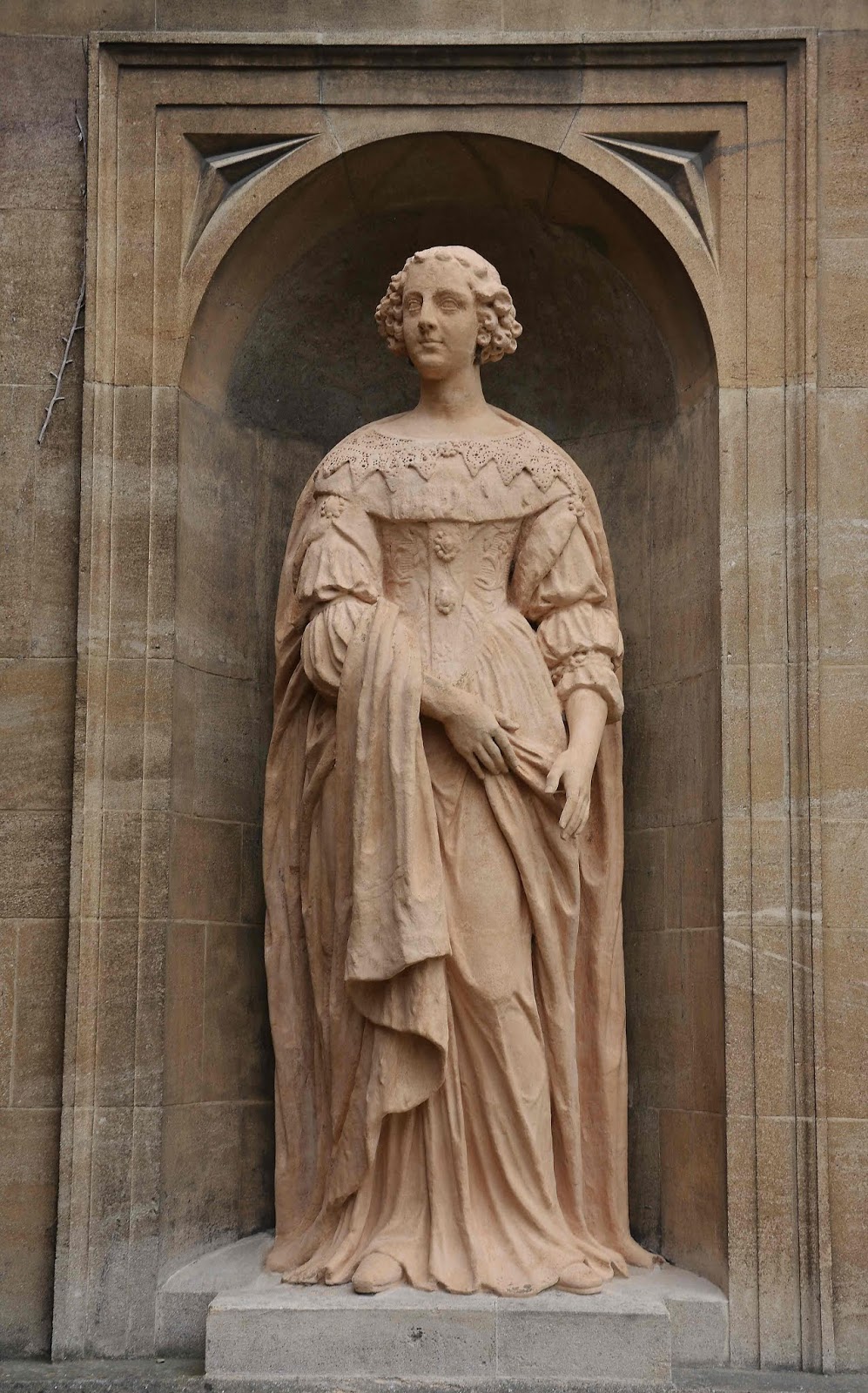
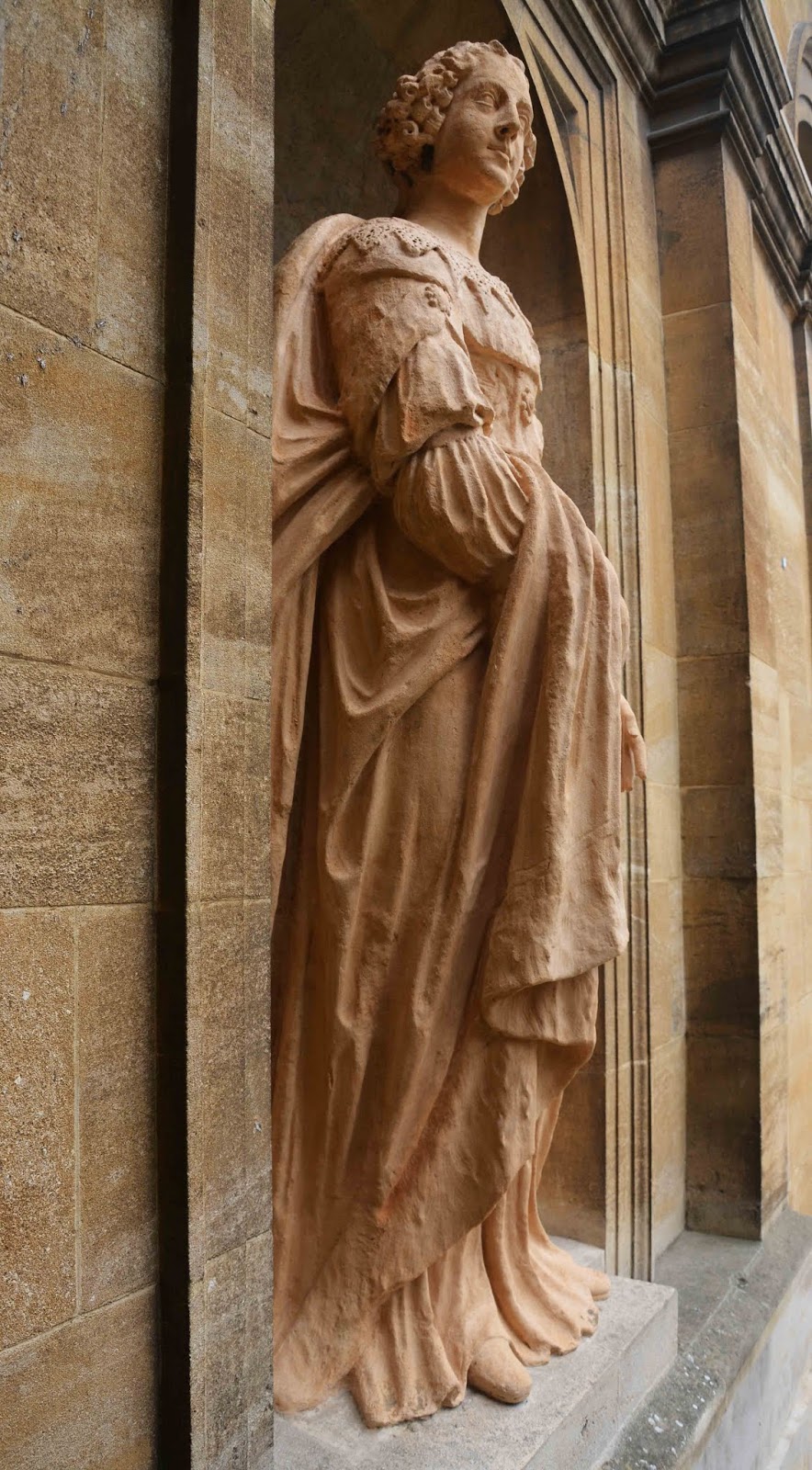
One of Eight Statues in niches on the ground floor on the west front of the Library at Queen's College - looking from North to South.

Queen Henrietta Maria (1609 - 69) Queen consort of Charles I. She requested the King to grant advowsons to Fellows of Queen's - allowing them to take up a position in a parish church and also to marry!

Sir Joseph Williamson, (1633 - 1701), Fellow of Queen's College. Founder of the Royal Society.

Bishop Thomas Barlow, (1601 - 1691). Fellow of Queen's College, Bishop of Lincoln.

Archbishop Thomas Lamplugh, (1615 - 91). Fellow of Queen's College, Archbishop of York.

Robert Eglesfield, (c 1295 - 1349). Founder of Queen's College in 1341.

Edward III, (1312 - 77).

Queen Philippa.(1314 - 69). Queen Consort of Edward III.

Charles I; 

I am very much indebted to Dr Graeme Salmon, Curator of Pictures at Queen's College, Oxford for making me welcome at Queen's and for making this work possible.


This blog entry is part of a much larger work investigating and recording the 17th and 18th Century portrait sculpture at Oxford. This project was suggested to me by Dana Josephson of the Bodleian Library, Oxford who is currently in the process of cataloguing the portraits at the Bodleian and to whom I extend my heart felt thanks.


Henrietta Maria was Queen Consort of England, Scotland, and Ireland as the wife of King Charles I. She was mother of his two immediate successors, Charles II and James II/VII.

It is difficult to judge the condition of these statues - they have recently been conserved by Cliveden Conservation and given a perhaps, in my opinion ill advised shelter coat of copperas (ferrous sulphate). This has had the duel effect of turning them a rather bright orange and obscuring the finer detail of the carving.

It has also obscured any restorations


All photographs above the authors own.


For the conservation work at Queen's College see 
Queens College Library Insight -


For Comparison.
Queen Henrietta Maria.
Cast by Hubert le Sueur.
Bronze.
West Front.
Canterbury Quad.
St John's College, Oxford.


______________________


Tuesday, 13 November 2018

Handel Terracotta Relief by Roubiliac - Ashmolean Museum Oxford


George Frederick Handel.
A Terracotta Relief.
The Maquette for the Monument in Westminster Abbey

by Louis Francois Roubiliac - 
c 1760.

Ashmolean Museum, Oxford.


98 cms tall.


Given by James Wyatt to Oxford University in 1848.

I have already posted at some length on the portrait sculpture of Handel see -


http://bathartandarchitecture.blogspot.com/2015/06/a-marble-bust-of-handel-by-heaven.html

http://bathartandarchitecture.blogspot.com/2014/01/asummary-of-researches-into-bust-of.html


All photographs taken by the author.


_______________________________________


The Foundling Hospital Terracotta Modello of The Handel Monument
Height 12 - 15" approx.


Black and White photograph of the modello at the Foundling Hospital Museum.

This modello was noted to have been recently discovered in Bath, in Early Georgian Portraits by Kerslake. pub. NPG. 1977.


 Photographs of the Modello taken in very poor light at the Foundling Hospital Museum.
12 - 15" tall approximately.


It is possible that there were plaster copies made of the Roubiliac model for the monument although none have come to light so far. John Flaxman senior, father of the more famous sculptor offered casts from the original mould of the monument in The Gazetteer and London Advertiser of 13 January 1764. 

Perhaps lot 61 on the 2nd day of the sale of the contents of the Roubiliac Studio in St Martin's Lane, 13 May 1762.


John Flaxman I (1726 -1803), father of the more famous John Flaxman the Younger was at the Shakespeares Head, New Street, Covent Garden from 1763, King Street, Covent Garden  1773 -76, In 1776 he moved 420 The Strand (opposite Durham Yard). In 1792 he bought several moulds formerly belonging to John Cheere, He is believed to have been employed by both Scheemakers and Roubiliac. (see Dict. of Sculptors in Britain....).


 Above - snippet from The Gazetteer and London Advertiser of 13 January 1764.
This would suggest that there was another, third modello for the monument which was 2' high.
unless it refers to a version of the plaster bust below.


So far neither a terracotta or plaster versions have surfaced.


________________________________


The Westminster Abbey Monumentof Handel
Louis Francois Roubiliac


https://www.westminster-abbey.org/abbey-commemorations/commemorations/george-frederic-handel/


Overexposed but the best image I can find of a close up.

https://www.weijerkoor.nl/componisten-handel-gf.shtml

Westminster Abbey, whilst having updated their internet image bank, still fail to put up good photographs of their monuments preferring to make anyone interested pay for the privilege.


_______________________________


The Royal College of Musicians Plaster bust of Handel.
and other versions of this bust.


52 cms approx.

Painted a rather bilious shade of magnolia!

Given to the Royal College of Musicians in 1889.


Another version of the Westminster Abbey Head of Handel by Brucciani is at the Fitzwilliam (below).

These busts appear to have been taken directly from the Handel Monument in Westminster Abbey and whilst obviously related to the Roubiliac portrait busts of Handel it is also very close to the head of the Vauxhall Statue of 1738 now in the V and A.

I believe that all of the Roubiliac sculptures of Handel were originally derived from sittings - or a life mask taken in about 1736 /77 before the creation of the Vauxhall statue and Royal Collection marble and the terracotta versions of the bust with the hat of 1737/8.

Given the changes in his appearance after this time when he put on a great deal of weight, which does not show in any of these sculptural portraits I believe that Roubiliac used an earlier bust or busts in order to create the monument in Westminster Abbey.


also for company history and much more of interest on plaster casts in the 19th century see -


_______________________________


The Fitzwilliam Museum, Cambridge Plaster Bust of Handel.
unsigned - possibly cast by Brucianni.


Probably cast by D. Brucciani. Mid - late 19th Century, in the Fitzwilliam Museum, Cambridge.

Given to the museum in 1906

Height 52 cms.


____________________________


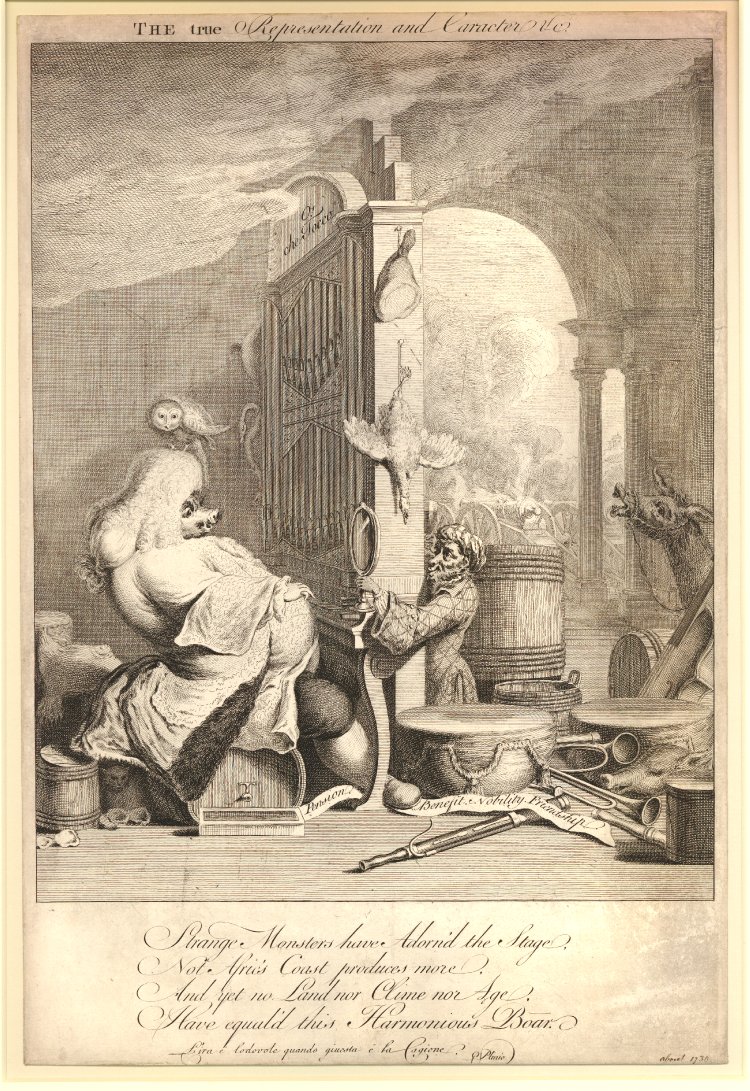
With title along the top, and below four lines of verse: "Strange Monsters have Adorn'd the Stage,/Not Afric's Coast produces more,/ And yet no Land nor Clime nor Age,/Have equal'd this Harmonious Boar./L'ira è lodevole quando giuesta è la cagione. Plinio'.

A corpulant Handel satirised by Joseph Goupy
1754
Engraving
315 x 311 mm.
British Museum.

____________________________


A ticket for a performance of "a sacred oratorio" by Handel 
to be performed at the Foundling Hospital. 
c.1750 

Etching and engraving, printed in red

197 x 214 mm


Paulson does not believe that any of the versions of the Foundling Hospital coat-of-arms were engraved by Hogarth, although he accepts that the design is Hogarth's. See also 1858,0417.579. An impression of this ticket at the Handel House, Halle, is completed in manuscript for a performance of Messiah at 12 noon on 1 May 1750. 

Handel performed the oratorio at the Foundling Hospital every year from 1750 to 1754 and not only raised over £7,000 for the charity, but established the lasting fame of the oratorio.

Coat-of-arms with a naked child, a lamb holding a sprig of thyme as the crest, figures of Diana of Ephesus and Britannia as supporters, and the motto "Help"; a landscape beyond, and a rococco frame; below, a ticket for a performance of "a sacred oratorio" by Handel to be performed at the Foundling Hospital. c.1750 Etching and engraving, printed in red


© The Trustees of the British Museum