Monday, 5 February 2018

A Lead Bust of John Locke in the Bodleian Library


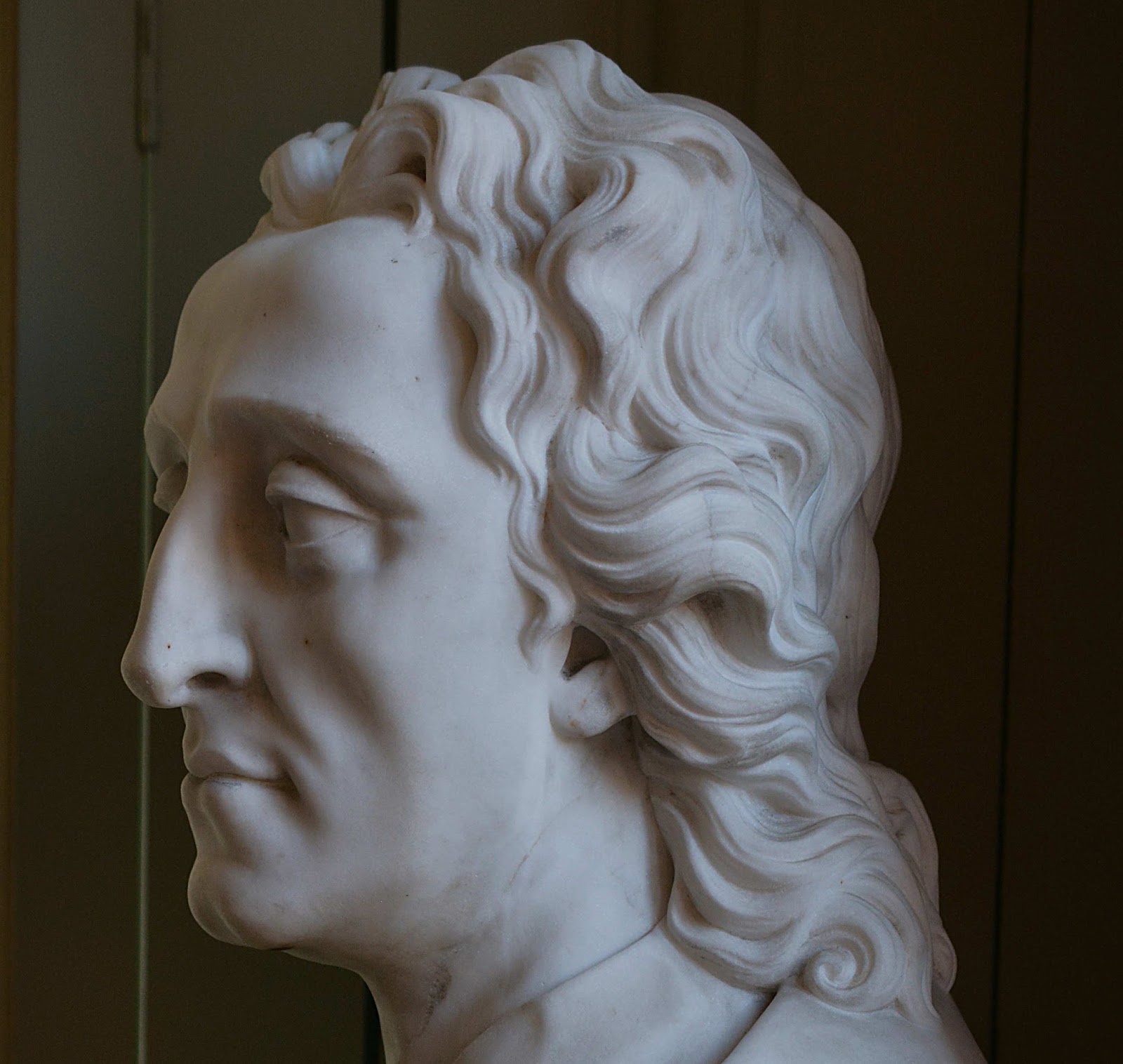
A Lead Bust of John Locke. 

probably by John Cheere.

Mid 18th Century.

in the Bodleian Library.

On a painted turned wooden socle.

Presumed mid 18th Century.

Attributed here to John Cheere.

___________________________________

This post is part of a much wider study into the portrait sculpture at Oxford University, with particular reference here to the lead Cheere type bust of John Locke at The Bodleian Library and the marble bust after Roubiliac by Edward Hodges Baily at Magdalen College, Oxford.

I am very grateful to Dana Josephson for suggesting the project and for all his assistance.


I would also like to thank Dr Nicolas Bell of the Wren Library, Sir David Clary, Lady Heather Clary and Rachel Mehtar at Magdalen College Oxford. and Stephen Hebron of the Weston Library, Oxford for allowing me to visit and to photograph the busts under their care.


___________________________

The Lead Bust of John Locke.

attributed to John Cheere.

Mid 18th Century.

on a turned wooden socle.

Bodleian Library Collection.

Height of the bust without socle approx. 23.5"

There are remains of white paint on the underside of the front of the costume which suggests that it has been stripped and was originally painted white to represent marble.

Bequeathed by Ethel Locke King to the Bodleian Library in 1956.

At first glance this is a very impressive and imposing bust but after close inspection it becomes slightly less so.

The workmanship lacks the subtleties found in other finer lead busts of the period - particularly the three lead busts in the Victoria and Albert Museum. On the bust of the unknown man (see below) the detailing of the buttons and buttonholes and the punch work and chiselling on the embroidery of the waistcoat are much superior.

William Shenstone in Unconnected Thoughts on Gardening pub. 1764 writes on lead statuary.

"Though they may not express the finer lines of an human body yet they seem perfectly well calculated on account of their duration to embellish landskips, were they some degrees inferior to what we generally behold. A statue in a room challenges examination, and is to be examined critically as a statue. A statue in a garden is to be considered as one part of a scene or landskip: the minuter touches are no more essential to it than a good landskip painter would esteem them were he to represent a statue in his picture"


This aptly describes the lead bust of Locke which was probably made for a niche on the exterior of a building.


The original, from which this bust derives is probably now lost, but it must have been a very fine object. 
This lead bust is very close to the marble busts perhaps by or after Roubiliac mentioned in my previous post. What differentiates it from the marble versions is the work on the embroidery of the waist coat and edge of the mantle.

The original of these busts was perhaps by Louis Francois Roubiliac.

See my recent post on the Magdalen College Marble of Locke after Roubiliac by Edward Hodges Baily - https://bathartandarchitecture.blogspot.co.uk/2018/01/busts-of-john-locke-and-francis-bacon.html

It should be stated that this sort of bust in lead is very rare survival.
I have also posted previously on 18th century lead bust see for instance -

http://bathartandarchitecture.blogspot.co.uk/2014/01/some-more-eighteenth-century-busts.html

There is a bronze version of this bust currently on the London Art Market (2018) - this is of a markedly lesser quality than the mid 18th Century bronze busts that we know of - such as the bronze busts of Lord Chesterfield (see my next post).


Back of the bust with the plaster in fill - it is impossible to tell whether this is original but the lead would need filling in order for it to keep its shape - without it the weight of the lead would cause it to eventually collapse.


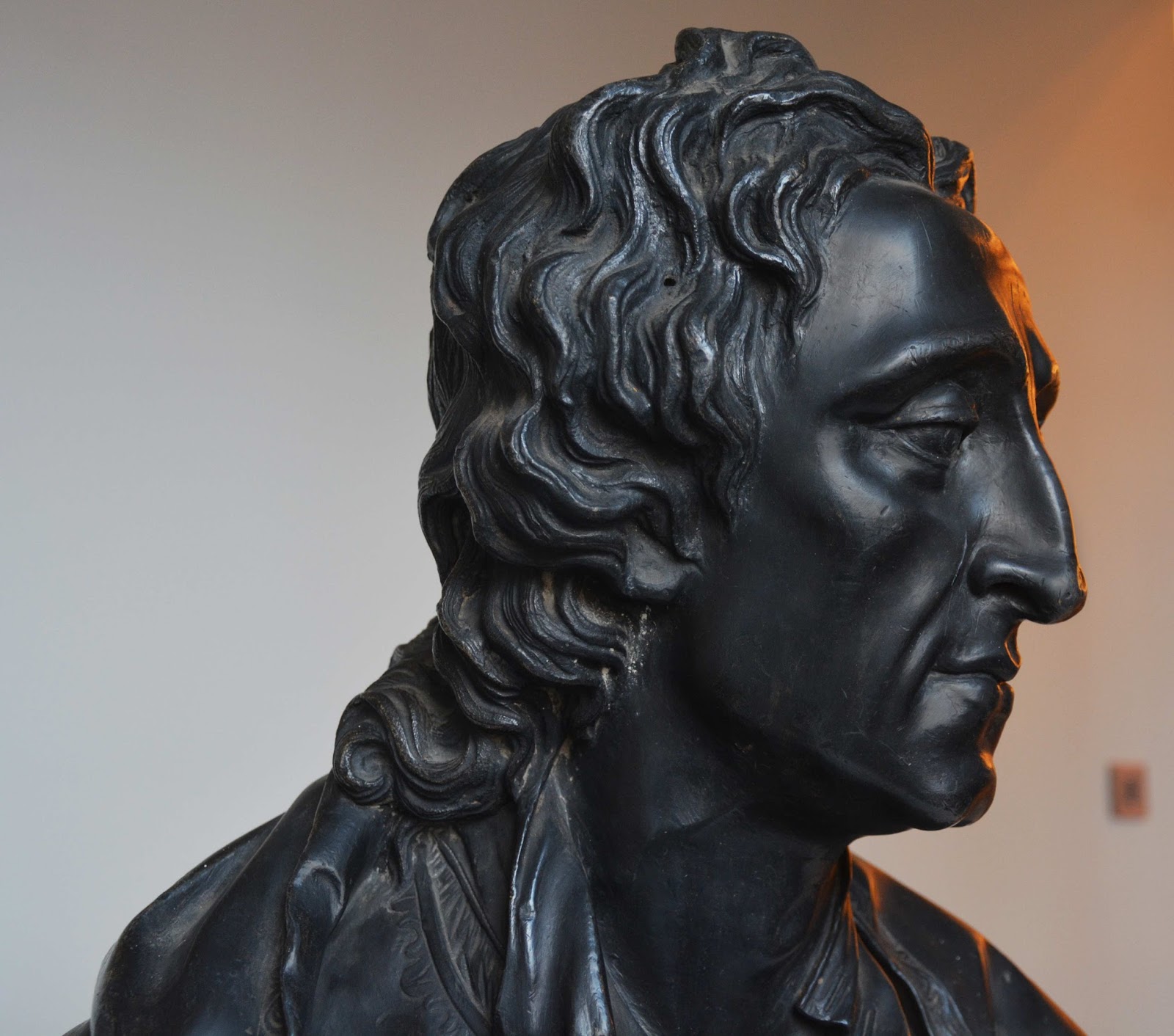


Details of the turned wooden socle.

This appears to be original  the grain would suggest that it is oak with a very old painted finish.

The bottom section of the socle appears to be a perhaps, slightly later softwood addition, screwed to the original with three screws to make the bust more stable. 

________________________________________


The Bodleian Lead and the Wren Library Plaster - Side by Side for Comparison.

There are minor variations in these busts  - there is extra embroidery on the waistcoat of the plaster bust.

This begs the question of which came first, the lead was not cast from this version of the plaster but is so close that they must be related.

In the plaster, even though it has been over painted several times, the quality of the finish of the detail is obviously much superior to that of the lead. 

Again comparison of the embroidery of the waistcoat is very instructive.

 Both photographs here taken by the author.

With grateful thanks to Stephan Hebron,  the Bodleian Library Curator of Special Projects and Dr Nicolas Bell College Librarian of the Wren Library, Trinity College Cambridge and to Dana Josephson for all their kindness assistance with this project.


A Lead bust of an anonymous young man.

75.5cms including the socle.

Lent to the museum by Lt Col. GB Croft Lyons in 1913 and bequeathed to the museum in 1926.

Victoria and Albert Museum.

This bust is of a superior quality to the Bodleian bust of Locke.


The same bust photographed in the mid 20th century and described as Hogarth.


It is important point to note the quality of the finish of this bust - particularly the buttons and button holes, the shirt at the collar and the embroidery on the waistcoat.

I would suggest that the detail of the V and A bust has been punched and chiselled by hand, whereas the Locke has come directly from the mould and has only perhaps been hand finished in the detailing of the hair.

Both images from the Victoria and Albert Museum website see -


____________________

The Lead Bust said to be of Mrs Salmon.

Victoria and Albert Museum.


Height 63.5 cms.


Detail of the Chemise of the lead bust of Mrs Mary Salmon.

Showing the hand finishing to the chemise.

This bust is one of a pair - the pendant lead bust of Dr William Henry Salmon of Holcombe, Somerset is also at the V. and A.

The pair purchased in 1921 from a descendant of Dr Salmon - the Rev. JDC Wickham of 8 Lansdown Place East, Bath


_______________________


For the methods of casting in the 18th Century The Handmaid to the Arts by R. Dossie, 1758 pp 349 - 365 -  is a useful introduction.

this publication is available free online see - 


_________________________________
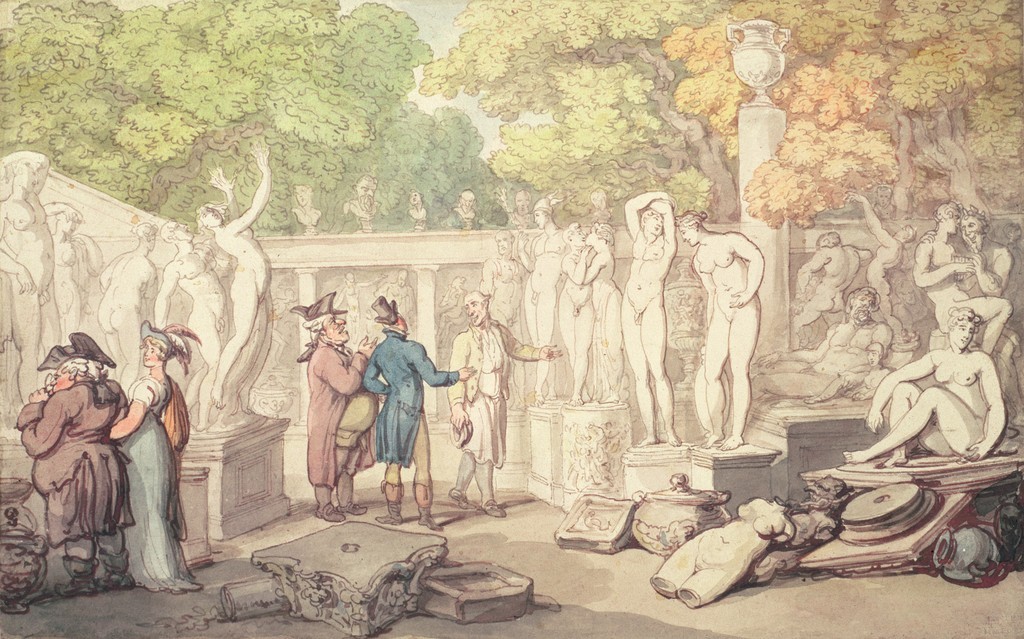


A visit to a Statuaries Yard.

Thomas Rowlandson (1756 - 1827).

Note the busts ranged on top of the Loggia

Image courtesy Ashmolean Museum, Oxford.

Bust of Francis Bacon Magdalen College, Oxford by Edward Hodges Baily.


The Marble Bust of Francis Bacon (1561 - 1626).

Magdalen College, Oxford.

by Edward Hodges Baily.

After the Original by Louis Francois Roubiliac
1828.
Paired with the bust of John Locke.
Edward Hodges Baily

This post is a brief survey of the Roubiliac type busts of Francis Bacon.

I have already posted on the Wren Library bust of Bacon by Roubiliac, but since this posting I have visited and taken my own photographs of all the portrait sculpture at the Wren Library and Trinity College Chapel, Cambridge and will be updating my previous posts in the near future.


Whilst their are very obvious similarities in the depiction of the hair and ruff the clothing has been adapted by Hodges Baily.

In my opinion a competent bust marred by the finish of the ruff, particularly in the very obvious drilling in the folds at the edge.

______________________________________


A Marble Bust of Francis Bacon.

After Roubiliac.

suggested here as workshop of Hodges Bailey

Royal Collection.

Privy Chamber, Kensington Palace.

78 cms tall.

They say 18th Century - there is no record on the website for when it entered the Royal Collection.

Image from -


_________________________________________


Marble Bust of Francis Bacon.

Louis Francois Roubiliac.

1751.

Wren Library, Trinity College, Cambridge.

Photographed by the author.

There is / was a plaster cast in the library at Wilton House (Esdaile).

This must refer to the terracotta now in the double cube room at Wilton.
see my post


There is no mention of any bust of Bacon in the Roubiliac auction sale catalogue at his St Martin's Lane workshop by Langford's12 - 15th May 1762.


______________________________


Francis Bacon.

Library, Trinity College, Dublin.

Photograph by the author.

Unsigned but almost certainly from the workshop of  Louis Francois Roubiliac.

My theory is that the unsigned busts at Trinity are perhaps works by John van Nost III,
perhaps working in the studio of Louis Francois Roubiliac and based on an original by Roubiliac.

It is possible that the missing original terracotta was once in the British Museum (see the ambiguous reference in Esdaile page 105).

Update 13 August 2024.

It is now clear that the terracotta is at Wilton House.


_________________________


Francis Bacon
Sudbury,
 National Trust
Cheere type bust by Robert Shout of Holburn.

see - http://bathartandarchitecture.blogspot.co.uk/2017/05/two-mysterious-plaster-busts-probably.html

_____________________________


Francis Bacon.
John Cheere 
Supplied in 1749
Plaster Height 22" 
Supplied to Kirkleatham Hall by Cheere.
York Museums.

Whilst these busts appear to resemble the Roubiliac type busts. They were probably an invention by John Cheere or somone in his workshop at Hyde Park Corner.


_______________________________


Bronze Medallion 
by Jean Dassier 
Bronze 42 mm Diam.
1733.

______________________________________________


Silver medal in very low relief. It has a ring for suspension.


Francis Bacon
Bronze Medallion
by Thomas Bushell
41 mm
1660
British Museum


see - http://www.britishmuseum.org/research/collection_online/collection_object_details.aspx?objectId=952059&partId=1&searchText=Francis+Bacon&page=1


____________________________________________


All the 18th century images seem to derive from the engraving below by Simon de Passe


Portrait of Sir Francis Bacon when Lord Keeper, HL, wearing hat and ruff, in an oval cartouche Engraving


Francis Bacon
Simon van de Passe
Engraving
182 x 115 mm
c. 1618
British Museum

An engraving of Francis Bacon (1561–1626), politician and philosopher, Privy Councillor from 1616, Lord Chancellor from 1618, Viscount St Alban from 1621. Portrait wearing hat, with high ruff, brocade corselet and fur mantle. Holding the purse of the Great Seal. This print records Bacon's role as Lord Keeper, which he held from March 1617, but not his appointment as Lord Chancellor in January 1618, suggesting it was made in the latter part of 1617. The plate was later altered to be a portrait of Thomas Coventry.


Portrait of Francis Bacon, half length in an oval, wearing ruff, robes, and ribbon; hand resting on a coat of arms; above, a motto, 'Moniti meliora'.  Engraving


Francis Bacon
Crispian de Passe
Engraving
154 x 97 mm

1617 - 1630.
British Museum


______________________________________________


Portrait of Francis Bacon, nearly whole length, wearing hat, ruff, robes, ribbon and medal, and fur-trimmed cloak, seated at a table writing in a book; books and coat of arms in background to right, curtain in background to left; above, laurel wreath with inscription: 'Tertius A' Platone Philosophiæ Princeps'; frontispiece to Bacon's 'Of the Advancement of Learning' (1640) and 'The Historie of the Reign of King Henry the Seventh' (1641). 1640  Engraving

Francis Bacon

Frontispiece to Bacon's 'Of the advancement of Learning' 1640
and 'The Historie of the Reign of King Henry VII' 1641

William Marshall 
Engraving, 1640.

British Museum.


____________________________________


Francis Bacon.

William Larkin.

Oil on Panel.

113 x 83 cms.

c. 1617.

Trinity College, Cambridge.

Gifted from Peter Burrel - 1751.


_______________________


Portland Stone bust of Francis Bacon in the Temple of Worthies 
at Stowe, Buckinghamshire
Michael Rysbrack 
1728


Monday, 29 January 2018

Busts of John Locke and Francis Bacon by Edward Hodges Bailey copied from originals by Roubiliac. Magdalen College, Oxford.


The Two Marble Busts of John Locke FRS (1632 - 1704), 
and Francis Bacon.

by Edward Hodges Baily, R.A. (1788 - 1867),

According to the inscription carved on the back copied from the originals by Louis Francois Roubiliac.

1828.

In the President's Lodging, Magdalen College, Oxford.

Given to the College by R.H. Daubeny.

This is the first of a series of posts investigating the sculptural portraiture of John Locke in the 18th century, with particular reference to the John Cheere lead type bust at the Bodleian Library, Oxford and the marble bust by Edward Hodges Baily at Magdalen College Oxford.


This post forms part of a much wider study into the portrait sculpture at Oxford University, with particular reference here to the lead Cheere type bust of John Locke at The Bodleian Library and the marble bust of Locke after Roubiliac by Edward Hodges Baily at Magdalen College, Oxford.


I am very grateful to Dana Josephson for suggesting the project and for all his assistance.

I would also like to thank Dr Nicolas Bell of the Wren Library, Sir David Clary, Lady Heather Clary and Rachel Mehtar at Magdalen College, Oxford and Stephen Hebron of the Weston Library for making these posts possible.

__________________________________


The first mention of a bust of Locke by Baily after Roubiliac.

Christie's Sale - Robert Vernon Esq. 5 July 1849. 

Lot 101 - £45.13.

Bought Sir G Sergeller (?)

This perhaps refers to a member of the Seguier family of noted art dealers.

The two busts of Locke and Bacon by Hodges Bailey after Roubiliac are described as being in the Library at Magdalen College in 1866 in The Eclectic Magazine of Foreign Literature, Science... Vol. 4; vol.67.

There is a marble bust of Newton by Hodges Bailey copied from the bust by Roubiliac in the Wren Library now in The National portrait Gallery - it differs slightly from the original in detail (as do both of these busts) in that the sculptor has omitted the inner chemise. It is also dated 1828 (see below).


___________________


Edward Hodges Baily was a pupil of John Flaxman and was principally known and regarded for his neoclassicism, especially his poetic works, such as Eve Listening to the Voice (Victoria and Albert Museum, London). He was also an experienced portraitist, producing over 130 portrait busts in his career, and applied for numerous public commissions for portrait statues, including an unsuccessful bid to carve the statue of George Canning in Liverpool Town Hall (Baily’s model is in the Bristol Museum and Art Gallery). In 1839 he won the commission to carve the statue of Admiral Lord Nelson for the top of the column in Trafalgar Square, the work for which he is best remembered.

For a more in depth biography see

A Biographical Dictionary of Sculptors in Britain, 1660 - 1851.

see - http://liberty.henry-moore.org/henrymoore/sculptor/browserecord.php?-action=browse&-recid=100&from_list=true&x=0

see - http://sculpture.gla.ac.uk/view/person.php?id=msib7_1218119321

__________________________________


Surprisingly although there are a number of busts existing of John Locke by the leading sculptors of the early to mid 18th century, including John van Nost I, Guelfi, Peter Scheemakers and Michael Rysbrack, there are none recorded to be by Louis Francois Roubiliac before the Magdalen College Oxford bust inscribed copied from Roubiliac.

The drawings and engraving below by and after Daniel Chodowiecki would seem to place these busts in the 18th century - they do not show the embroidery on the waistcoat as on the Cheere bust in the Wren Library, Trinity College, Cambridge.

The only reason we have to suspect that Roubiliac also made a version of a bust of John Locke is that the marble bust of Locke at Magdalen College, University of Oxford has inscribed on the back -

Copied by E.H. Baily.

From the Original by

Roubiliac.

It is paired with another bust by Bailey of Francis Bacon which is also derived from the Roubiliac model in the Wren Library, Trinity College Cambridge, the terracotta prototype is at Wilton House the finished marble is at the Wren Library Trinity College, Cambridge. (see my next post).

Whilst it is always possible that Edward Hodges Baily was mistaken about the author of the original bust, I believe that this is unlikely, especially given that it has always been accompanied by the bust of Bacon adapted from the Roubiliac version at Wilton and in the Wren Library.

To my knowledge there are four marble busts of John Locke extant all of which are very close to the Hodges Bailey version - none are signed and none have a provenance going back to the 18th century.

There are slight difference in that the mantle on his left hand (proper) shoulder is missing and the detail of the shirt and waistcoat where the buttons and buttonholes is missing on the Oxford version but the detailed carving of the hair is very close.


There is ample evidence available to show that the original version of this bust is of 18th century origin with the existence of several plaster busts and a lead bust, which were cast or derived from models made in two sizes in the workshop of John Cheere (1709 - 87) at Hyde Park Corner, which flourished from 1738 until the sale of its contents 1788. It is possible that these busts were carved by John Cheere or in the workshop of his brother Henry Cheere but there is no record.

I will stick my neck out here and suggest that the original of this bust of Locke was probably from the studio of Roubiliac, especially given the quality of the marble bust of Lock which appeared at Sotheby's, London, Lot 148 on 23 March 1971 described in error as after Rysbrack. Unfortunately I only have a very poor photocopy of this bust and it has since disappeared - hopefully it will reappear soon! 

I cannot be certain but a letter published in Country Life Magazine of 17th March 1960 which asked about the subject and its author, would appear to show this same bust.

There is another version of this bust at the Kelvingrove Museum Glasgow, and there are two further examples in private collections.


I have attempted to put the various versions of the busts of Locke into some sort of order for this blog.


........................................


A List of the 18th Century Busts of John Locke in (more or less) chronological order -

The first Lead bust - probably a version of the bust now at Yale Centre for British Art New Haven Conn. USA and mentioned in the van Nost I sale catalogue of April 1712.

The Michael Rysbrack Portland Stone bust  in the Temple of Worthies at Stowe after 1735, carved for an earlier building at Stowe in 1729.

The bust by the execrable Guelfi from Queen Caroline's Grotto, c 1730, now in the Royal Collection.

A bust possibly by Roubiliac - perhaps that sold Sotheby's 23 March 1971 (photo - see below). There are probably at least 4 versions of this bust extant but none with a secure 18th Century provenance including -.

A Marble version at Gennings Sale Lot 220 - 26 / 27 May 1982 1972, Phillips with a private owner in 1987. (Photo in Heinz Archive)

Various plaster busts in two sizes and a lead bust probably by John Cheere all based on the 'Roubiliac' type bust.


The Marble Bust of Locke, signed by Peter Scheemakers in Trinity Library, Dublin, supplied c 1745.

A Bust of Locke was sold at the Scheemakers sale Lot54, 11 March 1756 (£22. 1s) which is possibly that mentioned below.

A cast of a bust of Locke sold at the Scheemakers sale of 6 June 1771.

Another version of the Scheemakers bust of Locke (attributed incorrectly to Guelfi) was sold at Christie's September 2013 possibly that sold in Scheemakers sale 1756.


Another Rysbrack version of 1756 (the terracotta for Lord Lyttleton), which was unsold at Christie's in December 2010, the form of this bust was used again in full length statue at Christ Church, Oxford.

These busts are all easily distinguishable from each other.

___________________________________________

 For the National Portrait Gallery webpage on the various portraits of Locke see -

https://www.npg.org.uk/collections/search/personextendedlinkid=mp02773&tab=portraits&tab=iconography


____________________________________________


The Magdalen College bust of Locke. 

by Hodges Bailey.

Adapted from a bust by Roubiliac?


All the Photographs above taken by the author.

I am very grateful to Rachel Mehtar of Magdalen College, Oxford for organising the visit to the President's Lodgings at Magdalen for me and to Professor David Clary and his wife Heather for allowing me into their home and for being so welcoming.


There are perhaps at least 4 versions of this bust.

The Marble bust sold to the Glasgow Museums by Mrs WM Thomson in 1961 .

The Marble bust sold Sotheby's, Lot 148, on 23 March 1971 (below).

 The Marble version sold at the Messrs Phillips Auction - The Gennings Sale, Lot 220 - 26 / 27 May 1982 1972 with a private owner in 1987.

The Marble version at Westminster School.


see below


_________________________________________


The Marble Bust of John Locke.

Kelvingrove Museum, Glasgow.

Image kindly provided by Winnie Tyrrell, Photo Library Coordinator at Glasgow Life/Glasgow Museums.


This image of the Kelvingrove marble bust retrieved from the web.


Note from a curator at Kelvingrove, Glasgow.

This sculpture was purchased from Mrs. W.M. Thompson (vendor), Northumberland in 1961 and came from the Runciman Collection? with an attribution to either Rysbrack or Guelfi. 

At that time, Dr Whinney at the Courtauld Institute was consulted and she leaned more to Rysbrack, thinking the sculpture was “too good” to be by Guelfi. But she also thought there was a possibility it could be by Roubiliac...

This information above kindly provided by Winnie Tyrrell, Photo Library Coordinator at Glasgow Life/Glasgow Museums.

The Runciman Collection presumably refers to that of William Ist Viscount Runciman of Doxford
Northumberland (1870 - 1949). He was the son of Walter Runciman First Baron Runciman self made shipping magnate of South Shields.


_____________________________________


The three images above courtesy Country Life Magazine of 17th March 1960.
showing what appears to be the Kelvingrove bust.

Too good for Guelfi!

The cutting of the eyes is the same.

I am very grateful to Sarah Hart, Library assistant at Country Life Magazine for finding and supplying me with this extract.


_______________________________________


Is this the Roubiliac bust of Locke??


Photocopy of a photograph of a marble bust of John Locke.

sold Sotheby's, Lot 148, on 23 March 1971.

The location of this bust is currently unknown.

I would suggest that this might be the original by Roubiliac.

The very obvious quality of this one shines through even though the image above is taken from a photocopy.

Where is it now??


____________________________________________


The Westminster School Marble Bust of John Locke.

This is possibly the bust illustrated below.


___________________________


There is a photograph of the Philllips / Genning sale Marble bust in the Heinz Archive of the National Portrait Gallery.

Unfortunately they jealously guard their holdings and you are under strict instructions not to use the photographs from their very useful archive, although they do allow you to have photocopies.


The Phillips / Gennings Marble  Bust - The Roubiliac / Hodges Baily type.

Again wrongly attributed to a model by Rysbrack.

The Marble version at The Gennings Sale, Lot 220 - 26 / 27 May 1982. Phillips with Harte, 1987.

This looks very like the Westminster School bust with the rectangular support between the turned marble socle and the base of the bust.


__________________________________


Portrait of John Locke; a marble bust, shown in four positions; with short hair, open shirt, and cloak over shoulders; after Chodowiecki; illustration to a German edition of Lavater's 'Physiognomy'.  Etching and engraving


Bust of John Locke.

The Roubiliac / Hodges Baily type.

James Neagle 1765 - 1822).

After Daniel Chodowiecki (1726 - 1801).

Engraving.

240 x 188 mm plate.

Late 18th Century.

 British Museum.

_______________________________


The Drawings for the plate facing p. 255, vol. 1, of the first English version of J.C. Lavater's 'Essays on physiognomy' (trans. Henry Hunter, London: John Murray [etc.], 1789-1798).

Lavater describes these three views (frame nos. 9349T, 9349BL and 9349BR) as "defective copies of a very middling bust"

The Original Pencil and Wash  Drawings and the description above from the Welcome Library Collection.

https://wellcomecollection.org/works/jsywj4d6

I will be posting on the Westminster School Bust of Locke shortly.


____________________________________


Isaac Newton.

Edward Hodges Baily (1788 - 1867).

Marble.

Height 711 mm.

Incised on the base E.H. Baily R.A. / AFTER ROUBILIAC /1828.

After the original marble donated by Daniel Lock, of 1751 by Louis Francois Roubiliac
in the Wren Library Trinity College, Cambridge.

Commissioned by Robert Vernon (1774 - 1849) and with a bust of Samuel Johnson and his art collect bequeathed to the nation.

Mrs Esdaile was rather unkindly, very scathing about the 'incredible inferiority of the drapery'
She didn't like the socle either describing it as an hideous circular foot.

see - Roubiliac's Work at Trinity College Cambridge, Katherine A. Esdaile. Cambridge 1924.


Currently on the staircase at Beningbrough Hal, Yorkshire

There is another later version of this bust by Hodges Baily at Woolsthorpe Hall, dated 1849.

National Portrait Gallery.

see https://www.npg.org.uk/collections/search/portraitExtended/mw04663/Sir-Isaac-Newton?LinkID=mp03286&search=sas&sText=Newton&role=sit&rNo=4

________________________________