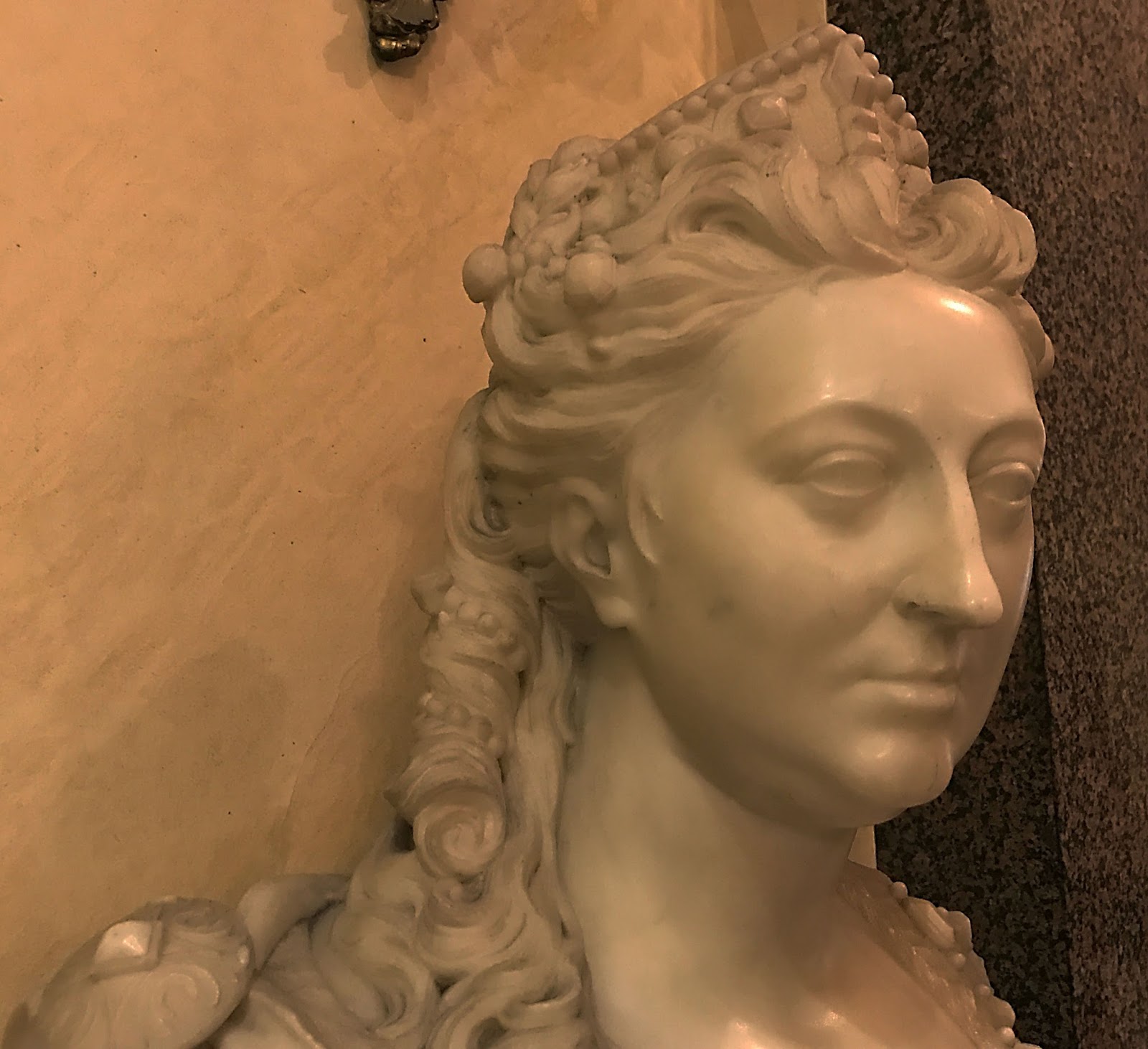
at the Sotheby's Howard Hodgkin Sale.
_____________________
My opinion - for what its worth.
This bust has suffered a great deal from being outside and much of the surface where it has been exposed has sugared probably by acids in the atmosphere. This is very evident in the laurel leaves and curls of the hair. At some time in its past it has been restored by polishing the sugared surface particularly on the face and front of the bust. In doing so this has removed the majority, if not all of the original surface and thus the original intentions of the sculptor.
It is my opinion that any further intervention could only worsen the state of the already compromised surface.
Whilst historically interesting it can no longer be described as an original work of art. It should be compared with the other versions which are in much better condition - the photographs of the Christ Church marble bust, the two Royal Collection busts and the Victoria and Albert marble bust by Rysbrack (pictured below) show clearly what this bust must have looked like originally.
My advice to any potential purchaser - think very carefully before bidding tens or even hundreds of thousands of pounds for a bust whose distressed and weathered surface has been altered from the original and therefore it is a work where the sculptors intentions have been severely compromised!
Inscription on the bust of Queen Caroline at the Wallace Collection
Photographs from the Sotheby's website
see -
http://www.sothebys.com/en/auctions/ecatalogue/2017/howard-hodgkin-portrait-artist-l17120/lot.193.html
Marble Bust of Queen Caroline by Michael Rysbrack
Wallace Collection.
Sotheby's suggest that the Hodgkin bust of George II could be the pair to it.
see below for a terracotta version
Photograph taken in very poor light by the Author.
___________________________
George II.
Michael Rysbrack
in the Christchurch Gallery, St Aldates, Oxford.
This bust was placed over the hall chimney-piece when the Hall was repaired and adorned under the direction of Dean Gregory in about 1752 and removed to Christchurch Library when the new Chimney-pieces were built before 1804 - see Oxford Almanack, Christ Church Hall drawn by JMW Turner and engraved with variations in 1807.
All photographs below by the author.
I am very grateful to Jacqueline Thalman curator of the Christ Church Gallery for allowing me to visit and to take photographs for this blog of the busts at the Gallery.
I am also very grateful for the assistance of Dana Josephson and for suggesting that I investigate and record the various busts in the Bodleian Library and at Christ Church and for enabling me to photograph this and the other busts.
_________________________________________
George II
Michael Rysbrack
1760
Victoria and Albert Museum.
George II
Michael Rysbrack
Marble.
Signed at the back with the initials MR and dated 1760
Height 89 cms.
Victoria and Albert Museum
Photographed by the author.
Photographs by the author.
________________________________________
George II
Michael Rysbrack
Marble Bust.
c. 1738/9.
Height 69.8 cms.
Royal Collection.
Located room 5 Kensington Palace.
This is one of a pair of portrait busts made by the
Flemish sculptor working in England, John Michael Rysbrack. They were ordered
for Queen Caroline, King George II’s consort and were commissioned for the
decoration of the new library at St James's Palace, designed by the English
architect William Kent.
George Vertue, in his diaries, provides valuable
information on the origin of these two marble portrait busts.
In 1738 he noted
that ‘the KING … sat to [Rysbrack] at Kensington twice. to have his picture modelled
in Clay. the likeness much approvd on – and with a good Air. – also a Moddel of
the Queen vastly like. Tho’ not done from the life’. The resulting terracotta
models, which are signed and dated 1738, can now be seen at Kensington Palace
(RCIN 1411-1412).
In 1739 Vertue recorded that ‘two Marble Bustos the one of
his present Majesty from a Model done from the life by MrRysbrack – and another
busto of the lat Majesty Q. Caroline both were erected in the New Library at
St. James, Green Park’.
Text from the Royal Collection website
Photographs from the Royal Collection website see -
https://www.royalcollection.org.uk/collection/31322/george-ii-1683-1760
_________________________________________
George II
Studio of Michael Rysbrack
unsigned
Marble Bust
Height81.8cms
Currently located in St Georges Hall Windsor Castle
Royal Collection
Presented in June 1817 to the Prince Regent by Mrs Lloyd
Originally located on the Grand Staircase at Carlton House
_____________________________________
George II
Michael Rysbrack
Terracotta Bust
signed and dated 1738.
Height 57.6 cms
Royal Collection.
Currently in the Presence Chamber Kensington Palace along with its pair of Queen Caroline.
This bust along with that of Queen Caroline was perhaps that sold at the Rysbrack sale at his studio on 14th January 1767: Lot 57 (although described in the catalogue as George I) after the life 1738, a comment scribbled in the margin of a copy of this catalogue says ' seemed to be the models of the busts in Queen Carolines Library in Green Park'
A terracotta bust of George II, facing half to the
left, with a long curled wig and a laurel wreath upon his head, wearing a
cuirass, with lion's mask shoulders, the Great George, a Garter star on his
left breast, and a high stock around his neck.
This is one of a pair of
portrait busts made by the Flemish sculptor working in England, John Michael
Rysbrack. They were ordered for Queen Caroline, King George II’s consort and
were commissioned for the decoration of her new library at St James's Palace
which had been designed by the English architect William Kent.
This is the
terracotta model for the final marble version which is also in the Royal
Collection (RCIN 31322). Rysbrack portrays George II as a powerful classical
hero and also wearing a medallion of the order of the Garter, the highest
English insignia, established in the fourteenth century.
The second bust in the
pair portrays Queen Caroline (RCIN 1411 and 1739) and it is thought to have
stood above the library’s door also at St James’s Palace.
Provenance -
Bought by Queen Mary at the dispersal of Lord
Hatherton's collection of Rysbrack terracottas by Spink in 1932. They were bought
by his ancestor, Sir Edward Littleton, for Teddesley Hall.
This text above from The Royal Collection website see -
https://www.royalcollection.org.uk/collection/1412/king-george-ii-1683-1760
Photograph from the estimable Royal Collection website -
Queen Caroline (1683 - 1737).
Terracotta
Signed and dated 1739.
Queen Caroline was born on 1/11 March 1683, under
the name of Wilhelmina Charlotte Caroline of Brandenburg-Ansbach. Her native
principality may have been one of the smallest of the Empire, but her family,
the House of Hohenzollern, was one of Germany’s most ancient and ambitious.
Caroline’s early life was obscured by the premature death of her parents, John
Frederick, Margrave of Brandenburg-Ansbach (1654-1686) and Eleonore of
Sachsen-Eisenach (1662-1696), as well as her step-father, George IV, Elector of
Saxony (1668-1694).
From the age of thirteen, the orphan princess was raised in
Berlin, at the court of Sophie Charlotte of Brandenburg, sister of George I.
Caroline benefited greatly from the cultivated and intellectual circle of
Sophie Charlotte and her mother, the Electress Sophia. The combination of wit
and beauty (and the negligible political weight of Ansbach), made Caroline one
of the most sought after princesses on the European marriage market. Owing to
her deep Protestant faith, she even declined the proposal of the most eligible
yet Catholic candidate, future Emperor Charles VI. This remarkable rejection
would later be used in Britain to publicise the Queen’s unfailing
Protestantism.
Caroline first met the then Electoral Prince George Augustus of
Hanover in June 1705, when he visited Ansbach incognito. George almost
immediately sought his father’s approval for the match, which he received soon
afterwards. George and Caroline’s relationship appears to have been one of
affection and interdependency. Although her influence over the King triggered
satire and mockery, he continuously relied on her advice and judgement. The
Queen endured the presence of her husband’s mistresses with serene tolerance.
On her death bed she thoughtfully advised him to remarry. The King’s promise
that he would limit himself to mistresses was met by the Queen’s famous reply:
‘Ah mon Dieu! Cela n’empêche pas!’ A woman of unusual erudition, Queen Caroline
was qualified by some of her contemporaries as ‘one of the most learned
princesses in Europe.’ Keen to emphasise her affiliation to the British
Monarchy in her patronage, the Queen even changed her name from Wilhelmina (as
she was known in Germany) to Caroline in order to simplify the pronunciation
for her English-speaking subjects. George Vertue provides valuable information
on the origin of this bust and another of George II (RCIN 31322). In 1738 he
noted that ‘the KING … sat to [Rysbrack] at Kensington twice. to have his
picture modelled in Clay. the likeness much approvd on – and with a good Air. –
also a Moddel of the Queen vastly like. Tho’ not done from the life’. The
resulting terracotta models, which are signed and dated 1738, can now be seen
at Kensington Palace (RCIN 1411-1412). In 1739 Vertue recorded that ‘two Marble
Bustos the one of his present Majesty from a Model done from the life by
MrRysbrack – and another busto of the lat Majesty Q. Caroline both were erected
in the New Library at St. James, Green Park’.
The busts probably stood in
niches over the fireplaces at either end of the double-cube interior, while
Rysbrack’s terracotta kings and queens rested on high brackets along the side
walls. The two portraits, though properly a pair, are yet distinguished both by
the fact that one was made posthumously and the other ‘from the life’, and by
the costumes. The King wears the laurels of victory and is dressed in armour,
albeit markedly old-fashioned in style. The Queen by contrast wears robes of
state, with strings of pearls threaded through her hair and a high, jewelled
diadem notable for its resemblance to those habitually portrayed on the goddess
Juno.
The likeness depends in almost every detail on her portrait in profile by
the painter Joseph Highmore (RCIN 406035) which must have been placed at the
sculptor’s disposal. A further terracotta version of Queen Caroline’s bust
(Amsterdam, Rijksmuseum) belonged to her daughter Anne, Princess Royal, and was
recorded at the Stadholder’s court in Leeuwarden in 1764.
Text adapted from The
First Georgians: Art and Monarchy 1714 - 1760, London, 2014
Text above from Royal Collection website see
https://www.royalcollection.org.uk/collection/31317/caroline-consort-of-george-ii-1683-1737
In 1735, Queen Caroline of Ansbach, King George II’s consort, commissioned John Michael Rysbrack, to create a series of busts of English sovereigns, of ‘all Kings of England from William the Conqueror’, for her new library at St James’s Palace, designed by William Kent. Rysbrack only produced terracotta busts of 11 Tudor and Plantagenet monarchs. Queen Caroline's early death in October 1737 prompted her husband, George II, to abandon the project.
The Bustos in Marble of all the Kings of England from William the Conqueror, which was reported in The Gentleman's Magazine, 30th June 1735.
'Her majesty has ordered Mr Risbrack to make the bustos in Marble of all the Kings of England from William the Conqueror in order to be placed in her new building in the gardens at Richmond'.
Vertue reports - In June 1735 Queen Caroline 'made a visit to Mr Rysbrake to see his works and especially the equestrian statue of K.William in brass that is to be set up in Bristol' and goes on 'also the busts of Marble of Kings and Queens done lately by him to adorn some palace. upon her seeing K. James I face she turned about and said si il me semble a une boureau I wont have that done, she said, one may guess she forgot from whence her succession came and also, lyes or what had been ingrafted or told her about that king.
Of the eleven terracotta busts that Rysbrack completed for Queen Caroline’s library at St James’s Palace only three survive: Edward the Black Prince, Edward VI, and Queen Elizabeth I . (The others were destroyed, and a fourth - the bust of Elizabeth of York, partially damaged, in 1906 when the shelf on which they stood collapsed. The busts had been moved to the Orangery at Windsor Castle in 1825 when Queen Caroline’s library at St James’s Palace in Westminster was demolished.
see my previous post -
http://bathartandarchitecture.blogspot.co.uk/2015/08/the-terracotta-busts-by-rysbrack-from.html
and the following posts
_______________________________________
George II.
by Michael Rysbrack
1758
Terracotta
Durham University.
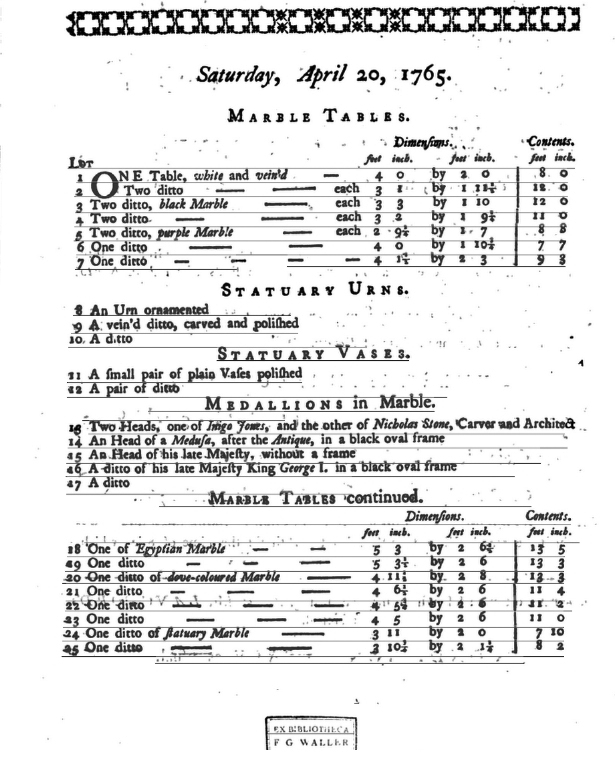
I think it is safe to say that this bust is the bust included in the Rysbrack sale of 20th April 1765
Lot 46 Ditto of his late majesty, given that the pair of terracotta busts of the King and Queen were probably those sold at the Rysbrack sale of 14th January 1767 - Lot 57.
Lot 13 The Two heads in Marble one of Inigo Jones and the other of Nicholas Stone should be noted
Note here Lot 74 the Bronze bust of Oliver Cromwell
and Lot 75 the Bronze bust of Isaac Newton - pehaps that at the Fitzwilliam Museum, Cambridge.
______________________________________
George II
Michael Rysbrack
Signed and dated Mich. Rysbrack 1758.
Terracotta.
Durham University.
I am very grateful for the photographs below which were provided by Gemma Lewis, Deputy Curator (Castle and Archeology), University Library Durham.
Reproduced
by permission of Durham University.
_____________________
Stop Press :The Sotheby / Hodgkin bust sold for £130,000 + premium.
So far the buyers remain anonymous.