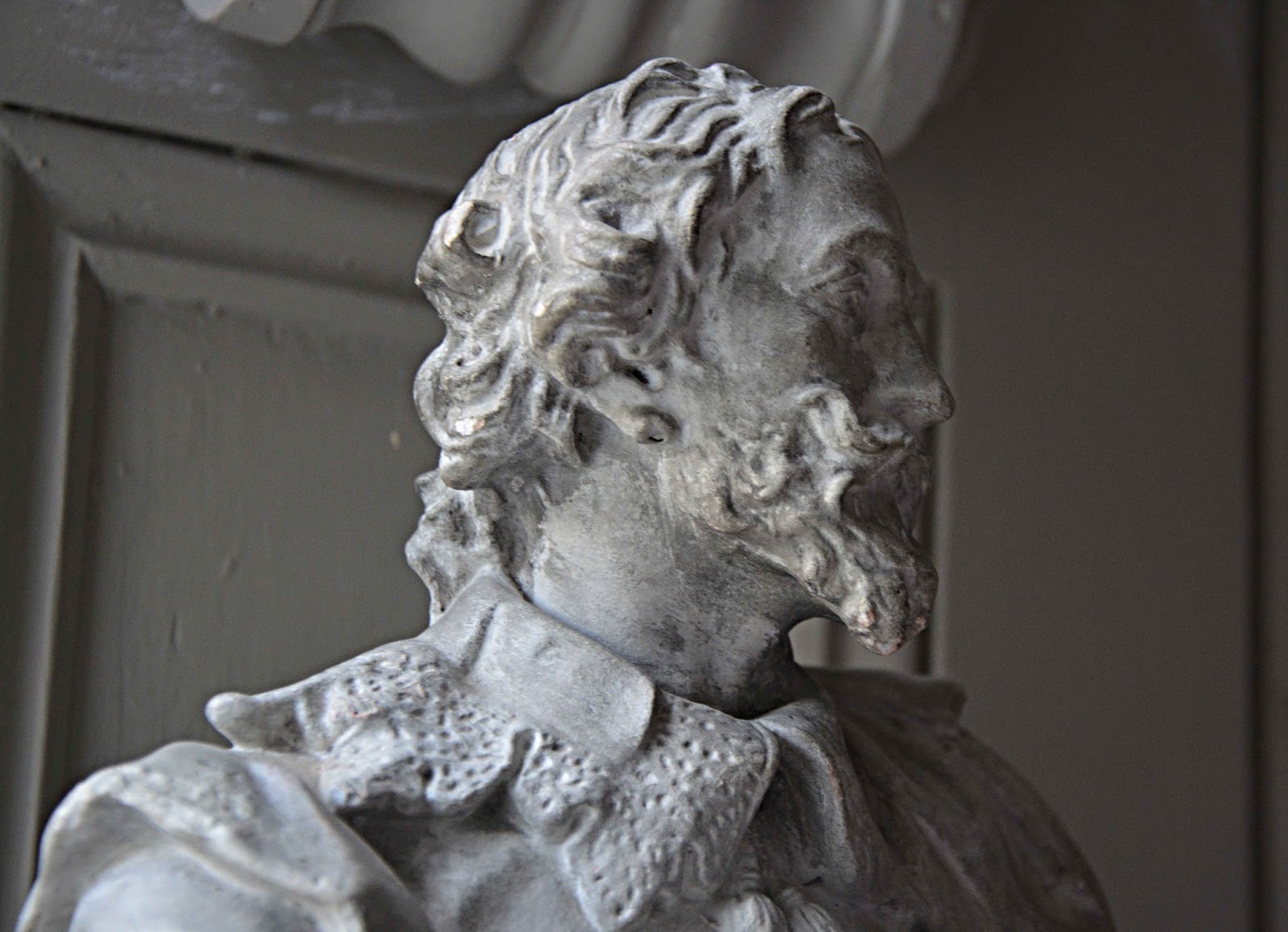
The Daily Advertiser, 19 December 1743.
The announcement of the Publication of the Proposal to cast in plaster of Paris the three statuettes of Rubens, van Dyck and du Quesnoy from the original terracottas by Michael Rysbrack in the collection of Joseph van Haken. It appears again on Wednesday 4th January 1744.
Price to subscribers seven guineas and a half for the set. Three guineas to paid at the time of subscription the remaining four and a half guineas paid on the delivery of the set.
Subscriptions taken by Messrs Claessens and van der Hagen at Mr Rysbrack's at Vere St, near Oxford Chapel where the models could be seen, or at John Brindley's booksellers to his Royal Highness the Prince of Wales at New Bond Street.

George Vertue wrote in praise of the sculptures in 1743 Rysbrack had 'lately since made three models in clay, being the representation of 3 most excellent artists (about 2 foot hi each figure) Rubens van Dyke and Fiamingo Quenoy all three his countrymen These three models for the invention being standing the gracefulness of the Actions the dispositions of their habit, attitudes, and natural likeness, is most excellent. Q[uestion] if any other Artist living could do better and more masterly execute them.’
Vertue goes on to say that Rysbrack's popularity had been eclipsed by that of Peter Scheemakers, after the completion in 1740 of the latters monument to Shakespeare in Westminster Abbey and that he was feeling 'the effects in the line of Busines' there is no suggestion that there was any financial motive rather that he had time on his hands and that 'these (statuettes) are the effect of leisure and study'.
__________________________________
Notes on the people mentioned in the newspaper:
Peter Claessens - In his will, proved 12 December 1749 (PROB 11/775) he is described as a ‘Statuary of Saint James Westminster, Middlesex.’ He is known to have been one of the foremen to Michael Rysbrack, along with Gaspar Van Der Hagen. He was in London by 1744 Claessens died on 4 December 1749. In his will he left all to his wife and sole executrix, Ann (nee Bridget, who died in 1766, PROB 11/922/437). His time with Rysbrack must have been fruitful as Claessens owned no fewer than six leasehold properties in London and Chester at the time of his death (PROB 11/775, ff99-100). basic info - Henry Moore Foundation.
Gaspar van der Hagen -
A carver in ivory and marble, Van der Hagen was a long-term assistant to Michael Rysbrack. His date of birth is unknown and no information has surfaced on his training, but he had relatives in Antwerp. He was in London by late 1743, according to George Vertue (see above). In 1747 Vertue noted ‘Mr Vander Hagen. Sculptor works for Mr Rysbrack. has done several heads portraits in Ivory.—very well. but not meeting with propper encouragement did not continue’ (Vertue III, 135).
The lack of encouragement must have been temporary, for Van der Hagen was still exhibiting ivory portraits nearly 20 years later. His small bust of the Duke of Cumberland is a very assured, minutely detailed and textured rendering of a larger marble work by his master V and A . It suggests that Van der Hagen had considerable talent.
He was still lodging with his master in Vere Street, Oxford Road in 1766, and four works by him were sold in the auction of Rysbrack’s collection held by Langford on 14 February 1767 (2, 6, 10, 11). The Sacrifice to Hercules, which resurfaced in 2002 is a competent work after a terracotta model by Rysbrack, itself based on a relief on the Arch of Constantine in Rome.

Sacrifice to Hercules
Gaspar van der Hagen
61 x 73.5 cm
Yale Center for British Art, Paul Mellon Fund and a Gift from the Parnassus Foundation, Courtesy of Jane and Raphael Bernstein.
Literature:
Daniel Katz Ltd., European Sculpture, London, 2003, p. 54, no. 21, Dealer Cat. Daniel Katz Ltd.
Algernon Graves, The Society of Artists of Great Britain, 1760-1791, and The Free Society of Artists, 1761-1783: a complete dictionary of contributors and their work from the foundation of the Societies to 1791, Kingsmead Reprints, Bath, 1969, p. 263, no. 177, N5053 G73 1969
Free Society of Artists, A catalogue of the paintings, sculptures, architecture, models, drawings, engravings &c. now exhibiting by the artists, associated for the relief their distresed brethren, their widows, and children, at Mr. Moreing's Great-Room, in Maiden-Lane, Covent-Ga, Catalogue of the Free Society of Artists, London, 1766, p. 14 [p. 95], no. 177, N5055 S62 C3 1760A (YCBA) , Also available on line In 18th century Collection Online data base
Langford & Son, Langford & Son sales catalogue : A catalogue of the neat collection of pictures, marble bustos and vases, fine models of bassos relievos and monuments of Mr. Michael Rysbrack : 14 February 1767, London, February 14, 1767, p. 3, lot 44, Available on line : Art Sales Catalogues Online
Rysbrack bequeathed £50 to ‘Gaspar Vanderhagen Statuary who did live with me’ in his will, dated 5 March 1768, and an undated codicil adds ‘Gaspar Vanderhagen dyed before me’. In fact Vanderhagen was still alive in 1768, but had moved to York, where he died in 1769. Rysbrack died 8 January 1770.
The timing was unfortunate for Van der Hagen appears to have lived out his last days in penury. In 1768 he applied to the Society of Artists for support, ‘being in great necessity’, and received four guineas (Society of Artists’ Archives, Burlington House).
His goods were administered by his sisters Isabella and Catherine (Harman), both of whom lived in Antwerp. These executors held a sale of their brother’s work on 17 April 1771. Van der Hagen was described in the catalogue as the ‘principal assistant to the late Mr. Rysbrack,’ and the sale included ‘several fine heads and figures in ivory, basso relievos in marble, books of prints, &c’ (Anecdotes 1937, 154-5).
There is a small ivory relief of Isaac Newton also in the V and A.
In the letters of administration Van der Hagen is described as a ‘bachelor’, so it is perhaps unlikely that Vanderhagen of Shrewsbury was, as Gunnis supposed, his immediate offspring. The Royal Academy pension paid to a Mr Vanderhagen between 1769 and 1775, and subsequently to the widow of the same until 1781, also relates to another family.
After Jean Cavalier and David le Marchand, with whom he shares some stylistic similarities, Van der Hagen is currently the best documented ivory carver of the 18th century. However the large corpus of works includes many attributions, not here listed. Among them are an oval medallion of John Milton, signed ‘VDHN’ (VAM), as well as many unsigned works and others with the incongruous signatures, ‘GVD,’ ‘GVDR’ and ‘GVR.’ (Add inf. Gordon Balderston, Marjorie Trusted)
MGS
Literary References: Graves 1907, 263; Webb 1954, 68, 186, 189; Gunnis 1968, 406; Davis 1970 (1), 16; Davis 1971 (4), 1223
Archival References: SAA SA/34/1; SA/37/6
Wills and Administrations: Administration of the will of Jasper otherwise Gaspard Vanderhagen, 17 July 1769, FRC PROB 6/145/27; will of Michael Rysbrack PROB 11/954/224-6
Auction Catalogues: Van der Hagen 1771.
Info Henry Moore Foundation. -
| |||
__________________________________________
Short Biography of Joseph van Aken (c.1699 – 4 July 1749).
As on many of the pages in this blog I only meant to touch on the subject, but as no one else appears to have taken much interest in the van Aken brothers I thought I might as well put my finding down. As the main thrust of this blog is to present a visual history and appreciation of the art of the mid 18th century, I felt that it was import to show the skills of the van Akens - most scholars will be aware of the part taken by the older Joseph van Aken in the portraits of Ramsay and Hudson, but Alexander van Aken is a slightly more shadowy figure. Another thrust of this blog is to try to show the links between the artists of this period.
Joseph van Aken (various spellings - van Haken, van Haaken, Vanhaeken). He came to London from Antwerp in about 1720 along with his brother Alexander (1701–57) who was an engraver and mezzotinter, and also by possibly at the same time an older brother called Arnold (d.1735/6). Michael Rysbrack (1694 - 1770) the sculptor of the terracotta originals of Rubens, van Dyck and du Quesnoy arrived in England from Antwerp at about the same time.
He initially painted genre scenes and conversation pieces (see below) before becoming the most important specialist drapery painter in London in the mid -1730's. See an English Family at Tea of c. 1720 in the Tate Gallery, (see R. Edwards, 'The Conversation Pictures of Joseph van Aken', Apollo, xxii, 1936, pp. 79-85).
His works as an independent artist, include a view of Covent Garden (Museum of London), which he painted a further two times, and The Stocks Market (Bank of England, London) are important topographical views of London.
George Vertue wrote in 1743 - 'Mr Van acken – whose draperys silks satins Velvets, gold & embroideryes which he dos paint for several of them painters extreamly well- and is a great addition to their works and indeed puts them so much on a Level that its very difficult to know one hand from another'
From the above news clipping it is clear that van Aken had a business relationship with Michael Rysbrack. Whilst the terracotta statuettes were clearly in his possession, the plaster reproductions were being sold from Rysbrack's business premises at Vere Street, Oxford Market. It is unclear who cast these statuettes but it is unlikely that they were made by Peter Vanina, who was first recorded working for Rysbrack after 1753. In 1758 when Sir Edward Littleton approached Michael Rysbrack for plaster copies of his own portrait bust, Rysbrack replied that making multiples was ‘a thing Entirely out of my way’, going on to say that he had consulted ‘Mr Vannini, the Caster in Plaster of Paris. (Whom I Employ when I want). Peter Vanina owned a pair of the statuettes of Rubens and van Dyck which were disposed of from his house in Dover Street in his 2nd sale of 3 July 1770 on the occasion of 'his going abroad', (Rupert Gunnis 1951).
In The London Tradesman (1747), a handbook of professions, the drapery painter is listed as a ‘mere mechanic hand’ who is ‘employed in dressing the figures, after the painter has finished the face, given the figure its proper attitude, and drawn the out-lines of the dress or drapery.’ the work of van Aken rather disproves this statement.
Jean Andre Rouquet says in The present State of the Arts in England, originally published in French in 1754, written by the Swiss born artist Jean André Rouquet, a friend of Hogarth and David Garrick, who resided in London between 1726 and 1750. A brief preliminary discourse is followed by reviews of the various arts in England, not only dealing with painting, but with sculpture, woodcarving, silk manufacture, engraving, printing, stonecarving, porcelaine, and further with theatrical declamation, music, the decoration of shops and the sale of pictures.
"When a portrait painter happens to have a little business, it is usual for him to employ other hands in the painting of the drapery. Two rival artists took it into their heads to hire entirely to themselves another painter whose name was Vanhaken, to be employed in the drawing of the drapery: this man had real abilities, and might have done much better things, but chose to confine himself to this branch, because he was always sure of business. The two painters agreed to pay him eight hundred guineas a year, whether they could find work for him to this amount or not; and he on his side engaged to paint no drapery but for them. When either of those painters was employed to draw a picture, it was frequently on condition that the drapery should be done by Vanhaken. And indeed his drapery was charming, in an excellent taste, and extremely natural. The two rival painters who had thus engrossed Vanhaken, occasioned a great deal of confusion among the rest of their brother artists, who could not do without his assistance. The best of them knew not how to draw a hand, a coat or ground; they were obliged to learn it, and of course to work harder. Sad misfortune! From that time ceased that extraordinary sight at Vanhaken’s, when he used to have canvases sent him from different parts of London, and by the stage coaches from the most remote towns in England, on which one or more masks were painted, and at the bottom of which the painter who sent them took care to add the description of the figures, whether large or small, which he was to give them. Nothing can be more ridiculous than this custom, which would have still continued, had Vanhaken still continued". (Rouquet 1755, 44-45).
For the complete Rouquet see - https://archive.org/details/ltatdesartsenan00rouqgoog
Joseph van Aken painted drapery for the leading portrait painters of the time including, Hamlet Winstanley, George Knapton, and particularly Thomas Hudson and Allan Ramsay who were both executors to his will.
For more on Ramsay and his relationship with van Aken see - Allan Ramsay, A complete Catalogue of his Paintings by Alastair Smart, edited by John Ingamells pub. Yale, 1999.
Given the huge output of portraits by Hudson and Ramsay - Joseph van Aken must have worked in a similar fashion to Damian Hurst today, with a studio that was almost a production line, turning out variations of draperies on portraits for the artists perhaps using some sort of template system. His brother Alexander van Aken was obviously also very capable but not with perhaps the same business head, certainly working with him and Alexander was able to continue the studio after he died witnessed by payments to him in Hudsons bank account at Coutts in 1752 - 3.
There is a group of 14 drawings by van Aken (Vanhaecken) in the National Gallery of Scotland which relate to portraits by Ramsay.
Possibly by co incidence 14 of his drawings were sold in the posthumous sale by Langford's, lot 24 on 12 February 1750, the second night of the disposal of his substantial collection (see below).
His studio was at King Street, Seven Dials, Covent Garden.
George Vertue again noted in 1744 'It is truly observd that Hudson has lately more success and approbation than the other or any other of ye busines – at present a great Run – his pictures being dressd and decorated by Mr Joseph Van Aken – who is a very elegant and ingenious painter. Serves & helps him and other painters to dress and set off their pictures to advantage he having an excellent free Genteel and florid manner of pencelling Silks Sattins Velvets. Gold laceings Carvings &c'
Hudson has to my mind been unfairly ignored since his death having been eclipsed by William Hogarth and overshadowed by his most successful pupil Joshua Reynolds. Hudson’s highly successful practice was based in Covent Garden where he employed a large studio which included amongst his apprentices Joshua Reynolds, Richard Phelps and Joseph Wright of Derby.
The creative relationship between Hudson and Van Aken was strengthened by their joint acquisition of lots from Jonathan Richardson’s sale of drawings in 1746, as George Vertue noted with Hudson: ‘Mr Van Aken jointly bought also drawings paintings &c.’ This suggests to me that their relationship was a business partnership, perhaps a similar deal to that struck with Rysbrack with the statuettes. At the sale of Richardson’s paintings the same year, a priced copy in the Houlditch MS reveals, Van Aken purchased £36.12.6 worth of paintings and Hudson £92.15.
In 1748 the van Aken brothers accompanied Hogarth, Hudson, Hayman and (John?) Cheere on a 5 week trip to the continent (ill fated for both Hogarth and Hayman, who were arrested in Calais as spies - the others continued to Paris and then to Holland - Vertue again).
He was living in Southampton Row, Bloomsbury, where he died on 4th July 1749. The catalogue of his sale at Langford's, 11 February 1750 gives his address. According to George Vertue he was about fifty years old at the time of his death, and had spent more than 30 years in England.
George Vertue has the last word 'The Ingenious Mr Joseph VanhAcken painter (had been 30 years or more in England) haveing catchd cold fell into a Feavour of which in about a fortnights Time he dyd – aged about 50 – a man of good compleaxion a good round fatt face and shortish stature. A small cast with one Eye'
The 'original models of Rubens, van Dyck and Fiamingo' were included in Langford's of the Piazza Covent Garden, posthumous van Aken auction sale of 11th February 1751. van Dyck
For the entire catalogue of this sale over 15 nights from Monday Feb 11th 1750, until Saturday 16th, the sale recommencing on Monday 18th until Saturday 23rd, and continued from Monday 24 until Wednesday 27th February 1750.
For our purposes the most instructive day of the sale was the first day - Monday 11th February 1750 when van Aken's collection of 77 pieces of sculpture were sold.
Under the heading - MODELS IN TERRA COTTA, CASTS IN PLAISTER, &c.
Lot 45 - King William on horseback, by Mr. Rysbrack.
Lot 47 - Palladio and Inigo Jones, by Mr. Rysbrack.
Lot 48 - Rubens, Vandyck and Fiamingo, by ditto.
Under the heading MODELS &c.
Coincidently? the first plaster versions known to have been produced by John Cheere (the Rubens and van Dyck statuettes from the set of Kirkleatham plasters at York Museum) are signed and dated Cheere F 1749. and would have been manufactured almost immediately after the death of Joseph van Aken on the 4th July 1749.
|
The van Dyck, one of the pair of plaster figures (the other is of Rubens) at West Wycombe Park is signed Mich. Rysbra and dated 1743 on the right hand side of the pedestal. The accompanying figure of Rubens has been damaged where one might expect to see the signature and consequently there is no sign of it (see forthcoming page on this blog with photographs of the West Wycombe statuettes).
This would suggest that the moulds for these figures were disposed of by Rysbrack or a new deal struck with Cheere for the reproduction of these statuettes, almost immediately after the death of van Aken and Cheere promptly commenced production.
Handel bought a 'Conversation' by Watteau at Langford's sale of van Aken's collection and Hudson acted as agent for several purchasers at this sale and no doubt as a serious collector purchased items for himself.
For the will of Joseph van Aken (Vanhaecken) see Public Records Office PROB/11/772
Horace Walpole famously declared in Anecdotes of Painting in England, published London, 1786 'As in England almost everybody's picture is painted, so almost every painter's works were painted by Vanaken'
In Hogarth, vol. III by Ronald Paulson, 1993, the author relates the story - possibly apocryphal, that Hogarth had etched a caricature plate of mourners in the funeral procession of van Aken "composed of all the portrait painters of the metropolis as mourners and overwhelmed with the deepest distress".
_____________________________________________
The following text is from the National Portrait Gallery collection catalogue: John Kerslake, Early Georgian Portraits, Her Majesty's Stationery Office, 1977 (now out of print).
The drapery painter cannot be Alexander van Aken who died in 1757 but illustrates the common practise of the use of drapery painters even by Reynolds
Ref. Portrait of William Pulteney, first Earl of Bath (1684 - 1764) portrait painted by Sir Joshua Reynolds.
Painted for Mrs Elizabeth Montagu in 1761 and given to her by the sitter, NPG 337 is a documented example of the use of the drapery painter. There are appointments in the sitter book for 28 and 31 August, 17 September, 16 October and 30 December, and progress may be followed in seven letters to and from Mrs Montagu. In early September, the painting is noted as due back from the drapery painter on 15 October and presumably despatched after the sitting of the next day. It then meets with criticism and goes back to Reynolds to be altered on 30 December, after which no more sittings are recorded. Relevant sections of correspondence include Mrs Montagu writing to Elizabeth Carter, 6 September: 'I have not told you that my Lord Bath has sat twice for his picture, it will be very like him but not so handsome, as long as he lives I shall look on it with pleasure, always with reverence'
William Pulteney's letter of 15 October 1761touches on the drapery painter: ‘. . . I was yesterday with Mr. Reynolds, & have fixed Fryday next at twelve, to finish the Picture. I have discovered a secret by being often at Mr. Reynolds, that I fancy, he is sorry I should know. I find that none of these great Painters finish any of their Pictures themselves. The same Person, (but who he is, I know not) works for Ramsay, Reynolds, & another, calld Hudson, my Picture will not come from that Person till Thursday night, and on Fryday it will be totally finished, and ready to send home . . .'.
The 'Person' could be Alexander Vanhaecken mentioned in 1752-3 in the accounts of Thomas Hudson, Coutts Bank archives, perhaps the younger brother of Joseph Vanhaecken, who is known to have worked as drapery painter for the artists named by Bath. (As we know) Joseph's death in 1749 is recorded by Vertue and there are references to payments, 1751, in the accounts of Ramsay, his executor, also at Coutts.
The Earl of Bath does not appear in Reynolds' sitter book under Wednesday 14 October 1761, but he is entered at noon on the 16th. The remaining letters concern corrections:
__________________________________________
For the notebooks of George Vertue which are indispensable to the study of English Art in the 18th century see the Walpole Society Journals. For limited free access see http://www.jstor.org/
This one of those really annoying brickwall websites that one hits from time to time when researching on the internet. They have managed to monetise numerous academic magazines etc. They suggest that unless you belong to an institution that subscribes to their services you give them an enormous amount of money in order to see the required information.
They do offer however offer a very limited access if you register with them - three free articles every month - again really annoyingly limiting. It is my guess that the owners of the copyrights to these articles were ignorant of the implications of giving this information to jstor to publish online, and had no idea how limiting to the independent researcher this was going to be.
My advice - register and use a digital camera to photograph each page so that you can save it for long term access.

Joseph van Aken. c. 1745.
Thomas Hudson
Oil on Canvas.
825 × 705 mm
©2015 Lowell Libson Ltd.
Provenance:
Presumably Hudson sale, Messrs. Langford, London, 3rd March 1779, lot 18 ‘Vanhaken’
John Lane (1854-1925), The Bodley Head, Vigo Street, London;
Lane sale, Sotheby's, London, 1st July 1925, lot 117;
Sir George Sutton, Bt.
Sold Christie's London, 3 December 2014 lot 191.
Currently with dealers Lowell Libson, of London.

Joseph Vanhaeken after Thomas Hudson by John Faber Jr,
published by George Pulley,
mezzotint, 1740s.
(352 mm x 249 mm) paper size.
© National Portrait Gallery, London.

Alexander van Aken
Thomas Hudson
© National Portrait Gallery, London.

Alexander van Haecken
by John Faber Jr, after Thomas Hudson
mezzotint, 1748.
The Original oil by Thomas Hudson is in the NPG
© National Portrait Gallery, London.
Alexander van Haeken engraver and mezzotinter. There are twenty engraved portraits by him at the NPG including one of Senesino the Castrati opera singer after Thomas Hudson. He took over as drapery painter for Thomas Hudson after the death of his brother.

Alexander van Haeken
by Thomas Hudson
unfinished oil on canvas.
406 x 349 mm.
Yale Centre for British Art.

The van Aken brothers.
circa 1740.
possibly a self portrait by Joseph van Aken.
Inscribed on the back of the original canvas “For Mr Ford”. We have not yet traced the identity of “Mr Ford”, though it way well be a reference to the Irish portraitist and engraver Michael Ford (d.1765) who was in London for an extended period before his return to Dublin in 1742, and who is documented as engraving portraits after Hogarth, Cotes, Hudson, Arthur Pond et al..
The right eye of the sitter in the present portrait seems to have a slight squint: whilst the left eye looks directly at the beholder, the right eye is canted a little to the sitter's left. This accords with George Vertue's eye-witness account of the artist's appearance: “a man of good complexion, a round fat face and shortish stature, a small cast with one eye” (Notebooks, III p.150; Walpole Society 1933-4 Vol XXII),
Image and description courtesy Lane Fine Arts.
________________________________________________________

Joseph van Aken
A Tea Party.
- Oil on canvas, 37.4 x 45.7 cm
- Collection: Manchester City Galleries.
- They say circa 1720, but I believe perhaps ten or fifteen years later, possibly a self portrait of the artist with his family. Full of fascinating incidental detail. For a similar silver tea kettle and table of 1724 - 5 by the Huguenot silversmith Simon Pantin see - http://www.metmuseum.org/toah/works-of-art/68.141.81
- An interesting detail is the sculpture on the right hand side of the painting.
____________________________________________________

Joseph van Aken
Saying Grace
Ashmolean.

Attrib. Joseph van Aken
64,2 x 76,9 cm
Lot 39, 6 August 1995
Christie's London.
I am including this painting as it is a very rare early depiction of the interior of a tavern or coffee house.
From the detail of the windows I would suggest that it is a representation of a tavern in Holland.
____________________________________
I am including various engravings below by Alexander van Aken to show his ability to depict drapery.

The sculptor Laurent Delvaux (1696, Ghent – 24 February 1778, Nivelles)
after Isaac Whood 1734.
Mezzotint by Alexander (Vanhaken)
1735

Mezzotint
Lettered with four verses,
and "Jos. Van Haecken Pinx. / Alex. Van Haecken Fecit /
Sold by Alex. Van Haecken ye corner of Queen Street in Holborn".
Added in pencil by Horace Walpole 'His daughter'
330 x 270mm.
British Museum.

Kitty Clive
After J Davison 1735.
Engraving by Alexander van Aken
1735
National Portrait Gallery.

Seeing
After Amigoni
Mezzotint by Alexander van Aken
Mezzotint
British Museum.
__________________________
Below are the two castrati Opera Singers Senesino and Farinelli who readers of this blog will have met before.
Both had their portraits sculpted at about the same time as these mezzotints were produced.

Senesino
Francesco Bernardi (c.1680 - 1750)
After Thomas Hudson
Mezzotint by Alexander van Aken
after Thomas Hudson.
354 mm x 251 mm plate size;
1735.
© National Portrait Gallery, London

Farinelli
Carlo Broschi (1705 - 82).
after Charles Lucy
Mexzzotint by Alexander van Aken,
mezzotint, 1735
13 7/8 in. x 10 1/4 in. (352 mm x 260 mm) paper size
© National Portrait Gallery, London

Gizziello
Gioaccino Conti (1714 - 61)
Alex van Aken
Mezzotint after Charles Lucy
1736.
357 mm x 255 mm. plate size.
© National Portrait Gallery, London.

King George II
by Alexander van Aken,
published by Thomas Jefferys, and published by William Herbert, after Sandie
308 mm x 254 mm. plate size
mezzotint, 1736.

Caroline Wilhelmina of Brandenburg-Ansbach
Queen of George II.
by Alexander van Aken, after Jacopo Amigoni
mezzotint, 1736
359 mm x 254 mm
© National Portrait Gallery, London.
___________________________________________
Arnold van Aken (van Haecken) d. 1736.
For the eight still lives Wonders of the Deep at Fishmongers Hall, the engravings of these paintings
by Jongelinckx
In an advertisement placed in London’s Daily Journalon Thursday 20th December
1733, the artist announced that both “Paintings and Prints” could be seen at his house in Belton Street near
Long Acre.
Arnold van Haecken issued a new
advertisement for The Wonders of the Deep in the London Evening Post on February 24th 1736, explaining
that new subscribers would thereafter receive an additional print “representing the Humours of a Fish Market…deliver’d gratis.
| |||