Friday, 14 November 2014

Plaster Sculpture at Stourhead - The Bust of Alexander Pope


The Plaster Sculpture at Stourhead House, Wiltshire. 2.


Alexander Pope - The Library, Stourhead, Wiltshire, Plaster.


Height 22"


Barber Institute life size terracotta by Louis Francois Roubiliac, c. 1738


The Barber Institute life size terracotta of Alexander Pope by Roubiliac of c. 1738.

These two busts are so close and of such quality that the plaster must be a reduced copy of the Roubiliac terracotta.

The Plaster has a pronounced forward lean and the hair is slightly cruder than the Barber Roubiliac terracotta, but the modelling of the face, neck and clothing is of excellent quality(note the second smaller fold on the edge of the chemise).

The Gentleman's Magazine, and Historical Chronicle, Volume 95, Part 2, 1825 with reference to Stourhead mentions "a most spirited bust of Pope by Roubiliac which is generally admired".

The attribution to Harris of the Strand of c 1780 by various authors, I think should be questioned.

My current opinion is that it is a reduced version from the Roubiliac workshop


Thursday, 13 November 2014

Plaster Sculpture at Stourhead.


The Plaster Sculpture at Stourhead House, Wiltshire. 1


The Farnese Hercules

Black painted plaster. 23.25" - 590 mm tall. The colossal Roman version in marble was discovered in 1540 and stood in the Cortile of the Palazzo Farnese until 1786. It was removed and placed in the Museo Nazionale in Naples. One of the great sites of the 18th century Gentlemans "Grand Tour"


The Farnese Flora.


Plaster Bust of Dryden

At First glance this bust appears to be the same as the one at York originally from Kirkleatham Hall (see below) but on close inspection there are several distinct differences particularly in the detail of the dress.


Dryden from Kirkleatham Hall, Yorkshire.

Supplied in 1749, Plaster, Height 16ins.
Currently in store York Museum Trust.


Tuesday, 11 November 2014

Lead Bust of Matthew Prior


A Lead Bust of Matthew Prior by John Cheere (1709 - 87).

Matthew Prior (1664-1721) was a poet, diplomat and politician, who became a fellow of St John's College Cambridge in 1688. He published translations from Horace and Ovid, and throughout his life wrote poems and essays. Prior was a collector of paintings and prints.


This three quarter life size, lead bust on a turned wooden socle was sold by the Paris auction rooms Fraysse, Lot 193, on 6 June 2012 for 97,000 Euros - a somewhat surprising result - it was estimated at 4 - 8000 euros. It was catalogued as a bust of the painter Hyacinth Rigaud (1659 - 1743) and described as early 18th century, Height: 53 cm Width: 33 cm and probably derived from the famous painting in the Museum of Perpignan, "Self-portrait with a turban" produced in 1698.

This bust is in fact a lead version of a bust of Matthew Prior which was also produced in plaster.


A Three quarter life size plaster bust of Matthew Prior described as probably from the workshop of John Cheere sold at Sotheby's, Bond Street, London 14 July 2010 - 44.5cm., 17½in tall. 

There is another version of this bust at the York Museums Trust - currently in deep store and unavailable for inspection or photography until late summer of 2015. The photograph on their website is a very poor, low resolution example (see below), but is still easily recognisable as the Cheere bust of Prior.


This bust was originally supplied in 1749 to Chomley Turner d. 1757 for Kirkleatham Hall in Yorkshire along with busts of John Dryden (after Peter Scheemakers), William Congreve, Joseph Addison,Sir Francis Bacon (after Roubiliac), Dr Samuel Clark, Dean Swift, Cicero and Horace, along with Statuettes of Rubens and van Dyck (after Rysbrack), Shakespeare (after Scheemakers), Homer, Spencer, Alexander Pope, Milton, Inigo Jones, Isaac Newton and John Locke.

Image courtesy of York Museums Trust :: http://yorkmuseumstrust.org.uk :: CC BY-SA 4.0

This bust appears to be very loosely based on the bust of Prior on his monument at Poets' Corner in Westminster Abbey, The tomb, designed by James Gibbs, incorporates Antoine Coysevox's bust of Prior presented by King Louis XIV. (below).


 Matthew Prior by Hyacinthe Rigaud (1659 - 1743) at St John College, University of Cambridge.


Matthew Prior by Thomas Hudson after Jonathan Richardson
National Portrait Gallery.

__________________________________


Portrait of Matthew Prior - Charles Viennot after Hyacinthe Rigaud. 1700.
Copyright Tajan, Paris.

_______________________________________


Wedgwood & Bentley Basalt Bust of Matthew Prior c. 1775.
British Museum
15.2 inches tall.

The original plaster supplied to Wedgwood & Bentley in 1775 by Hoskins and Grant is in the Wedgwood Museum, Barlaston (4592).

________________________________


For the first in depth work on the plaster statuary of John Cheere see the exhibition catalogue of 1974, Leeds, Temple Newsam and Marble Hill House Twickenham. 

The Man at Hyde Park Corner -

organised and compiled by Dr Terry Friedman Timothy Clifford.


Mezzotint after Jonathan Richardson Snr.
C.1775.

British Museum.


Tuesday, 4 November 2014

Agnes Strickland Brief Biography.


Agnes Strickland - Some further Images and a Brief Biography.
 
 
Frontispiece from The Life of Agnes Strickland
By Jane Margaret Strickland. 1887.


Agnes Strickland (1796 -1874) was second of Eight children, five of whom achieved some sort of literary fame. Her father Thomas Strickland d.1818. He was described as an Importer and Manager of the Greenland Docks in Rotherhithe. Noted as Wharfinger in The Gazette of  6 March 1792.  His father was clerk at Wells and Hallets Dockyard, which later became the Greenland Docks.

After 1803 he retired from the dock and bought a house in Norwich and rented Stowe House, near Bungay, Suffolk. He kept the house in Norwich where he had invested in his new business Thomas Strickland and Company, Coach Manufactory of St Giles Gate. In 1808 he purchased Reydon Hall, nr Southwold, Suffolk, a large manor house with tenant farms expecting to live the life of a gentleman.
The failure of the coach building business and his death in 1818 (Agnes was 22) severely reduced the family fortunes, and although they still received rents from the land at Reydon Hall, parts of the house had to be closed up. The house in Norwich had to be sold. This resulted in the need to earn some sort of living.
Their financial circumstances, forced the Strickland girls to supplement the family income by writing for the literary markets available to young ladies during the pre-Victorian period. There was a demand for children’s books and the sisters wrote for many such works. They also contributed stories and poems to the flourishing gift-book and annual trade of the 1820's but their most significant outlet was the magazines for women. It was in such periodicals as the Ladys Magazine and Museum (1831–37) and the Court Magazine and Monthly Critic (1838–47) that Agnes and Elizabeth first published biographical sketches of royal ladies, and in La Belle Assemblée (1827–28).
 
 
Agnes Strickland aged 50
Signed and dated E Hodges Bailey RA. 1846


Cropped image from the portrait of Agnes Strickland by John Hayes, 1846. NPG.
 
 
The Strickland Children.
 
Agnes Strickland was the second of eight children - the first six were girls, followed by two boys. Five of the children had some sort of literary career.
 
Elizabeth Strickland (1794 - 85) was co author with Agnes in many of her work but preferred to remain in the background. She never married.
 
Jane Margaret Strickland - (1800 - 88),  was born 18 April 1800. She died at Park Lane Cottage, Southwold, Suffolk,14 June 1888, and was buried in the churchyard there beside her sister Agnes. Her chief work was ‘Rome, Republican and Regal: a Family History of Rome.’ It was edited by Agnes, and published in two volumes in 1854. She wrote some insignificant books for children, and a biography of her sister The Life of Agnes Strickland, published in 1887.She never married.
 
Catherine Parr Strickland, b. Rotherhithe, Kent (9 June 1802 - 1899). m. Thomas Traill ( d. 1859) an Orcadian, retired Army Officer They emigrated to Newcastle Canada in 1832.
 
 
Catherine Parr Strickland - National Archives of Canada.
 
A small selection of her writings -
The Tell Tale: an original collection of moral and amusing stories including The Blind Highland piper and other stories(1818).
The Young Emigrants (about settlement in Canada) 1826, after favourable reports sent from her brother Samuel Strickland
The Backwoods of Canadabeing letters from the wife of an emigrant officerillustrative of the domestic economy of British America (London, 1836)
 
Canadian Crusoes:  a tale of the Rice Lake plains (1852)
Pearls and Pebbles (1894)
 
Susanna Strickland, (1803 - 85)  b. 6 Dec 1803 at Bungay, Suffolk, married Lt John Wedderburn Dunbar Moodie, retired from the 21st Foot on half pay 4 April 1831, at St Pancras Church London met at Thomas Pringles house in Hampstead, wrote two anti-slavery tracts, The history of Mary Prince, a West Indian slave . . . (1831) and Negro slavery described by a negro: being the narrative of Ashton Warner (1831). They emigrated to Canada in the summer of 1832. She wrote -
Roughing it in the Bush. 1852. pub. Richard Bentley. The edition published in 1988 has a very useful introduction written by Carl Ballstadt. This very popular work probably saved the family fortunes and is now acknowledged as a Canadian classic.
Life in the Clearings. 1853
Canadian Setters Guide. 1855
 
 
Susanna (Strickland) Moodie.
National Library of Canada.
 
See - Work of Words: The Writing of Susanna Strickland Moodie, By John Thurston. 1996
 
Sarah Strickland - 1798 - 1890. She appears to have been delegated to looking after their mother
 
Samuel Strickland. b.6 Nov 1804, He emigrated to Canada in 1825. In 1852 Mary Strickland died giving birth to her 13th child, and Samuel, with one of his daughters, visited his sisters in England. There Agnes, now famous as a writer of historical novels and biographies, persuaded her brother to write down the story of his life and times in Canada. Twenty-seven years in Canada West(1853). He died at Lakefield, Canada in3 Jan 1867
 
Thomas Strickland. 1807 - 74. Became a sailor.
There appeared to be something of a schism between Agnes, Elizabeth and Sarah and the other three sisters in the 1820's Agnes and Elizabeth being drawn to the High Church whilst the others were drawn in the opposite direction towards the Dissenters or low Church, which might have contributed to Catherine and Susanna's emigration to Canada, although any rift was mended in later years.


After the death, on 3 Sept. 1864 of her mother, Reydon Hall, which had always been the family home, was sold, and Agnes removed to Park Lane Cottage, Southwold. She had just finished revising the proofs of a new edition of the ‘Queens,’ which appeared in six volumes in 1864–5. In the latter year she published a novel in three volumes, ‘How will it end?’ for which Richard Bentley paid her £250. There was a second edition in the same year. In 1869 she visited Holland in order to collect materials for her ‘Lives of the last Four Princesses of the Royal House of Stuart’ (published 1872), her last work. At The Hague she had an interview with the queen of the Netherlands.
On 3 Aug. 1870 she was granted a pension of 100l. from the civil list (cf. Colles, Literature and the Pension List, p. 54). In 1872 her health gave way; she broke an ankle through a fall, partial paralysis supervened, and she died at Southwold on 13 July 1874. She was buried in the churchyard of Southwold.
 
Reydon Hall, Southwold, Suffolk.


                 Selected Works of Agnes Strickland. 
 
 
  • Lives of the Queens of England. 12 vols., 1840–1848
  • The Letters of Mary Queen of Scots. 1842-1843
  • Lives of the Queens of Scotland and English Princesses Connected with the Regal Succession of Great Britain. 8 Vols., 1851–1859
  • Lives of the Bachelor Kings of England. 1861
  • The Lives of the Seven Bishops Committed to the Tower in 1688. Enriched and Illustrated with Personal Letters, Now First Published, from the Bodleian Library. 1866
  • Lives of the Tudor Princesses, Including Lady Jane Gray and Her Sisters. 1868
  • Lives of the Last Four Princesses of the Royal House of Stuart. 1872

  • Children's Books


    • The Moss-House: In Which Many of the Works of Nature Are Rendered a Source of Amusement to Children. 1822
    • The Tell-Tell. 1823
    • The Aviary; Or, An Agreeable Visit. Intended for Children. 1824
    • The Use of Sight: Or, I Wish I Were Julia : Intended for the Amusement and Instruction of Children. 1824
    • The Little Tradesman, or, A Peep into English Industry. 1824
    • The Young Emigrant. 1826
    • The Rival Crusoes, or, The Shipwreck: Also A Voyage to Norway; and The Fisherman's Cottage : Founded on Facts. 1826
    • The Juvenile Forget Me Not; Or, Cabinet of Entertainment and Instruction. 1827
    • Historic Tales of Illustrious British Children. 1833
    • Tales of the School Room. 1835
    • Tales and Stories From History. 1836
    • Alda, the British Captive. 1841 


    Agnes Strickland (1796 -1874) by Edward Hodges Bailey (1788 - 1867)


    A Life Size Marble Bust of Agnes Strickland (1806 - 1874)
         by Edward Hodges Bailey, 
       signed and dated 1846.


    Formerly in the Collection of Dr Terry Friedman, died 2013.

    Friedman was originally from Detroit, between 1969 and 1993, he was keeper of Decorative Art Studies at Temple Newsam, Leeds, and, later, principal keeper at Leeds City Art Gallery (where he was largely responsible for setting up the Henry Moore Centre for the Study of Sculpture).


    Max. 28" Tall x 21" Wide.


    Currently in a private collection.


    For the biography of Edward Hodges Bailey see - A Biographical Dictionary of Sculptors in Britain Ingrid Roscoe et al, Yale, 2009, which lists some 346 works where the bust is listed no 346 as Agnes Strickland, undated.


    Edward Hodges Bailey R.A. (1796 - 1874) is probably most famous as the the sculptor of Admiral Lord Nelson atop the column in Trafalgar Square. Born in Bristol, his father was a ships carver, a pupil of John Flaxman, he studied at the Royal Academy Schools. He designed for the silversmiths Rundell and Bridge. He had a large studio in Newman Street, London - among his pupils were William Theed and Joseph Durham.

    He was responsible for a large number, perhaps 112 funerary monuments, many portrait busts and ideal and other sculptures.


    see - http://217.204.55.158/henrymoore/sculptor/browserecord.php?-action=browse&-recid=100


    For a PhD Thesis by Caroline Patricia Jordan, University of Leeds, 2007, entitled Edward Hodges Bailey (1788 - 1867) and the Notion of Poetic Sculpture see - http://etheses.whiterose.ac.uk/4404/1/uk_bl_ethos_496537.pdf


    Agnes Strickland by John Hayes, 1846.

    Oil on canvas, 36 1/4 in. x 28 1/4 in.

    Bequeathed by Agnes Strickland, 1875. to the National Portrait Gallery.

                          Currently on display in the Ladies Drawing Room at Bodelwyddan Castle


    _________________________


    Agnes Strickland c.1844 by Charles Gow, fl 1844 - 72.
     from the Morgan Library, New York
    Given by John Pope Hennessey.

    Black chalk, stumped, heightened with red and white chalk, on dark gray paper.
    13 1/8 x 9 5/16 inches.


    __________________________________


    Agnes Strickland by Charles Gow, 1844. 10 in. x 8 in.
    National Portrait Gallery.
    Black chalk, stumped, heightened with red and white chalk, on dark gray paper.


    ____________________________


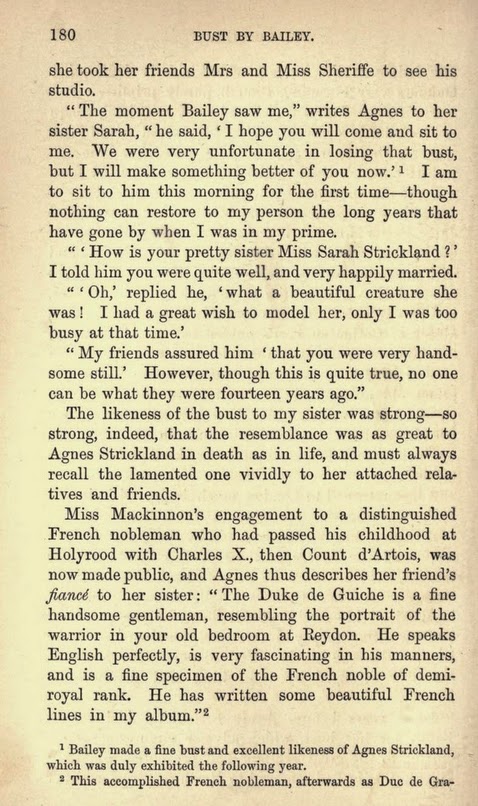
          Extracts from the Life of Agnes Strickland by her sister Jane Margaret Strickland published William Blackwood and Sons, 1887. With references to Agnes sitting for her bust by Edward Hodges Bailey.


     Above three photographs of Agnes Strickland in later life looking serious and rather grim from NPG.
    For further reading and information on the Strickland family see
    Agnes Strickland by Una Pope Hennessy. 1940.
    Life of Agnes Strickland by Jane Margaret Strickland. 1887.
    Literary History of the Stricklands by Carl Ballstadt. 1965
    For Susanna (Strickland) Moodie see Patrick Hamilton Ewing Collection Nat. Archives of Canada