Saturday, 27 January 2024

A Pair of Late 18th Century Busts by Christopher Hewetson at the Ashmolean Possibly. (Part 1). Some notes Including in this post the marble bust of Catherine Viscountess Sudeley.

(Post under construction). 

Christopher Hewetson (1737 - 99) an Irish Sculptor in Rome.

Working in Rome from 1765 - 99.

Part 1.

This is part 1 of a series of 37 posts investigating the life and works and in particular the portrait sculpture of Christopher Hewetson.


The Pair of Anonymous Marble Busts of (probably not) Thomas Fermor, 2nd Lord Lempster, Earl of Pomfret, and his Wife Henrietta Louisa, at the Ashmolean Museum, Oxford.


https://www.ashmolean.org/collections-online#/item/ash-object-739087


Here tentatively suggested as sculpted by Christopher Hewetson (sometimes Houston, Huston or even Hudson).

For a list of the works of Hewetson see my post -

https://bathartandarchitecture.blogspot.com/2024/02/hewetson-in-rome-part-12.html


This very fine pair of busts have always bothered me since the time I first saw them many years ago - they are obviously not by (the not very good Guelfi) (1690 - 1736), but the subjects and the sculptor have remained elusive to me.


I now don't believe that these busts represent the Fermors and think that it is time for their serious reassessment. 


I shouldn't be too unkind to poor Guelfi - he executed a couple of fine terracottas but working in marble was not his forte. He had a particular problem with executing necks.


This pair of busts have in the past been attributed to Guelfi - but the quality of these busts is so good that I now believe that they could not possibly have been executed by him. 


The main reason for this attribution (by Nicholas Penny in Ashmolean (III) 1992, p. 96 Cat Nos 516 and 517) would appear to be the fact that Guelfi had been employed at the Fermor family country seat at Easton Neston, Northamptonshire, restoring - some would say butchering the ancient Arundel Marbles.


Malcolm Baker has since argued in 1996 that they were made by a later sculptor such as Joseph Wilton (1988), but an examination of the socles used by Wilton (most are usually of squat and oval  in plan- although not exclusively) suggests not.

Guelfi had left England by 1734.


For the known bust by Guelfi see my post -


Whilst I cannot pretend to be an expert, the style of the clothing and the hair would appear to be later than the 1720/30's and most likely 1760/70's.

I have included below for comparison photographs of the five busts from Queen Caroline's Hermitage at Richmond Park known to be by Guelfi.

..........................

 
There is no mention of the Ashmolean busts in the correspondence of the Countess which suggests that if they are Thomas and Henrietta (and I suspect not) they were probably not made by an Italian sculptor whilst the Fermor's were on their grand tour but by a later sculptor probably 1760/70's.


If on the other hand the subjects are not the Fermors but another couple then it is much more likely that these busts were made in Italy (see below).


I humbly suggest that they were perhaps sculpted by Christopher Hewetson (1737 - 99).
probably early 1770's


Hewetson was probably a former pupil /assistant of John van Nost III (this needs to be confirmed!). Hewetson was working in Rome from 1765 until his death in 1799. 

The Conway Library file with photographs see below suggests that the Ist Earl, of Arran was sculpted by van Nost.


Evidence is needed for the van Nost connection.

.............................


The Physical Evidence.

The turned coloured marble socles of the Ashmolean busts have a very similar profile and detail to the socles and to the support to the props on the back of the busts of Charles Townley, Catherine, Viscountess Sudely, Charles Townley and others illustrated below and in later posts.

The fact that these turned socles are in a coloured marble also suggests perhaps a continental origin.

The turned socle doesn't appear to have been used very frequently in England until the 1760's.

Hewetson seems not to have used the square bases on his socles, used in English portrait busts in the mid 18th century.

The cutting of the pupils of the eyes on the bust of Catherine, Viscountess Sudely and various other Hewtson busts are also very similar to the cutting of the eyes of the Ashmolean busts.

The backs of the busts all have similar fairly deeply recessed backs with a supporting prop, somewhat roughly finished with a claw chisel.

.......................................


A Selection of the Available Hewetson Literature.


Royal Dublin Society Library, Dublin, The Society Minute book 1758–61, 10; see Dictionary of Irish Art, Strickland 1913; Mentions John Crawley assistant to John van Nost going away (to Italy) but probably too early for Hewetson.

Available on line at - · RDS

Terence Hodgkinson, ‘Christopher Hewetson, an Irish sculptor in Rome’, Walpole Society, xxxiv (1952–4). An excellent starting point.

Christopher Hewetson, by Brian de Breffny, Irish Arts Review (1984-1987), Vol. 3, No. 3 (Autumn, 1986), pp. An updating of  Hodgkinson.

K. A. Esdaile, Christopher Hewetson and His Monument to Dr. Baldwin in Trinity College, Dublin -The Journal of the Royal Society of Antiquaries of Ireland, Vol. 77, No. 2 (Dec., 1947).

Christopher Hewetson: Nuovi Documenti, Nuove Interprezioni. by Paolo Coen, 2012, in "Bollettino d'arte"

Will and Inventory of Christopher Hewetson (c1737–1798): Introduction - Ana María Suárez Huerta.The British Art Journal, Vol. 15, No. 2 (Winter 2014/15), pp. 3-17.

A Dictionary of British and Irish Travellers in Italy 1701 -1800. John Ingamells. Pub Yale. 1997.

.......................................

The next two sources are invaluable for an overview of Art and Artists in Rome in the Late 18th Century. 

Grand Tour, The Lure of Italy in the Eighteenth Century. Exhibition Catalogue, Andrew Wilton and Ilaria Bignamini, Pub Tate. 1996.

Art in Rome in the Eighteenth Century. Ed. Bowron and Rishel. Pub Philadelphia Museum of Art. 2000.

.................................................


Of Tangential Interest - a complete family history of the Hewetsons.

The Hewetsons of the County Kilkenny, John Hewetson - The Journal of the Royal Society of Antiquaries of Ireland, Fifth Series, Vol. 39, No. 4, [Fifth Series, Vol. 19] (Dec. 31, 1909), 


.............................................


The Anonymous Ashmolean Busts.

Photographs taken by the author.


For the Ashmolean website entries see -


Lord Pomfret died 8 July 1753, and was succeeded by his eldest son, George. 

This son's extravagance obliged him to sell the furniture and objects from the family seat at Easton Neston, Northamptonshire. 

His statues, which had been part of the Arundel Collection, and had been purchased by his grandfather, were bought by his mother for presentation to Oxford University (now in the Ashmolean). A letter of thanks, enclosed in a silver box, was presented to her by the university, 25 February 1755, and a poem in her honour was published at Oxford in the following year.
........................


 The Bust at the Ashmolean described by the museum  as Henrietta Louisa Fermor, nee Jeffreys, Countess of Pomfret. (1698 - 1761) by Guelfi.

Here tentatively attributed to Christopher Hewetson.


...............................


Henrietta Louisa Fermor, nee Jeffreys, Countess of Pomfret.

Attributed to Thomas Bardwell (1704 - 1767).

Provenance: Sotheby’s London 10th July 1991 [Lot 126]


Images above from Titan Fine Art.

They say c. 1742.


...........................


Thomas Farmor, Earl of Pomfret, and Henrietta Louisa Jeffreys, his Wife.


Thomas Bardwell (1704 - 67).
 
Ashmolean Museum, Oxford.
 
Oil on canvas; 216 x 124 cm
Signed: T Bardwell.f. and inscribed: Thomas Farmor, Earl of Pomfret, and Henrietta Louisa Jeffreys, his Wife.
Presented by the Countess of Pomfret, 1759.
Thomas Fermor succeeded as 2nd Baron Leominster in 1711 and was created Earl of Pomfret in 1721. He was Master of Horse to Queen Caroline from 1727 to 1737. He married Henrietta Louisa Jeffreys (1703-1761) in 1720.
 
This portrait of the couple in peer's robes may have been painted to commemorate thirty years of married life and the parchment he is handing to her would have been the marriage settlement.
 
After the death of her husband, Lady Pomfret bought the celebrated Arundel marbles from her dissolute son George before he could disperse them and presented them to the University of Oxford in 1755.
Around 1757, she built a large town house in Arlington Street, designed by Sanderson Miller in the Gothic style. The frame was designed for Pomfret House.


.................................


Catherine, Viscountess Sudely (1739 - 1770).

Marble bust.

Christopher Hewetson 

carved 1767 - 9.

Christie's, London 4th December 2019, Lot 260.


Formerly Coll. Earl of Arran - Dictionary of Sculptors in Britain... Yale 2009.


 Catherine, Viscountess Sudley (1739-1770).

Christopher Hewetson. (1737-1799).

Carved in Rome, Circa 1767- 9.

Marble bust; signed to the reverse 'Christophus Hewetson. fect - 

CATHERINE VISCOUNTESS SUDLEY -'; on a circular marble socle and a later square marble pedestal.

24 ¼ in. (62 cm.) high, overall (this needs to be confirmed). 


Provenance. 

 By descent from the sitter to the 6th Earl of Arran (1868-1958).

Christie's, London, 11 December 1984, lot 19, where acquired by the present owner.

Literature -


B. De Breffny, ‘Christopher Hewetson, a Preliminary Catalogue Raisonné’, Irish Arts Review, vol. 111, 1986, pp. 52-75, no. 26.

I. Roscoe, et. al., A Biographical Dictionary of Sculptors in Britain 1660-1851, London, 2009, p. 610, no. 7.


Christie's Lot Essay.

The sitter, Catherine Annesley, daughter of William, 1st Viscount Glerawly, married Arthur Gore, Viscount Sudley, in 1760. The couple embarked on a Grand Tour in Italy together from 1767, and Horace Walpole noted that Gore had been invited to dinner by Leopold II, Holy Roman Emperor in Florence that year. 

By 1769 they had reached Rome, where they commissioned Batoni to paint their joint portrait (Christie's, London, 5 July 2018, lot 55). 

The portrait bust by Hewetson must have been executed between 1767 and 1769, and is therefore Hewetson's earliest known work in Italy.


Images below courtesy the Conway Library website.

The file details suggest that her father was sculpted by van Nost - the marble bust is in the Rotunda in Dublin but there is some doubt as to the identity of the sitter.


https://photocollections.courtauld.ac.uk/sec-menu/search/detail/6415af3e-ca56-4439-9ea7-50e1a07558a8/media/08132c66-b8e4-a37e-a8fa-047f833a5ed3


...............................................


Charles Townley.

British Museum.

Included here for comparison.

see my later post -

https://bathartandarchitecture.blogspot.com/2024/02/christopher-hewetson-irish-sculptor-in_2.html


Crop showing the treatment of the pupils of the eyes.


....................................

Mrs Martha Swinburne.

Cast after Hewetson by Luigi Valadier.

1799.

Lotherton Hall.

Photograph by Richard Avery from Wikimedia.

The profile of the coloured marble socles of the Swinburne busts should again be noted. 


.......................


The Art Institute of Chicago Bronze version of Martha Swinburne.

Christopher Hewetson.

Cast and inscribed by Luigi Valadier.


...........................................


Portrait of Henry Swinburne.

by Pompeo Batoni.

1779.

Laing Art Gallery, Newcastle.


As far as I know the companion portrait of his wife also dated 1779 is in the private collection of Sir Hugo Boothby at Fonmon Castle (in 1971).


.......................


The Lotherton Hall bust of Sir Thomas Gascoigne (1745 - 1810).

Christopher Hewetson


Cast by Luigi Valadier.

1778.

Another version at Lotherton Hall, Yorkshire.


...........................

The Victoria and Albert Museum Bronze bust of Sir Thomas Gascoigne.

Hewetson.

1778.


Sir Thomas Gascoigne with the busts of his friends Henry and Martha Swinburne (1747 - 1809).

Portrait by Pompeo Batoni.

Dated 1779.

Lotherton Hall. Yorkshire.

Photograph by Richard Avery - Wikimedia.

For the relationship between Sir Thomas Gascoigne and the Swinburnes see - Catholicism, Identity and Politics in the Age of Enlightenment: The Life and ...

By Alexander Lock


It has been suggested that these busts are terracotta models for the bronze busts but equally they could be missing marbles - either way they remain to be rediscovered.


.....................................


Luigi Gonzaga di Castigleone.

Hewetson.

1776.

Museo di Roma, Palazzo Braschi.

Formerly in the Roman Academy known as the Arcadia.


NB. The treatment of the Pupils.

..................................................


Bust of the poet Maria Maddalena Morelli Fernandez (1727 - 1800).

sometime lover of Luigi Gonzaga.

Inscribed Coreyllae Etruscae Sapphus Aemula Christoph. Hewetson Hiburnus Sculp d MDCCLXXVI.

Museo di Roma, Palazzo Braschi.

Formerly in the Roman Academy known as Arcadia.

Christopher Hewetson.

1776.


........................................................................................


.......................................................


The Portrait Busts by Giovanni Battista Guelphi.

Five busts originally made for Queen Caroline's Hermitage at Richmond. 1731/2.

I suspect that the socles and supports with the carved inscriptions are 19th century replacements.

For more on the Hermitage at Richmond see my post 

 https://bathartandarchitecture.blogspot.com/2015/08/queen-carolines-hermitage-at-richmond.html


Pictured here to illustrate the limits of Guelphi's talent.


Marble Bust of John Locke (1632 - 1704) by Giovanni Battista Guelphi (1690 - 1736).

Royal Collection Trust / © HM Queen Elizabeth II, 2015.


The back of the Royal Collection bust of Locke by Guelphi to illustrate his treatment of the backs.


https://www.rct.uk/collection/search#/8/collection/1395/john-locke-1632-1704

.........................................


Marble Bust of Isaac Newton (1643 - 1727) by Giovanni Battista Guelphi (1690 - 1736).

Royal Collection Trust / © HM Queen Elizabeth II, 2015.


............................................


Marble bust of Samuel Clarke, DD, (1675 - 1729) 

by Giovanni Battista Guelphi (1690 - 1736).

Royal Collection Trust / © HM Queen Elizabeth II, 2015.

..........................


Marble Bust of Robert Boyle (1627 - 1691) by Giovanni Battista Guelphi (1690 - 1736).

Royal Collection Trust / © HM Queen Elizabeth II, 2015.


..................


William Wollaston.

by Giovanni Battista Guelphi (1690 - 1736).

Royal Collection

https://www.rct.uk/collection/search#/4/collection/1390/william-wollaston-1660-1724


.........................................

see The Sculpture Journal (Vol. 17, Issue 1). Gordon Balderstone:-


Guelphi - An Italian sculptor, he spent a long period in England where he enjoyed the protection of Lord Burlington, the ‘architect earl’ for about 14 years.


Guelphi worked in Rome in the workshop of Camillo Rusconi (1658  -1728), lived in Rome with his brother Carlo from 1714 until 1720 (at the Casa della Monache di Milano from 1716). 

John Bridges (notes for History of Northamptonshire in the Bodleian Library) met Guelphi at Easton Neston on 18 July 1721 and describes him in his notes as from Bergamo, Lombardy.
info - Giometti - The Sculpture Journal  (see below).

George Vertue’s short account of the sculptor in 1734, which suggests an irritation with the Italian’s imperious manners, provides the best insights into the English phase of his career.

'Signor Guelphi. Statuary. Sometime wrought under Cavalier Rusconi. Statuary of great reputation at Rome, from thence Lord Burlington encouraged. or brought him to England. he was sometime at Ld Pomfrets Eston Northampt imployed. repairing the Antique Statues. Arundel Collect. Afterwards Guelphi was much employed for many years. by Lord Burlington. in his house in London. & made many statues for his villa at Chiswick. being much continually almost employed bty him for several years. also several busts. he much commended him to the Nobility for an excellent sculptor. procured him many works to that of the Monument of Sec Craggs Westmint Abbey. he left England in 1734. after residing near 20 years. went to Bologna. a man of slow speech much opinionated. and as an Italian thought nobody could be equal to himself. in skill in this Country. yet all his works seem to the judicious very often defective. wanting spirit and grace. its thought that Ld Burlington parted him very willingly'. (my italics).


By the 4th August 1732 these busts had been placed inside the hermitage and suitable inscriptions were being sought as the Gentleman's Magazine had reported -

'Her Majesty having built a fine grotto at Richmond and adorned it with bustos Mr Locke, Sr Isaac Newton, Mr Woolaston an Dr Clark: it has been recommended to all the fine genii of two universities, and the schools of Eton and Winchester, and all the learned to compose a proper Latin inscription'.

The London Journal 26 August 1732 reports -
' The grotto or hermitage which her Majesty hath made at Richmond or, rather the bustoe's with which she has adorned that little rural temple, sacred to learning and virtue doth not reflect more honour on the memories of the deeds than glory on herself: for Locke, Newton, Clarke and Woolaston, were the glory of their country: they stampt a dignity on human nature: they were all well skilld in those arts which naturally tend to improve and exalt the mind, mend the heart or reform the life.

27th January 1733 The Weekly Miscellany published
'With inward grace more polite
The vaulted dome attracts the sight
Where as in disputation stand
For worthies from the sculptors hand
....
The chisel has such justice done
They reason and confute in stone'.

In February 1743 the bust of Boyle was set up in the place of honour, on a pedestal designed by William Kent in front of a golden sun, in the exedra in the Hermitage.

Sylvanus Urban pen name of Edward Cave (1691 - 1754) editor of the Gentleman's Magazine, April 1733, wrote,

'The 4 busts so often mentioned stand in niches at each quarter in the walls of the vaulted dome... but the bust of Mr Boyle stands higher than these on a pedestal, in the inmost and as it were the most sacred recess of the place; behind his head a large golden sun, darting his wide spreading beams all about and towards the others, to whom his aspect is directed. To the dome is an iron door by which you enter, on each side of it an apartment to which are iron rails; and each of these compartments is capable of receiving more busts'.

Edward Curll in The Rareties of Richmond: being exact description of the Royal Hermitage  and Merlins Cave...... 2nd edition 1736, describes entering the Hermitage -

' The entrance to this pile is adorned with a range of iron palisades finely gilt. A person attends to open the gate to all comers Upon entering you behold elevated on high, a very curious busto of the Honourable, and justly celebrated Robert Boyle Esq; incompassed with rays of gold And on each side of him below are Sir Isaac Newton, Mr Locke, Dr Clarke and Mr Woolaston....'

It was believed for a long time that the busts were by Rysbrack but Balderstone finally puts the argument to rest.

George Virtue had quoted in his manuscripts a statement to that effect by William Arnall who had published it in the Free Briton - it is firmly refuted in the Grub Street Journal Thursday 6th September 1733.

' an indigested heap of fly blown tautologies... there are several historical mistakes, and one egregious blunder which overturns his whole panegyric, and entirely destroys the reputation of his judgement in the art of statuary. For, in order to do honour to Mr Rysbrack, he has attributed to him
the bustos in her majesty's grotto; which unfortunately happen to be the work of another, and as some think a much inferior hand', (my italics).

So that clears that up!

Jonathan Swift Wrote on the Hermitage -

A place there  is, t'was purchased cheap
Thanks, Ormond, thy undoing
And there  they  build a mind heap
For all they build is Ruin!
Three holes there  are, thro which you see
Three seats  to set your Arse on
And idols four-, of wizards three
And one unchristian parson
in praise of Clarke (observe  the  joke!  )
writes ev'ry bard and gown
And Locke's the theme of courtly folk
who loved nor court nor crown.


...............................


Monument to Anne Brudenell, Duchess of Richmond.


Image courtesy Paul Mellon Photographic Archive.


........................


Some further busts by Hewetson.


......................


Sir John Henderson 5th Baronet of Fordell.

Terracotta.

Museo de la Real Academia Bellas Artes San Fernando, Madrid.

From the Captured English Ship The Westmorland.

see my post -


_________________________________

Some English Sculptors working in Rome in the 2nd half of the 18th Century.


 Among the English sculptors working in Rome were Joseph Wilton (1722 - 1803), Francis Harwood (1727 - 83), Joseph Nollekens (1737 - 1823), Thomas Banks (1735 -1805), John Deare and Christopher Hewetson (1737 - 99). 

.......................


Joseph Wilton in Rome.


The style of these busts (particularly the hairstyle of the lady suggests to me that they are perhaps too late for Wilton, who was in Rome from 1749 - 55.

Joseph Wilton in Rome 1749 - 55.

For notes and photographs of  Joseph Wilton's works  see -


http://english18thcenturyportraitsculpture.blogspot.com/2019/06/sir-joseph-wilton-by-roubiliac-at-royal.html

https://bathartandarchitecture.blogspot.com/2016/10/a-marble-bust-of-thomas-sydenham-md-by.html

https://bathartandarchitecture.blogspot.com/2018/03/bust-of-isaac-newton-in-bodleian-library.html  probably not Wilton.

 https://bathartandarchitecture.blogspot.com/2019/04/richard-gipps-bust-in-west-harling.html

A Monument with bust.

 http://english18thcenturyportraitsculpture.blogspot.com/2016/03/marble-bust-of-george-iii-by-agostino.html 

The Fragmentary head of George III, Montreal.

 http://english18thcenturyportraitsculpture.blogspot.com/2018/12/the-17th-and-18th-century-busts-of_25.html

 http://english18thcenturyportraitsculpture.blogspot.com/2019/02/oliver-cromwell-marble-bust-by-joseph.html

 http://english18thcenturyportraitsculpture.blogspot.com/2019/06/sir-joseph-wilton-by-roubiliac-at-royal.html

 http://english18thcenturyportraitsculpture.blogspot.com/2018/12/william-pitt-senior-harvard-ceramic-bust.html


Francis Harwood in Rome.


Francis Harwood spent over 30 years in Italy. He was in Rome in 1752 and is reported living with Simon Vierpyl and Joshua Reynolds at Easter of 1752 in the Palazzo Zuccari. He was working with Wilton in Florence in 1755 and spent the rest of his life working in Florence. I have touched on him in my posts -


Joseph Nollekens in Rome.


Joseph Nollekens spent nine years in Rome arriving 11 August 1761. In 1764 he was working for Cavaceppi. He left Italy in October of 1770. As well as being an excellent sculptor - particularly of portrait busts he was a very astute businessman. Nollekens deserves a stand alone biography.
I have touched briefly on his works see -

Marble busts of Pope (a copy of the Milton/Fitzwilliam bust, paired with Lawrence Sterne by Nollekens in the Met. NY.

 https://bathartandarchitecture.blogspot.com/2015/09/nollekens-by-rowlandson.html

 http://english18thcenturyportraitsculpture.blogspot.com/2016/03/marble-bust-of-george-iii-by-agostino.html

 Nollekens, the bust of George III, at the Royal Society. 

http://english18thcenturyportraitsculpture.blogspot.com/2016/05/unidentified-marble-bust-of-lady.html 

http://english18thcenturyportraitsculpture.blogspot.com/2016/04/a-plaster-bust-of-lord-mansfield-at.html

The Three plaster busts of Lord Mansfield - One perhaps after Rysbrack – Nollekens, a plaster bust by Sarti.

.................................


Thomas Banks in Rome.

Some brief notes.

Banks deserves a modern biography - 

Thomas Banks and his wife were in Italy from 1772 -79. For the first three years he was supported by the scholarship from the Royal Academy and the next four years at his own expense

1777/78 the family lived with painter James Durno (1745 - 95) who had arrived in Rome in June 1774, in the Stalla di Mignanelli, near the Piazza di Spagna.


He was treated very shoddily by Frederick Hervey, the Earl Bishop of Derry - who commissioned Cupid catching a butterfly on his wing and then reneged on the deal it was eventually sold to the Empress of Russia, and George Grenville, later the Marquis of Buckingham refused to pay 200 guineas for a relief of Caractacus before Claudius and offered only 100 guineas.


He was seriously ill in 1779. In order for him to return to England Lady Catherine Beauclerk (later Duchess of St Albans (her bust and her husbands were made by Hewetson) organised a raffle for his Alcyone - it was won by Henry Swinburne (also portrayed by Hewetson) who gave it to Sir Thomas Gascoigne (also portrayed by Banks) - it is now at Lotherton Hall near Leeds

for Banks busts see -

https://english18thcenturyportraitsculpture.blogspot.com/2019/01/thomas-banks-list-of-busts.html

and for what I suggest is possibly an early self portrait -

https://english18thcenturyportraitsculpture.blogspot.com/2019/01/bust-of-roubiliac-or-not.html


............................

John Deare in Rome.

Another late and great 18th Century Sculptor who could do with an up to date biography.

Deare was in Rome from 1785 until his death in 1798.


John Deare (1759 - 98). Former apprentice to Thomas Carter II. 

His first address was on the Corso. The studio /workshop of Bartolemeo Cavaceppi was also on the Corso.
...........................

Nollekens and his Times - by John Thomas Smith 1829 has great deal of very interesting information about Deare, his workings with Thomas Carter in London and his experiences in Rome including many letters from him to members of his family 


Tuesday, 23 January 2024

Mays Buildings, St Martin's Lane and the surrounding area. Some Notes.


Post in Preparation.


 May's Buildings, St Martin's Lane.

Sometimes referred to as Great May's Buildings to distinguish it from Little Mays Buildings (which was on the East side of Bedfordbury).

A Court of 21 properties on the East side of St Martin's Lane behind numbers 40 to 42 St Martin's Lane.

Between St Martin's Lane and Bedfordbury built in 1739, on what was formerly Feathers Court.

One of eight courts which ran East West between the two streets.


The Courts between St Martins Lane and Bedfordbury.

Strypes Survey of 1720 -

A little beyond the Church is Moor's Yard, a large Place for Stablings, with several ordinary Houses, and hath a Paassage into Church Lane, and another into Thackham's Court, and so into Shandois Street; (of which more anon) and beyond this Street are several Allies and Places, most of which have a Passage into Bedfordbury, but are very narrow, ill built, and as ill inhabited, viz. - Dawson's Alley, near unto which is a new erected Water-house, designed to serve this End of the Town with Water, to be wrought by an Overshot Mill, &c. For the carrying on of which there are several Adventurers and Sharers; but how it will take, Time must produce.

Bedford Alley, Feather Alley, and Kenison's Alley; all three with Passages into Bedfordbury,


Goodwin's Court.

Goodwin's Court first appears in the ratebooks in 1690, replacing Fishers Alley which had occupied a similar position in preceding years, and it seems probable that the houses in the court and those on either side of it, i.e. the present Nos. 55 and 56, St. Martin's Lane, were erected in that year.

Kings Arms Court.

.................................

Hop Garden.

 The Hop Gardens is a small court between Nos. 49 and 50, St. Martin's Lane, extending backward to Bedfordbury. Prior to 1649 it was known as Jenefer's Alley from the occupant of a house at the western end, Roland Jenefer. The ratebooks from 1652 to 1655 give the alley as Fendalls Alley, but from 1656 onward it appears as The Flemish Hop Garden (later the Hop Gardens). Perhaps named from an inn with that sign.

The Hop Yard indifferent good for Stabling, and hath an open Passage into Bedfordbury. King's Arms Inn, or Yard, a Place for Stablings. Goodwin's Court, but small, having about two or three Houses.


.....................................

Chymisters Alley.

........................


May's Buildings.

........................

Turner's Court.

...............................

Charles Court.


......................................

Dawson's Alley.


Strypes Survey - Dawson's Alley, near unto which is a new erected Water-house, designed to serve this End of the Town with Water, to be wrought by an Overshot Mill, &c. For the carrying on of which there are several Adventurers and Sharers; but how it will take, Time must produce.

............................

see - London Past and Present: Its History, Associations, and Traditions, by Henry Benjamin Wheatley and Peter Cunningham.

May's Buildings, St. Martin's Lane, east side, leading to Bedfordbury. Built in 1739, and so called after May, the builder, who lived in No. 43.

 Foote, in his Taste 1752, speaks of May's Buildings as inhabited by poor artists. The Sutherland Arms (No. 7) was the favourite place of meeting of "The Eccentrics," a club of privileged wits so called.


........................


Mays Buildings looking East into Bedfordbury.


View of May's Buildings looking West before the South side was demolished for the building of the Coliseum Theatre in 1904.


Illustration from The history of Harrisons the printers see -

The House of Harrison, pub. 1914.

https://ia600907.us.archive.org/16/items/houseofharrisonb00harrrich/houseofharrisonb00harrrich.pdf

.............................


Locating May's Buildings.


John Roque's Map of 1746.

............................


A very useful plan/survey 

This is particularly useful showing the layout of the various courts east of St Martin's Lane


.....................................


Horwood's Revised Map of 1819 showing the proposed improvements.

........................


Ordinance Survey Map 1871.

Image Courtesy National Library of Scotland.


...........................


Goads Insurance Plan.

.................................

A Few Notes.

Thomas May (alias Broadmax, alias Knight) obtained in 1738, an Act of  Parliament authorising him to grant building leases of property in St. Martin's Lane and Feather's Court which had been left  him by  Henry May, his  kinsman, by his will dated 1727. 

 Leases were granted to Thomas Parton, bricklayer, who proceeded to erect May's Buildings.  

Thomas Parton was living in Mays Buildings in 1749 (see below).

The houses on  the  north side  were  taken over at various times between 1866 and 1913 by Messrs Harrison & Sons, printers.

....................

George Pyke. fl 1710 - 77, Clockmaker.

London Metropolitan Archives: Records of the Sun Fire Office:

Ms 11936/119/156086 (8 February 1757, George Pyke, clock maker and organ builder, Mays Buildings, St Martins Lane, total value £600).

Westminster City Archives: St Martin in the Fields, Rate Books:

1756. Vol.F537, Poor Rates Collectors Books, Bedfordbury Ward, p.19; FamilySearch Film #005134275, image 729. George Pyke recorded as a rate payer of Mays Buildings.

1760. Vol.F541, Poor Rates Collectors Books, Bedfordbury Ward, p.18; FamilySearch Film #005134277, image 410. George Pyke still recorded as a rate payer of Mays Buildings.

.......................


1749.

A Copy of the Poll for a Citizen for the City and Liberty of Westminster.

 Available on line.

https://books.google.co.uk/books?id=yqRbAAAAQAAJ&pg=PA247&dq=%22Mays+Buildings%22&hl=en&newbks=1&newbks_redir=0&sa=X&ved=2ahUKEwjAjNvxqPuDAxW7efEDHWMIAF4Q6AF6BAgMEAI


Some inhabitants of May's Buildings. 1749.


Jonathan Judson, Woolen Draper.

James Shuter, Taylor.

Henry Simmond, Taylor.

John Loyd Shoemaker.

George Shelton, Butcher.

Benjamin Sutherland, Victualler.

Samuel Love, Woolen draper.

Robert Ellis, Goldsmith.

William Dowe, Staymaker.

Andrew Mackely, Chandler.

John Mitchell Cheesemonger.

Phinehas Spines, Hosier.

Jos Hayes, Peruke maker.

George Bickhan, Engraver (more of him later).

John Mackwell, Joiner.

James Massiot, Potter.

Thomas Maltwood, Shoemaker.

Daniel Scruby, Orangeman.

Tho. Siddal, Woolendraper.

David Constable, Perukemaker.

James Dawson, Taylor.

Edward Waywin, Carpenter.

Thomas Parton, Bricklayer (Builder of the houses in May's Court).


...............................


May's Buildings from the Survey of London. 1940.


Nos.  42, 43 and  44, St. Martin's Lane. — 

These premises consist  of four floors and  basement. 

The  exteriors  are  in  red  brick. Nos. 42  and  44  have  a  moulded brick band at second floor level  and  a  brick  modillion cornice  to  the  floor above.  The  window  openings  have  brick dressings  and  segmental  heads with  the  frames  slightly  recessed.


No.  43  has  a  more elaborate front, consisting of fluted Doric pilasters.


These  three  houses  were  built  in  1739  by  Thomas  Parton, bricklayer, at the same time that May's Buildings were erected. 

............................


According to the St Martin's rate books and other sources the residents to 1800 were —


No.  42. St Martin's Lane  —

 John  Prignan  (1739-41),  Henrietta  Johnson  (1743), 

Henry  Dickes  (1744-45),

Wm.  Ayrton  (1746-48), 

George  Rigg  (1749-53), 

Wm.  Simpson  (1754-56),  Elizabeth  Simpson

(1757-66), 

John  Simpson  (1767-72), 

Charles  Conolly  (1773),  Barth.  Conolly  (1774-79), 

Jas.

Tomlinson  (1780-84), 

Sarah  Hamilton  (1785-87), 

R'.  Spence  (1789-90), 

Jno.  Gittos,  oil  and Italian  Warehouse  (1790-     ).


No.  43. St Martin's Lane — Inhabitants.

 Anthony Call  (1740-42), 

John Clark  (1743), 

Richard Thomson  (1744-45),

Catherine Cunningham  (1746), 

Wm.  Palmer  (1746-55), 

Jas.  Nunn  (1756-57), 

Lewis  Topp (1758-59), 

Jos.  Treble  (1760-  ?).


43 St Martin's Lane, built c. 1738. Erected by Thomas Parton.


.......................


The same building in July 1859.

Thomas Wykeham Archer (1806 - 64).

The man with the blue bag exiting from Chymisters Alley.

https://www.britishmuseum.org/collection/object/P_1874-0314-379


.......................


 .........................


No.  44. St Martin's Lane — 

Williams (1742), 

Catherine Laroune  (1743-58), 

Danl. Payan,  jeweller, (1759-97),

 Hugh  Russell  (1798-     ).


........................................

Bedfordbury.

Some notes.


 from Strype's Survey pub 1720.

Bedfordbury, on the Backside of St. Martin's Lane, of no great Account either for Buildings or Inhabitants; in which are these Yards and Places, viz. White Horse Yard, but ordinary; Bell Yard, only for some Stables. Goat Yard, also for Stablings. Key Yard, now converted into a Brewhouse; and Pipemakers Alley, (so called from a Pipemaker there dwelling) a very ordinary Place.


Bedfordbury in 1873.

A street running parallel to and East of St Martin's Lane and linked to St Martins Lane by 7 courts

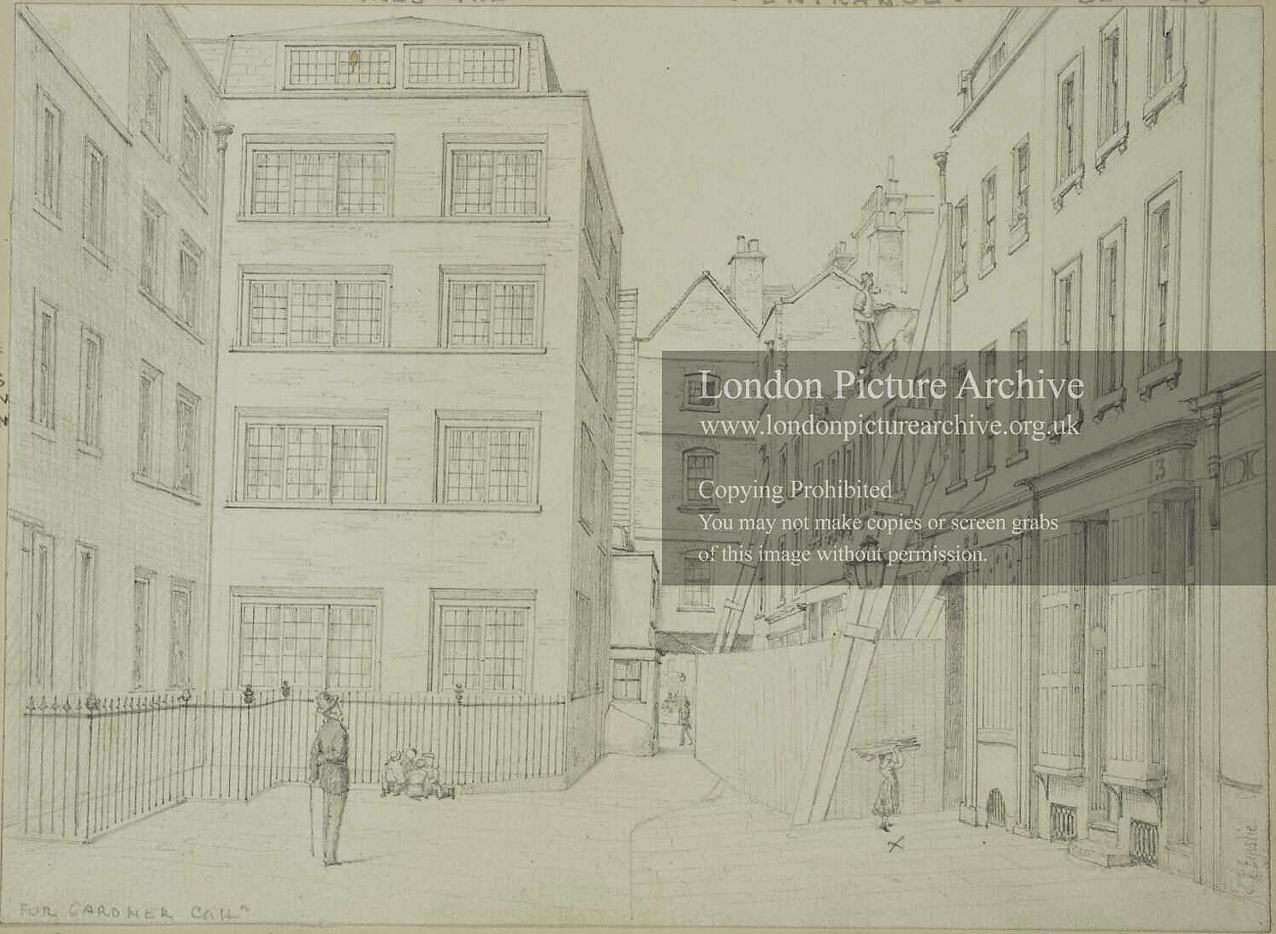
The entrance to May's Buildings is in the middle of the drawing.


Bedfordbury West side showing the entrance to Lemon Tree Yard, and Mays Buldings.


This image from watercolour world.

https://www.watercolourworld.org/collections/936e72e0-8c96-3c20-9621-f3b9d726c604/?s%3DBedfordbury&pos=1

Given modern technology it is difficult to understand why they post such poor quality images!


Lemon Tree Yard. Presumably looking West.

Emslie.

1880.

Image courtesy watercolour world.


...............................


St Martin's Lane looking East.

The Entrance to Mays Buildings on the right.


Harrisons have  now expanded to take over most of the North side of May's Buildings.

c. 1880.

42, 43 and 44 St Martins Lane.

Published here with permission.

Image courtesy London Picture Archive.

For an history of Harrisons see -

The House of Harrison,. 1914.

https://ia600907.us.archive.org/16/items/houseofharrisonb00harrrich/houseofharrisonb00harrrich.pdf

James Harrison was at 6 Lancaster Court in 1801. the end house adjoining the gate to the St Martin in the Fields graveyard. The court was demolished in about 1829, after a time in Orchard St, Westminster in 1840 the company moved to 45 St Martin's Lane.


"The court was about 18feet wide narrowed down to about 8 feet at both ends by the overlapping of the corner houses in the main thoroughfare. Some of the houses were fitted with oak panelling, elaborate plastering, and handsome staircases with carved banisters, and in one of them was found a handsomely designed leaden cistern and a pump dated 1740. 

Of the eleven houses which formed the north side of the court the first two were taken by the Firm, rebuilt, and occupied in 1866, about the time when Orchard Street, Westminster, was pulled down, and gradually the whole of this side of May's Buildings was absorbed for the purposes of the printing offices

 Nos. 15 and 16 in 1866. No. 20 in 1873. No. 14 in 1 88 1. No. 18 in 1890. Nos. 17 and 19 in 1891.No. 21 in 1896. No. 12 in 1898. No. 13 in 1910. No. 22 in 1913".


"Immediately at the back of the long extended workshops of 45 and 46, St. Martin's Lane, there stood a court or blind alley which was entered from Bedfordbury, and which, as we have said, in conjunction with the yard of 45, St. Martin's Lane, once formed a thoroughfare between the two main streets.

In the year 1899, when it was absorbed for building an additional printing office, it consisted of five small houses to which access could only be had through a very narrow passage. It was inhabited by an exceedingly rough class of people, such as occupied many of the slums round Covent Garden. The Vestry of St. Martin's had the privilege of providing a lamp-post for lighting the court, and of cleansing it, but rarely of collecting their rates; and the police passed down the narrow passage on extremely rare occasions and with the utmost caution"..............


"When the property was being purchased the Firm's Solicitors naturally tried to describe it by its proper name, and searched the old documents to ascertain what was the correct form of the name, of which several versions had been used. As many as thirteen different spellings were discovered amongst these papers, of which we recall a few :Chemister Alley.

Chymister, Chemisters  Chemists, Kemster Alley. Kemster's, Kenister,Kenaster. In Stowe's Survey of London, 1755, we find the name given as Keniston's.


Nearly facing it at the opposite side of Bedfordbury was a similar court known as Pipemakers' Alley. May's Buildings was also continued on the opposite side of Bedfordbury as Little May's Buildings, but all these slums were pulled down in 1880 for the erection of Peabody Buildings".


Images above from Harrisons

............................


National Archives Reference to Mays Buildings. 1757.

https://discovery.nationalarchives.gov.uk/details/r/ea61b83e-70ab-44fa-bbe0-5f268d752c93

Goodwood Estate Archives – West Sussex Record Office.

Reference:  GOODWOOD/E409-412


Bargain and Sale Enrolled, 21 April 1757, for the making a tenant for the suffering of several Recoveries; (ii) Exemplification of a Common Recovery, Easter Term 1757; (iii and iv) Settlement by Lease and Release, 27, 28 April 1757, pursuant to several Recoveries. The descriptions of the properties are very full in the documents; the parties to the settlement (no. GOODWOOD/E412) were:


(a)    Thomas Knight of Godmersham, co. Kent, esq. (formerly Thomas Brodnax, afterwards Thomas May); (b) Thomas Knight, only son and heir of (a); (c) Christopher Hull of Cliffords Inn, London, gent.; (d) John Kirril of Sevenoaks, co. Kent, esq. and John Knowler of the Inner Temple, London, esq.; (e) Thomas Lambard of Sevenoaks, esq. and Jacob Sawbridge of Canterbury, co. Kent, esq.

(b)    ……………………………..

34 tenements, etc. called Mays Buildings and Little Mays Buildings in St. Martin's Lane and Bedford Bury in St. Martin in the Fields and St. Paul Covent Garden, all in co. Middx. and late the estate of Henry May of the Middle Temple, London.

.......................................


Some 18th Century Trade Cards Mays Buildings.


Image below courtesy Lewis Walpole Library.


.................................................


George Bickham Junior. Mays Buildings.

https://data.historicaltexts.jisc.ac.uk/view?pubId=ecco-1241702800

For a fan with Bickham's engravings see

https://theprintshopwindow.wordpress.com/2013/04/09/george-bickham-the-younger-printed-fan-leaf-c-1750/


...................................


............................


William Rufus Chetwood (d. 1766) writer, publisher and bookseller lodged at the Golden Ball, Mays Court in 1741.

see - https://www.grubstreetproject.net/people/1763/


........................


Bedfordbury - The East Side.

Images from Sows Survey of 1755

Adapted from the original map of 1720


The Parish Boundary between St Martin in the Fields and St Paul's Covent Garden is the straight line Running North South.


Bedford Court.


An 18th Century plan.


........................

Some Trade Cards at the British Museum which don't turn up in internet searches.
They have been pasted into an interesting 18th Century notebook of 85 pages with several interesting cards of traders in the Strand and elsewhere.


Henry Pfahler. Married Jan 18 1731

Wife Mary Nipping 

by M'' William Wilson,

 .

Daughter Frances baptised St Paul's Covent Garden 26 Dec 1739.

John Henry baptised St Paul's Covent Garden 7 March 1741.

Henry baptised St Paul's Covent Garden 19 November 1743.


https://www.britishmuseum.org/collection/object/P_1982-U-4528


..............................


Little May's Buildings on the East side of Bedfordbury,

This court ran Eastward into Bedford Court.

Horwood's Map of 1799.

Bedford Court was an L shaped court running East accessing Bedford Street between no 16 and 17 Bedford Street.

and South into Chandos Street between no 23 and 24 with further access Westward to Little Mays Building.


Bedford Court.

1879.

John Phillips Emslie.

Images below used with permission London Picture Archive.

Bedford Court Looking South towards Chandos Street.


Bedford Court Looking East towards Henrietta Street.


Bedford Court.


This original, L-shaped, part of the court was included in the site leased by the fourth Earl of Bedford in 1631 to Richard Brigham, the King's coachmaker. Brigham did not appropriate all the hinterland of his plot to the houses on his street frontages in Bedford Street and Chandos Street but left a large irregular open space, which in the 1670's was still used as a 'stable and coach house yard' by his successor, Thomas Brigham, also a coachmaker: (fn. 1) at a much later period, after the site had been rearranged, a firm of Victorian coachmakers had their premises in this area. (fn. 2)


On the north side of Brigham's open yard (that is, just behind the present Post Office building at Nos. 17–19 Bedford Street) Remigius Van Leemput, the Flemish painter, lived from about 1647 until his death in 1675: his large house is shown, as that of 'Mr. Remee', on Lacy's map (Plate 2). (fn. 3)


In 1688 the fifth Earl had this incompletely exploited part of his estate cast into a regular court of houses and shops. Building leases of eleven sites for forty-one years were granted in July to William Beech, a vintner, and of one more site in September to Nicholas Spelden, a coach harness maker. The houses were to be of the second rate as categorized in the Act of 1667 for rebuilding the City after the Fire. The leases contained some building specifications, required the lessee to examine and if necessary reinforce the natural foundations, to make a sewer from his house, and to contribute to the cost of the sewer and paving which the Earl was to provide in the court. Some few noxious trades were prohibited. (fn. 4)


As these leases indicate, Bedford Court was not the insignificant backwater of ramshackle little houses that usually resulted from seventeenth-century urban 'in-filling'. Strype in 1720 treated it respectfully: 'a very handsome large Court, with an open Square in the Midst: Its Houses, which have not been very many Years built, are very good, and well inhabited; being a great Through-fare, and a Place of Trade'.  In 1726 the occupations in the court included those of upholsterer (two), tailor (two), mantuamaker, staymaker, mercer, peruke-maker, grocer, pastry-cook, and coffee-house-keeper.

....................


A Catalogue of Valuable and Curious Libraries Lately Purchased, in Most Languages and Faculties, ... Which Will Begin to be Sold ... on Tuesday the 13th of October 1741: By William Sare, Bookseller, at Cæsar's Head, in Bedford-Court.

........................

J Jarvis Trade Card.


Engraved by George Child.


https://www.britishmuseum.org/collection/object/P_Heal-100-40


........................

The Twelve Months of Flowers, hand coloured engravings by Robert Furber after Peter Casteels (1684 - 1749) on laid paper, sold by J. Jarvis, Bedford Court, Covent Garden 35 x 24cm.

First published in 1730.

J Jarvis (fl. 1725 - 55) at the Crown Bedford Court - Print publisher and seller; in 1746, sold an unauthorised print after Hogarth's painting, "Taste in High Life". Trade card in Heal Collection (Heal,100.40) advertises "J. Jarvis... Sells all sorts of Prints, Maps, &c. Either Colour'd or Plain, Also Frames & Glazes Prints in the neatest Manner and at the lowest Price. Likewise All Sorts of Stationary-Wares, Bibles, Common Prayers, Books for Accounts, Plays & Pamphlets." (info BM)

https://www.britishmuseum.org/collection/term/BIOG145041


.......................


Little May's Buildings on the East side of Bedfordbury,

Looking Eastward to Bedford Court,

John Phillips Emslie.

September 1879.

An excellent drawing that provides all sorts of incidental detail. 

Showing substantial four storey houses with basements.


Images used with permission.
London Picture Archive.
..................

Little Mays Buildings, 1872.


.........................


The Horse and Groom, 31 Bedfordbury.

Described as a sporting house in Fistiana, 1868.

Bedfordbury East side looking South to Chandos St. 1873.


The same view as above Bedfordbury the East side looking South into Chandos St. 1870.


Images used with permission.


.............................

Brewers Court, A Court on the East side of Bedfordbury.

Between 33 and 34 Bedfordbury on Horwoods Map of 1799.


Thomas Tattenham, Chimney Sweep.

at his house in Brewer's Court, Bedfordbury.


.............................


A short list of some Public Houses in Bedfordbury in the first half of the 18th Century.

Pubs attested in the first half of the 18th century in the area covered by the

Strand Bermudas. Data taken from Garrod and Garrod (2002: 72—81).

info from Garrod and Garrod


Bear & Staff, 11 Bear St. 1714.

Black Horse, 10 later 11 Bedfordbury. C.1721.

Cock & Bottle 21 Bedfordbury. 1736.

Golden Fleece, Sheltons Court, Bedfordbury. C 1738.

Goldsmith's Arms, 42 Bedfordbury. 1745.

Green Man 20 New Street. C. 1743.

Half Moon & Candles 36 Bedfordbury. C. 1704

Horse & Groom. 31 Bedfordbury. 1739

King of Prussia's Head. 23 Bedfordbury. 1740.

Lemon Tree. 4 Bedfordbury. C.1737. (see image of the Lemon Tree Yard)

............................

St Martin's Lane.1938.

Starring Charles Laughton and Vivian Lee.

https://www.youtube.com/watch?v=YgqyiRdtd84