Wednesday, 27 January 2021

Some Wedgwood busts after the originals by John Cheere including Alexander Pope

 Some Wedgwood Busts 

After the originals by John Cheere 

including a bust of Alexander Pope.

This post under construction.

Images below courtesy Sotheby's, New York.

see - https://www.sothebys.com/en/buy/auction/2019/wedgwood-and-beyond-english-ceramics-from-the-starr-collection/


A WEDGWOOD AND BENTLEY BLACK BASALT BUST OF ALEXANDER POPE LATE 18TH CENTURY

On an integral socle base, impressed lowercase Wedgwood & Bentley mark to reverse at side.

 Height 14½ in.   - 36.8 cm


_______________________


A WEDGWOOD BLACK BASALT BUST OF THE POET EDMUND SPENSER LATE 18TH CENTURY

on a separate socle base, the reverse of the shoulder impressed with uppercase WEDGWOOD mark, the lower body SPENSER, the underside of socle WEDGWOOD over numeral 2.


Height 15⅛ ins - 38.3 cm

 In 1769 the sculptor P. Theodore Park sent a bill to Wedgwood for modeling several statues including Spenser. A second example which had been in the collection of Frederick Rathbone is illustrated in Captain M. H. Grant, The Makers of Black Basalts, London, 1967, pl. XLIV, no. 1.


A WEDGWOOD AND BENTLEY LARGE BLACK BASALT BUST OFTHE POET AND PLAYWRIGHT BEN JOHNSON LATE 18TH CENTURY

On a separate socle base, the reverse of the shoulder with impressed uppercase WEDGWOOD, letters RK, the lower edge with uppercase JOHNSON, the underside of the socle with uppercase WEDGWOOD & BENTLEY mark.


Height 17⅝ in.   - 44.7 cm

 Provenance

The Milton Milestone Collection of early Wedgwood Pottery, Sotheby Parke Bernet, Inc. New York, April 6, 1976, lot 217

Sotheby Parke Bernet, Inc. New York, December 1, 1977, lot 64


Another example is in the Manchester Museum, illustrated in Robin Reilly, Wedgwood, London, 1989, Vol. I, p. 455, who notes that the plaster cast was supplied by Hoskins & Grant and that the bust is first listed in the Wedgwood and Bentley catalogue of 1774 (see Reilly, 1989, Vol. II, p. 750).


A WEDGWOOD BLACK BASALT BUST OF CHAUCER EARLY 19TH CENTURY

On a separate socle base, the reverse of the shoulder with impressed uppercase CHAUCER, uppercase WEDGWOOD mark to lower body and underside of socle.


Height 12 in.    - 30.5 cm


A WEDGWOOD AND BENTLEY VERY LARGE BLACK BASALT BUST OF THE DUTCH JURIST HUGO GROTIUS CIRCA 1775-80.

 After Michiel Janszoon van Mierevelt (1566-1641), wearing a large layered ruff over a doublet, raised on a separate socle base, the reverse of the shoulder with impressed uppercase GROTIUS, over letter H., the underside of socle with uppercase WEDGWOOD & BENTLEY mark.


Height 20⅜ in. - 50.7 cm


Provenance -Sotheby Parke Bernet Inc. New York, December 1, 1977, lot 66


Literature - Gallagher, Ars Ceramica, 2019, no. 31, p. 18, fig. 9

 Gallagher, 2019, op. cit., writes that in September 1779, an order of six large busts, including a Grotius, was fulfilled for the Dutch market and which came through Wedgwood's Amsterdam agent Lambertus van Veldhuysen. A bust of Grotius is also included in Wedgwood and Bentley's 1779 trade catalogue. The source for the bust is likely the 1631 oil painting by Michiel Jansz. Van Mierevelt (1576-1641). A second bust of Grotius of this large size from the Bernheim Collection was sold at Sotheby Parke Bernet, New York, February 26, 1972, lot 116.


A WEDGWOOD VERY LARGE BLACK BASALT BUST OF WILLIAM SHAKESPEARE LATE 18TH CENTURY

 On a separate socle base, the reverse of the shoulder embossed in uppercase SHAKESPEARE, and lowercase Wedgwood mark, the underside of the socle with uppercase WEDGWOOD & BENTLEY mark.


Height 19 in  - 48.2 cm


Provenance - Sotheby Parke Bernet, Inc. New York, December 1, 1977, lot 65.

 In February 1774 the sculptor John Cheere supplied Wedgwood with busts of Shakespeare, Plato, Homer and Aristotle at half a guinea each, Robin Reilly, Wedgwood, London,1989, Vol I, p. 450. A bust of this larger size was sold at Sotheby Parke Bernet, Inc. New York, January 15, 1976, lot 28.

A WEDGWOOD AND BENTLEY VERY LARGE BLACK BASALT BUST OF ROBERT BOYLE LATE 18TH CENTURY

 On a separate socle base, the reverse edge of the shoulder impressed in uppercase BOYLE, traces of two further impressed BOYLE marks, the underside of the socle base impressed uppercase WEDGWOOD & BENTLEY mark.


Height 18 in.  - 45.7 cm

.................................


A WEDGWOOD AND BENTLEY VERY LARGE BLACK BASALT BUST OF JULIUS CAESAR CIRCA 1779.


On a separate socle base, the reverse edge at the shoulder impressed uppercase JULIUS CAESAR, the lower edge impressed lowercase Wedgwood & Bentley mark, the socle base impressed uppercase WEDGWOOD & BENTLEY.


Height 18⅝ in.  47.4 cm

 Provenance - Sotheby's New York, October 11, 1995, lot 164


Wedgwood wrote to Bentley in February 1771: "I wrote to you in my last concerning of Busts. I suppose those at the [Royal] Academy are less hackney'd & better in General than the Plaister shop can furnish us with; besides it will sound better to say - This is from the Academy, taken from an Original... than to say, we had it from Flaxman."

 though he concluded that "we must be content to have them [the moulds] as we can, & as Oliver, as a plaister figure maker, in selling his moulds, transfers his business likewise to us he must be pd. handsomely for them.", Reilly, 1989, Vol. I, p. 450. It was apparent to Wedgwood that he could create more durable, and beautiful models than anything produced in plaster. By 1774 Josiah proclaimed he would have "a collection of the finest Heads in the Word". (Reilly, ibid, p. 456.)


 According to Robin Reilly and George Savage, The Dictionary of Wedgwood, 1980, p. 67, this bust of Caius Julius Caesar was "supplied by Hoskins & Grant [to Wedgwood in] 1779, [and] not listed in the Catalogues after that date."


__________________________________________________


A WEDGWOOD AND BENTLEY BLACK BASALT BUST OF THE POET HORACE CIRCA 1775


 the reverse of the bust impressed HORACE, lowercase Wedgwood & Bentley, incised marks, the underside of the socle impressed uppercase WEDGWOOD AND BENTLEY.


Height 14⅜ in.  36.4 cm


____________________________


A WEDGWOOD AND BENTLEY BLACK BASALT BUST OF CICERO CIRCA 1777.

 on a separate socle base, impressed lowercase Wedgwood & Bentley mark to reverse of shoulder and underside of socle, the shoulder with uppercase CICERO.


Height 10¼ in.   26 cm


__________________

A WEDGWOOD AND BENTLEY BLACK BASALT BUST OF THE POET SAPPHO, LATE 18TH CENTURY

 on a separate socle base, impressed uppercase SAPPHO to reverse of bust, the underside WEDGWOOD & BENTLEY.


Height 14⅝ in.   -  37.2 cm.

Tuesday, 26 January 2021

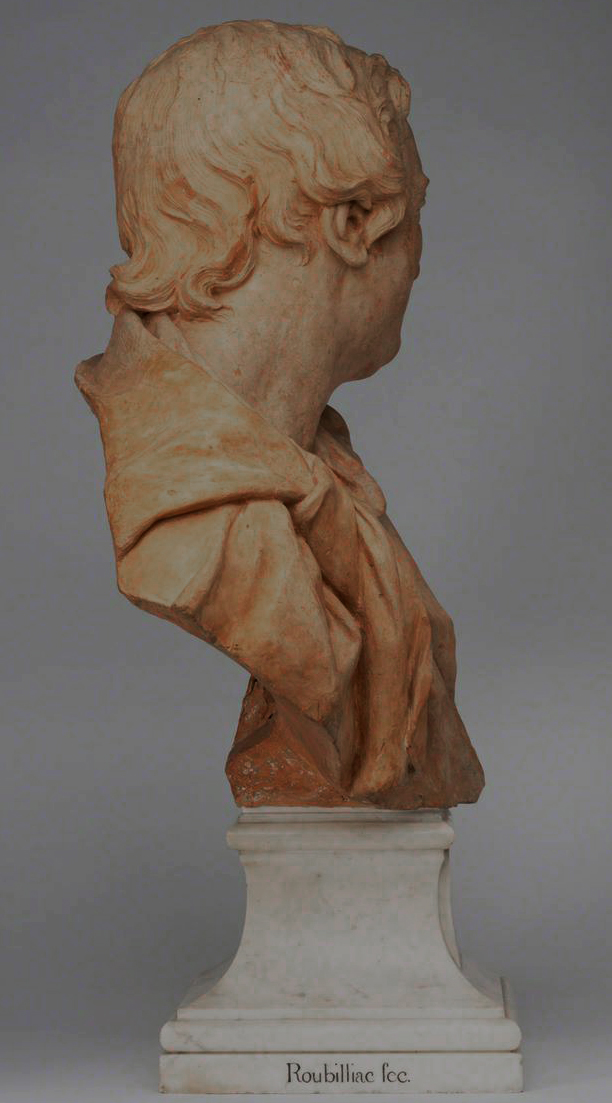
Henry Herbert 9th Earl of Pembroke, A terracotta Bust by Roubiliac


This post is still currently under construction.

Henry Herbert 9th Earl of Pembroke, 

A Terracotta Bust by Roubiliac.

in the Fitzwilliam Museum, Cambridge.


These rather indifferent photographs below were recently added to the Art UK website.

It is a great shame that these photographs are so poor - hopefully next time I an in Cambridge I will be able to see and photograph this bust myself.


https://artuk.org/discover/artworks/henry-herbert-16931749-9th-earl-of-pembroke-frs-300352/view_as/grid/search/work_type:sculpture--makers:louis-franc_ois-roubiliac-169517021762/page/1

Currently their website is quite difficult to navigate to unless saved to favourites. 


The socle is almost certainly a slightly later addition

nb. the spelling of Roubiliac.


Acquisition: bequeathed; 1816; Fitzwilliam, Richard, 7th Viscount.


Provenance:

Henry Herbert, 9th Earl of Pembroke, FRS (1693-1749/50; Countess of Pembroke, his widow; ? ; Richard, 7th Viscount Fitzwilliam of Merrion (d. 1816).

Notes:

The 9th Earl of Pembroke married Mary Fitzwilliam in 1733 , sister of the 6th Viscount Fitzwilliam, whose heir, Richard, was the founder of the Fitzwilliam Museum.

 In The Life and Works of François Roubiliac. London: Oxford University Esdaile, Katharine A.. 1928.Pressp. p. 91.  this work is not to be entirely trusted.


Ref. p. 91, note 4, says the inscription 'Roubilliac [sic] fec' is modern. 'The model passed first to the Countess's family, then to Cambridge along with the Hercules (pl: XIII b and now atrributed to Rysbrack R.A.B.) and the antique head of Agrippina with a pedestal by Roubiliac (Arnold's Library of the Fine Arts iv, 183, p. 1840).' 

The marble bust, for which this was the model, and that of the Countess are at Wilton in the church; there is another of Lord Pembroke in Wilton House, and one at the Birmingham City Museum  and Art Gallery.?? 

Mr Gunnis's records there is a bill from Roubiliac for the bust in the church

see my blog entry: - https://english18thcenturyportraitsculpture.blogspot.com/2019/07/bust-hamilton-orkney-rysbrack.html?m=0


__________________


Henry Herbert, 9th Earl of Pembroke (and 6th Earl of Montgomery), FRS.


Louis Francois Roubiliac.


Circa 1749.

Depicted facing to sinister; on an integral square marble socle carved with the Pembroke coat of arms and inscribed ‘VNG. GP. SERVERAY’.

Photograph courtesy Lullo Pampoulides.


24 5/8 in. (62.5 cm.) high  32¼ in. (82 cm.) high overall, including socle

Provenance:


Henry Herbert, 9th Earl of Pembroke, by descent to his son

Henry Herbert, 10th Earl of Pembroke;

 Placed on the monument to the 9th Earl of Pembroke in St. Mary’s Church, Wilton, Wiltshire, before 3 July, 1754 (when seen by Dr. Richard Pococke)

The bust and parts of the monument moved to the new Church of St. Mary and St. Nicholas, Wilton, Wiltshire in 1845;

Bust sold (following the grant by the church court of a faculty for removal) by

17th Earl of Pembroke (heir-at-law of the 9th Earl of Pembroke, and therefore owner of the bust) in 1997 (via Christie's) to


Professor Ian Craft, by whom sold, 2005, to

Private Collection, London.

This bust was exhibited at the Victoria and Albert Museum, London, in the Sculpture in Britain Galleries since 2005.

Sold by dealers Lullo - Pampoulides to a private collector, USA.


______________


Extract from the Christie's Sale Catalogue. Lot 83, 2nd December 1997.


Three versions of the present bust are known. The other two, one of which is paired by a bust of the Earl's wife, Mary, the eldest daugher of Richard, Viscount Fitzwilliam, are at Wilton House. Although none is signed, their attribution to Roubiliac has not been doubted since they were first discussed by Mrs. Esdaile in her monograph on the sculptor, where she also referred to a terracotta model of the bust of the Earl in the Fitzwilliam Museum, Cambridge, bearing a modern inscription, 'Roubilliac [sic] fec.' (Esdaile, loc. cit.).


More recently, archival research has revealed that Roubiliac received £165 and a halfpenny in 1751 from the executors of the 9th Earl for his monument, of which the present bust formed a part (Bindman and Baker, loc. cit.).


It would appear, however, that the bust may not originally have been intended for the monument, but was more probably an independent portrait, which was subsequently enlisted for the task. It was, in any event, certainly in place as early as 3 July 1754, when it was described by Richard Pococke as having the form of 'a marble bust as against a pyramid' (Pococke, loc. cit.).


The original form of the monument was considerably modified when it was transferred from the chancel of the old medieval church at Wilton in 1845 to its present location in the new church.


The bust has now been replaced by a replica.


Here are some snaps of this bust taken by the author at the Victoria and Albert Museum.

It is my guess that this bust might have spent some time outdoors and has suffered some weathering.

The flesh of the face and the robe have at some point been repolished (to my eye over polished) and then a wax applied which has given the surface a sort of shiny quality 


For this marble bust of Pembroke by Roubiliac formerly on the monument in the church of St Mary and St Nicholas at Wilton sold at Christies lot 83 2nd December 1997.


_______________


There was originally a marble pyramid and urn on the monument at one time which has since disappeared - probably when the medieval church was remodelled in 1845. It was perhaps at this period that it spent some time outdoors.

see -


https://www.christies.com/lot/lot-a-carved-marble-bust-of-henry-herbert-304181/?

______________


The Bust of the 9th Earl of Pembroke at Wilton House.

and Mary Fitzwilliam Countess of Pembroke.

Roubiliac.

Currently no good close up photographs available - I hope to rectify this in due course.

Photographs below are courtesy Country Life Archives.


The Busts of Andrew Fountaine and Martin Folkes by Roubiliac at Wilton House.

________________


Left foreground - Roubiliac's bust of Henry Herbert

_____________________


William Shakespeare.

Portland stone.

Peter Scheemakers.

All being well I will be visiting Wilton House shortly to obtain my own photographs of the portrait sculpture.

see my blog post.


Images courtesy.

Country Life Picture Library.

__________________


Busts of Leland and Linacre at All Souls Oxford.


The Plaster and Terracotta Busts of Leland and Linaker/Linacre originally in the Hall at All Souls College, Oxford University.


The black painted plaster bust (one of 23) of Linacre on the bookcases in the former Codrington Library supplied by John Cheere in 1750.

The second and far superior terracotta bust of Linacre here suggested as sculpted by Roubiliac.

and the missing bust of Leland seen in the engravings (below) also suggested as by Roubiliac.


It had recently come to my attention via the Art UK website that I had missed the bust of Thomas Linacre at All Souls when I visited in order to photograph the 23 Cheere busts in the Codrington Library, and the busts of Archbishop Chichele and Nicholas Hawksmore by Roubiliac, annoyingly neither the existence of the second and far superior bust of Linacre, the plaster bust of Chichele or that of Giles Bennett had been pointed out to me - had I been aware I would have taken my own photographs of these busts.


This bust of Linacre was not in the library at the time of my visit - I also missed the bust of Giles Bennett and Nicolas Hawksmoor which are still in the Buttery at all Souls.


I am very grateful to Gaye Morgan, Librarian at All Souls for her help in putting together this essay and others on the portrait sculpture at All Souls.


_______________


For a good overview of the portrait sculpture at All Souls see my previous post -

http://bathartandarchitecture.blogspot.com/2018/04/cheere-busts-codrington-library-all.html

and the individual posts for each of the 24 busts and the matching set of urns.

In 1750, twenty-five bronze vases and twenty-four bronze 'bustoes' of college worthies were ordered from Cheere to decorate the top of the shelves.


Versions of these urns/vases are at Lydiard House, near Swindon along with a group of classical plaster busts supplied by John Cheere.


___________________________


Thomas Linacre (c.1503 - 52).

Painted terracotta.

 Measurements  H 55.9 cm.

It has been suggested (in wikipeadia) that these two busts are by Roubiliac and certainly the quality of the bust of Linacre could point to him as creator.


Certainly put up prior to 1767 and given that the plaster bust of Linacre by John Cheere which is an inferior version of this bust was put up in 1750 - I would suggest that it was sculpted pre 1750.

The marble bust of Chichele is signed and dated 1751 but the plaster bust was perhaps taken from an earlier terracotta.

Photographs above  credited to All Souls College Oxford.

Courtesy Art UK website

https://www.artuk.org/discover/artworks/thomas-linacre-c-14601524-275526


Thomas Linacre was a Fellow of All Souls from 1484 until 1493. He became the first President of the College of Physicians founding lectureships in medicine at both Oxford and Cambridge. 


This historical bust was originally in the Hall with a corresponding bust of the Antiquarian John Leland, now missing, an engraving of which was published in W. Huddersford's 'Life of Leland' in 1772. Another portrait bust of Linacre by John Cheere is amongst the twenty-three in the Codrington Library.


These busts of Linacre and Leland are mentioned as being in the hall on the chimneypiece flanking the bust of Chichele by Roubiliac in The English Connoisseur: Containing an Account of Whatever is Curious in Painting Sculpture etc ...By Thomas Martyn published 1767. Volume II page 29

_____


The Plaster Busts of Linacre

 Supplied by John Cheere 

in what was until recently called the Codrington Library, All Souls College Oxford.

Height 55 cms.


The bust on the bookcase closely resembles the bust of Linacre above but is obviously by a less skilled sculptor 

either by John Cheere or a workman in the yard at Hyde Park Corner 


One of a set of twenty three plaster busts of Fellows of the College which were commissioned from John Cheere and put up in 1750 at the cost of £195 15s following the order and selection of Sir William Blackstone. A few of them are based on contemporary portraits.


_________________


Thomas Linacre.

Black chalk, graphite, with highlights and red chalk on face and hands.

17th? Century .

347 x 208 mm.

British Museum.

Annotated in pen in brown ink below drawing -

"Thomas Linacre professeur en medecine a son Isle Anglaise, homme certes docte aus deux langues, Grecqs et Latine, ayant copose plusieurs doctes liures, mourat a Lodres Lan de nee seigr." On verso in pencil "

D. Lincoln in letter of Oct. 28, 1949 suggests that this drawing is by the same hand as the original studies for the engravings in Theret's 'Hommes Illustre' 1584, which are in an interleaved copy of the work in the Bibliotheque Nationale".

Bequeathed to the BM by: Clayton Mordaunt Cracherode (on verso in ink Cracherode's monogram and date 1778).

see -

https://www.britishmuseum.org/collection/object/P_Gg-1-413


Thomas Linacre.

Etching pub. 1794 of the Cracherode drawing above.

114 x 97 mm.

__________________


The Bust of Leland. 

in the Refectory at All Souls in 1772.

engraving from Huddersfield's Life.

1772.

Grignion (1721 - 1810).


The conformation of the Socle should be noted 

(as that on the bust of Linacre).

It is tempting to suggest that this missing bust was the pair to the bust of Linacre and that they were both sculpted by Roubiliac.


___________


John Leland published by William Richardson.

line engraving, published June 1796.

7 1/2 in. x 5 1/8 in. (191 mm x 129 mm) 


See my previous post for an in depth look at the Codrington Library Statuary at All Souls College Oxford University:

http://bathartandarchitecture.blogspot.com/2018/05/the-codrington-library-plaster-busts-by_8.html


________________


Archbishop Chichele.

The Plaster and marble busts.

Louis Francois Roubiliac.


The grey painted plaster and marble busts of Archbishop Chichele for comparison.


The grey painted version might well have been subject to some damage which would explain the thick overpainting.

It would be a very interesting exercise to remove the overpainting on this bust.

The socle or support of the plaster has been copied from that of the marble but there remains some of the original socle which follows that of the busts of Linacre and Leland.

At first glance the appear to be the same but close inspection reveals some differences. 


Roubiliac's masterful depiction of the fur on the dress of the marble is missing on the plaster.

This perhaps suggests that the plaster was taken from a terracotta prototype and that the marble is a refined version of the original.

.....................

The Bust of Nicholas Hawksmoor.


Nicholas Hawksmoor.

Roubiliac.

Life Size Plaster.

Height 54.6.

Buttery, All Souls College, Oxford. 

Photograph  at All Souls from Art UK Website.


https://artuk.org/discover/artworks/nicholas-hawksmoor-16611781-275517/search/venue:all-souls-college-university-of-oxford-7507/page/3


The architect Nicholas Hawksmoor was apprenticed to Christopher Wren and was employed in the construction of the Chelsea Hospital between 1687 and 1689, St Paul's from 1691 to 1712 and at the Greenwich Hospital in 1705. 

For the last fifteen years of his life he was responsible for the designs for the redevelopment of All Souls and was the architect of the formerlay called Codrington Library, the Buttery, the North Quadrangle and the Hall, all built between 1716 and 1740.This bust is the only known likeness of Hawksmoor. The  bronze cast  was given by the Warden and Fellows of All Souls in 1962 to the National Portrait Gallery in London.


Monday, 25 January 2021

An egraving of a bust of Ben Jonson


An Engraving of a Bust of Ben Jonson, 1752


A Ticket of the Drury Lane Theatre , 

Tuesday, Mar. 15th, announcing Every man in his humour, for the benefit of Mr. Woodward

March 10th, 1752.


Image from the Bodleian Library


https://digital.bodleian.ox.ac.uk/objects/af9ab876-9030-4115-9fc7-2e89d9316bf3/surfaces/af9ab876-9030-4115-9fc7-2e89d9316bf3/#


I have posted at some length on the busts of Ben Jonson but this is a recent discovery for me

see -


http://bathartandarchitecture.blogspot.com/2017/08/bust-of-ben-jonson-anonymous.html


Wedgwood bust of Ben Jonson

Image courtesey Sotheby's New York

Lot 99 23 October 2019.


The catalogue entry states "modelled wearing a doublet and shirt collar, raised on a separate socle base, the reverse of the shoulder with impressed uppercase WEDGWOOD, letters RK, the lower edge with uppercase JOHNSON, the underside of the socle with uppercase WEDGWOOD & BENTLEY mark.


Height 17⅝ in.   44.7 cm

 Provenance:

The Milton Milestone Collection of early Wedgwood Pottery, Sotheby Parke Bernet, Inc. New York, April 6, 1976, lot 217


Sotheby Parke Bernet, Inc. New York, December 1, 1977, lot 64


Catalogue note:

Another example is in the Manchester Museum, illustrated in Robin Reilly, Wedgwood, London, 1989, Vol. I, p. 455, who notes that the plaster cast was supplied by Hoskins & Grant and that the bust is first listed in the Wedgwood and Bentley catalogue of 1774 (see Reilly, 1989, Vol. II, p. 750).


____________________


The Soane Museum Plaster bust of Ben Jonson
Early - mid 19th century?
Perhaps from an original by John Cheere
Not dated and first mentioned in an iventory of 1842

The socle is very unusual and also appears on two other busts (of Camden and Shakespeare) at the Soane Museum

_________________


Ben Jonson
Plaster

Early 19th century
National Trust Sudbury


From a set of four busts by Robert Shout.

Marked on the back Made and sold by R Shout, Holborn

Plaster

Sudbury House, Derbyshire

On loan from Hughenden House, Bucks.

National Trust.

Photograph - National Trust.


For more on the Sudbury busts see - https://bathartandarchitecture.blogspot.com/2017/05/two-mysterious-plaster-busts-probably.html

  see also - https://universitypublishingonline.org/cambridge/benjonson/k/essays/jonsons_images_essay/

Friday, 8 January 2021

Huggins after Hogarth


Another post in an occasional series of busts illustrated in other media.

an Engraved Portrait of William Huggins (1696 - 1761, 

The translator of Ariosto

1760.

After William Hogarth.

Thomas Major (1720 - 99).


Sheet: 3 3/8 x 3 3/8 in. (8.6 x 8.6 cm).

Image courtesey Metropolitan Museum, New York.

https://www.metmuseum.org/art/collection/search/414599


_____


William Huggins

William Hogarth


Houghton Library

Harvard

ttp://id.lib.harvard.edu/alma/990092850700203941/catalog


__________________________


John Huggins father of William Huggins

evidently not a very nice man!

see  Hogarth Paulson pub.1992

Warden of the Fleet Prison

William Hogarth

before 1745

Oil on Canvas 

47 x 41 cms.