Sunday, 4 December 2016

Bust of the so Called Demosthenes, Long Room Trinity College Library, Dublin.


The Marble Bust of the so called Demosthenes.

in the Long Room Trinity College Library, Dublin.

Peter Scheemakers.
 
Signed P.S. Ft.

Photographed by the author.


Friday, 25 November 2016

Jonathan Swift by Roubiliac, Trinity College Library, Dublin.


The Marble Bust of Jonathan Swift (1667 - 1745).
by Louis Francois Roubiliac,
circa 1748/49. 
Trinity College Library, Dublin.
 
Photographs taken by the author 4 October 2016.


 ______________________________________________


 Sources for Trinity College Library Roubiliac bust of Swift.
It is most unlikely that Roubiliac ever met Swift.
Swift was last in London in 1727 when he stayed with Alexander Pope.


Jonathan Swift.
after Charles Jervas.
engraved by Paul Foudrinier.
c.1718.
Plate 355 x 262 mm.
 
 
 © National Portrait Gallery, London.


Jonathan Swift.
after Charles Jervas (1675 - 1739).
Engraved by George Vertue.
Plate size -372 x 262 mm.
First quarter of the 18th century.
 
© National Portrait Gallery, London
 
The two engravings above are possibly the sources for the Roubiliac Busts of Swift.


  __________________


Jonathan Swift.
Mezzotint after Markham.
signed Vanhaeken.
 
This engraving is much closer to the Cunningham bust and was probably the source for it.


Mezzotint after Markham.
Thomas Burford.
dated 1744.
Pub Bowles London.
Plate size - 351 x 249 mm.

__________________
 
 
For an Article by Malcolm Baker on the Trinity College Library busts  


The Magnificent Baroque Plaster Ceiling of c. 1670/80. 
removed from Armitage's Oriental Café.
Formerly the Sign of the Feathers. 
6 Wheelergate, Nottingham
when demolished in 1961.
 
Rescued and restored by Peter Hone with the assistance of the author.
 
Currently in store and ready for installation with Messrs Taylor Pearce of New Cross, London.
 
The pivotal decision in the history of England to ally the northern aristocracy with the protestant William III and to depose the Catholic James II - The Glorious Revolution was made at The Sign of the Feathers on 23 November 1688.
 
 
for a full description and the researches into the ceiling see -


1950's photograph of the frontage of 4 - 6 Wheelergate, Nottingham.
6 Wheelergate on the left. The ceiling was in the ground floor room on the left.
 
The Corner building was destroyed by enemy action in 1941.
the bomb missed the ceiling by about 18 ft.
 
 
Late 19th Century photograph of 2 - 6 Wheelergate, on the corner of Friar Lane and Wheelergate showing the 2 Wheelergate - the Old Moot Hall Wine Vaults building prior to rebuilding in 1901.
 
 
The ceiling in Armitage's Oriental Café
Photographed in the late 1950's.
 
 
Press cutting from Nottingham Post 7 March 1960
Photograph Courtesy Nigel Waring.


The ceiling with the 30 layers of paint removed
Laid out at the workshop of Messrs Taylor Pearce, New Cross, London.


Detail of the Ceiling showing the Coat of Arms of the Braddylls of Brockholes


Photographs - the author.
 
for a full description and researches into the ceiling see -
 

Tuesday, 15 November 2016

Margaret Cavendish Bentinck nee Harley Marble Bust by Michael Rysbrack and an Anoymous Bust at Powis Castle


Margaret Cavendish Bentinck nee Harley (1715 - 85).
Marble Bust.
Michael Rysbrack.
1727.


_________________________________


Both of these poor quality low resolution images above from the Bridgman Image Library.
 
Carefully edited so that the inscriptions are illegible
 
Available in higher resolution a mere snip at £50 + vat each.


Margaret Cavendish Bentinck (née Harley), Duchess of Portland, by George Vertue, after  John Michael Rysbrack, 1727 - NPG D14100 - © National Portrait Gallery, London


Margaret Cavendish Bentinck nee Harley

Duchess of Portland
Engraving by George Vertue
217 x 170 mm.
dated 1727.

© National Portrait Gallery, London

An Engraved portrait of Margaret Cavendish Bentinck, Duchess of Portland (1715-85), collector of art and natural history specimens and patron of the arts and sciences, after a bust sculpted by Rysbrack. 

This engraving originally published as a plate to the poet Elijah Fenton's edition of Waller's 'Works' of 1729. Portland spent fifty years assembling an immense collection of natural history and the fine arts at her home at Bulstrode, Buckinghamshire, which became the largest in Britain, exceeding even that of Hans Sloane. The most famous item in her collection was the so-called Portland vase which she purchased from Sir William Hamilton (now in the British Museum). After the duchess' death, her collection was auctioneed in a sale lasting thirty-eight days. 


Bust Margaret Cavendish Bentinck, Duchess of Portland (1715-1785), 1727
___________


Margaret Cavendish Bentinck nee Harley.

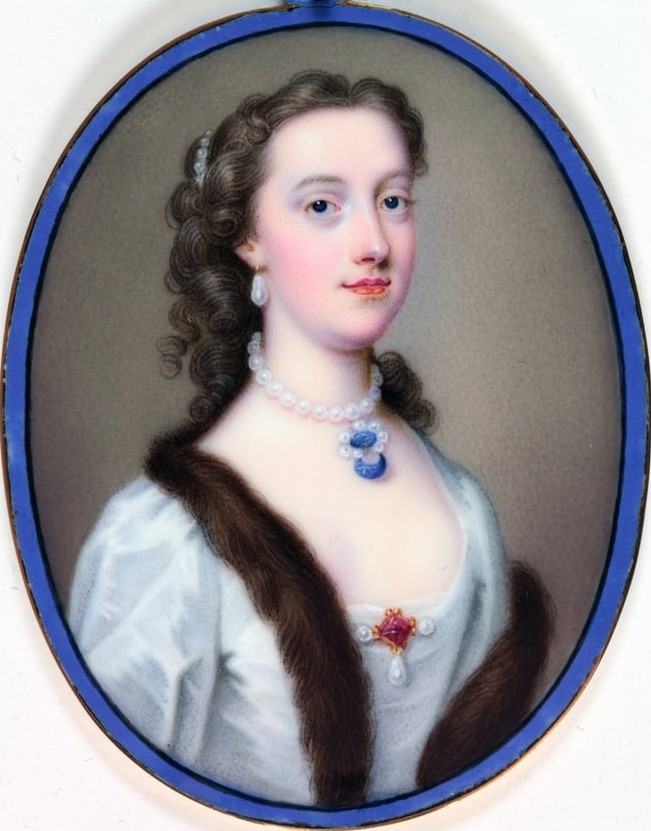
Miniature by Christian Frederick Zinke 1683/4 - 1767).

© The Portland Collection. The Harley Gallery.


Margaret Cavendish (Harley), Duchess of Portland; William Bentinck, 2nd Duke of Portland; Lady Mary Wortley Montagu 

Engraving 
After Zinke 
George Vertue
1738
233 x 332 mm.

© National Portrait Gallery, London


 A Tea Party at The Countess of Portland’s, 1732. 
Charles Philips

© The Portland Collection. The Harley Gallery.


Margaret Cavendish Bentinck nee Harley.


Thomas Hudson

© The Portland Collection. The Harley Gallery.


Margaret Cavendish Bentinck nee Harley.


Michael Dahl

Image Courtesy Christie's


An Anonymous Plaster Bust at Powis Castle.


An Anonymous Plaster Bust
traditionally believed to be French.

Very low resolution image from the National Trust Website

see - http://www.nationaltrustcollections.org.uk/object/1185530


Monday, 14 November 2016

The Sydney Plaster bust of Shakespeare after Roubiliac


A Plaster bust of Shakespeare 
after the original Terracotta by Louis Francois Roubiliac 
State Library of New South Wales,
Sydney, Australia.


for my previous posts and in depth  work on the subject of the Roubiliac busts of Shakespeare see

http://english18thcenturyportraitsculpture.blogspot.co.uk/2015/11/shakespeare.html

http://english18thcenturyportraitsculpture.blogspot.co.uk/2015/11/the-british-museum-terracotta-bust-of.html


Photographs and the description below from the website of the State Library of New South Wales


The Shakespeare Room is home to a portrait bust of William Shakespeare. Made from plaster with a bronze finish, the bust is a replica of a terracotta original by Huguenot sculptor, Louis Francois Roubiliac (1702-1762) which is housed in the Garrick Club in London.
The State Library bust was originally donated to the Australian Museum by Sir Richard Owen in 1857, it was then transferred to the National Art Gallery of New South Wales in 1912 before finally arriving at the Library in 1955. Another identical terracotta bust is housed in the British Museum with direct provenance to Roubiliac.
The Garrick Club, London believed two replicas of the terracotta bust were produced. One is in the Royal Shakespeare Company Collection in Stratford and the other was presumed lost in the London Crystal Palace fire in 1866. The presence of the State Library’s bust in Australia in 1857 strongly suggests that either a third replica was produced, or that this may be the bust that was believed lost in the Crystal Palace fire.


http://www.sl.nsw.gov.au/stories/shakespeare-400/bust-william-shakespeare

Image result for Shakespeare Roubiliac Garrick club

_______________________________


William Shakespeare.
A Plaster Bust taken from the Davenant Garrick Bust.
The Royal Shakespeare Company, Stratford on Avon.

The copy which had belonged to Professor Sir Richard Owen (1804 - 1892) - the Assistant Curator of the Royal College of Surgeons' Hunterian Collections from 1827 - he was elected a Fellow of the Royal Society, and appointed Hunterian Professor then Professor of Anatomy at the Royal College of Surgeons, then Fullerian Professor of Comparative Anatomy and Physiology at the Royal Institution.

Photograph and info supplied  by Marcus Risdell curator at the Garrick Club 2015.


 Communication from Marcus Risdell.

'Roubiliac original terracotta bust -  The Garrick Club bust, (rediscovered by William Clift, first curator of the Hunterian Museum) in 1834 (source is Clift's papers held at Royal College of Surgeons) it was found in the garden of No 39 Lincoln's Inn Fields by a water pump in a position I have identified in surveys made by the Royal College of Surgeons to have been right by the main entrance. 

It became known through association of the theatre as the Davenant Bust, but as we now suspect was sited at the theatre by Henry Giffard who attempted the last theatrical season there in 1742-43 (Incidentally Giffard also used a full size Scheemakers statue as a pantomime stage prop at his previous theatre Goodman's Fields where he first put on Garrick. This I covered in the catalogue: The Face & Figure of Shakespeare at Orleans House Gallery. 

Anyway I digress: the bust passed to Professor Owen who showed it at the Crystal palace, where it came to the attention of the Duke of Devonshire who bought it and gave it to the Garrick Club, who incidentally used to use it as a door stop'. Not before at least two casts were made!

_________________________________________


Not an unusual fate for portrait busts - the  16th century Lumley / Pomfret marble bust of Henry VIII suffered similar humiliation whilst it was in the Ashmolean Museum offices, until rescued in the mid 20th century (communication Michael Vickers).


The British Museum Terracotta by Roubiliac Purchased by Matthew Matey at the Posthumous 
Roubiliac Sale in 1762.


The Garrick Club Terracotta of Shakespeare by Roubiliac