Ivory relief of Francois du Quesnoy.
by Gaspar van der Hagen, d.1769.
Here would seem as good a place as any to post photographs and information on the known works of Gaspar van der Hagen. As far as I know no one else has put all these works together.
There has previously been some doubt as to the authorship of these ivory reliefs, not least because of the various monograms used - VDHN, VAM, others with the incongruous signatures, ‘GVD,’ ‘GVDR’ and ‘GVR.’, but given that there are few other candidates for these miniature pieces of sculpture, those with the monogram can, I believe be safely ascribed to him.
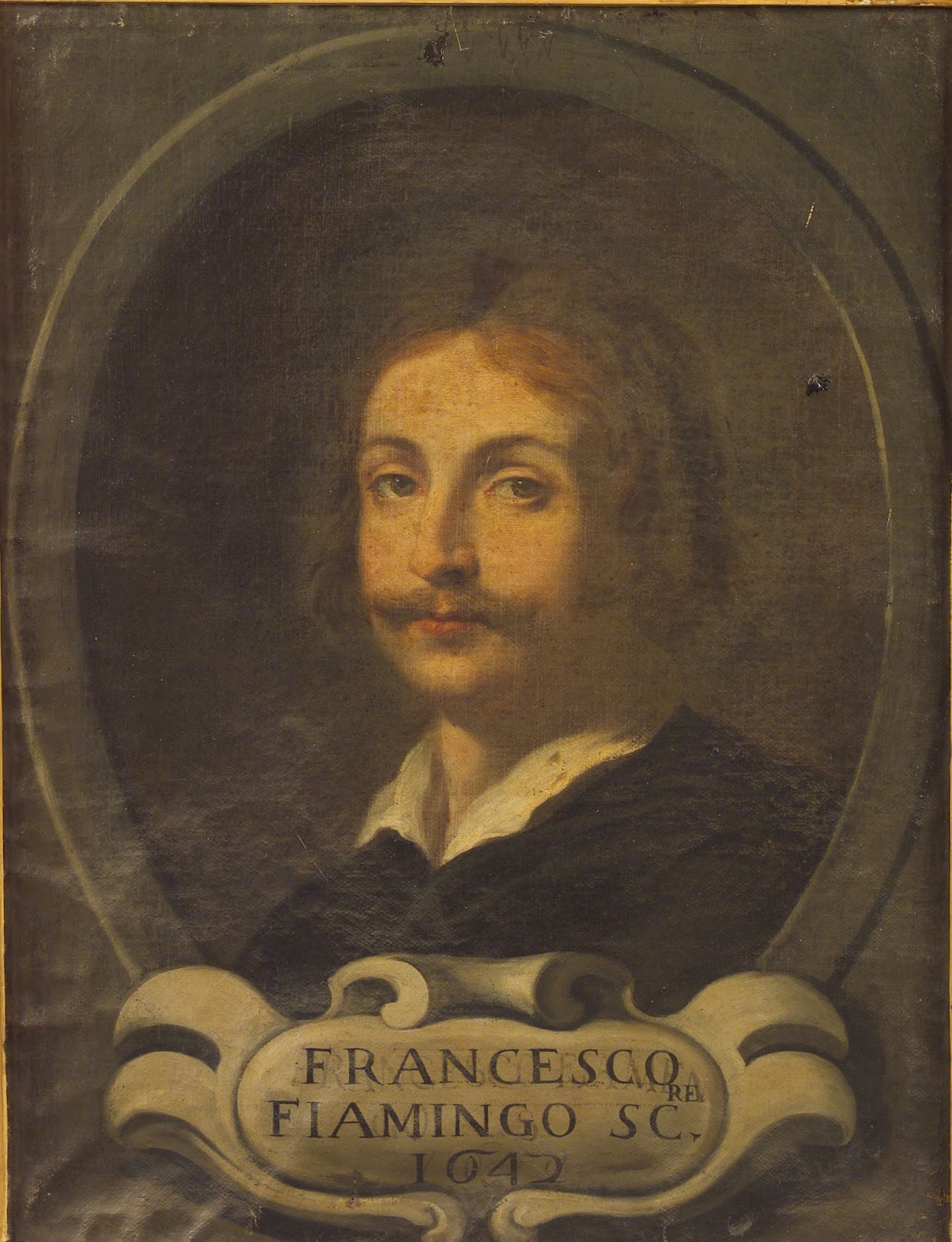
The only other real candidate is James Francis Verskovis (Jacob Frans Vescovers) who died in 1768. He was responsible for the three ivory figures of François Duquesnoy, flanked by the architect Inigo Jones and the painter Rubens on The Horace Walpole Cabinet, which was formerly at Strawberry Hill and is now in the Victoria and Albert Museum (An almost identical cabinet, which was made at the same time for Walpole's friend Thomas
Brand, of The Hoo, Hertfordshire, was sold by Christie's London, 5 July 2012 lot
5, and acquired by the Art Institute of Chicago in 2015. (see photographs below).

Francois du Quesnoy
Gaspar van der Hagen.
Ivory relief.
Signed lower left: "G.VDR"
15 x 10 cm
Yale centre for British Art.
Daniel Katz Ltd., European Sculpture, London, 2003, p. 54, no. 21, DealerCat Daniel Katz Ltd.
Algernon Graves, The Society of Artists of Great Britain, 1760-1791, and The Free Society of Artists, 1761-1783: a complete dictionary of contributors and their work from the foundation of the Societies to 1791, Kingsmead Reprints, Bath, 1969, p. 263, no. 177, N5053 G73 1969
Free Society of Artists, A catalogue of the paintings, sculptures, architecture, models, drawings, engravings &c. now exhibiting by the artists, associated for the relief their distresed brethren, their widows, and children, at Mr. Moreing's Great-Room, in Maiden-Lane, Covent-Ga, Catalogue of the Free Society of Artists, London, 1766, p. 14 [p. 95], no. 177, N5055 S62 C3 1760A (YCBA) , Also available on line In 18th century Collection Online data base
Langford & Son, Langford & Son sales catalogue : A catalogue of the neat collection of pictures, marble bustos and vases, fine models of bassos relievos and monuments of Mr. Michael Rysbrack : 14 February 1767, London, February 14, 1767, p. 3, lot 44, Available on line : Art Sales Catalogues Online.
_______________________________

Portrait of Gaspar van der Hagen (1692 - 1780).
by Joseph Highmore
90 x 69.5 cms
Sold Sotheby's, London. Lot 24: 22 November 2007.
van der Hagen is shown holding an ivory medallion and on his right under a glass dome a copy of the Medici Venus. The inclusion of this statuette would suggest that van der Hagen was also producing statuettes although so far none have come to light.
__________________________________
A few notes on Gaspar Van der Hagen d. 1769.
With some photographs of his reliefs.
A carver in ivory and marble, Van der Hagen was a long-term assistant to Michael Rysbrack. His date of birth is unknown and no information has surfaced on his training, but he had relatives in Antwerp. He was in London by 1744 when the Daily Advertiser made reference to “Mess. Claessens and Ven Hagen, at Mr Rysbrack’s in Vere Street, near Oxford Chapel’. Claessens was Rysbrack’s foreman who died on 4 December 1749. In 1747 Vertue noted ‘Mr Vander Hagen. Sculptor works for Mr Rysbrack. has done several heads portraits in Ivory.—very well. but not meeting with propper encouragement did not continue’ (Vertue III, 135). The lack of encouragement must have been temporary, for Van der Hagen was still exhibiting ivory portraits nearly 20 years later. His small bust of the Duke of Cumberland is a very assured, minutely detailed and textured rendering of a larger marble work by his master (4). It suggests that Van der Hagen had considerable talent.
He was still lodging with his master in Vere Street, Oxford Road in 1766, and four works by him were sold in the auction of Rysbrack’s collection held by Langford on 14 February 1767 (2, 6, 10, 11). The Sacrifice to Hercules, which resurfaced in 2002 (6) is a competent work after a terracotta model by Rysbrack, itself based on a relief on the Arch of Constantine in Rome.
Rysbrack bequeathed £50 to ‘Gaspar Vanderhagen Statuary who did live with me’ in his will, dated 5 March 1768, and an undated codicil adds ‘Gaspar Vanderhagen dyed before me’. In fact Vanderhagen was still alive in 1768, but had moved to York, where he died in 1769. The timing was unfortunate for Van der Hagen appears to have lived out his last days in penury. In 1768 he applied to the Society of Artists for support, ‘being in great necessity’, and received four guineas (Society of Artists’ Archives, Burlington House).
His goods were administered by his sisters Isabella and Catherine (Harman), both of whom lived in Antwerp. These executors held a sale of their brother’s work on 17 April 1771. Van der Hagen was described in the catalogue as the ‘principal assistant to the late Mr. Rysbrack,’ and the sale included ‘several fine heads and figures in ivory, basso relievos in marble, books of prints, &c’ (Anecdotes 1937, 154-5).
In the letters of administration Van der Hagen is described as a ‘bachelor’, so it is perhaps unlikely that Vanderhagen of Shrewsbury was, as Gunnis supposed, his immediate offspring. The Royal Academy pension paid to a Mr Vanderhagen between 1769 and 1775, and subsequently to the widow of the same until 1781, also relates to another family.
After Jean Cavalier and David le Marchand, with whom he shares some stylistic similarities, Van der Hagen is currently the best documented ivory carver of the 18th century. However the large corpus of works includes many attributions, not here listed. Among them are an oval medallion of John Milton, signed ‘VDHN’ (VAM), as well as many unsigned works and others with the incongruous signatures, ‘GVD,’ ‘GVDR’ and ‘GVR.’ (Add inf. Gordon Balderston, Marjorie Trusted).
Literary References: Graves 1907, 263; Webb 1954, 68, 186, 189; Gunnis 1968, 406; Davis 1970 (1), 16; Davis 1971 (4), 1223
Archival References: SAA SA/34/1; SA/37/6
Wills and Administrations: Administration of the will of Jasper otherwise Gaspard Vanderhagen, 17 July 1769, FRC PROB 6/145/27; will of Michael Rysbrack PROB 11/954/224-6
Auction Catalogues: Van der Hagen 1771.
Info above lifted from -

Hamlet Winstanley
Gaspar van der Hagen
Ivory Relief .
Height: 14.1 cm, Width: 10.4 cm, Depth: 4 cm
Victoria and Albert Museum.

Hamlet Winstanley
Back of the Ivory relief.
Gaspar van der Hagen.
Victoria and Albert Museum.

Self Portrait of Hamlet Winstanley.

Hamlet Winstanley (1698 - 1756)
John Faber Jr
Mezzotint 1731
354 mm x 254 mm plate size.
© National Portrait Gallery, London.
Winstanley was born in Warrington, John Finch, rector of Winwick and brother of the Earl of Nottingham helped him and he studied at Godfrey Kneller's Academy which was founded in Great Queen Street, London in 1711. In 1721Winstanley returned to Warrington with a commission to paint the portrait of Sir Edward Stanley. He was in Rome from 1723 - 25.
Hamlet Winstanley was another portrait painter who frequently used van Aken as a drapery painter along with Alan Ramsay and Thomas Hudson.
Vertue and William Whitely on Hamlet Winstanley
Hamlet Winstanley, the pupil of Kneller at the Academy and the first teacher of that fine painter George Stubbs, had a considerable practice in portraiture in Lancashire and other northern counties, but he could do nothing beyond the faces of his sitters. The figures and draperies were beyond the powers of his brush and the painting of a group or composition out of the question. He was obliged, therefore, to invent a method “quite new and extraordinary.”
“Winstanley travelled about and drew pictures from the life in oil colours—often on small pieces of cloth, only the face; pasted them when sent to London on larger cloths; one, two three or more whole family pieces he did in this manner; only did the faces, sent them to town to Mr. Vanaken an excellent painter of drapery. He stuck the, on large strained cloths as he pleased an made postures and draperies, and so made them complete pictures. This sort of trade Winstanley pursued.”
He spent his later years at Warrington, where he built Stanley Street, and named it after his patrons at Knowsley. He died at Warrington on 18 May 1756. His collections of copper-plates and prints are stated by Horace Walpole to have been sold by auction at Essex House on 18 March 1762.
________________________________________________

Mrs Winstanley
Mezzotint by John Faber
British Museum.
____________________________________________


Gaspar van der Hagen
Ivory Relief .


Gaspar van der Hagen
Ivory Relief
12.3 x 9.5 x 2.2 cm
This pair of plaques was presumably made to commemorate the wedding of Princess Anne and William of Orange in 1734. The source is an engraved double oval portrait of the royal couple after Philippe Mercier (1689 -1760), which was widely circulated in a number of printed impressions in both Paris and London or the two mezzotints of 1734(see below).
Royal Collection.
see - https://www.royalcollection.org.uk/collection/70166/pair-of-portrait-reliefs-of-william-iv-of-orange-and-anne-princess-royal

Ann Princess of Orange and William Prince of Orange
Daughter of King George II, wife of William Charles Henry Friso, Prince of Orange.
After Philippe Mercier
Engraving 1734.

John Faber Jr.
Mezzotint 1734
352 mm x 248 mm
© National Portrait Gallery, London

John Faber Jr.
Mezzotint
1734
260 x 180 mm.
© National Portrait Gallery, London
_____________

Here attributed to Gaspar van der Hagen
Oliver Cromwell, Inigo Jones, John Milton and William Shakespeare
Four Ivory Reliefs.
Each 11.5cms high.
Sold Christies, London.
Lot 68 8th July 2010.
Three of the reliefs are after busts by Rysbrack while the fourth - of Shakespeare - is derived from the full-length marble executed by Rysbrack's contemporary, Peter Scheemakers, for the playwright's monument in Westminster Abbey.
Another set of four oval ivory reliefs - portraits of Milton, King Alfred, Queen Elizabeth and Cromwell were sold at Sotheby's London, 8 December 1988, lots 398-401.
____________________________
____________________________

John Milton
Tentatively attributed to Gaspar van der Hagen
Ivory relief
10.3 cms
British Museum.
The quality of the portrait below would suggest this portrait was carved by a less gifted sculptor.

John Milton by van der Hagen
signed VDHN
Christie's South Kensington.
Lot 205; 1st Dec 2015
Height12 cms.
This relief based on the Rysbrack bust of Milton.
_____________________________
This relief based on the Rysbrack bust of Milton.
_____________________________

George II after Michael Rysbrack by Gaspar van der Hagen (1683 - 1773)
16.5 x 14.0 x 8.9 cm
The Thomson Collection © Art Gallery of Ontario.

William, Duke of Cumberland.
Gaspar van der Hagen.
An ivory bust of William Augustus, Duke of Cumberland, made by Gaspar van der Hagen in ca. 1767. It is almost certainly the ivory bust exhibited by the sculptor at the Free Society of Artist in 1767. The entry in the Catalogue reads '271. Mr Vander Hagen, at Mr Rysbrack's in Vere Street, Oxford Road. A bust of his Royal Highness the late Duke of Cumberland, in Ivory.
Height: 14.8 cm ivory alone, Height: 21.5 cm whole
Purchased in London from Mr A. Spero for £50 in 1937.
Victoria and Albert Museum.

William Duke of Cumberland
Here Attributed to Gaspar van der Hagen
Ivory relief
10.5 cms
British Museum.
______________________

Inigo Jones
Gaspar van der Hagen
After an original bust by Michael Rysbrack
Ivory relief.
Height: 9.5 cm, Width: 2.75 in.
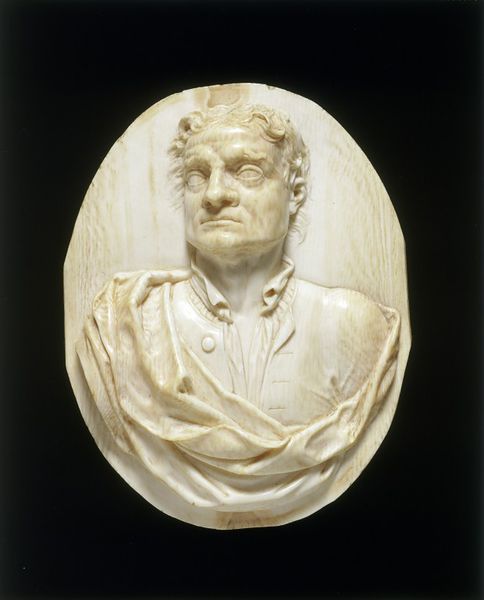
Isaac Newton
by Gaspar van der Hagen
Ivory relief
Height: 12.3 cm, Width: 10 cm
There is a virtually identical relief in Walters Arts Gallery, Baltimore, attributed to 'Alexander' van der Hagen - (see below). Another version is in the Royal Society, and another is in Kings College Library (Keynes Collection), Cambridge. This ivory portrait is probably derived from the so-called Conduit marble bust of Newton by John Michael Rysbrack (1694-1770), and his terracotta bust in the Wren library, Trinity College (info from V and A).
Bought for £30 through Messrs. Spero and Kerin, 9 Clifford Street, New Bond Street, London, who purchased it at auction on behalf of the Museum in 1929. Previously the property of A.D. Doughty Esq., sold at Sotheby's, London, 20 June 1929, lot 100, there said to have been 'in the possession of the present owner's [Mr Doughty's] family for many years'.
Notes and photograph courtesy Victoria and Albert Museum.

Isaac Newton
by Gaspar van der Hagen
Ivory relief.
Walters Arts Gallery, Baltimore.
________________________

Isaac Newton
Gaspar van der Hagen
Ivory Relief
Height: 9.2 cm, Width: 6.5 cm.
Victoria and Albert Museum.
_____________

Oliver Cromwell (1599-1658),
Gaspar van der Hagen
Monogramed G.VR.
Victoria and Albert Museum
After the original Terracotta Bust of Oliver Cromwell by Michael Rysbrack c. 1758. ex Teddesley Hall.
A marble by Rysbrack is in the Huntington Library, California
Another similar Marble bust was offered for sale at Sotheby's New York, lot 356 26 Jan. 2012 - attributed to the workshop of Michael Rysbrack
National Maritime Museum Greenwich.
Height: 10.3 cm

Elizabeth I
Gaspar van der Hagen
Ivory Relief
Height: 10,5 cm
Queen Elizabeth I is shown in bust form, crowned and wearing a ruff, with a pendant at her neck. The image is very closely related to the lifesize terracotta bust of the monarch by Michael Rysbrack in the Royal Collection.
Victoria and Albert Museum.
_______________________

John Roe
Gaspar van der Hagen.
monogrammed GVDR
Ivory relief.
size 14 x 10 cms
The identity of John Roe is uncertain,
although he may be the John Roe of Henley (1649-1728).
If he is indeed the subject this is almost certainly a posthumous portrait.
Purchased through Alfred Spero at Sotheby's November 19, 1937, lot 179 for £32. Formerly on loan to the Museum (until 1929) from Mr W. Saunders Fiske, a solicitor (d. 1932), 35A Hyde Park Gate, London S.W.
Victoria and Albert Museum.
________________________

George II
Gaspar van der Hagen
Height: 9.3 cm, Width: 6.5 cm
Victoria and Albert Museum.
___________________

George I.
Poss. Gaspar van der Hagen
unsigned
Ivory relief.
9.5cms
Bonham's Auctioneers, lot 560,11 Dec 2007.
_____________________

Gaspar van der Hagen
Ivory Relief
9.6 cms
Monogrammed G.VDR
It is inscribed on the back HR Wooten
British Museum.

Alexander Pope
Possibly Gaspar van der Hagen
Ivory Relief
Height: 13 cm, Width: 10 cm
After the original bust by Roubiliac
Victoria and Albert Museum

Alexander Pope
Perhaps Gaspar van der Hagen
It lacks the quality and subtlety of the relief above
Walters Art Museum Baltimore.
________________________________________________

Sacrifice to Hercules.
Gaspar van der Hagen.
Subject adapted from the arch of Constantine Rome.
61 × 73.5 cm.
Yale Centre for British Art.
Another relief plaque with a relief of Hercules is currently with dealer Danny Katz.
______________________________
James Francis Verkovis
and the ivory statuettes on the Walpole Cabinet.
Given the date of manufacture of the Walpole cabinet of 1743 it can be safely assumed that Verscovis had access or perhaps worked in the studio of Michael Rysbrack. The two figures of Rubens and Inigo Jones are based on earlier statues by Rysbrack, the du Quesnoy repeats the pose of the statuette by Rysbrack but he is depicted leaning on a column rather than on the antique Belvedere Torso, as depicted on the Rysbrack terracotta and plaster statuette of du Quesnoy of 1743.
Walpole had written to Horace Mann 'There is a Fleming here who carves exquisitely in ivory, one Verkovis: he has done much for me and where I have recommended him' 26 June 1747.
Walpole mentions - Cabinet heads of eagles by Verskovis - in his Anecdotes of Painting.

The Walpole Cabinet from Strawberry Hill
now in the Victoria and Albert Museum.
Height: 152.4 cm, Width: 91.5 cm, Depth: 21.6 cm
Horace Walpole, born 1717 - died 1797 (designer).
William Kent (probably,
designer).
William Hallett, born 1702 - died 1781 (probably, maker).
Verskovis, James Francis (ivories, carver).
Pozzo, Giovanni Battista,
born 1670 - died 1752 (ivories, carver).
'1743, made for Horace Walpole; 1842, Strawberry Hill Sale, day 15, lot 66, bought by [Richards for] Mr Charles Redfern of Warwick, £126.0.0; Mr Harry Quilter; Sir George Donaldson, Private Museum in Sussex; 1925, July 9. Donaldson Sale at Hove, Sussex, lot 482, bought Sutton; 1925, The Victoria and Albert Museum, Purchased with the assistance of the Murray Bequest.'
The cabinet was described by Walpole in 1743 as a "new
cabinet for my
enamels and miniatures,"
Walpole commissioned this cabinet to store part of his fine collection of
portrait miniatures. It was originally made for his house in Arlington Street,
London but later became the main piece of furniture in the Tribune at Strawberry
Hill.
For more detail on this and the Brand Cabinet see

Francois du Quesnoy
Ivory Statuette
James Francis Verskovis

Peter Paul Rubens
Ivory Statuette
James Francis Verskovis
1743
On the left-hand figure of the cabinet is the statuette of Rubens. The figure adds a
bearded head to a body that repeats the pose and dress of Rysbrack's Palladio
at Chiswick House by c.1730.

Inigo Jones
James Francis Verskovis
1743
Ivory Statuette which repeats the pose and dress of Rysbrack's Palladio at Chiswick House by Michael Rysbrack c.1730.
______________

The Tribune at Strawberry Hill by Edward Edwards.

Another view of the Tribune Strawberry Hill by Edward Edwards.
________________________
Literature - The van der Hagen Reliefs.
Victoria and Albert Museum, Review of the Principal Acquisitions During the Year 1929. London, pp. 9-10. (Newton)
Randell, R. H. ed. Masterpieces of ivory from the Walters Art Gallery, Baltimore, 1985, p. 318, cat. no. 484 (Newton)
Graves, Algernon. The Society of Artists of Great Britain, 1760-1791, London, 1907.
Esdaile, K. A. The life and works of Louis François Roubiliac. London, 1928, p. 20
Walpole, Horace. Anecdotes of painters, who have resided or been born in England, with critical remarks on their productions. 1771, IV. p. 98.
Trusted, Marjorie, Baroque & Later Ivories, Victoria & Albert Museum, London, 2013, cat. no. 127
_____________________
Another van der Hagen (of Shrewsbury) d. circa 1790.
Nothing is known of this Van der Hagen’s early life except that, according to his own advertisements, he trained at ‘European Academies’ (inf. James Lawson). He is unlikely to have been a direct descendant of Gaspar Van Der Hagen who was described as ‘a bachelor’ in the administration letter of his will, but he may have been connected in some way to another Van der Hagen, who received a Royal Academy pension from 1769 until 1775, when the payments were transferred to his widow. He had certainly settled in Shrewsbury by 1765, where he was employed as a carver by Thomas Farnolls Pritchard and established his own business as a monumental mason.
An album of Pritchard’s designs in the American Institute of Architects in Washingon DC (reproduced in full by Ionides 1999) includes information on the craftsmen responsible for their execution. It shows that Van der Hagen frequently worked in collaboration with John Nelson and Swift and occasionally with Danders and Halley, carving chimneypieces, frames and other decorative features in various styles for Pritchard.
Van der Hagen, Nelson and Swift were all employed on Pritchard’s monument to Richard Ward Offley at Pontesbury (2) and it seems likely that the same team was responsible for carving the large wall-monument, designed by Pritchard, to Richard Lyster at Alberbury, which Gunnis thought ‘exactly like, and very nearly equal to, the work of Sir Henry Cheere’ (Gunnis 1968, 406). Their involvement in the Lyster cannot be confirmed, though Van der Hagen’s signature appears on the small, simple tablet to the memory of Lyster’s wife which was added at the base of the monument at a later date.
Van der Hagen’s most important independent works are the monuments commemorating Maria Lloyd, 1780, at Corwen, Merioneth, and William Vaughan, 1786, at Llanddwywe in the same county, both of which have medallion portraits (8, 15). He appears to have died about 1790 for the following year John Carline I and his partner John Tilley announced that they had purchased Van der Hagen’s stock in trade and intended to carry on his business in monuments and chimneypieces (Shrewsbury Chronicle 1791, inf. James Lawson).
Literary References: Gunnis 1968, 406; Rococo 1984, 207; RG/JP, 8, 1495; Ionides 1999, passim.
This info lifted entirely from -
http://217.204.55.158/henrymoore/sculptor/browserecord.php?-action=browse&-recid=2775
______________________________________
______________________________________