Thursday, 24 September 2015

3 Dassier - The Medallions of the Kings and Queens of England - 1731

The Medallions of the Kings and Queens of England, 1731.
by Jean Dassier (1676 - 1763).
Part 3.
Each Medallion 41 mm diam.
All images courtesy Ben Weiss - I am very grateful for his support and assistance.
I would like to thank Professor Ben Weiss, Emeritus Professor of Pharmacology and Physiology
Drexel University College of Medicine,
 for allowing me to reproduce the photographs and captions.
A visit to his website is essential for anyone interested in pre 19th century European Medallions.


Edward III (1327 - 1377).
Obv: Bust of Edward III wearing a helmet decorated with a dragon, the device of Cadwallader.    EDOUARD. III. D.G. ANG. FR. ET HIB. REX.
Rev: Circular temple, with a statue of Mars, symbolic of the warlike nature of Edward. On the base are two cupids: one is holding a garter, an allusion to the establishment of the Order of the Garter, and the other, is holding an olive branch, an allusion to the King’s victorious career. On the base is inscribed:  
NAT. J312. COR. J327. MORT. J377
Signed: J. D.
Ref: M.I. i, 9/8; Eimer 28/12; Thompson 25/11; Eisler I, 256/13a


Richard II (1377 - 99).
Obv: Bust of Richard II    RICHARDVS. II. D.G. ANG. FR. ET. HIB. REX.
Rev: A sepulchral monument, on which are two infants, one holding a cypress, the other a skull and a dagger, in allusion to the King’s tragic death. The bas-relief on the base represents him in the dungeon of Pontefract Castle, with a crown, sword and scepter at his feet.
Exergue:  NAT. J366. COR. J377 MORT. J399.
Signed: I. D.
Ref: M.I. i, 10/2; Eimer 28/13; Thompson 25/12; Eisler I, 257/14
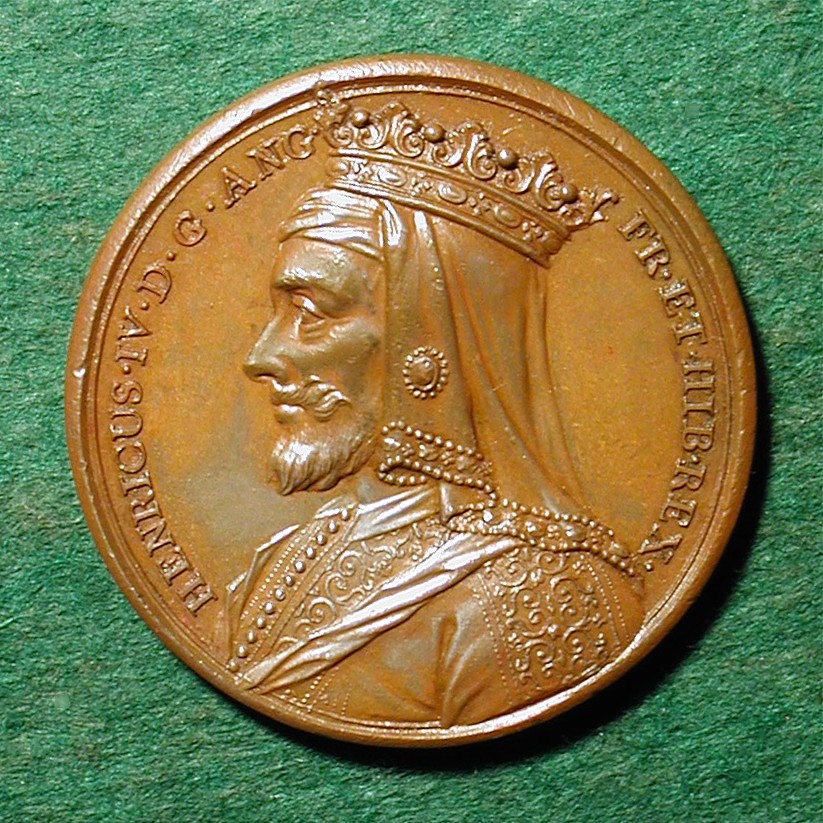


Henry IV (1399 - 1413).
 
Obv: Bust of Henry IV (l) wearing embroidered robe and veil with Lancastrian rose    HENRICUS. IV. D.G. ANG. FR. ET. HIB. REX.
Rev: Tomb surmounted by reclining figure of Death holding a scythe in one hand and an ax in the other, surrounded by military trophies. Below the tomb is a bas-relief representing at left Prince John of Lancaster ordering his officers to suppress the rebellion of Scrope, Archbishop of York, and Mowbry, Earl Marshal. The crushing of the rebel forces is depicted at right. (From Eisler)
On base:
 NATUS J366 CORONAT. J399 MORT. J413
Signed:
 I.D.
Ref: M.I. i, 12/6; Eimer 28/15; Thompson 26/13; Eisler I, 257/15


From An Explanation of Dassier's Medals of the Sovereigns of England, a series of six engraved plates of the Kings and Queens of England, by Pye, c. 1773
 
 
______________________________


Henry V (1413 - 22).
Obv: Bust of Henry V    HENRICUS. V. D.G. ANG. FR. ET. HIB. REX.
Rev: Henry, amid captured arms, is reclining on monument in form of a sarcophagus. Fame is crowning him and sounding his praises. A skull between palm and laurel branches decorates the side.
  NATUS 1388 CORONAT. 1413 MORT. 1422.
Ref: M.I. i, 12/6; Eimer 28/16; Eisler I, 257/16a; Thompson 26/14


Henry VI (1422 - 61).
Obv: Bust of Henry VI    HENRICUS. VI. D.G. ANG. FR. ET. HIB. REX.
Exergue:  NAT. 1421. COR. 1422. MORT. 1471.
Rev: Statue of Time in niche of a temple holding a crown in one hand and manacles in the other, an allusion to the throne and prison he alternately occupied.
Signed: J.D.
Ref: M.I. i, 16/6; Eimer 28/17; Eisler I, 258/17; Thompson 27/15
 

Part 2 - Jean Dassier - The Kings and Queens of England - 1731.


The Medallions of the Kings and Queens of England, 1731.
by Jean Dassier (1676 - 1763).
Part 2.
 
Each Medallion 41 mm diam.


Richard I Lionheart (1189 - 99).
Obv: Bust of Richard I    RICHARDUS. I. D.G. ANG. HIB. ET. CYPRI. REX. (Richard I, by the Grace of God, King of England, Ireland and Cyprus).
Rev: Monument surmounted by volutes, at the extremities of which are the crowns of England and Cyprus. The bas-relief on the front of the monument depicts a lion trampling upon a stag and menacing another animal, in allusion to the name of Coeur de Lion. Above is Fame reclining on clouds and holding a palm branch and a trumpet, symbolical of the victories and military career of the king.
Exergue:
 NAT. J157. COR. J189. MORT. J199.
Ref: MI i, 3; Eimer 27/6; Eisler I, 255/8; Thompson 23/6


John (1199 - 1216).
 
Obv: Bust of John   IOANNES D.G. ANG. ET. HIB. REX.
Rev: Monument with fluted columns and a central medallion. The columns are surmounted by a semicircular pediment decorated with a winged cherub. The medallion is a bas-relief depicting the king, being crowned, kneeling before Pandulph, the papal legate, suggesting his submission to papal authority. Below is a papal tiara resting on a thunderbolt. On either side are two amphorae containing burning incense.
Exergue:  
NAT. J166. COR. J199. MORT. J216.
Signed:
J.D.
Ref: MI. i. 4; Eimer 27/7; Eisler I, 255/9; Thompson 24/7


Henry III (1216 - 72).
 
Obv: Bust of John   IOANNES D.G. ANG. ET. HIB. REX.
Rev: Monument with fluted columns and a central medallion. The columns are surmounted by a semicircular pediment decorated with a winged cherub. The medallion is a bas-relief depicting the king, being crowned, kneeling before Pandulph, the papal legate, suggesting his submission to papal authority. Below is a papal tiara resting on a thunderbolt. On either side are two amphorae containing burning incense.
Exergue:  
NAT. J166. COR. J199. MORT. J216.
Signed:
J.D.
Ref: MI. i. 4; Eimer 27/7; Eisler I, 255/9; Thompson 24/7
 
On his brother Richard’s death John was invested as Duke of Normandy and crowned King of England by Pandulph, the Pope’s Legate, the event alluded to on the reverse of this medal


Edward I Longshanks (1272 - 1307).
 
Obv: Bust of Edward I, in armor with mantle, crowned   EDOUARD. I. D. G. ANG. ET. HIB. REX.
Rev: A circular temple articulated with Tuscan half-columns, surmounted by a cupola. In the niches are statues of Prudence at left, holding a mirror, Minerva in the center to indicate Edward’s wisdom and military genius, and Hercules at right, in allusion to the magnitude and variety of his successful enterprises. On the left of the monument is History recording the king’s deeds. At right are two figures in Roman dress admiring the monument.
Exergue:
NAT. J230. COR. J272 MORT. J307.
Signed:
J.D.
Ref: M.I. i, 5/2; Eimer 28/10; Eisler I, 256/11; Thompson 24/09


Edward II (1307 - 27).
 
Obv: Bust of Edward II    EDOUARD. II. D.G. ANG. ET. HIB. REX.
Rev: Sepulchral monument articulated with Doric pilasters. In the center is a bas-relief representing Gournay and Maltravers, in Roman attire, who are about to cover up the body of the monarch, whom they have just murdered in Berkeley Castle.
Exergue:  NAT. 1284. COR. 1307. MORT. 1327
Ref: M.I. i, p.5; Eimer 28/11; Eisler I, 256/2; Thompson 25/10
 

Sunday, 20 September 2015

Part 1 - Dassier - The Medallions of Kings and Queens of England, 1731.


The Medallions of the Kings and Queens of England, 1731.
by Jean Dassier (1676 - 1763).
Part 1.
 
These medals were struck by the Swiss medallist Jean Dassier (1676-1763) in 1731. They represent the kings and queens of England in chronological order from William I (reigned 1066-1087). Dassier presented the group up to and including George II (reigned 1727-1760).

Dassier published his series of the medals of the Kings and Queens of England in 1731, dedicating it to George II. The medals were available individually and as complete sets. They were struck in bronzed-copper, damascened copper (the relief gilded in contrast to bronzed fields) and silver. The dies for the medals were eventually purchased by Sir Edward Thomason of Birmingham, who reissued the medals c.1820. New obverse dies were also modelled after the originals and used to strike sets in white metal with new reverses that carried an inscription describing notable events of the reign of the individual depicted on the obverse.   

 Dassier produced this series for English collectors who required a set of medals of their own monarchs that mirrored the chronological sequences in which they arranged ancient Roman coins of emperors. This in turn derived from the collectors' interest in matching coins and medals to written histories of the ancient world.

This form of arrangement had been set out in John Evelyn's Numismata (1694): see -
This was later developed in John Pinkerton's Essay on Medals (1784).
 
There was no known likeness for a number of the monarchs in the series, usually because they had not issued medals during their reigns. Dassier therefore based some of their portraits on the imagined engravings in the History of England by Paul de Rapin-Thoyras (1661 - 1725).
 
Rapin - Thoyras was the French author of a 'History of England', which was published by the Knapton brothers with enormous success in the 1730s, both in the original French and in English translation. Illustrations were commissioned for it from George Vertue. Translated by Nicolas Tindall (1687 - 1774).
Jean Dassier (1676-1763) was one of the most prominent and celebrated engravers of the eighteenth century.   Jean Dassier was a member of a noted Swiss family of medallists.  He trained under his father, Domaine Dassier (1641-1719), chief engraver at the mint in Geneva.  Jean later studied in Paris under Jean Mauger and Joseph Roettier(s).  After serving his father as assistant engraver at Geneva, Jean assumed the position of chief engraver following his father's death, a position he held until his own death over forty years later. Jean Dassier was the most prolific of the family, issuing several series of medals, including a series of small medals (jetons) Les metamorphoses d’Ovide, a series of medals representing celebrated men and women in France during the 17th century (Les Hommes Illustres du  Siecle de Louis XIV), a series of medals depicting the principal Protestant Reformers, the Genevan Theologians, medals illustrating the history of Geneva. In conjunction with his son, he also issued a series of small medals illustrating Roman history.  Jean Dassier's three sons followed his footsteps in engraving, most notably Jacques-Antoine Dassier (1715-1759).
 
"The first published set of medals of the Kings and Queens of England, was damascened, bronze  with the design highlighted in gold. The sets contained 33 medals. Only a few of these sets were made for presentation purposes. One set was presented to George II, to whom the series was dedicated. George II asked that a medal for Caroline, his wife, be added. When the series was offered for sale in London in 1731, it contained 34 medals. The medals from this set suggest that the set was on sale for some time and some of the dies were re-cut by Dassier, presumably because the original dies had become damaged whilst in use.

I would like to thank Professor Ben Weiss, Emeritus Professor of Pharmacology and Physiology
Drexel University College of Medicine,
 for allowing me to reproduce his photographs and captions.
These are the Medallions on a green background - in order to complete this study I have found illustrations of these medallions in various other websites.


For in depth information on the Dassiers see -   - The Dassier Family and its Medals, Dr. Peter Thompson, 2000.
and also - 
The Dassiers of Geneva: 18th Century European Medallists, the excellent and comprehensive two volume set  written by William Eisler. Association des Amis du Cabinet des Medailles du Canton de Vaud, Palais de Rumine, CH-1005 Lausanne , et le Musee d’art et d’histoire, Geneve, 2002.

For an excellent overview of the Medallions of the Dassier Family see - The Medals of the Dassier Family of Geneva: Lustrous images from the Enlightenment. William Eisler, Pub Skira. 2010.

See also the Essay by Eisler on the Dassiers in The Republican Alternative: Netherlands and Switzerland compared, edited by Andre Holenstein and Thomas Maissen. 2008.

For Contemporary description see A set of Medals of all the Kings of England (London 1731). Dassier.
 
Below an Engraved Plate from Diderot and d'Alembert Encyclopaedia (1751 - 72).
 
Monnayeur.


An Explanation of Dassier’s Medals of the Sovereigns of England, a series of six engraved plates of the Kings and Queens of England, by Pye, c. 1773,

 The final plate with additional medals of George III and Queen Charlotte - "The additional medals chosen are interesting, the first the undated medal of George III, by Lewis Pingo. Eimer [Pingo, 54], dates the medal to c. 1775, when the medal was exhibited at the Free Society of Artists. Stainton (private notes) believed it to have been used by the Welch Society. However it is catalogued by Brown [BHM 265], following Col. Grant’s lead, as "American Independence", and placed ten years later in 1785. The second medal is John Kirk’s medal of Queen Charlotte, for the founding of the Medical Society of London in 1773 [BHM 184].

Dassier's Medals  - London published 1.st Jan.y 1797 by M. Young Ludgate Hill.
Oblong 4to, with blue original paper covers, stitched spine. Etching and engraving 6 plates (plate size: 224 x 275mm (8¾ x 10¾"). 


William the Conqueror, (1066 - 87).
Signed: J.D.
 
Obv: Bust of William I with winged helmet to indicate the rapidity of the conquest. GULIELMUS. I. CONQUAESTOR. D. G. ANG. REX.  (William I, the Conqueror, by the Grace of God, King of England).
Rev:
Seated on pedestal of tomb are a captive and England lamenting her subjugation. Pedestal is ornamented with a bas-relief representing the surrender of the keys of London to the Conqueror after the Battle of Hastings.
Exergue: NAT J023. COR. J066. MORT. J087
The date of the birth should have been 1027.
Ref: M.I. i, p.2; Med. Hist. Engl. 1/1; Eimer 27/1; Eisler I, 253/3; Thompson 21/01


Lead bust of William I
attributed to Rysbrack
 
Christie's London, Lot 56, 9th June 1999
 
Loosley based on the Medallion by Dassier.
Particularly the head and details of the helmet. 
 
George Vertues engraving of William the Conqueror of 1745 uses details of the clothing but a different helmet.
 
 
William I
 
Engraving by George Vertue 1745.
 
_______________________________________
 
 
From An Explanation of Dassier's Medals of the Sovereigns of England, a series of six engraved plates of the Kings and Queens of England, by Pye, c. 1773
 
_______________________________________


William II (Rufus), (1087 - 1100).
Signed: J. D.
 
Obv: Bust of William II   GULIELMUS. II. D.G. ANGLIAE. REX. (William II, by the Grace of God, King of England).
Rev: Tomb in form of a casket, the front of which is decorated with a winged head; the sides are decorated with the head of a Faun between two withered branches. A Faun, in Roman mythology, is one of a group of rural deities represented as having the body of a man and the horns, ears, tail, and sometimes legs of a goat.
Exergue: NAT. J060. COR. J087. MORT. J100.

Ref: M.I. i, 2; Thompson 22/02; Eisler I, 253/4a
 
_______________________________________


Henry I (1100 -35).
Signed:  J. D.

Obv: Bust of Henry I
  HENRICUS. I. D.G. ANGLIAE REX.
Rev: Tomb with a bas relief representing the king investing St. Anselm, Archbishop of Canterbury, with his pastoral dignity, while Anselm is paying homage to Henry.
Exergue:  
NAT. J070. COR. J100. MORT. J135
Ref: M.I. i, 2; Thompson 22/03; Eisler I, 253/5a
 
_______________________________________


 Stephan (1135 -54)
Signed:  J. D.
 
Obv: Bust of Stephen   STEPHANUS D.G. ANGLIAE REX. (Stephen, by the Grace of God, King of England).
Rev: A tomb upon which sits a winged infant leaning on globe. On the front and one side are bas reliefs: one representing the battle of Lincoln, where Stephen was made a prisoner, and the other representing Stephen’s queen beseeching his release from the Empress Maud (Matilda).
Exergue:  NAT. J105, COR. J135. MORT. J154

Ref: M.I. i, 3; Thompson 22/04; Eisler I, 254/6a
 
_____________________________
 
 
Anonymous engraving 1677.
After Renold Elstrake
78 x 177 mm.
© National Portrait Gallery, London.
 
______________________________________________


Henry II (1154 - 89)
Signed: I.D. 
 
Obv: Bust of Henry II    HENRICUS. II. D.G. ANG. ET HIB. REX.
Rev: On monument the king is kneeling at the shrine of St. Thomas a Becket. Below, Mars seated amid military trophies, leaning on the shield of England and holding a Victory. The lilies of France on the standard and prostrate shield of Ireland indicate the scenes of the exploits of this military monarch.  NATUS 1133 CORONAT. 1155 MORT. 1189

The correct date of the coronation is 1154.
Ref: M.I. i, p.3; Eimer 27/5; Eisler I, 254/7; Thompson 23/05
 
 
The portrait based very loosely on an engraving by Elstrack.

Tuesday, 15 September 2015

Cabinet de L'art de Schulpture


Cabinet de L'Art de Schulpture.
Francis van Bossuit (1635 - 1692).
Published Amsterdam 1727.
 
Frontispiece - I am including this remarkable engraving for several reasons, not least because it depicts a female sculptor and her rather risqué subject


Allegory of sculpture by Geronimo (Girilamo) Pischi.
detail of above.
 
 
A Painted version by Pischi
Private Collection.


Cabinet de l'Art de Schulpture [sic] / par le fameux sculpteur Francis van Bossuit ; executé en yvoire ou ebauché en terre ; gravées d'apres les desseins de Barent, Graat par Matthys Pool
1727.
 
A collection of 91 engravings illustrating the sculptures of the Flemish sculptor Francis Bossuit (Born in Brussels 1635, died Amsterdam 1692). He was famous for his ivory sculptures. During his youth and after he lived and worked in Italy. He was brought to Holland by Bonaventura van Overbeek .
 
Some of the sculptures represented here are identified and can be traced in famous collections. E.g. Plate X (David sees Bathseba , Wallace collection). Plate XXIII (Adonis death , Rijksmuseum). Plate XXV (Christ on the cross , Bruxelles, Musée du Cinquentenaire). See Van Bever '' Les Tailleurs d'Yvoire...'' Bruxelles, 1946. pp 31-36.