Monday, 31 August 2015

A terracotta bust of Queen Philippa of Hainault wife of Edward III from Queen Caroline's Library.


A Terracotta bust of Queen Philippa of Hainault (1314 - 69),
Wife of Edward III.
One of the Seven Terracotta Busts by Michael Rysbrack,
Accidently Destroyed when a Shelf Collapsed
at Windsor Castle in 1906.
 
The Original Photographs were taken by Livingstone in 1874 for a royal inventory.

The busts had been moved to Windsor Castle in 1825 when Queen Caroline’s library at St James’s Palace was demolished. 


The Rysbrack bust based on the monument in Westminster Abbey and the portrait by Thomas Murray of 1710 engraved by John Faber Snr.
 
Royal Collection Trust / © HM Queen Elizabeth II, 2015.


Queen Philippa of Hainault by Elkington & Co, cast by Domenico Brucciani, after Jean de Liège
electrotype, 1873 (circa 1367)
17 1/4 in. (438 mm) high
 
This electrotype is a copy from the head and shoulders of the marble tomb effigy in Westminster Abbey. It is one of a series of electrotype reproductions of tomb effigies made for the National Portrait Gallery by Elkington & Co in the 1870s. An electrotype sculpture of this type is made by electro-deposition of copper onto a mould or cast of an object. The electrotype could then be patinated like bronze.
Bought by the NPG in 1872
Photograph NPG.
 
 
Portrait of Philippa of Hainault by Thomas Murray, 1710.
 
Current location unknown.


Queen Philippa of Hainault by John Faber Jr, after Thomas Murray.


mezzotint, possibly mid 18th century
9 5/8 in. x 9 1/2 in. (245 mm x 240 mm) paper size
 
NPG.


The Faber Mezzotint from the collection of Louis Philippe at the Chateau of Versailles.
 
 
Detail of the Faber Mezzotint giving the source of the image as both of the painting by Murray and the monument in Westminster Abbey.


Another mid 18th Century portrait of Queen Philippa of Hainault
possible by John Faber Sr.
 
For a surprisingly good biography of Philippa of Hainault see Lives of the Queens of England by Agnes Strickland. 1864.
On page 408, she tantalisingly mentions, a portrait on board (in Crowle's Pennants London vol. VIII. British Museum) discovered in St Stephens Cloisters.
 
__________________________________________________


 Royal Collection Trust / © HM Queen Elizabeth II, 2015.

Sunday, 30 August 2015

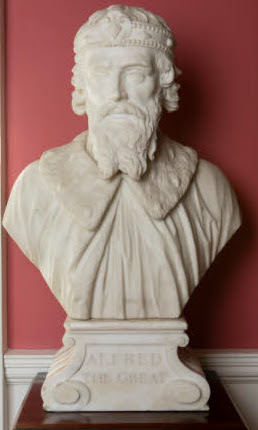
Alfred The Great, Terracotta bust from Queen Caroline's Library, Destroyed in 1906.


Terracotta bust by Michael Rysbrack.

Alfred the Great
 
One of the Eleven Busts from Queen Caroline's Library by Michael Rysbrack.

Seven were accidently destroyed when a shelf collapsed at Windsor Castle in 1906.
 
The Original Photographs were taken by Livingstone in 1874 for a royal inventory.

The busts had been moved to Windsor Castle in 1825 when Queen Caroline’s library at St James’s Palace was demolished.


The Terracotta Bust of Alfred the Great.

This bust had until now been wrongly identified as Edward III.
 
Royal Collection Trust / © HM Queen Elizabeth II, 2015.

........................................


The Stourhead marble bust of Alfred the Great by Michael Rysbrack.


Dreadful lo res photographs from the Nat Trust website.


.........................


Portland Stone bust of Alfred the Great by Michael Rysbrack.
 
in the Temple of British Worthies at Stowe.

The terracotta at Windsor was obviously the model for the Alfred the Great Bust at Stowe 


......................


The earliest representation of Alfred the Great is in Matthew Paris's Major Chronicle of c.1250. 

The portrait above was commissioned by Thomas Walker master of University College Oxford. The claim that Alfred the Great was the founder of the college had been promulgated by William Camden (1551 - 1623) who published Brittania  in 1586 first  in Latin and later in English - 1603 edition of Asser's Life of King Alfred.
 
______________________________________________


Late 17th century Engraving of Alfred the Great.

Michael Burgers.
 
From the Stone head of Alfred the Great at Brasenose College, Oxford.

Engraved by Michael Burgers (1653 - 1727).

43 x 44 mm (cut).
 

...........................


Engraving of the head of Alfred the Great.

by Michael Burgers (1653 - 1727).

258 x 158 mm.
 
Showing two stone heads - the left head being the obvious inspiration for the engraved portrait of Alfred the Great.

Note - Michael Burgers, Engraver, born Amsterdam, emigrated to England 1672/3. 

Working in Oxford, initially as Loggan's assistant from 1673, and appointed (or was called) University engraver after Loggan's death in 1692. Engraved the university almanacks.
 
British Museum.
 
________________________________________________


Late 17th century engraving by Michael Burgers.
 
253 x 158 mm
 
 
Portrait, half length, of Alfred the Great, wearing crown, ermine mantle and holding sceptre, from a statue (?) in St Albans; below two portraits of Alfred with orbs and sceptres; from a window at All Souls' College, Oxford.
 
British Museum.
 
____________________________________


Headpiece from Unidentified book attrib. to Michael Burgers.

74 x 186 mm.
 
British Museum.
___________________________________________


Frontispiece from Sir John Spelman's Life of Aelfred.1709.


____________________________________


Mezzotint of Alfred the Great.

Engraved by John Faber Snr. 1712.

257 x 200mm.

British Museum.
 
.......................


Engraving Anon mid 18th Century
 
156 x 93 mm.
 
NPG.
....................................


Engraving by Giles King.

pub. James Mechell.

c.1733 360 x 230.

British Museum. 

.......................


....................


Engraving by George Vertue 1732.

From Paul Rapin de Thoyras

288 x 191 mm.
 
British Museum 
.......................................


  Alfred the Great.

Engraving by George Vertue.

162 x 92 mm

NPG.
 
.................................... 


Alfred the Great.
 
Plaster Roundel in Caesars Hall, Kedleston. Circa 1760.


.........................

The Joseph Wilton Bust of Alfred the great at University College, Oxford.


Image above from the Paul Mellon Centre Photographic Archive.

https://photoarchive.paul-mellon-centre.ac.uk/objects/406981/bust-of-king-alfred


In 1771, when he was 21 years old, Jacob, 3rd Viscount Folkestone and later 2nd Earl of Radnor presented this bust to the College, costing him £51 18s. This work is based on the bust of King Alfred by Rysbrack at Stourhead, Wiltshire, ordered by Henry Hoare in 1764.


Some more poor low resolution images from the Art UK website.


Whilst the aims of the project are laudable - one has to ask why post such poor quality low resolution photographs. 

At the beginning of the project I had volunteered to take photographs for the scheme but the need for an expensive high resolution camera and to take photographs of stuff that didn't interest me put me off the idea.


  ..........................
 

Friday, 28 August 2015

Elizabeth of York, A Terracotta bust from Queen Carolines Library, damaged in 1906

Terracotta bust by Michael Rysbrack.
Elizabeth of York (1466 -1503), consort of Henry VII.
 
65.3 x 35.0 x 23.0 cms
 
One of The Busts by Michael Rysbrack,
Seven were accidently destroyed when a shelf collapsed
at Windsor Castle in 1906.
 
The Original Photographs were taken by Livingstone in 1874 for a royal inventory.

The busts had been moved to Windsor Castle in 1825 when Queen Caroline’s library at St James’s Palace was demolished.


Damaged by accident 1906 but not destroyed - It remains in the Royal Collection.


Electrotype of Elizabeth of York
Cast by Domenico Brucciani.
Purchased by the NPG in 1870.
864 mm.
NPG.
 
 
This electrotype is a copy from the upper part of the gilt bronze effigy of the queen on the double tomb with her husband Henry VII by the Italian Torrigiano at Westminster Abbey. It is one of a series of electrotype reproductions of tomb effigies made for the National Portrait Gallery by Elkington & Co in the 1870s. An electrotype sculpture of this type is made by electro-deposition of copper onto a mould or cast of an object. The electrotype could then be patinated like bronze


An amusing photograph from A Pictorial History of Westminster Abbey.
1950's
 
 
Elizabeth of York
Funeral Effigy
Westminster Abbey
 
 
387 x 278 mm.
 
Royal Collection.
 
This is an early portrait type of Elizabeth of York. It has been overpainted and scientific research needs to be carried out to verify its date, but it probably dates to the early sixteenth century and therefore could be counted among the earliest Royal Portraits in the Royal Collection. 

The wife of Henry VII is shown in head and shoulders view, holding a white rose in her hands and wearing a ‘gable-hood’. It is possibly a contemporary image taken from the life. In 1502 a Flemish artist, Maynard Waynwyck, was commissioned to paint individual portraits of Henry VII, Elizabeth of York, Princess Margaret and Prince Henry to be sent to Scotland on the occasion of Margaret’s betrothal to James IV. It is possible that this is a variant of this, now lost, portrait type.
 
Royal Collection Trust / © HM Queen Elizabeth II, 2015.


Another early version of the Royal Collection portrait.
From Philip Mould, Historical Portraits.
 
58.5 x 44.5 cms.
Collection of the Earls of Essex at Cassiobury, by descent.


Another anonymous early version of the Royal Collection portrait.
From Philip Mould, Historical Portraits.
29.7 x 23 cms


_______________________________________


Engraving by Pieter Stevens van Gunst, after Adriaen van der Werff
line engraving, 1697
 
318 x 184 mm.
NPG.
___________________________


Engraved by Houbraken for Birch's Heads 1737.
365 x 230 mm.
British Museum.
 

Thursday, 27 August 2015

Henry V, A Terracotta Bust from Queen Caroline's Library

Henry V (1387 - 1422).
 
One of the Seven Terracotta Busts by Michael Rysbrack,
Accidently Destroyed when a Shelf Collapsed
at Windsor Castle in 1906.
Circa 1737.
 
The Original Photographs were taken by Livingstone in 1874 for a royal inventory.

The busts had been moved to Windsor Castle in 1825 when Queen Caroline’s library at St James’s Palace was demolished.  


Royal Collection Trust / © HM Queen Elizabeth II, 2015.
 
__________________________________________________


Henry V.
Oil on Panel 565 x 360 mm.
 
Royal Collection Trust / © HM Queen Elizabeth II, 2015.
 
This is one of the five earliest paintings surviving in the Royal Collection. The others are Henry VI, Edward IV, Richard III and Elizabeth Woodville. Recent dendrochronological (tree-ring) analysis indicates that this panel was painted between 1504-1520. It would have been part of a set of heads of kings and queens either commissioned by Henry VII or Henry VIII.
Perhaps derived from the monument stolen from Westminster Abbey
 
 
First recorded in the 1542 and 1547 inventories of Henry VIII and Edward VI.
Anoth probably slightly later version in the NPG.
 
______________________________


Anon. Early 17th Century.
 
117 x 86mm
NPG
 
________________________________________________


Engraving of Henry V.
 
William Faithorne (1620 - 1691) 
after the oil on board version in the National Portrait Gallery.
93 x 65 mm.
British Museum.
___________________________________________


Mezzotint of Henry V
by John Faber Jnr. c. 1731
254 x 173 mm.
NPG.
_______________________________________________


Henry V.
Engraving by George Vertue, 1732.
284 x 176 mm.
 
 Inscribed 'from an antient Picture now in the Palace at Kensington'