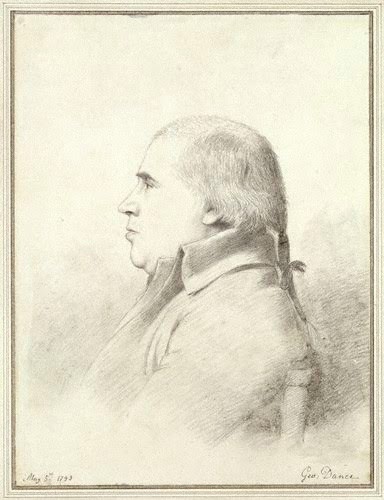
Samuel
Vandewall (1719 – 1761)
and his wife Martha ne Barrow (d. 1793).
Samuel Vandewall was an active Quaker and member of the Linen Drapers Guild.
A
Chronological History prepared to illustrate the social and cultural
life of the owners of a marble bust of Alexander Pope by Roubiliac.
A
few chronological notes on John Vandewall III – (1685 -1731) father
of Samuel Vandewall.
1685. Born
at Harwich. the son of John Vandewall II.
1710. – Member of the Linen Drapers Guild and Citizen of French Ordinary
Court, Crutched Friars, London marries his first wife, Martha Diamond
at the Friends Meeting House, Devonshire House. William Penn, and
George Whitehead are amongst those who sign the marriage certificate.
1714
– 16 Feb, - John Vandewall is described as an eminent corn factor,
and merchant marries his first wife, Ann Moore, daughter of
Joseph Moore of Clements Lane, merchant, and mother of Samuel
Vandewall at the Bull and Mouth Quaker Meeting House in Aldersgate,
City of London.
1714
– 30 December – Birth of Joseph Vandewall at French Ordinary
Court, Crutched Friars, the oldest son.
Note: French Ordinary Court – from Strypes Survey of London 1720 - This Crouched Fryers Street hath several good Buildings and Places of Name, viz. on the North Side, French Ordinary Court already mentioned, being a large open Place with very good Buildings, especially on the East Side; having Pallisado Pales, with Trees before the Court Yards of the Houses, and a Free Stone Pavement betwixt the Houses. Out of this Court is a Passage down Steps into Fenchurch Street.
Now underneath Fenchurch St Station.

The entrance to French Ordinary Court, Crutched Friars City of London.
1719
- 24 December - Birth of Samuel
Vandewall, at French
Ordinary Court, he is the future stepfather of the Neate children in Reynold portrait in the Metropolitan Museum, New York.
1722. John Vandewall was one of the signatories to an address by Quakers to King
George I.
1726
- 6/7 January – his wife Ann Moore / Vandewall (daughter of Joseph Moore) dies of
consumption.
1728 - John Vandewall marries his third wife at the Friends Meeting House Bristol,
Martha Goldney daughter of Thomas Goldney the elder, of Clifton,
Bristol.
1728 - both John Vandewall and Silvanus Bevan
are subscribers to A view of Sir Isaac Newtons Philosophy by Henry
Pemberton.
1731
– 5 January - John Vandewall III dies of a fever and is buried at
the Friends Burial Ground at Whitechapel Mount, his executors are his
brother in law Thomas Gouldney II of Bristol, maker of the famous
grotto at Clifton, Bristol, his father in law from his second wife
Joseph Moore and the Apothecary and amateur sculptor Silvanus
Bevan.
His
estate is left in trust to his children, Joseph Moore is the owner of
a house lands and the Copperas Works at East Greenwich, which is
later to be inherited by Sam. Vandewall.
1742
- 16 September - Martha Gouldney / Vandewall bereaved wife of John Vandewall marries Nehemiah
Champion (1709 -1782 ) of Bristol at the Friends Meeting House, Bristol.
Notes
-
Nehemiah Champion - After Abraham DARBY left the brass mills at
Baptist Mills, on the Avon near Bristol Nehemiah CHAMPION, a Bristol
Quaker, assumed leadership. He was son of Nehemiah, a Bristol
merchant who lived at 68 Old Market, who traded, with his son
Richard, with Abraham Darby of Coalbrookdale, buying and re-selling
his hollow-ware pots and pig iron.
In 1723 Nehemiah held a patent for
a new method of preparing copper for use in brass making which was
used at Baptist Mills.
Nehemiah had three sons, the eldest being John (1705-1794), the second Nehemiah (1709-1782) and the youngest William (1710-1789). William travelled extensively to the continent to learn the art of brass making, returning to Bristol in 1730. He then experimented at Baptist Mills with producing metallic zinc sulphide (which at that time was imported from India and Asia at a high price) from English calamine. He was the first man, in this country, to produce zinc on a commercial scale and it took him about six years to achieve success. He obtained a patent for his method in July 1738 and his system remained in production for over 100 years.
Nehemiah had three sons, the eldest being John (1705-1794), the second Nehemiah (1709-1782) and the youngest William (1710-1789). William travelled extensively to the continent to learn the art of brass making, returning to Bristol in 1730. He then experimented at Baptist Mills with producing metallic zinc sulphide (which at that time was imported from India and Asia at a high price) from English calamine. He was the first man, in this country, to produce zinc on a commercial scale and it took him about six years to achieve success. He obtained a patent for his method in July 1738 and his system remained in production for over 100 years.
In
1742 father Nehemiah Champion married the widow of John Vandewall, Martha VANDEWALL (a sister of
Thomas GOLDNEY), and moved to a new home in Clifton opposite the
family home of the Goldneys. This cemented a relationship with the
Goldney family, which was to last for many years.
In 1746 Champion broke away from the Bristol Brass & Copper Co. and formed the partnership called the Warmley Company for "the making of copper and brass, spelter and various utensils in copper and brass". His chief objective in founding the new company was to exploit his patent for making spelter or zinc from calamine. William Champion recruited workmen from the continent who agreed to come if they could have free exercise of their religion for which permission was obtained.
At this time large quantities of spelter were being imported from the East Indies, and desperate efforts were made by the merchants to crush him. Before his invention spelter had been selling at £260 per ton, but the Bristol importers undercut him until in 1750 they were selling it at £48 to discourage him from continuing to smelt zinc. Although they were losing money at this price they made it impossible for William to sell his stock at a profit - he lost about £4000 on the cost of his stock.
The early partners in this venture were Sampson LLOYD, a Quaker ironfounder of Birmingham who had married William Champion's sister Rachel, Thomas GOLDNEY, a Bristol Quaker, and Thomas CROSBY a Quaker (married to Charles HARFORD's widow, Rachel nee REEVE), and others. These Quakers were all related to the Champion family. The shares in the new Company were divided eight ways and the partners contributed over £1000 each. Because some of the partners were members of The Bristol Brass Co. it was the cause of some ill feeling, which later developed into acrimony.
In 1746 Champion broke away from the Bristol Brass & Copper Co. and formed the partnership called the Warmley Company for "the making of copper and brass, spelter and various utensils in copper and brass". His chief objective in founding the new company was to exploit his patent for making spelter or zinc from calamine. William Champion recruited workmen from the continent who agreed to come if they could have free exercise of their religion for which permission was obtained.
At this time large quantities of spelter were being imported from the East Indies, and desperate efforts were made by the merchants to crush him. Before his invention spelter had been selling at £260 per ton, but the Bristol importers undercut him until in 1750 they were selling it at £48 to discourage him from continuing to smelt zinc. Although they were losing money at this price they made it impossible for William to sell his stock at a profit - he lost about £4000 on the cost of his stock.
The early partners in this venture were Sampson LLOYD, a Quaker ironfounder of Birmingham who had married William Champion's sister Rachel, Thomas GOLDNEY, a Bristol Quaker, and Thomas CROSBY a Quaker (married to Charles HARFORD's widow, Rachel nee REEVE), and others. These Quakers were all related to the Champion family. The shares in the new Company were divided eight ways and the partners contributed over £1000 each. Because some of the partners were members of The Bristol Brass Co. it was the cause of some ill feeling, which later developed into acrimony.
1739.
John Vandewall's eldest son aged 25, Joseph Vandewall (married to Frances Ingram)
dies of fever at French Ordinary Court.
-------------------------------------------------------------------------
A Chronological history
of Samuel Vandewall (1719 - 1761).
1719
– 24 December. Samuel Vandewall is born at French Ordinary Court,
Crutched Friars, London – the son of John Vandewall II and his second
wife Anne Moore.
1731.
The death of his father John Vandewall III. The executors of his fathers
will are his grandfather, Joseph Moore, the owner of property and
Copperas business at East Greenwich, Thomas Goldney and Silvanus
Bevan, apothecary of
Plough Court, Lombard St. London
Some
notes on Silvanus Bevan F.R.S. of Plough Court, Lombard St. London.
(1691 -1761).
I
intend to write a more detailed history of Silvanus Bevan in a future
entry to this blog. His name appears several times in the Vandewall family
history, but his connections with Pope and the Vandewall / Neates is
perhaps more than mere coincidence.
Silvanus
Bevan was a very important figure in the Quaker world and a close
associate of the Vandewall family throughout his life. He was born in
Swansea, South Wales of a Quaker Family with mining and copper
smelting interests.
Bevan
was apprenticed with Thomas Mayleigh, Quaker Apothecary of
Gracechurch Street. Mayleigh had interests in America.
Silvanus
Bevan
obtained
his "Freedom" from the Worshipful
Society of Apothecaries
in
1715
having served his seven years’ apprenticeship. He then established
his Pharmacy at Number Two Plough Court, Lombard Street in the city
of London,
the
former family home of Alexander
Pope,
the poet, where Pope was born in 1688.
He leased the building at Plough Court from linen draper and tobacco dealer, another Quaker Salem Osgood. William
Cookworthy
(1705 - 80) (see below) was one of his apprentices.
On
9
November
1715,
he married Elizabeth, the daughter of Daniel
Quare,
the royal clockmaker at the Gracechurch St, Friends' meeting-house in
the City. His wedding was attended by many of the Great and good including Sarah
the Duchess of Marlborough,
Lord Finch, Lady Cartwright, William
Penn,
the Venetian ambassador and his wife. Elizabeth died soon after their
marriage in giving birth to a son, who lived for only a few hours.
Silvanus Bevan subsequently married Martha Heathcote, by whom he had no children.
His business at Plough Court prospered and he was joined by his younger brother,
Timothy Bevan (1704-1786) in 1725.
He
was elected Fellow of the Royal Society 1725 and was a friend of the
renowned Dr Richard Meade.
Timothy Bevan,
who married Elizabeth Barclay of the Barclays Banking family
continued the Plough Court Pharmacy after his brother's retirement.
He was succeeded by his son, Joseph Gurney Bevan (1753-1854).
Plough
Court Pharmacy became one of the leading pharmaceutical companies in
London in the nineteenth century, under William
Allen
and the Hanbury family, called Allen
& Hanburys.
It still exists as Smith, Kline, Beecham.
There
is a portrait of Timothy Bevan illustrated in Plough Court, The Story
of a Notable Pharmacy by Ernest C. Cripps 1927 which appears to be by
Thomas
Hudson
of about 1740 but it has disappeared.
William
Cookworthy, Apothecary went into partnership with the Bevan Brothers
in Plymouth, as an apothecary but he is probably best remembered and
most importantly for the part he played in the development of the
English porcelain industry using China Clay from Thomas Pitt, Lord
Camelford’s estates in Cornwall. They
primarily made decorated tea services, jugs and vases. However, the
business was not very profitable at Plymouth, and it amalgamated with
a pottery in Bristol.
Cookworthy
made his cousin, Richard Champion (1743 – 91), his manager of
"William Cookworthy and Company." In 1774, Cookworthy sold
his interest in the business and patent to Champion. Champion
continued to buy the ingredients for the porcelain from Camelford,
and paid a royalty to Cookworthy. A London warehouse, at 17 Salisbury
Court, Fleet Street, was opened in 1776 and the best period of the
enterprise seems to have been from 1776 to 1778, but at the end of
that time Champion was forced to sell up to Wedgwood and a consortium
of Stoke on Trent Potters.
Cookworthy
and Bevan's apothecary shop in Plymouth, Devon was established in 1735, and continued in business as a pharmacy premise until 1974 when the last proprietor
retired.
Silvanus
Bevan was associated with another London Quaker business man Thomas
Hyams, and Benjamin Franklin with the establishment of The
Pennsylvania Hospital in Philadelphia in the 1750’s.
Silvanus Bevan
is also known for carving in ivory the only known portrait of William
Penn and carved many other portrait reliefs in stone and ivory some
of which were reproduced by Wedgwood in the late 18th
century.
In
later life he lived at Barber's Barn, off Mare Street in Hackney where
he had a famous garden and where Busch, the future gardener to
Catherine the Great of Russia was employed, leaving in 1771. This
garden later became the famous Loddiges Nursery.
---------------------------------------------------------------------
1737.
The marriage of Samuel Vandewall's older brother Joseph Vandewall to
Frances Ingram daughter of Joseph Ingram of Cheapside, Draper,
amongst those at the wedding were the apothecary Silvanus
Bevan, Joseph Moore, and
many of the Ingram family.
1739.
– 5 Nov. His older brother Joseph (b. 1714) dies of fever at French
Ordinary Court. Crutched Friars, He leaves to his dear wife Frances
his personal estate and the reversion of an estate at Greenwich
“settled on testator” by his father in law Joseph Ingram on his
Marriage.
1740.
Samuel Vandewall inherits Ravensbourne House and the Copperas works
at East Greenwich next to the Ravensbourne at Deptford Creek and also
property in Peckham, South London from Joseph Moore, his grandfather
on his mothers side. The Gentleman’s Magazine in its usual
mercenary manner reports the death of Joseph Moore and estate of £30,000, an immense
amount of money at the time. See Public Records Office, Kew London,
Will of Joseph Moore. Prob 11/705.
Copperas
was a valuable substance used in the production of acids &
chlorine, as a dye fixative, printers ink, tanning agent and as a
component of gunpowder. It was obtained from iron pyrite-rich nodules
found within London Clay. The stones were placed in chalk or
clay-lined beds and left to weather for up to 6 years! The resulting
liquid was boiled with scrap metal for 3 weeks then cooled for 15
days during which time it crystallised. The ferrous sulphate crystals
were then heated to melting point and poured into moulds. Copperas
works prospered for some 200 years and by 1746 England was amongst
the largest sources in Europe. However this method of production was
superseded during the 18th
century and the Deptford works closed in 1828.
Charles
Pearson a member of the Glovers Company took over the Copperas
industry at East Greenwich and was living at Ravensbourne House in
1780. He married Elizabeth Radford. He seems to have taken over the
manufacture of Copperas products throughout the Thames Estuary area
including those at the Crispe works at Deptford on the West side of
the Deptford Creek and at Tankerton, Whitstable, Kent.
Mr
Sympsons works at Tankerton in Kent were sold to Thomas Gold who left them to
Elizabeth Radford.
See
-The Copperas Industry (Allen and Pike 1997; Allen, Pike and
Cotterill) provided the foundation for the development of the modern
chemical and pharmaceutical industries and was also the first heavily
capitalised industry to be established in Britain.
For an excellent in depth study of the Copperas Industry in Kent see also
1740’s – Both
Samuel Vandewall and Harris
Neate had their portraits painted by George Knapton (1698 -1778) at about the same time. George
Knapton, and Thomas Hudson had both been pupils in the studio of
Jonathan Richardson and had become very successful portrait painters. (both
portraits now in the possession of Susannah Harris Hughs).
1740
- 11 April, Thomas
Neate II
was born at Laurence Pountney Hill, City to Harris Neate and Martha
Neate ne Barrow.
1740
- Harris Neat & Co, Merchants of Laurence Pountney Hill are noted in
Kent’s Directory of London.
1741
– Birth of Martha Neate.
1742
- 6 September – Harris Neate of the parish of St Lawrence Jewry,
died of a fever and is buried at Friends Burial Ground, Long Lane.
London.
1743
- Saturday, June 18, Daily
Advertiser,
London, England, Issue 3874.
"A
black negro women about nineteen years old with two letters on her
breast and her shoulder made her escape from the ship Hannah, Capt
Fowler, for Jamaica the 6th inst. Goes by the name of Sabinah is
supposed to be deluded away by some other black about Whitechapel,
Rag Fair or Rotherhith, whoever brings her to the late Mr Neates, on
Lawrence Pountney Hill, shall have three guineas reward, or if put on
board the ship again any time between this and next Tuesday, ten
shillings more".
The
above advert was repeated in the Daily Advertiser (London,
England), Wednesday, September 14, 1743; Issue 3949 without the last
sentence.
1744,
Samuel Vandewall married`Martha Neate the widow of Harris Neate, nee Barrow at the Hereford,
Worcester and Wales, Quaker Meeting House.
1744.
22 November. The marriage was also celebrated at the Friends Meeting
House, Devonshire House in London, amongst those present were Samuel
Hoare, Hannah Harman, Grizzel Hoare (nee Gurnell), Thomas Gurnell,
John Barclay, Thomas Samuel and Mary Ingram, Sarah Gurnell, Gabriel
and Margaret Goldeney, William Markes, Sarah Nichols, Frances,
Daniel, Anna, Sarah, and Elizabeth Vandewall, Anthony
Neate, Nathaniel and
Elizabeth Newberry, William and Jane Lorance, Thomas and George
Marishall, Thomas and Ann Hyam, Michael Russell etc.
Intriguingly
Samuel Johnson in his famous dictionary uses as an example of the use
of the word eminent in the notice of the Gentleman’s Magazine 1745
p.51 “Mr Samuel Vandewall, an eminent merchant was married to the
relict of Mr Harris Neate”.
I
have also found a reference to the Vandewall - Neate marriage in
the Daily Advertiser,
23 November 1744: 'Yesterday was married at the Quakers Meeting at
Devonshire-Squire, Mr.Samuel Vandewall, a Merchant of this City, to
Mrs. Martha Neate, Widow and Relict of Mr.Harris Neate, late an
eminent West-India Merchant of this City, a beautiful Lady, with a
handsome Fortune.'
The
London Evening Post reported on Thursday 22 November 1744, issue 2660
“Last Thursday was married at the Quaker Meeting in Devonshire
Street, Mr Vandewall an eminent merchant to Mrs Neate, widow of Mr
Harris Neate, a West India merchant, an agreeable lady with a large
fortune, after the ceremony was over there was an elegant
entertainment prepar'd at the White Lion Tavern in Cornhill,
consisting of 60 dishes where 110 persons sat for dinner” It
was again reported in the General Advertiser 23 November 1744 issue
3129 using
the same wording.

Scan of the Thomas Hudson Portrait of Samuel Vandewall c. 1744.
In about 1744.
Samuel Vandewall, aged about 25, has his portrait painted by the
celebrated portrait painter Thomas
Hudson (1701 -1779) who
was then at his peak of popularity. Hudson lived and worked at 55 -
56 Great Queen St.
It seems most likely that this is a portrait painted
to celebrate his wedding to Martha Neate and that a matching portrait
of Martha also existed.
Thomas Hudson was a former pupil and son in law of
the portrait painter Jonathan Richardson, He was the most successful
portrait painter of this period and amongst his pupils were Joshua
Reynolds and Allan Ramsay.
Samuel
Vandewall is portrayed in the van Dyke manner popular at the time and
unusually for a Quaker he is shown three quarter length with a sword
at his side and a masquerade mask in his hand – the clothing was
probably painted by Hudson’s drapery painter van Aken.
This
portrait was sold from the collection of Admiral Sir Walter Cowan Bt.
By decent from the sitter by Sotheby’s, Bond St, London lot 45, 22
November 1967. Information – Heinz Archive, National Portrait
Gallery, London.
If
the note on the Metropolitan Museum website with reference to the
Diary once in the possession of Eleanor Neate is
correct then it would have been at about this time that the
friendship between the young Joshua Reynolds and Samuel Vandewall
developed.
It
is interesting to surmise his possible relationship with other
members of the St Martin's Lane artistic community including
architect Isaac Ware, who was the architect for the division of
Lindsay House, (bought by Samuel Vandewall in 1752), Hogarth to whose
prints he later subscribed, and the men who made his furniture and
who supplied his pictures.
Perhaps
the pocket book mentioned in the Walpole Society Journal in 1916,
once in the possession of Eleanore Neate and recording a payment to
Joshua Reynolds for the portrait of Joseph Vandewall still exists
somewhere and will one day reappear.
Records
of National Portrait Gallery Portrait of Samuel Vandewall in
Collection Admiral Sir Walter Cowan. bought. Sothebys, Nov. 22 1967
Lot 45. Prov. By descent from the sitter? Catalogue Illustration.
1745.
– 26 July - Joseph Moore Vandewall was born at Brabant Court, in
the City of London, the child in the portrait by Joshua Reynolds.

No. 4, Brabant Court today - perhaps the address of Samuel Vandewall in the 1740's.
1746
to 1756 Samuel Vandewall is listed as one of the Governor 'takers
in' of St Thomas Hospital, Southwark who met weekly to deal with
admissions to the hospital.
1748.
– 28 Feb – Joseph Moore Vandewall died of teething. This is the
child painted by Sir Joshua Reynolds.
1747.
Joseph Moore Vandewall was painted by Joshua Reynolds. This painting
sold by Christie's London 1 December 2000, lot 31. Provenance
- by
descent to Commander C.E. Neate; Sotheby's London, 3 July 1956, lot
31, (1,350 gns. to Agnews). It was sold by Agnews to Vice-Admiral
B.C.B. Brooke, 1957. It was acquired through Agnews by Sir Michael
Sobell, 1959.
See
- D. Mannings, Sir
Joshua Reynolds, A Complete Catalogue of his Paintings,
London, 2000, p. 452, no. 1785, fig. 27.
September
1748 Sam. Vandewall gave £20 for the relief by the fire in Cornhill
on 25 March – Gentlemans Magazine Vol XV111.
1748.
The Neate
children, Thomas and Martha Neate his
two stepchildren with their tutor Mr Needham are painted by Sir
Joshua Reynolds. See above.
See
Walpole Society Journal 1918 “the father of the two children (Samuel Vandewall) was a
friend of the young artist (Reynolds) and a diary once in the
possession of Miss Eleanor Neate recorded a payment to Reynolds for a
portrait, but the sum mentioned was thought too small to apply to
this portrait group. (This payment obviously refers to the portrait of Joseph Vandewall only child of
Sam. Vandewall and Martha who died aged two and a half).
An old label on the back of the Met. portrait gives us a little help. It says “Boy the paternal grandfather of
the Rev. A. Neate. / Girl sister of the above married — Williams of
—, Esqre / Tall figure Needham tutor of the Boy. / Painted by Sir
Joshua Reynolds.
It
is an unusual portrait in that it prominently shows the children's tutor Thomas
Needham. Samuel Vandewall left in his will, to Mr Thomas Needham of
Clifford’s Inn. Gent. £800.
This
portrait illustrates the cultured world that Samuel Vandewall
inhabited, employing the up and coming portraitist who was to
supersede Thomas Hudson by the 1750’s as the premier portrait
painter in England.
1750.
Brother of Martha Barrow / Neate / Vandewall – Francis
Barrow, of Charleston.
Brother-in-law: Mr. Samuel Vanderwall of
London, all estate.
Mentions: Alexander Broghton and Thomas
Broghton, Jr. of Charlestown, merchants, executors.
Wit: William
Michie, John Snow
D: 12 July 1750, P: 20 July 1750 R: nd P. 30
Page 117.
1750.
Both Samuel Vandewall and his wife Martha subscribe to The Posthumous Works
of Jeremiah Seed, MA.
1751.
Sam Vandewall subscribes to two engravings by William Hogarth of Paul
before Felix and Moses brought to Pharoah’s Daughter – The
subscription ticket – an engraving entitled Paul before Felix
(Burlesqued) was advertised in The General Advertiser, 15 May.
1751.
A copy with the Robert McDougal Gallery Christchurch, New Zealand noted 2002,
with Saml Vandewall Jun 5th
1751. written in as subscriber.
Note: Autograph Letters and Historical Documents - Page 136 Catalogue of Maggs Bros, Maggs Bros - Autographs - 1928 - 304 pages.
2522
HOGARTH
(WILLIAM, 1697-1764). Famous Painter and Engraver. ...
Vandewall
for the first instalment of his subscription to two Prints, "
Moses brought to …This was the
source of the McDougal Gallery engraved subscription ticket. Source -Google Books
30
Dec 1751
-
From – The Oxfordshire Record Office
E8
ALVESCOT ESTATE - ESTATE OF THOMAS NEATE & ARTHUR NEATE: MAINLY
PROPERTY IN MIDDLESEX AND KENT (E8/8) TITLE DEEDS and Associated
Papers
E8/8/D/01-02
Lease and Release.
Parties:
- Silvanus Bevan of London, apothecary, and Walter Coleman of Black Fryars, London, woollen draper.
- Frances Vandewall of Bloomsbury, Middx. Widow.
A
few notes - Frances Vandewall (ne Ingram see below).
Captain
George Augustus Killigrew
was born sometime before 1719. He was the son of Thomas
Killigrew.
He served in Col. Douglas' Regiment of Marines according to the 1740 Army list: Captain George Augustus Killigrew, commission dated 10 Dec 1739, Ensign 17 Dec 1735 on 10 December 1735.
He served in Col. Douglas' Regiment of Marines according to the 1740 Army list: Captain George Augustus Killigrew, commission dated 10 Dec 1739, Ensign 17 Dec 1735 on 10 December 1735.
Captain George Augustus Killigrew and Frances
Vandewall
obtained a marriage licence on 27 June 1753 at London.
Captain George Augustus Killigrew married Frances Vandewall after 27 June 1753.
Capt George Augustus Killigrew to Sir R Wilmot. Scheme to dispose of his troop and retire on the half-pay of captain on the Irish establishment. Stewart Douglass willing to resign half-pay for him.
George died before 20 August 1757 at Bond Street, Soho, Westminster.
His will was proved on 20 August 1757 at the Prerogative Court of Canterbury. He was a Captain in the Regiment of Carabiniers.
3.
Samuel Vandewall of East Greenwich, Kent, Esq.
Property:
Moiety of seven messuages and lands in St.Giles without Cripple Gate,
Middx., eight messuages and lands in Whitecross St. St.Giles messuage
with summer house, messuage in Gloucester Court, ten messuages in
Crown Court, Whitecross St., messuages and lands in Whites yard,
eight messuages in and near Basket alley near Golden Lane, eight messuages
and lands in Carpenters Yard, Whitecross st., three messuages and
lands in Golden Lane, thirteen cottages or almshouses in Golden lane,
St.Giles, in the Lordship of Finsbury; parties
1. and 2. convey to 3. Comments:
deed recites details of Lease and Release
dated 12/13 Aug 1737.

1751.
Sam. Vandewall takes Lindsey House, Arch Row, now 60, Lincoln's Inn
Fields. Described as ‘Perhaps historically, the most important
single house in London’ (John Summerson). It was purchased from The
Duchess of Somerset. This house was divided into two by the architect
Isaac Ware.

Originally
one great house, the centrepiece of Arch Row, perhaps designed by
Inigo Jones and put up for the gentleman speculator William Newton in
1638 - 41, (see Vitrouvious Britanicus for the elevation and plans).

Lindsey
House was divided into two in 1751 and altered by Isaac Ware (who sat
to the sculptor Roubiliac in 1741). New staircases were inserted. These two houses
become 59 and 60 Lincolns Inn Fields. Other residents include the
future Prime Minister Spencer Percival (1762 - 1812). The house still
stands although much altered. Henry Shiffner, M.P. an executor of Sam
Vandewall’s will lived next door at 59 the other half of Lindsay
House from 1757.
Info.
Survey of London.

In
Charles
Dickens'
novel Bleak
House,
the sinister solicitor to the aristocracy Mr Tulkinghorn has his
offices in Lincoln's Inn Fields, and one of its most dramatic scenes
is set there. The description of his building corresponds most
closely to Lindsey House.
After a spell as a patent agents, Lindsey
House, 60 Lincolns Inn Fields has become home to the leading civil
liberties barristers', Garden Court Chambers.

1752-57
his neighbour at 59 was Samuel Wegg – of
the Hudson Bay Company.
Note
-Wegg,
Samuel,
Governor, Hudson’s Bay Company, 1782-1799.
Samuel
Wegg was the second son of George Wegg of Cochester, Essex, a
merchant tailor, born on 17 November 1723. His mother was Anna Maria
Cowper, daughter of John Cowper of Cornhill, London; she was the
third wife of George Wegg. He attended schools at Colchester and Bury
St. Edmunds before being admitted to St. John’s, Cambridge. He was
admitted to Gray’s Inn in 1741 and admitted to the Bar in 1746.
Samuel Wegg received his first stock in the Company at the age of 25,
on the death of his father in 1748. He was elected a member of the
Committee of the Hudson’s Bay Company in 1760; and served as
Governor from 1782-1799. Wegg was elected a Fellow of the Royal
Society in 1753 and played an important role in the relationship
between the Society and the Company. He died at his own in Action in
December 1802.
Elected
fellow of the Royal Soc.1753.
Samuel
Wegg was followed by Henry Shiffner who lived there from 1757 –
1762.
Henry Shiffner was executor of the will of Samuel Vandewall.
Notes
-Henry Shiffner who married Mary, a Bridger heiress, came of a
merchant family. His grandfather, Matthew, was a Russian subject who
became a naturalized Englishman in 1711 under the Act 7 Anne, c.5
(1708), and is described as 'an Antient Member of the Russia Company
in England'; he took up residence in London. Matthew's father was
reputedly an Archbishop of Riga, Matthew married Agnata Brewer, said
to be gouvernante to the Duchess of Courland, who later became
Empress Ann of Russia, 1730-1740 (not Elizabeth, as stated in some
papers i The Empress was godmother to Matthew's daughter Benigna.)
but no such dignity seems to have ever existed. Matthew refers to
five of his six children in his will proved in 1756, and it appears
that his sons Henry and John carried on his trade as merchants in
Broad Street, London, principally with Northern Europe, and we have
some accounts and papers relating to their insolvency in 1761 which
Henry, in a letter to the Duke of Newcastle, ascribed to his
brother's foolishness. It was an unfortunate event because Henry has
just been elected Member of Parliament for Minehead, Somerset.
For more see
the Shiffner Archive -
for an
excellent short biog of Henry Shiffner see -
http://www.historyofparliamentonline.org/volume/1754-1790/member/shiffner-henry-1721-95
1751.
From Oxfordshire County Records, Alvescot Estate.
Lease
and Release - E8/8/D/01-02 30
Dec 1751 - Parties:
1.
Silvanus
Bevan of London,
apothecary, and Walter Coleman of Black Fryars, London, woollen
draper
2.
Frances Vandewall (ne Ingram) of Bloomsbury, Middx., widow (of Joseph
Vandewall, brother of Samuel)
3.
Samuel
Vandewall of East
Greenwich, Kent, Esq.
Property:
Moiety of seven messuages and lands in St.Giles without Cripple Gate,
Middx., eight messuages and lands in Whitecross St., St.Giles,
messuage with summer house, messuage in Gloucester Court, ten
messuages in Crown Court, Whitecross St., messuages and lands in
Whites yard, eight messuages in and near Basket Alley near Golden
Lane, eight messuages
and lands in Carpenters Yard, Whitecross St., three messuages and
lands in Golden Lane, thirteen cottages or almshouses in Golden lane,
St. Giles, in the Lordship of Finsbury; parties
1. and 2. convey to 3.
Comments:
deed recites details of Lease and Release dated 12/13 Aug 1737.
1752.
Vandewall, Samuel is listed in the Complete Guide as at Brabant Court,
Philpot Lane.
1753
Samuel Vandewall subscribes to The Works of the late Aaron Hill Esq.
1753 Sam. Vandewall subscribes £5 to a fund for the suppression of
Lawlessness at Blackheath.
1753
- Reported sold at auction in 2008 - see Artnet - Brecon
- Pipton. A large nine-page vellum indenture, 25th July 1753,
concerning the release of lands in Pipton to John Lloyd and Thomas
Williams, for the sum of £6,240, somewhat soiled and some lettering
faded, with ten seals and signatures, including Thomas Foley, Phineas
Andrew, Samuel
Vande Wall,
Nathaniel
Newberry,
Thomas Browne, Thomas Williams, Mary Williams, S Alston and P Case,
overall 64 x 75 cm.
1753. - It was reported in Read's Weekly Journal or British Gazetteer (London, England), Saturday, September 15, 1753; Issue 1486. - Mr Goulding of St Paul's Churchyard was chosen Master of the Drapers Company for the year ensuing, in the room of Mr Vandewall who has paid his fine to be excused from the said office.
1754.
Sam.Vandewall purchased the Lordship of the Manor, and the Rectory of
Aldenham, Hertford from the Prime Minister Thomas Pelham Holles,
Duke of Newcastle (1693 - 1768), who lived two doors away from
Sam.Vandewall at Newcastle House, Arch Row, Lincolns Inn Fields. (Newcastle was
Prime Minister (1754 - 1756 and 1757 - 1762).
Martha
Vandewall in turn became patron of the living at Aldenham and
presented three rectors in 14 April 1774, 7 June 1775 and 20 March
1794.
1755. Dr
Johnsons Dictionary is published – for the word eminent he uses the
example of
Samuel
Vandewall, an eminent merchant, was married to the relict of Mr.
Harris Neate.' Gentleman’s
Magazine 1745.
1756.
Samuel Vandewall and Sylvanus Bevan are both listed as Governors and Guardians of the foundling Hospital.
1755.
- 65 - Benjamin West paints the portrait of Mrs Vandewall.
C.1760.
A miniature enamel portrait of Samuel Vandewall is painted by Gervase
Spencer (d. 1763) a leading miniature portrait painter of his day.
Sold Sotheby’s.
1757.
- 11 August Samuel Vandewall makes his will at Greenwich.
1758.
Samuel Vandewall subscribed to “History of the life and reign of
Philip King of Macedon the Father of Alexander by Thomas Leland DD
1758.
Both Samuel and Martha Vandewall subscribe to Milton – Paradise
Lost, published by Tonson.
1758
Samuel Vandewall subscribes £5. 5s. To the Marine Society, from June
1756, to February 16, 1758.
note.
philanthropist Jonas Hanway founded the Marine Society the first
seamans charity.
1760.
Easter Term 1760. Court of Kings Bench, Rex v Vandewall presided over by Lord
Mansfield. Samuel Vandewall was Lord of the Manor of Aldenham.
1760. June 5. Is
listed as a member of the Soc. for the encouragement of Arts,
Manufactures and Commerce.
1761.
22 – Feb. Death of Sam. Vandewall, Esquire
at Lincolns Inn Fields. See The Gentleman’s Mag.
It
was reported in the London
Chronicle (Semi-Annual) (London,
England), Saturday, February 21, 1761; Friday morning died at his
house in Lincolns Inn Fields; Mr Vandewall a gentleman of large
fortune.
In
his will he leaves his wife Martha £500 a year, and gives her a
further sum of £5,000, he also gives her the house in Lincoln's Inn
Fields “where he resides when in London and also gives her all his
furniture, books, pictures etc. at both his houses at Lincolns Inn
Fields and at Greenwich”. (Lindsey House and Ravensbourne House).
For a comprehensive history of the Copperas works owned by Sam. Vandewall, inherited by his stepson Thomas Neate and then owned by Pearson see -
He also left
Thomas Needham Esq. of Clifford's Inn, Gent. £800. ) ( PCC 110
Cheslyn.)
The
rest of his property he leaves in trust for Thomas and Martha Neate
and four other relatives.
Executors
are Henry Shiffner (of 59 Lincolns Inn Fields, MP of Pontrylas,
Hereford, and from a family of former German / Russia Merchants) and
Nathaniel Newberry merchant (who owned land in Pennsylvania).
He
left John Bynes, supervisor of his Copperas
works
at Greenwich £20.
There
existed an Account Book of Thomas Neate which was seen by Lt Cmdr
Frederick. Colvile. (This account book unfortunately disappeared but
notes with Susanna Harris Hughs).
This extensive account book has now been found and will be the subject of new posts in due course.
It notes -
“According
to the inventory Samuel Vandewall who died 8.2.1761 had estates”
a)
Aldenham -
£16,109, Freehold
b)
Common Birch, Aldenham, £400
Copyhold
c)
Whitecross St, £2129.
d)
Hyde Green, Ingatestone. (Essex), £1348.
e)
Peckham, £3,126.
f)
Jordans, (Quaker meeting House properties) £2,298.
g)
Greenwich, £1,712:11.
h)
Stable Yard St, Greenwich, £230.
i)
Copperas, the works and Ravensbourne House, Greenwich, £5,000.
j)
House Arch Row), Lincolns Inn Fields, £3,972.
k)
Lead Mines at Wirksworth, £75 (1/48 share)
l)
Lifehold from Harris Neate at Gastard, £2,500.
Samuel Vandewall was interred in the family vault that he had prepared in his lifetime
at Jordans Quaker Meeting House Burial Ground, Chalfont St Peters,
Buckinghamshire. Rebekah Butterfields Journal 27th Feb
1761 states that “Samuel Vandeval Esquier was buried at Jor. Thomas
Whited (Whitehead) spoke at ye grave their was ye hairse and four
coches”
William
Penn of Pennsylvania is buried close by. Friends had objected to this
outward display of ostentation by Samuel Vandewall but he simply
added in 1748 a plot of his own land adjacent to the burial ground
and made his vault. This was for many years separated from the main
burial ground by a row of lime trees but these have now disappeared.
The
appearance of the vault was like an ancient tumulus or burial mound,
the enclosure was about 10 yards by 9 yards wide.
“From
the abstracts of trust property belonging to the Upperside Monthly
Meeting, it appears that, "by indenture of lease and release,
dated 23rd and 24th of 6th month, 1763, the devisees of the late
Samuel Vanderwall added a piece of ground adjoining to Friends'
Burial Ground on the north side, in the first place for a burying
place for the family of the late S.V., and then for the use of
Friends in the like manner as the Burial Ground is. The length of it
is about twenty-two yards and width ten yards, taken from an orchard
called Garden
Orchard, a part of an estate called Jordans, which by recent purchase
had become the property of the late Samuel Vanderwall."
Another
account states that Samuel Vandewall had made over the ground in his
lifetime, by a deed dated 1748, but there would' seem to be some
error here. Possibly 1748 was the date of his purchase of the old
Jordans property. Later on, by indenture dated 17th day of July,
1777, the same piece of ground was transferred in trust to Joseph
Steevens, T. Edmonds, sen., R. Eeles, sen., R. Eeles, jun., T.
Bayley, and T. Edmonds, jun., whereby the whole of the property of
the Friends at Jordans became vested in the same trustees.” - From
Memories of Jordans and the Chalfonts… by WH Summers 1895.
Jordans
Meeting House and burial ground founded 1688, also contains the
bodies of William Penn, Founder of the Commonwealth of Pennsylvania,
buried in 1718 and his family, Isaac Pennington and other early
Quaker grandees. The meeting house recently suffered a fire and has
been rebuilt as it was.
Amusingly
for many years many visitors confused this vault, because of its
grandness, with the grave of William Penn.
See
- November 20, 1898, Wednesday. New York Times. Section:
illustrated Magazine Supplement, Page IMS13,
Digitalised
full text of Memories of Jordans and the Chalfonts and the Early
Friends in the Chiltern Hundreds by WH Summers 1895.
1762.
- Martha Vandewall leaves Lindsey House 60 Lincoln's Inn Fields.
1766. In 1767. Martha Vandewall’s address is given as Harley St, London –
See
Assignments of mortgages in connection with DE/Wy/39603, and
DE/Wy/39604,
These are the Manorial
Records, Title deeds and family papers
of the Heaton Ellis family of Wyddial Hall, 1465-1885. Also Gulston
Wyddial papers. Hertfordshire
Archives and Local Studies.
1771.
Thomas Neate marries Charlotte Seward (sister of the dilettante author William Seward) at St Giles, Cripplegate,
London.
In
1771, Martha Vandewall appears to be living with her daughter Martha
Williams at Roehampton.
1773;
General Evening Post (London,
England), Tuesday, April 13, 1773; Issue 6164. The death of John
Williams, husband of Martha Neate is reported.
“on
Monday last at Mrs Vandewalls house in Harley Street, - John Williams
Esq of Pant Howell in the county of Carmarthen.
1777.
Martha Vandewall moved to Bath.
...........................................
The History of St. Lukes, Golden Lane.
Previously properties owned by the Vandewalls.
The boys’ school began in a house in Golden Lane. Although there are no records of the Foundation, or Institution in actual documents, there are many references in contemporary writings to The Greycoat Charity School for boys, Golden Lane, founded 1698. The boys were dressed in a grey uniform, giving the school its name.
In the year 1732 the parish boundaries were altered. The school, now in a new parish changed its name to the St Luke’s Charity School for Boys, Golden Lane.
The boys’ school was fulfilling the hopes of its founders and its success inspired efforts to provide a similar school for the girls of the parish.
Twenty girls were admitted in 1761 and although there were many applicants each year the number remained constant until 1772.
Both schools were inundated with applications and had to turn down the majority because of lack of space.
In 1773 the committee decided that something must be done to make more space available so that more children could be admitted, for applications were still far in excess of the numbers that could be accommodated.
After a great deal of searching in the overcrowded parish a possible site was eventually found, and on the 3rd March 1780 the foundation stone of a new building was laid.
The site in Golden Lane was originally occupied by some dilapidated almshouses. The owners, Mrs. Mary Vanderwall? (Martha Vandewall) and her son, Thomas Neate Esq. agreed that the trustees could have the site, for the purpose of building a school and no other, on a 999 years’ lease.
...........................................
1780
- William Storer’s petition to Parliament for funding of
experiments to improve his newly
invented
portable telescope, 1780
-
Note
- From The Journal of the House of Commons, vol. XXXVIII November 26th
1778 to August 24th 1780. is signed by Mrs Vandewall and many of the
great and good.
1784.
Martha Vandewall inherits from William Markes, Citizen and Glover of
Cheapside, (see family tree), £20 and the five pictures in his
Dining Room.
18
Jan 1787 – In the newspaper The Bath Chronicle - Property:
to let - modern-built house & court, coach-house, kitchen,
gardens etc, next to Lansdown Rd, Walcot, late in occuptn Harford
Lloyd, esq. Previous tenant Mrs Vandewall. Partcrs John Jefferys,
Crescent, Bath. [No lease details/price given].
22
Feb. 1787 – Bath Chronicle - Property:
to let or for sale - large modern house with spacious area and court
before it and coach house stable and kitchen gardens & pleasure
grounds, late Harford Lloyd's, esq, & late in possession of Mrs
Vandewall as tenant thereoff. Adjoins Lansdown Road in the parish of
Walcot, near the city of Bath commanding a very rich and variegated
prospect of the beautiful vale, river and hills environing Bath and
not more than a quarter of a mile distant from it. For particulars
and agreement please to apply to John Jeffery's, Crescent, Bath.
These
probably refer to Lansdown Grove a very substantial house on the north slopes overlooking the city– now the Lansdown Grove Hotel.
27
Feb, 1794 – Bath Chronicle - Deaths: Mrs Vandewall of George Street,
Hanover Square, London, at her apartments in Bennett Street, Bath.
Yesterday.
She
is buried in the family vault prepared by Samuel Vandewall at
Jordans, Friends Burial Ground, Chalfont St Giles, Bucks.
From
the Rebekah Butterfield manuscript.
"Martha
Vandewall was put in the Vart [vault] to her husband, her son and
husband's brother. She died 2nd day, 24th of 2nd mo. was brought from
Bath, Beaven's wife of London spoke at her burial. She was 83 years
old." This probably refers to the wife of the apothecary Timothy
Bevan brother of Silvanus of Barbers Barn Hackney, and Plough Court,
Lombard Street, London.
______________________________________________