Wednesday, 16 July 2025

The Lead Statuary at Castle Hill, Devon Part 1


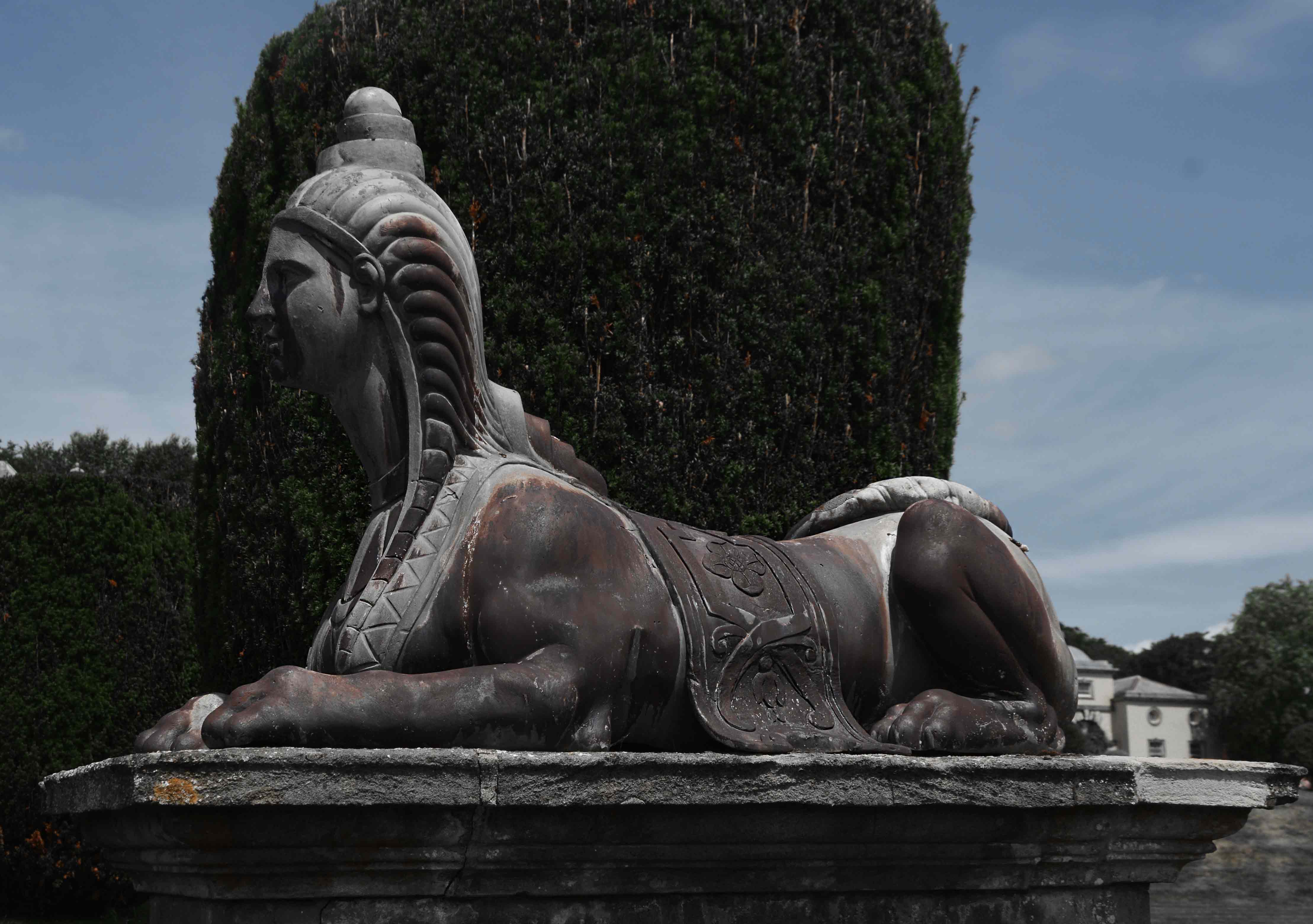
The Four Lead Sphinx.

John Cheere.

One of a set of four.

All four sphinx were cast from the same moulds.

There are remains of a white paint in the crevices which suggests that they were originally painted to appear like marble.

The tails are not handed but sweep across the backs in the same direction,

Photographed by the author July 2025.

It should be noted that these are not from the same model as the pair now at Anglesey Abbey, Cambridge.


Sir Hugh Fortescue (created Lord Clinton in 1721 and Earl of Clinton and Lord Fortescue in 1746), a leading Whig politician, inherited Castle Hill in 1719.


A programme of improvement, with a concentrated period of activity in the early 1730s coinciding with his resignation from political office included the remodelling of both house and grounds.


A new Palladian mansion was designed by Lord Burlington (1694-1753) with advice from the ninth Earl of Pembroke (1693-1749). 

The extent of Earl Clinton's landscape is recorded on field surveys (1763 and 1765), and views by John Wootton (about 1735-1740) and John Lange (1741).


Another Pair of lead shinx at Saltram - Sizes -1210 x 560 mm; 900 mm.

Two Sphinx supplied along with 2 gladiators for £45 3shilllings to Newhailes in 1740 (Newhailes Archives, Davis 1991). Stolen in 1949. 

It should be noted that several Chimneypieces at Newhailes appear to have been supplied by Henry Cheere.

see -

https://oldedinburghclub.org.uk/wp-content/uploads/2025/02/BOEC_NS14_2018_Joe_Rock_Design_and_Building_of_Newhailes_House.pdf


The Saltram Sphinx.


............................


The Chiswick House Lead Sphinx.

There appears to have been five sphinx at Chiswick - the pair on the gate piers at the front and three in the garden.


In 1749, two decades later, a lead sphinx cast after Guelphi’s model was produced by John Cheere (1709-87), England’s leading manufacturer of sculpture in lead (Davis 1991, pp. 95-101; Barnard and Clark 1995, p. 110). The Burlington accounts record a payment to Cheere in February 1749 for ‘a sphynx in Lead’, the cast installed in the gardens of Chiswick House with its stone counterparts by 1753 (they appear in ‘A View of the Back Front of the House and part of the Garden of the Earl of Burlington at Chiswick’ after John Donowell, etching, first issued 1753, re-issued 1760-66, RCIN 701784.g, Royal Collection Trust). All three remain at Chiswick to this day.


By 1742, Burlington had these Sphinxes moved onto pedestals and positioned on the North lawn near to the Exedra, and he commissioned a pair of lead ones for the forecourt gates from John Cheere. Seven years later Cheere produced a third lead Sphinx for the lawn to go next to the stone pair.

Casts of this sphinx were taken by Messrs Rupert Harris to replace the sphinx originally on the gate piers and removed to Green Park in 1897 to celebrate Queen Victoria's Diamond Jubilee.

 The Rupert Harris casts have now replaced the sphinx on the gate piers.


........................

View of Chiswick House.1729 - 31.

Showing the gate Piers with the Pair of Sphinx.

Pieter Andreas Rysbrack .

One of eight views commissioned by Lord Burlington.

This view is now at Chatsworth.


..............................

John Roque. 

1736.

British Museum


..............................

Chiswick House.

 1753.

After Donowell

Engraving - Printed for Henry Parker.


......................

There is another pair of these Sphinx on the gate piers at Temple Newsam House.


The Pair of lead sphinx on the gate piers at Temple Newsam House, nr Leeds.

Designed by Capability Brown and put up in 1768? 

Very old fashioned at the time post Rococo and way past the birth of Neo classicism of Adam Chambers et al.

The gates are below the stable block are copies of those designed by Lord Burlington for Chiswick, The gates were cast in 1768, and cost £47 and 5 shillings.

https://britishlistedbuildings.co.uk/101255952-sphinx-gates-pair-of-gate-piers-and-gates-approximately-137-metres-east-of-barn-temple-newsam-ward


....................


The Arundel /Easton Neston/ Ashmolean Sphinx.

Ancient Modern.

65 x 115 x 40 cm

Images courtesy Ashmolean Image Library.

https://images.ashmolean.org/search/?searchQuery=%20sphinx


......................

The Peter Tillemans (1684 - 1734) The Drawing of the Sphinx at Easton Neston, 1719.

Northamptonshire in the Early Eighteenth Century: The Drawings of Peter Tillemans and others.

From the Journal of Northamptonshire Record Society. Founded in December, 1920,Vol. XXXIX

For the two years ended 31 Dec.1994.


https://www.northamptonshirerecordsociety.org.uk/pdf/volume-39/vol-39-tillemans.pdf

The following paragraphs lifted from the NRS Journal


A Fabulous resource of early 18th century topographical drawings of Northamptonshire (highly recommended).

No titles on the drawings, but there are notes on the reverse of some. They all form part of a series of consecutive drawings of statuary of which the title-page bears the heading: Boughton near Kettering D. of Montagus Draught of the Bustos. In fact, only one sheet Plate 24 relates to Boughton (see ).

Date: July 1719 (see Notes below). 


The sheets in this series of drawings are numbered 1 to 47, although 35 is missing. The last sheet, no. 47 is that referred to above, showing busts under the arcade at Boughton House. The rest clearly show statuary which decorated the house and garden at Easton Neston. 

Several drawings show plinths carved with a coronet and linked Ls, denoting the tide of the owner of Easton Neston, Lord Lempster.

This collection of statuary has an interesting history. It originated with Thomas Howard, Earl of Arundel, who, in 1613, accompanied by his wife and the architect Inigo Jones, spent some eighteen months touring northern Italy. In Rome and elsewhere he acquired many of the items portrayed in these drawings.

Jones was the designer of a covered gallery for Arundel House in the Strand about 1615 to house the collection. Items were added until the middle of the century when it contained several hundred pieces. 

Lord Arundel's later years were beset by problems and he retired abroad, dying in Italy in 1646.

After the Civil War Arundel's grandson, who had no interest in the sculptures, was prevailed upon by the diarist John Evelyn to present the inscriptions to the University of Oxford in 1667. 

The items portrayed here remained in the gardens of Arundel House till 1691 when, for the price of £300, Sir Williarn Fermor purchased them. 

In 1692 they were taken to Easton Neston and there set up as decorations for the house and garden. In 1721 a note in Bridges' MSS records a visit on 18 July where he met "an Italian employed by the present Lord L in making perfect the statues maimed". This is a reference to Giovanni Battista Guelfi, a protege of the Earl of Burlington, who had brought him from Italy in 1718. 

The results of Guelfi's restoration of heads, arms and other appendages were not admired and George Dallaway, in his Anecdotes of the Arts 1800 describes them as "misconceived" and that he had "ruined the greater number of those he was permitted to touch".

George Vertue, an important antiquary of the arts in 18th century England, compiled in 1734 a Description of Easton Neston, which was published in 1758, and records the disposition of the sculptures.


By the time George Venue visited the gardens, Easton Neston had descended to Lord Lempster's son, Thomas, who was created Earl of Pomfret in 1721. When he died in 1753 his son George, who was encumbered by debts, decided to sell the sculptures.

With great foresight, his mother, Henrietta, Countess Pomfret, bought them in at the sale and in 1755 presented them to the University of Oxford, and they were- once more reunited with the marbles which had come to the University in 1667.

In the 1880s the whole collection was rehoused in the new galleries of what we know as the Ashmolean Museum. Guelfi's unfortunate restorations were removed, and there they remain to this day, variously known as "The Arundel Marbles" or "The Pomfret Marbles". In 1882 Adolf Michaelis' Ancient Marbles in Great Britain appeared and is still cited as the main authority for the Marbles.


The Peter Tillemans drawing of the Marble Sphinx at Easton Neston

Dated July 1719.


..........................


The Pair of  Lead Sphinx at West Wycombe.

765 x 590 mm; 1200 mm.

John Cheere.

Unfortunately there is no record of their purchase

The Design of  these Sphinx are derived from the Sphinx illustrated above but are much finer and more neo classical in their detailing.


..........................


Saturday, 5 July 2025

The Three Graces - A Monument in Gillingham Dorset.


The Dirdoe Monument.

Approx 18 ft tall.

Frances Dirdoe, who died at 33 in 1733, standing between her sisters Rebecca and Rachel. She was the youngest of 15 children, and was the last of her family.

Frances Dirdoe d. 1733.

Probably by the Bastards of Blandford.

Perhaps John Bastard I (1687 - 1770).


The Monument has for some obscure reason been attributed to brothers Richard (1736 - 1813) or Francis Lancashire of Bath (fl 1770 - 1829) but stylistically it is much earlier and it cannot be accepted.

For a useful look at Bath Marble Masons see -

https://historyofbath.org/images/documents/PROCEEDINGS%2008%202019-20.pdf


..................

Monument to Henry Dirdoe (1647-1724) in St Mary's Church, Gillingham, Dorset. 


By John Bastard of Blandford. Large, with three putto-heads at the top below a curved pediment. Inscription (translated from Latin): 

'Here lies what is left of Henry Dirdoe, esquire, the last male descendant of his family, highly respected and long resident in this parish; who took in marriage, Dorothy, the only daughter and heiress of Roger White, a rich merchant and gentleman of Sherborne in this county and by her he begat five sons, Henry, John, Christopher, James and Edward, the last died in infancy, the rest, apart from John, all bachelors, died before their father without offspring and are buried near him except John whose remains the City of London received; and ten daughters, Dorothy, Sarah, Mary, Ann, Elizabeth, Catherine, Rebecca, Jane, Rachel and Frances who suvived him. Departed this life on the 18th May, 1724. Aged 77. Then his wife succumbed to fate on Oct. 21st 1727, aged 70, and is also buried here. This memorial tablet was erected by their daughters Mary and Catherine who their mother had appointed executors of her will. Arms: arms of Dirdoe of Milton-on-Stour (The Manor House, now "The Old House") (Argent, a chevron between three cranes/herons sable) (?, not listed in Burke's General Armory) quartering White (Gules, three crossess bottony in bend argent).


Friday, 4 July 2025

The Statue of Aeneas and Anchises at Glendon, nr Kettering, Northamptonshire.


Another work in progress.

The Two Statues of  Aeneas and Anchises and Hercules and Cacus.

Attributed to Andreas Kearne (Kearn or Karn?).

Glendon Hall. Northamptonshire.

Originally at Boughton, Northamptonshire.

A good reason for posting here is so that there is no confusion with other versions of these statues.
Glendon Hall has now been divided into four apartments.

I believe that the statues are still in situ, but in a property now adjoining Glendon.


.....................

Andrew Kearne, seems likely to have been the sculptor at Lamport, Northamptonshire. He is known to have been working at Lamport when a chimneypiece was carved, with Vertue recording that he “carv’d many Statues for Sr Justinian Isum” at Lamport.


 George Vertue, MS 23.069, in “Vertue I”, 98. He is further recorded as being a competent sculptor in stone, and brother-in-law to Nicholas Stone. 

He created the lioness for the York Watergate (see below), and also a chimneypiece for Castle Ashby, not far from Lamport. Mark Girouard, A Biographical Dictionary of English Architecture 1540 – 1640, (London: Paul Mellon Centre for Studies in British Art, 2021), 188, 285. 

See also BDS, 683; Spiers, “Nicholas Stone”, 


Kearne married the sister of Nicholas Stone (1586 - 1647).

Stones workshop was on the South side of Long Acre at the St Martin's Lane end.

for Stone Notebook and Account Book see -  https://www.walpolesociety.org.uk/vol7

extracts below.

Page 31 -

We know that Stone had a sister, who married Andrew Kearne, a German sculptor, who assisted him in his work, and of whom mention is made later. In the cancelled portion of his will Stone left ' unto Grace the nowe wife of Andrewe Kerne and all her children tenn pounds vizt. five pounds to herself and the other five pounds amongst her children. The expression 'nowe wife' is ambiguous ; he does not call her his sister, and yet if she was a second wife it is difficult to understand why this ten pounds should have been left to her and her children.

Page 34

Nothing appears to be known of any original work of the various craftsmen employed by Stone with the exception of that of Schoerman and Kearne, a fact which suggests that it may have been only of value when under the supervision of a master mind ; of these two, however, Vertue has been able to give some information.

1 John Schoerman was born at Embden in the Low Countries; he executed for Sir John Danvers, of Chelsea, two sitting figures of shepherds and a group of Hercules and Antaeus, for which he received respectively £6 and £16, and an effigy of Sir Thomas Lucy for his monument in Charlcote Church, at a cost of £20 los. ; and another of Lord Belhaven at Holyrood, at a cost of £18; he also did some work for Sir Simon Baskerville. 

Andreas Kearne was a German who married Nicholas Stone's sister. He carved some statuary for Sir Justinian Isham, of Lamport, Northants, and statues of Apollo and Venus for the Countess of Mulgrave. These, for which he obtained £7 apiece, were six feet in height and were of Portland stone.


info above from -


......................

Aeneas and Anchises.

The Statue is perhaps loosely based on an engraving by Agostino Cerracci after Barocci (1595).
or less likely Gerard Audran (1640 - 1703), both engravings depict a bearded Aeneas wearing an helmet 

But the face of Aeneas possibly represents Charles I  - the bronze bust at Stourhead by Hubert Le Seuer has similar features.

It is not clear what materials are used here Kearne is known to have worked in lead and stone.


Image below from Country Life, November 1922.


A similar stone plinth without the decoration exists at Boughton.


.............


The Stourhead bust of Charles I.

Hubert le Sueur (c.1580 - 1658).


of Tangential Interest -

There is a lead bust at Castle Hill, Devon perhaps related that has similar features but represents Pan.
It has been much distressed and the head appears to have been grafted onto the herm type bust.
I will be posting on the statuary at Castle Hill in due course.


...................................


I have lifted the text below from Northamptonshire Past and Present. 1977.

https://www.northamptonshirerecordsociety.org.uk/pdf/npp/volume-5/npp-v5-n5.pdf


The Development of Tudor and Stuart Garden Design in Northamptonshire.

J. M. Steane

Boughton. (SP896814) This is probably the finest formal garden layout in England. The original scheme was carried out by Ralph Montagu, the first Duke, between 1684 and 1709 and then it was modified and extended by his son, John, second Duke, appropriately called "the Planter" in the 1720s, 30s and 40s. 

It had survived to such a remarkable extent largely because no one spent much time at Boughton between 1750 and 1900. 

The inspiration was mainly French (vistas, parterres, fountains) with a strong dash of Dutch (canals). Ralph Montagu had 'been Charles II's ambassador at the courts of Versailles and St. Cloud, and doubtless this was where he "formed the ideas in his own mind, both of buildings and Gardening". 

With the aid of his gardener, a Dutchman called Van de Meulen, and money from the dowries of two of the richest women of the kingdom, Ralph laid out over a hundred acres in the pattern of Le Notre: branching radial avenues, water in straight geometric canals, parterres, a cascade, ponds and fountains. 

As early as 1694 Charles Hatton wrote, "Here is great talk of vast gardens at Boughton: but I heardmy lord Montagu is very much concerned that ye water with wch he hoped to make so finefountains hath failed his expectations". There were two sources of water for the fountains. The highest pool which still survives South of the house, the Lily Pond, was fed from Warkton and provided a piped supply of water to the four fountains in the parterre seen in Stukely's plan and to those in the three pools at the West end shown on Delahaye's detailed survey of 1712 and Brasier's survey of 1715. 

The other source of water was a spring to the North-east of the house and a water course from Boughton wood: the former filled the Grand Etang, a rectangular earthen basin now dry and grassed over, which supplied the three fountain pools in the long garden to the North of the parterre. The latter flowed into the Dead Reach, a long arm which was dug from the river Ise to a point below the Grand Etang.

Morton, in his description published in 1712, mentions "below the Western front of the House ... three more remarkable Parterres: the Parterre of Statues, the Parterre of Basins, and the Water Parterre: wherein is an octagon basin whose circumference is 216 yards, which in the middle of it has a jet d'eau whose height is above 80 feet, surrounded by other jet d'eaux. 

On the North side of the Parterre Garden is a small wilderness which is called the "Wilderness of Apartments", an exceeding delightful place and nobly adorned with basins, jet d'eaux, statues, withthe platanus, lime tree, beech, bays, etc., all in exquisite form and order". 47 

The river Ise itself was canalised to frame the West end of the parterres. A right angle was dug taking the canalised river parallel with the Western approach avenue; at the corner was a short arm known as the Boat Reach. 

A further right angle led the river South of the Wilderness to the Cascade. Here the water was stepped down the cascade into the Starpond. 

In 1974/5 the sluice was renewed at this point, the water level of the Ise raised and the Star pond re-excavated. An elm sill was found at the top of the cascade. The stone cascade steps and surrounds of the pond were exposed.

A ceramic spigot, possibly one of the fountain spouts, and a number of elm pipes also came to light.


Lord Halifax wrote from Bushey Park in 1710 "I desire you would write to Boughton to Monsr Vandermulen to send me an exact account of the cascade, viz., how many feet the water falls, the dimensions of the steps, the breadth of each step, the distance from step to step, and, if he can, to make such a draft of the whole, by a scale, as we may follow the example as far our ·ground admits of it". 

Morton mentions that "to the Southward of the lower part of the Parterre Garden is a large wilderness of a different figure, having ten equidistant walks concentrating in a round area, and adorned also with statues. 

In one of the Quarters is a fine Pheasantery. The larger trees upon the side of the walks have eglantine and woodbine climbing up and clasping about the bodies of them". A number of minor water ways crisscross, creating islands which seem to have formed osier beds. In winter these can still be traced in the standing water of the partially flooded field.

The elaborately planted and ornamented parterres which figured on Stukeley's Westward view from the house of 1706 and the long garden by the side of the Dead·Reach were swept away by the second Duke in the 1720s. 

The Broad Water, a great rectangular pond about 200 metres East-west and 160 metres North-south, was dug and now occupied the space of the lower parterre with three fountains. The mount was built by William White from the upcast. This has ramped sides and is 70 metres by 75 metres at the base and 43 metres at the top. 

Stukely designed a mausoleum to be placed on the top in 1742. This was never carried out.

The gardens were adorned in both phases of construction with statues. Thomas Drew, one of the masons, set up pedestals in the figure garden and the octagon. In the inventory made in 1709, the year of Ralph Montagu's death, there were listed 10 lead statues, 7 marble statues and 14 large vases. There are only two left now, probably those shown on Stukeley's drawing of 1706.

In the garden by the pool at Glendon Hall are two groups on impressive pedestals which came from Boughton, probably brought by the Booths who were the agents at Boughton in the 18thand 19th centuries. 

They are Aeneas and Anchises, Hercules and Cacus, attributed to Andreas Kearne.by Rupert Gunnis

The second Duke seems to have directed operations in the first years, helped by Booth theagent, Joseph Burgis who was paid £250 a year for looking after the gardens, William White and George Nunns, the Kettering surveyor. In the late 1720s Bridgeman was employed and a bird's eye view attributed to him is found in the Gough volume in the Bodleian library with Bridgeman's plans. 

One of the Duke's undated letters to Booth says "I wish you could get Mr. Bridgerhan to go down with you to see the ground of the Parke in order to see the scheme I proposed" .


J. M. STEANE.


Note -48 Report on the MSS of the Duke of Buccleuch at Montagu House, Hist. MSS Comm., vol. 1, 1899,


............................


The York Watergate. Westminster.

An unfinished proposal

 a design by Nicholas Stone (attrib. by Dr Adam White).

Drawing in the Soane Museum

A Lion carved by Andreas Kearne (fl. 1627 - 76).