Under construction. Unedited version.
The Monument is inscribed by James Andrews (1735 - 1817) mason of Olney, Bucks.
This Alexander Small is not to be confused with another Scottish Surgeon Alexander Small (1710 - 94).
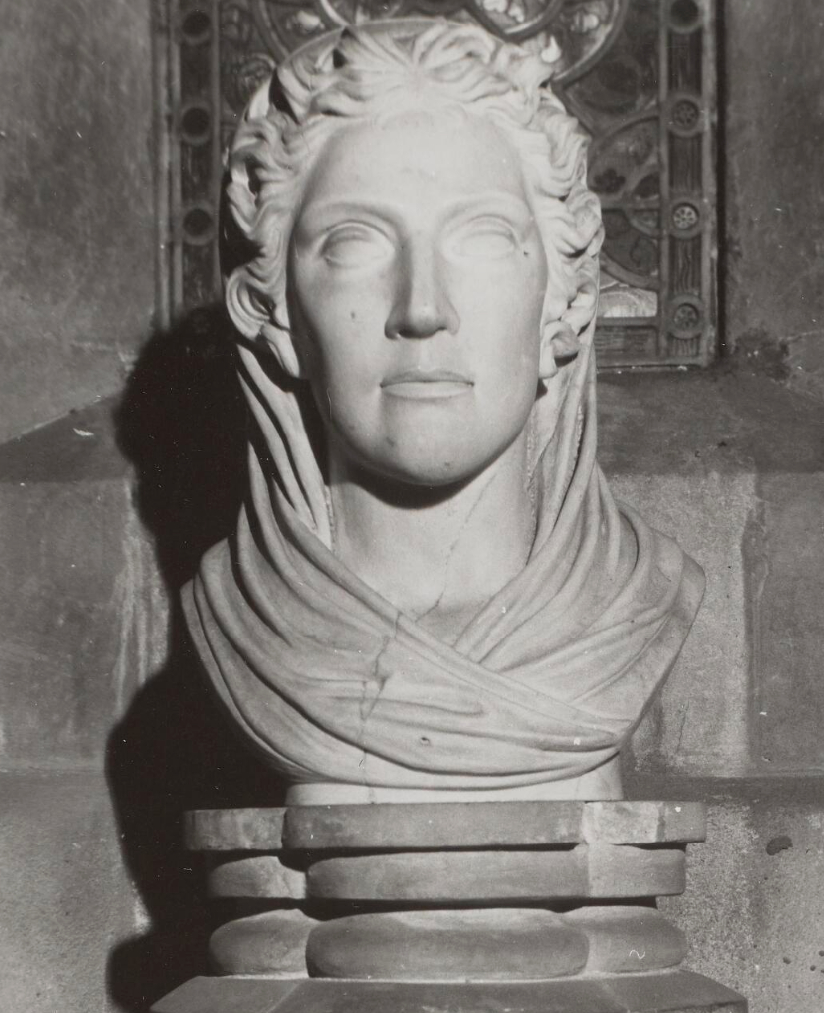
This very fine terracotta bust is almost certainly by Louis Francois Roubiliac (d.1762) but which in the past has also been attributed to Peter Scheemakers: Rupert Gunnis in his dictionary stated that the Parish Record records that the bust is by Scheemakers but subsequent attempts to discover this record have failed. Given the normally rigorous scholarship of Rupert Gunnis I suspect the information was at least second hand.
Whilst Scheemakers was capable of some very fine work I think that the modelling on this bust is just too good for him.
It should also be pointed out that with perhaps a couple of exceptions no terracotta busts by Scheemakers appear to have survived. The only one that immediately comes to mind is a half life size terracotta bust of Milton a model for the marble bust once owned by Alexander Pope now in the Library at Hagley Hall.
.................
See - Malcolm Baker, 'The Making of Portrait busts in the Mid-eighteenth
century', The Burlington Magazine, December 1995, 137, p. 830).
.........................
The Plaster fillet between the base of the monument and the bust clearly shows that the bust was probably made some time earlier and mounted on the monument after the death of Alexander Small and angled so that the bust is looking slightly downward.
.............
The prop on the back of the bust which should be compared with Roubiliac's terracotta of Bentley in the British Museum (illustrated below).
It was almost impossible to photograph the back of this bust, but just visible (if you climb on the table below the monument) is the square section prop which very similar to that used on the bust of Richard Bentley by Roubiliac at the British Museum (see below).
I am extremely grateful to Andrew Finn - Keley for opening the church and for all his assistance with
obtaining the photographs of the monument for this project.
..................
Andrews taught the poet William Cowper to draw and the poet called him ‘my Michelangelo,’ and in a letter to a
Mr Newton said that ‘James Andrews pays me many compliments on my success in
the art of drawing, but I have not yet the vanity to think myself qualified to
furnish your apartment (Wright 1886, 32). Andrews also drew Cowper’s portrait.
....................
Bought at the posthumous sale of Roubiliac May 1762.
Illustrated here to show the unusual square section prop at the back.
Text below from BM website.
......
Mezzotint.
John Faber, Jr. (British, born Holland, c. 1695 - 1756).
after Bartholomew Dandridge (British, 1691 - c. 1755).
Image below from the Wellcome Library website.
...........................
Inscription on the back of this enamel Alexr Small / C F Zincke pinxt / 1737.
Height: 45mm. Width: 38mm.
......................
Alexander Small.
Attributed to Bartholomew Dandridge (1691 - 1755).
New England Auctions Lot 230, 13 September 2022.
Stretcher inscribed "Alexander Small 1842".
Framed H 43-1/2" W
35". Canvas H 36" W 28".
Henry Alexander Small was bequeathed the advowson of Clifton Reynes in 1814
..https://www.bidsquare.com/online-auctions/new-haven-auctions/bartholomew-dandridge-portrait-of-alexander-small-3394149
.....................
Mrs Mary Small d. 1726 (nee Wing).
Daughter of Peter and Mary Wing of Wallingford.
by Bartholemew Dandridge.
Stretcher inscribed "H.A. Small 1842"
.New England Auctions - Lot 231, 13 September, 2022.
https://www.bidsquare.com/online-auctions/new-haven-auctions/bartholomew-dandridge-portrait-of-mrs-small-3394150#mz-expanded-view-991620160956
...................
Presumably Alexander Small Junior.
again attributed to Dandridge.
Stretcher inscribed "H.A. Small 1842".
Frame size H 43" W 35". Canvas H 36" W
28"
.New England Auctions - Lot 232, 13 September 2022.
https://www.bidsquare.com/online-auctions/new-haven-auctions/early-portrait-of-a-young-man-3394151
.................
.New England Auctions - Lot 233, 13 September 2022.
Period inscription on back HA Small and twice "Alexander Small, Clifton Hall".
https://www.bidsquare.com/online-auctions/new-haven-auctions/portrait-of-a-soldier-3394152
..................
The Alexander Small and the Henry Streatfield Busts by Roubiliac Compared.
Just so that there is no confusion.
Whilst the folds of the dress on the two busts are slightly similar, the belief that they were both modelled from the same basic bust can now be laid to rest.
.......
The Busts of George Streatfield, Jonathan Tyers and John Ray by Roubiliac.
All have the same basic dress.
The Henry Streatfield Bust of 1739.
Streatfield Mausoleum, Chiddingfold, Kent.
Photograph Taken by the Author.
...................
The Bust of Jonathan Tyers.
Roubiliac.
Image courtesy V and A.
........................
John Ray.
Roubiliac.
Terracotta.
British Museum.
Photograph by the Author.
..........................
Alexander Small - Some Biographical Notes.
In 1698 Alexander Small was described by John Colbach of York Buildings as "Mr. Alexander Small a surgeon in New Round Court, a young man of great honesty and industry, and one whom I frequently imploy." (J. Colbach, A Relation of a Very Sudden and Extraordinary Cure of a Person Bitten by a Viper, London. 1698).
See - A Collection of Tracts, Chirugical and Medical: Viz. I. A
New Light of ... By John Colbatch.1704. page 502 Ref Alexander Small at New Round Court.
The ancient physician's legacy impartially survey'd : and
his practice prov'd repugnant ... With practical observations ... To which is
added ... A discourse on quicksilver, as now commonly taken ... As also, a
particular account of Monsieur Bellost's pill compar'd with the author's. And
the case of Barton Booth ... as the same was communicated to the author by Mr.
Alexander Small ... / By Daniel Turner. 1733.
see - https://wellcomecollection.org/works/bzc7pnm8
Barton Booth [1681-1733] and Mercury Poisoning.
"A very great actor, the legitimate successor of Betterton.
He was one of Gibber's partners in management, and was the original
Cato".
Memoirs of the life of Barton Booth, Esq ; with his
character. To which are added several poetical pieces, written by
himself, viz. Translations from Horace, Songs, Odes, &c. To which
is likewise annex'd, the case of Mr. Booth's last illness, and
what was observ'd (particularly with regard to the quick-silver
found in his intestines) upon opening of his body, in the presence
of Sir Hans Sloan, by Mr. Alexander Small, surgeon.
Publish'd by an intimate acquaintance of Mr. Booth, by consent of his widow. London (Watts) : 1733. 8vo. Portrait, is. 6d.
....................
The Will of Alexander Small
To his wife Martha he gave the use of his house, etc., at
Chelsea, and 600 pounds per annum, which was to be reduced to 200 pounds
if she married again.
Other considerable bequests were - to his daughters, Mary ADAIR and Sophia CHURCHILL,
his brother Thomas SMALL, his sister Agnes SMITH of Dundee and her dau. Euphania CHESHOLME, and their children.
........................
How did Alexander Small make his money?
Why did Ann Smyth the mistress of Henry Lord Bradford leave him £12000 in her will and made him her residuary legatee, as well as giving him the whole income of the estates subject to an allowance for the maintenance and education.?
What was his relationship with William Pulteney Earl of Bath?
..........
Mary Smyth was married to Ralph Smyth at Stanwell on 26 June 1704.
Allegations for Marriage Licences Issued by the Bishop of
London, 1520 to 1828 ... By Joseph Lemuel Chester.
Collections for a History of Staffordshire, Volume 2, by Staffordshire Record Society. Page 188 - 193.
Available online.
Henry Newport, Third Earl of Bradford, was born at Eyton 8 August 1683 - . In his father's lifetime he represented the
county of Salop in several parliaments, and was appointed Lord
Lieutenant of the county of Salop 27 September 1715, and Custos Rotulorum 17 November of the same year : after the accession King
George I he was further appointed Lord Lieutenant and Custos Rotulorum of the county of Salop and also Custas Rotulorum of the
county of Montgomery.
Shortly after he had succeeded to the title, by
deed dated 15 January 1723 - 4 and a, fine passed in Hilary term of the same year, Henry Earl of Bradford cut off and barred,
so far as he was able, all the then existing entails of the family
estates, and having thus acquired the power of disposing of the vast
possessions to which he had succeeded on his father's death, the
inheritance of the Newports and De Burghs etc., he proceeded to
alienate them from his natural heirs in favour of a mistress and a
bastard son.(2)
By his will,
dated 8 Mav 1730, he devised all his estates John Hill Esq., Hugh Briggs Esq. (afterwards Sir Hugh Briggs
Bart) and George Middleton, goldsmith, upon trust (after raising
sufficient money to pay his debts and legacies a sum of £10,000 to be held
for such purposes as he should appoint) for the use of John Harrison an infant, some time under the
care of Mrs. Elizabeth Gardiner late of Richmond and since of Turnham Green, and
then under the care of Mrs. Le Place, in tail, with remainder as he should himself appoint and an ultimate remainder to his own
right heirs.
By a codicil or deed poll, dated a few days later, 16 May.
notes -
1. Reg. Prerog. Cant., 138 Richmond.
2. Among the estates thus wilted away were the mansions Eyton-upon-Severn, together with the Castle of Shrewsbury
(which had been granted to Francis Viscount Newport by King Charles Il), and
divers lands and manors, amongst which were the manors of Stottesdon Pimhill, Ercall, Wroxeter, Uppington, Eyton, Rowton, Kenley, Harley, Oxenbold, Hem, Eaton
Constantine, Garmston and Cressage, in Shropshire (which was said to
produce a rental of about, £45,000 per annum at accession of the Earl of Darlington in
1805), and considerable estates in the counties of Stafford and
Montgomery.
1730, he appointed the said sum of £10,000 to Mrs. Anne
Smyth (1693 - 1742) of Berkley Street, St. George's Hanover Square, who had a country house
near the sign of the Red Cow, Hammersmith, for her separate use exclusive of
her then present or any after taken husband;
by another codicil or deed poll, also dated 16 May 1730, he
appointed the reversion of his estates in default of issue of John
Harrison to Mrs. Anne Smyth in fee for her separate use, and he also
gave to her the rents during John Harrison's minority for her to
apply such part as she should think proper for his maintenance and education; and by a further codicil, dated 17 April 1733, he
postponed the vesting of the estates in John Harrison until he
should attain the. age of 26 (note 1).
The Mrs. Anne Smyth, who
benefited so largely under these dispositions, was the wife of Ralph
Smyth Esq. son of William, Bishop of Raphoe. She was married to him in the year 1704 when only thirteen years of age, but had for many
years been living separated from him under a separation deed dated 8 May 1711.
In the year 1720 the
husband was residing at a lodging in Windmill Street near Holborn, while the lady was living at the West end of
London or at Hammersmith as Lord Bradford's mistress.
John Harrison was her son and the reputed son of Lord
Bradford who paid for his maintenance and education and left him, as we have seen, a splendid fortune. He was
born in Martlet's Court, Covent Garden, on 2 February 1721.( note
2.)
Notes -
1. Reg. Prerog. Canturbury.
4, Ducie.
Many years afterwards on the death of John Harrison, or John
Newport as he was then called, a, question arose as to the administration of
his effects and the right to his personally between the persons who would be his next of kin
if he were legitimate (i.e. a great nephew of Ralph Smyth, or his representatives) and the Crown; and
The case was tried in 1792 before Sir William Wynne at
Doctors Commons. There was no proof whatever of Mrs. Ann Smyth having cohabited with
her husband between 1711 and the birth of the child, except, the fact
that. they both resided in London, and it was proved that on 16 July 1720 Ralph Smyth
executed a deed by which he confirmed the former separation deed and gave his
wife a power to dispose of property as if she were a femme sole.
There was however some evidence of access subsequent to the
year 1727, six years after the birth of the child, which in the opinion of Sir
William Wynne corroborated the presumption of access before that time.
Notwithstanding the non-recognition by
the husband, who would have had a strong pecuniary interest in the child's
legitimacy, and the clearest evidence that Mrs. Smyth living with Lord
Bradford as his mistress and that the child was treated by Lord Bradford as his own,
Sir William Wynne came to the conclusion that, access must be presumed
in the absence of proof to the contrary; and that, from the proofs in the
cause, the mother of Mr. Newport be presumed to have had access to her husband at the
time she became pregnant consequently the child must be legitimate.
Thus
the Husbands relatives established their claim as next kin to
the personal estate (see A summary of the facts and a full report of Sir William
Wynne's judgment in the case of Smyth v Chamberleyne, given in the Appendix C to the
Gardner Peerage Case, by Le Marchant, pp. 352—371).
It may well be doubted
whether similar decision would have been given in the present day.
An opposite conclusion was arrived at by the House Of Lords
in the year 1885 in the Aylesford Peerage Case, where in many respects the facts
were very similar.
Henry, (Newport) Earl of Bradford (1683 - 1734) died unmarried at his house in St.
James' Place on 23 December 1734, and was buried on 20 January following in King Henry VII's Chapel
in Westminster Abbey. (note 1).
(He was succeeded in his titles by his younger brother
Thomas Newport, an imbecile who never married).
His will and codicils were proved on 21 January 1734 - 5. (note
2).
It is not to be wondered at that this extraordinary will gave
rise to litigation, but nevertheless it was established by a decree in Chancery
dated 17 November 1739.
About the same time an Act of Parliament was passed to
enable John Harrison to take the name of Newport. His intellect however had for
some tune been getting more and more feeble, and the next year a commission of
lunacy was issued against him under which he, was pronounced a lunatic: though
he lived many years afterwards, he was always an imbecile.' (note 3).
On 19 June 1742 Mrs. Anne Smyth made her will, of which she
appointed the Right Honourable William Pulteney, afterwards Earl of Bath George
Wilson of Symonds Inn gent. and Alexander Small of York Buildings, St. Martin
in the Fields, surgeon, executors.
She bequeathed to her brother Thomas Smythl £3000 to Mary
wife of Charles Smyth £50, to several friends and servants sums varying between
£I0 and £200, and to the two first named executors £500 each.
To Alexander Small she gave £12,000, and made him her residuary
legatee, as well as giving him the whole income of the estates subject to an
allowance for the maintenance and education.
Notes
1. There is a portrait of Henry, Earl of Bradford, when Lord
Newport, at Weston, by Dahl.
2. Reg. Prerog. Cont., 4 Ducie.
3. It is said that his imbecility was caused by the
prescriptions of surgeon of the name of Alexander Small, who attended his mother Mrs. Smyth
and acquired great influence over her, and who certainly managed to
secure for himself a considerable share of the booty (The Daily Advertiser, 30
March 1780, which gives a most graphic and detailed account of this extraordinary
history ; Mr. Joseph Morris's MSS.),
4. Her own as well as her husband's name was Smyth (see marriage
allegation in the Bishop of London"' Registry, dated 26 June 1704,
in which the parties were described as Ralph Smyth Esq., bachelor, aged 26, and Mrs.
Ann Smyth, spinster,' aged about. 13, with the consent of her mother Mrs. Margaret
Smyth, widow, all of St. Jame's, Westminster).
etc. of her son John Newport, formerly called John Harrison,
until he should attain the age. of 26 years, at which time he would come into possession
of the estates under the Earl of' Bradford's will.
To William Pulteney, afterwards Earl of Bath, she gave the Reversion in fee simple of the estates in case John Newport,
should (lie without issue) (Note 1.)
Anne Smyth died on 31 August 1742, and after various proceedings
had been taken iin chancery by her executors, her Will was established by decree
dated 17 December 1751.
John Newport lived for than 40 years after his mother's
death, and in the meantime the reversion in fee of the Newport estates had
been devised by the Earl of Bath, who died without issue 8 July 1764, to his
brother General Harry Pulteney, and General Pulteney, who died without issue 26
October 1767, to his cousin Frances Pulteney and her husband William Johnstone
Esq. (who afterwards took the name of Pulteney and became a baronet) for their lives,
with successive remainder to their in tail male, with remainder to his cousin Henry Earl of Darlington
for life, with remainder to his sons in tail male.
John Newport died without issue 29 April 1783, whereupon the
Newport estates passed to Sir William Pulteney, whose wife Frances had died
without issue male, the previous year.
On the death of Sir William Pulteney in May 1805 the estates
devolved under the limitations of General Harry Pulteney's will upon William
Earl of Darlington, afterwards duke of
Cleveland, the only son of Earl of Darlington, who had died in the year 1792 ;
and after the the Dukes death ill 1842 they passed to his sons, the 2nd
3rd and 4th Dukes of Cleveland, who enjoyed them successively, and the
last of whom devised to Henry Lord Barnard
Notes
1. It was about this time that the Earl of Bath received much
praise and commendation for his patriotism in being the great promoter of a bill for preventing the marriage of lunatics -
a measure undoubtedly most excellent and wise but whether his motives in
bringing it forward at this time were solely patriotic may perhaps be
questioned by reader of these pages.
As a result of Mr. Small’s connection with estates under Mrs.
Smyth’s will it was declared by a Report of the Master in Chancery dated 19
February 1753 soon after his death, that there was due to the executors of
Alexander Small deceased a sum of £36,884 11s.
The whole of the debts due from the estate were stated to be £28,136 16s 1d which the Earl of Bath paid, taking a mortgage on the estates for
that amount and by deeds of 5 and 6 March 1753 and 12 and 13 March 1755.
The whole of the estates were subject to this mortgage,
vested in John Newport with reversion in fee simple to William Earl of Bath (Mr.
Joseph Morris's MSS).
.........................
For a much closer look at the relationships of Ann Smyth and Henry Newport, Lord Bradford and Ralph Smyth her husband which were revealed in the Smith v Chamberlayne 4th December 1792
see -
Report of the Proceedings of the House of Lords on the
Claims to the Barony ... By Denis Le Marchant 1828. Page 352 - 371.
This does not shed any further light on Alexander Small but is full of background details of the Smyths and Lord Bradford and his illegitimate son.
https://books.google.co.uk/books?id=rfsGAAAAQAAJ&pg=PA360&dq=Ann+Smyth+%22Ralph+Smyth%22&hl=en&newbks=1&newbks_redir=0&sa=X&ved=2ahUKEwiSmdqwwu6MAxXWaUEAHVYLCUAQ6AF6BAgIEAM#v=onepage&q=Ann%20Smyth%20%22Ralph%20Smyth%22&f=false
.............................
Aftermath.
From Biographical Catalogue of the Portraits at Weston, The Seat of The Earl of Bradford. Pub. 1881.
Available on line.
All these aforementioned legatees died in succession without
male heirs, excepting the Earl of Darlington, who left an only son,
afterwards Duke of Cleveland, on whom the whole of this enormous fortune
devolved, and is part of the heritage of the present Duke (1888). Thus the
ancient estates of the Newports, including those which descended to
them from the Princes of South Wales, passed away from the rightful
owners, excepting Weston-under-Lizard, Walsall, and some other
estates elsewhere mentioned, which became the property of Sir Henry Bridgeman,
grandson of Mary, Countess of Bradford.
The savings from the estate
during the lifetime of John Newport, which were said to exceed
£200,000, were ultimately divided (after deducting the great law charges)
between the Crown (to which it passed in default of heirs), and, through
a ridiculous quibble of the law, the representatives of Ralph
Smyth (John Newport’s mother’s husband).
..........................
John Newport (John Harrison) (1720 - 1783).
The illegitimate son of Sir Henry, Lord Bradford was born
John Harrison to Ann Smyth in 1720. His father died before John Harrison
obtained his majority and the considerable unentailed estate left to him was
administered by a committee chaired by his mother.
In accordance with his late
father's wishes, John Harrison changed his name to John Newport by private act
of parliament. His mother had him declared insane before he
came into his inheritance and she remained in control of his fortune. Upon her
death, William Pulteney, 1st Earl of Bath, controlled the estate
John Newport (formerly John Harrison) the illegitimate son of Henry Newport and Ann Smyth died on 29 April 1783 and was buried on 9 May 1783 in William Pulteney’s Vault at Westminster Abbey.
Parliamentary Archives: GB-061 Catalogue Reference: HL/PO/PB/1/1735/9G2n2
He was buried opposite the door of St Paul's chapel on 9th May
1783. He was said to have been a lunatic for most of his life. His mother, wife
of Ralph Smyth, had been buried in the north ambulatory on 7th November 1742.
Sources include The Marriage, Baptismal, and Burial
Registers of the Collegiate Church or Abbey of St Peter, Westminster, Volume 10
edited by Joseph Lemuel Chester, 1876, (digitised copy available at Google
books) which states
“page 436…
see - https://timisaacs.family/index.php/2020/08/09/the-newports-and-the-earl-3-john-harrison-later-john-newport-2/2/
.........................
Alexander Small and Clifton Hall, Clifton Reynes.
Extract from The Town of Cowper: Or The Literary and Historical
Association of Olney and ... By Thomas Wright, 1886 - available on line - Page 256.
"On the brow of Clifton Hill, in the time of Cowper, stood
three structures of interest—the Church, the Rectory, and the Hall; but the last, called also the Manor House, the "Mr. Small's house" of Cowper's letters, has now quite disappeared.
Clifton Hall was a large, square, and strongly built mansion of stone, with a large porch at the front that faced the
river.
It was of no great antiquity, having been built by Alexander Small, Esq. in about 1750 (his bust in a large wig by
Scheemakers can be seen in the church), but it stood doubtlessly on or near the site of the ancient castellated mansion of the
Borards and Reyneses, lords of Clifton, whose effigies lie in the church.
The mansion built by Mr. Small stood at a distance of about eighty yards to the north-west of the church ; the fishpond,
the orchard, a portion of the avenue, and the wall round the
garden still remain, and as the gate between the Hall garden and
the churchyard was removed only recently, its position is
indicated by the new appearance of the added portion of the wall".
It is odd that the house survived for less than 90 years.
................
This extract below from The History and Antiquities of the County of Buckingham, George Lipscomb 1847.Available on line at Google books
Page 108.
"On the decease of Sir John Maynard, Clifton became the
property of his only son and heir, Joseph Maynard, Esq. but he survived his
father only a very short time, and died without male issue, leaving two
daughters his co-heirs. Of these, Elizabeth, the eldest, had been married to
Sir Henry Hobart, Bart. of Blickling, Co. Norfolk,t who died in consequence of
wounds received in a duel with Oliver Le Neve, Esq. 21 Aug. 1698. She inherited
from her father the Manor and Estate of Clifton ; died possessed of it, in her
widowhood, 22 Aug. 1701 ; and was buried at Blickling, Co. Norfolk ; leaving
issue, John Hobart, afterwards Baron Hobart and Earl of Buckinghamshire, who became Lord Of Clifton, being then in the ninth year of his age but
before his death, in 1756, he sold this Manor and Estate at Clifton, to
Alexander Small, Esq. Surgeon. of Chelsea, Co. Middlesex, who died in
possession thereof, 18 April 1752, soon after he had completed his purchase ;
and was buried in the north chancel.'
Alexander Small, his only son, succeeded to his estate. He
was only four years of age at the death of his father: and married, before he
had accomplished his sixteenth year, a lady many years older than himself. by
whom he had a son, called Alexander, and One daughter. He married a second
time. and had several children. His eldest son, having attained his majority in
1793, joined in levying a fine to cut off the entail of the estate at
Clifton-Reynes, which thereupon became vested absolutely in Alexander Small,
the father.
Alexander the younger, died in his father's life-time, in
1791, and was buried in the north chancel of Clifton, without any memorial. Alexander
Small. Esq. (the father) died in 1816, and was buried in the same vault;
having, by his Will, dated 17 August next preceding his death, and proved at
London, 16 Oct. in the same year, bequeathed to his daughter and only surviving
child, by his first marriage, Martha Elizabeth Anne Small, this Manor and
Estate, for the term of her natural life, with remainder to an illegitimate
son, whom he designated, in his Will, by the appellation of Arthur Small.
Martha Elizabeth Anne Small, being thus in possession under
her father's will, carried this estate in marriage, in 1819, to Richard Hurd
Lucas, Esq. of Worcestershire, who, in right of his wife, became Lord of Keynes
Manor and Estate.
..............
Ordinance Survey pub. 1882.
Buckinghamshire - 25" to a Mile.
Image courtesy National Libraries of Scotland.
.......................
Alexander Small - Funeral and Burial in Westminster Abbey.
Source: The Marriage, Baptismal, and Burial registers of the collegiate church or Abbey of St. Peter, Westminster, edited by Joseph Lemuel Chester, London, 1876
The Funeral Book says that he died in his seventy-eighth
year, and the journals of the day describe him as formerly an eminent surgeon
in York Buildings.
See the note to the burial of Mrs. Anne Smyth, 7 Nov. 1742,
whose residuary legatee and executor he was.
His will, as of Chelsea, Midx.,
Esq., dated 2 Apl. 1751, was proved 9 Apl. 1752, by Robert Ord, of Lincoln's
Inn, Esq., Joshua Geekie, of the Inner Temple, Gent., and Alexander Small, of
York Buildings, Westminster, Gent., to whom he bequeathed his manors of Clifton
and Hardmead, co. Bucks, and his real and personal estate generally, in trust
for the purposes of his will.
To his wife Martha he gave the use of his house,
etc., at Chelsea, and £600 per annum, which was to be reduced to £200 if she
married again.
Other considerable bequests were to his daughters, Mary Adair
and Sophia Churchill, his brother Thomas Small, his sister Agnes Smith, of
Dundee, and her dau. Euphania Chesholme, and their children.
If his son
Alexander, then not twelve years of age, died without issue, his estates were
to revert to his dau. Sophia Churchill and her issue, with remainder to his
dau. Mary Adair, her sons William and Alexander Adair, William Chesholme, son
of his said niece Euphania Chesholme, of Dundee, and said Alexander Small, of
York Buildings, surgeon, as tenants in common. To the last named he left all
his chirurgical instruments, medicines, etc., in his house in York Buildings,
but did not state any relationship between them.
............................
Of Tangential Interest
York Buildings, Strand.
The home of Alexander Small.
The street Runs South - North - from York Stairs on the Thames towards the Strand.
Useful websites for putting York Buildings in context.
https://alondoninheritance.com/london-monuments/york-buildings-stairs-and-the-watergate/
https://www.british-history.ac.uk/survey-london/vol18/pt2/pp81-83
https://historicengland.org.uk/listing/the-list/list-entry/1066066?section=official-list-entry
The Water Gate is all that remains of the Palace of the
Dukes of Buckingham, which extended from the Strand to the river. The name York
House descended to the Palace from a former house on the site, bought about
1557 by Heath, Archbishop of York, who left it to his successors. (Stow,
p.153.) It was afterwards the residence of the Lord's Keeper of the Great Seal,
and here the great Bacon resided. Sometimes as Aubrey tells us, as he strolled
in the garden he bargained pleasantly with the fishermen throwing their nets in
the river below. In 1624, an Act was passed by which York House came, by
exchange for other lands, into the possession of James I., who bestowed it upon
George Villiers, the first Duke of Buckingham.
The second Duke of Buckingham sold York house in 1672 to a
party of building speculators, who pulled it down and erected on the site,
George Street, Villiers Street, Duke Street, Of Alley, and Buckingham Street,
thus preserving to the minute particle the name and title of the former owner.
These new streets were collectively know as York Buildings. They had their own
water works, the supply of water being raised from the Thames by means of
horses. The tapering wooden water-tower, octagonal in plan, is a conspicous
object in old views of this part of the Thames.
In the house at the bottom of Buckingham Street, on the east side,
marked by one of the too-few tablets of the Society of Arts, lived Peter the
Great, and in the house opposite to this, since largely rebuilt dwelt Pepys.
............
TQ 3080 NW CITY OF WESTMINSTER YORK BUILDINGS, WC2 72/146
Nos. 6 and 7 (formerly 24.2.58 listed as Nos 5, 6 and 7) - II Pair of terrace
houses. c.1676 with later alterations. No. 6 stuccoed, No. 7 stucco ground
floor and red brick (refaced), slate roofs. 3 storeys and dormered mansards,
with basements. Each 3 windows wide. No. 6: doorway to left with wood doorcase,
pulvinated frieze and cornice on consoles. Flush framed sash windows. Plat
bands between storeys; parapet with coping. No. 7 similar fenestration and
doorway to left with wooden doorcase and cornice on consoles. Wrought iron area
railings. No. 6 interior retains the upper flights of original dog leg, closed
string, turned baluster staircase, chimneypieces to 2nd floor rooms. No. 7
interior retains staircase with cut carved bracket strings and
turned-balusters, changing to closed string above 1st floor landing, stone
panelled chimneypieces with keyed centres beneath cornice-shelf. Survey of
London; Vol. XVIII.
Listing NGR: TQ3034780526
..............
York Buildings.
Thomas Sandby.
Graphite with pen and ink and watercolour
View of York Buildings, stairs, and waterworks, on the banks
of the Thames in London; the grand arched gateway at entrance to stairs in
centre of view, the peculiar York Buildings with tower to the left; a boat in
foreground; unfinished.
Image below courtesy British Museum.
....................
York Buildings from Roques Map of 1740.
.....................
of Tangential interest.
Samuel Pepys Library at York Buildings.
Looking South with the River Thames outside.
Sutton Nicholls, Pepys’s Library, York Buildings (View Facing Windows), 1693, ink and gray wash
on paper, 33.3 × 48.6 cm).
Giovanni Battista Falda’s view of Rome, published in 1676 is on the wall on the left.
Pepys Library, Cambridge, UK (artwork in the public domain; photograph provided by the Pepys
Library, Magdalene College, Cambridge).
Image from - https://arthistory.emory.edu/documents/faculty/mcphee_falda_map_art_2019.pdf
This very interesting site is primarily about early maps of Rome.