A Bronze Ecorche Figure
The Original Wax by Michael Henry Spang (d. 1762).
The Bronze Cast by Edward Burch
Depicted in the Self Portrait
by John Hamilton Mortimer

Self Portrait of John Hamilton Mortimer - c 1765 - 70.
29" x 24.5" - private collection.
Formerly with dealers Malletts of London.
nb. bust and ecorche statue by Burch after Spang on the table.
Hunter’s first documented écorché (from life or more truthfully death) was made for the Society of Arts. William Hunter’s brother, John, recalled the circumstances of its production: ‘About this time he read lectures on Anatomy to the Incorporated Society of Painters at their rooms in St Martin’s Lane, upon a subject executed at Tyburn.
His brother who had the management of the dissections had eight men at once from Tyburn in the month of April. The Society was acquainted with it and they desired to come and chuse the best subject for such a purpose. When they had fix’d upon one, he was immediately sent to their apartments. As all this was done in a few hours after death, and as they had not become stiff, Dr Hunter conceived he might first be put into an attitude and allowed to stiffen it, which was done, and when he became stif we all set to work by the next morning we had the external muscles all well exposed ready for making a mold from him, the cast of which is now in the Royal Academy.
Michael Henry Spang exhibited a wax version at the Society of Arts in 1761 which survives in the Hunterian Museum at Glasgow University (see below).
Apart from Edward Burch there probably exists another version of this figure, as Malcolm Baker records Albert Pars being awarded a premium for a
‘cast of an Anatomy figure, after Spang’ in 1767 by the Society of Artists.
__________________________________________
The Hunterian Museum, Glasgow, Bronze Ecorche cast by Edward Burch after Spang.


This
bronze statuette is a reduced version of Hunter's first plaster écorché, which
he cast from the life for teaching at the St Martin's Lane Academy in about
1750. The figure was moved to the premises of the embryo Royal Academy in 1767,
and it appears later in Zoffany's two paintings of the Academy. The statuette
was made by a Danish artist in the circle of Roubiliac, Michael Henry Spang,
who must have studied anatomy with Hunter at St Martin's Lane.
Spang exhibited
his wax reduction of Hunter's figure (Hunterian Museum) at the Society of
Artists in 1761 (see photograph below).The artist died soon afterwards, and Hunter seems to
have acquired the wax, and to have taken forward the project of making bronze
casts to provide artists with a portable version of his anatomical figure.
Hogarth's Analysis (1753, p. 64) recommended the use of small casts of the
Belvedere Torso, and he made the point in his Apology for Painters that the
smaller size had advantages: 'the little casts of the gladiator the Laocoon the
Venus etc. if true copies - are still better than the large as the parts are
exactly the same the eye comprehends them with most ease and they are more
handy to place and turn about.' Naturally, Hunter's écorché would have been
even more useful as an anatomical reference. Casts of varying quality exist,
and one - now lost - was originally in Hunter's collection. What little
information we have about the making of bronze casts suggests the involvement
of various artists over the decades following the making of Spang's wax figure.
Malcolm Baker records that Albert Pars was awarded a premium for a 'Cast of an
Anatomy figure, after Spang' in 1767 by the Society of Artists. The artist
Thomas Paine the younger carried with him on his journey to Italy in 1768 'a
little Anatomycal figure in bronze, by Spang, from a model he made in wax…',
and he reported that it was 'much admired at Paris, Rome etc. for its
excellence, and portability'. Spang had died by then, but his dedication to
Hunter's anatomy lived on through the fame of his reduction of Hunter's figure.
It was to artists what Gray's Anatomy would later become to doctors: J.T. Smith
in Nollekens and his Times referred to the statuette as 'that small anatomical
figure so well known to every draughtsman'. Purchased with the support of The
Art Fund and the National Fund for Acquisitions, 2006
This text above lifted from Hunterian Museum and Art Gallery, Glasgow Website.
After Hunter’s death Edmund Burch noted in the introduction to his Catalogue of one hundred proofs from gems: ‘Gratitude will not permit me to suffer the friendship and benefit I have received from
my late worthy friend, Dr Hunter, to pass unnoticed. It is to this gentleman I principally owe my practice of studying all my specimens anatomically.’
see - Edward Burch, A Catalogue of one hundred proofs from gems, London, 1795, p.xiii
__________________________________

Bronze Ecorche Figure
Height 25.3
The wax model of this figure is in the Hunterian Museum in Glasgow. Edward Burch (1730 - 1814) was
awarded a premium for a bronze ‘Cast of an anatomy figure, after Spang’ at the
Society of Arts, in 1767.
Edward Burch had an interest in anatomical precision which influenced a good deal of his work, he was a close friend and admirer of the Professor of Anatomy, Dr William Hunter and also designed the Hunter medal, which has a portrait of the anatomist on one side and a scene of the doctor instructing an anatomy class on the reverse.
Victoria and Albert Museum
___________________________


Another Example of Spang's Ecorche
25 cms including Base
Sold Stroud Auctions 12 March 2015
_____________________________

Bronze Ecorche
Height 24.8 cms
This version with the Metropolitan Museum, New York

____________________________________


Another Ecorche probably cast by Burch after Spang.
25 cms overall
With Finch and Co. London, 2015.
Provenance: Ex Collection the Earls of Warwick,
Warwick Castle, listed in 1900 (Heirlooms) in the Armoury Passage as ‘Antique
Bronze of Skeleton’
Sold Sothebys, Syon Park, May 1997; Lot 9
Ex English Private collection
Sold Sothebys, Syon Park, May 1997; Lot 9
Ex English Private collection
_____________________________________

Wax Ecorche
H. 25cm W. 10.5
This wax statuette was made by the Danish neo-classical sculptor Michael Henry Spang. It is a reduced version of a (life sized) flayed figure cast in plaster by William Hunter to use for teaching at the St Martin's Lane Academy in London c1753.
Spang came to London to train as an artist; he died young, and so little is known about him. However he was well known in London about 1760, both as one of Robert Adam's stone carvers, and as a teacher of drawing to Joseph Nollekens among others. This wax statuette is evidence that he studied anatomy at the St Martin's Lane Academy with William Hunter.
The Academy's life-size figure, cast in plaster by Hunter, is now lost, but it was taken from St Martin's Lane, with other equipment, to the Royal Academy in 1768, and it appears in the background of Johan Zoffany's painting of the Royal Academy life class, 1771 (Royal Collection).
Spang died soon after this wax was exhibited, but Hunter seems to have taken forward the project of making bronze casts of it to provide artists with a portable version of his anatomical figure. Various casts, of varying quality exist (e.g. Hunterian Museum, London; V&A, Science Museum), and one was originally in Hunter's collection, now lost. A replacement for the missing cast was purchased in 2006 (GLAHA 55238).
The artist James Paine (1745-1829) carried with him on his journey to Italy in 1768 'a little Anatomycal figure in bronze, by Spang, from a model he made in wax', and he reported that it was much admired in Paris and Rome for its excellence and portability (Martin Kemp, Burlington Magazine (June 1983).
Image and Text lifted from Hunterian Museum and Art Gallery Website

Portrait Miniature of Dr William Hunter
Attrib. George Michael Moser.
Oval 7.5 x 5 inches
After the Original by Mason Chamberlin of 1769 in the Royal Academy
This miniature portrait of Hunter was listed in the posthumous sale of the Moser, who was Keeper of the Royal Academy Schools. It is a copy of the three-quarter-length portrait of Hunter by Mason Chamberlin, which was Chamberlin's diploma work in 1769, and which hung in the Council Room of the Academy alongside portraits of Reynolds, Chambers and the King. Chamberlin shows Hunter standing at a rostrum, delivering a lecture. He is caught mid-sentence, with lips closing, and he clutches a bronze version of Spang's écorché figure which he is using to demonstrate an anatomical point. This portrait, which Moser kept in his Keeper's apartment in Somerset House, is surely evidence of Moser's affection for Hunter. They must have met when Hunter first attended the St Martin's Lane Academy as anatomist in about 1750. Moser was 12 years Hunter's senior, and was an important teacher and advocate of drawing, having played a role in the St Martin's Lane Academy from as early as 1730. In Nollekens and his Times, J.T. Smith describes how Moser was adept at precise metal work and the teaching of drawing: '…by the advice of his friend, Mr. Thomas Grignion, the celebrated watchmaker, [Moser] applied himself to enamelling watch-trinkets, necklaces, bracelets, &c. from which occupation he became an excellent enameller of larger and more eminent works. He drew remarkably well, and was successively at the head of several drawing schools, until at last he was elected Keeper of the Royal Academy on its foundation….' Moser died in January 1783, a few months before Hunter, and his miniature portrait of Hunter seems to have been borrowed by the engraver J. Collyer, to make his obituary engraving. This was published 28 April 1783, and is the same size as, and takes its oval format from, Moser's enamel. Presented by Norman C. King, 1927.
This text lifted from Hunterian Museum Glasgow website
William Hunter was born at Long Calderwood Farm near Glasgow in 1718. He matriculated at Glasgow University in 1731 and later studied medicine at Edinburgh.
In 1741 he moved to London.He quickly became well-known as a physician, especially as an obstetrician and built up a very distinguished clientele, which included members of the Royal Family particularly Queen Charlotte whose children's birth he attended. He also established himself as a teacher of surgery and anatomy, and assembled a collection of anatomical and pathological specimens, which were used to support his teaching work.
In 1768 he opened a medical school at his house in Great Windmill Street. As his reputation - and wealth - grew, Hunter also collected works of art as well as coins, books, manuscripts and curiosities. After his death in 1783 William Hunter bequeathed his entire collection to Glasgow University, where it formed the basis of the Hunterian Museum which opened in 1807.
___________________________

Dr William Hunter
by Mason Chamberlin RA. (1727 - 87)
Oil on Canvas
1270 x 1016 mm.
Photo:
R.A./Prudence Cuming Associates Limited
© Copyright protected
© Copyright protected
____________________________________________

William Hunter Lecturing at the Royal Academy.
Zoffany 1772
774 x 103.5 cms
Royal College of Physicians
____________________________________________

A Medallion of William Hunter by Burch
1774
Copper
8 cms diam.

Hunters Life Class at the Royal Academy after Zoffany
Mezzotint 1783
_____________________________________

William Doughty
With the Ecorche Figure by Spang.
c.1775
Possibly a self portrait.
Oil on Canvas
762 x 635 mm
Image from Philip Mould, Historical Portraits.
___________________________________
The Royal Academy Ecorche Figure

Écorché figure, Probably 1771.
Plaster cast, 1715 X 610 X 475 mm
Image from the Royal Academy website
Photo: R.A./Paul Highnam © Copyright protected
William Hunter is believed to have made or supervised the making of this cast in 1771 from the corpse of a thief. The painter James Northcote, then a student at the RA, noted that there were only two lectures over the corpse because Hunter needed 'the body fresh to cast a plaster anatomical figure from it...to be drawn from'.
____________________________________
Écorché figure.
Plaster Cast
Attributed to Bouchardon (1698 - 1762).
1470 x 680 x 600 mm.
Royal Academy.
They say 'Transferred from St Martin's Lane Academy, ca.1768'.

Photo: R.A./Paul Highnam © Copyright protected
________________________________
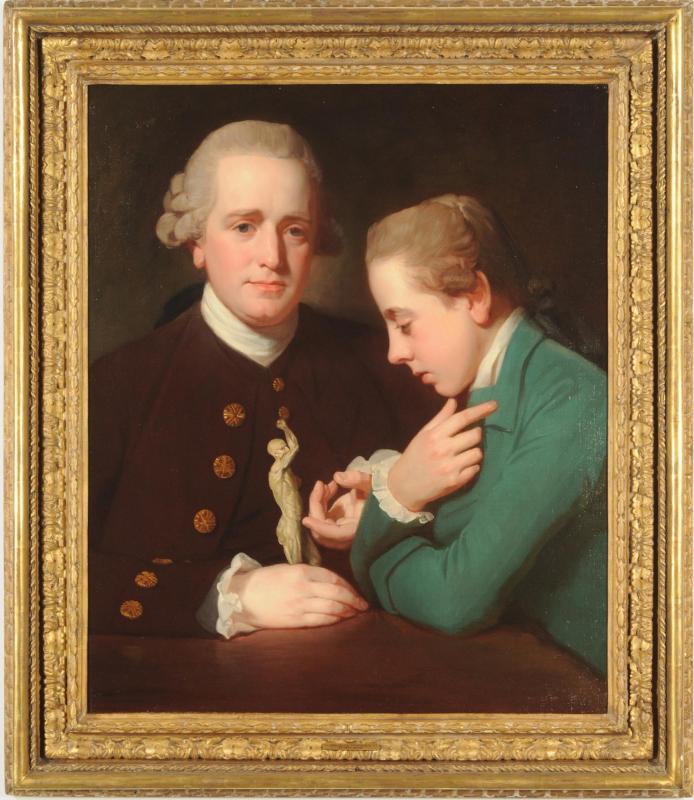
The Anatomy Lesson
Possibly Robert Baron Petre and his son.
George Romney
Oil on Canvas
76 x 63.2 cms.
McMaster Museum of Art Hamilton, Ontario, Canada.
_________________________________________
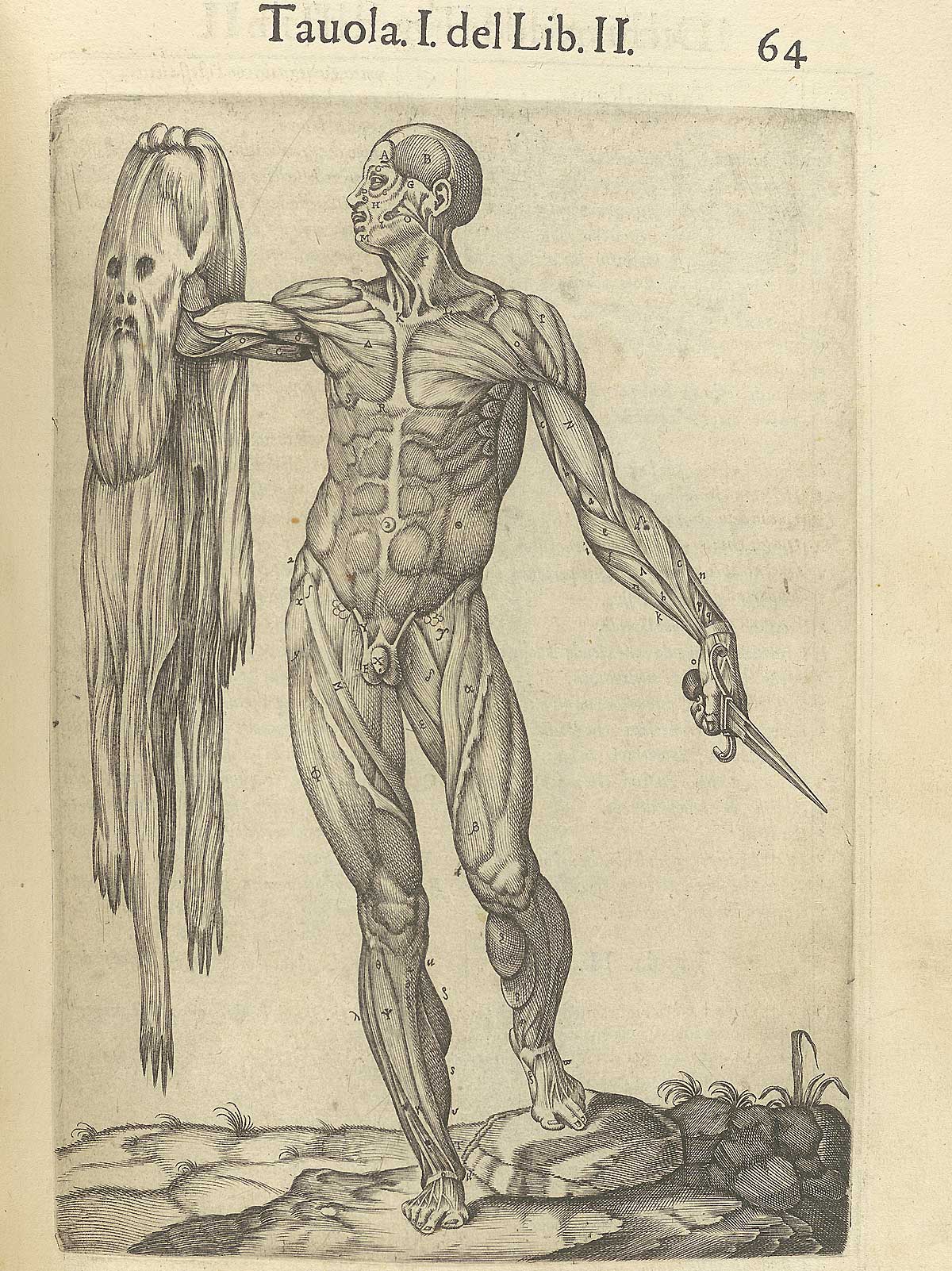
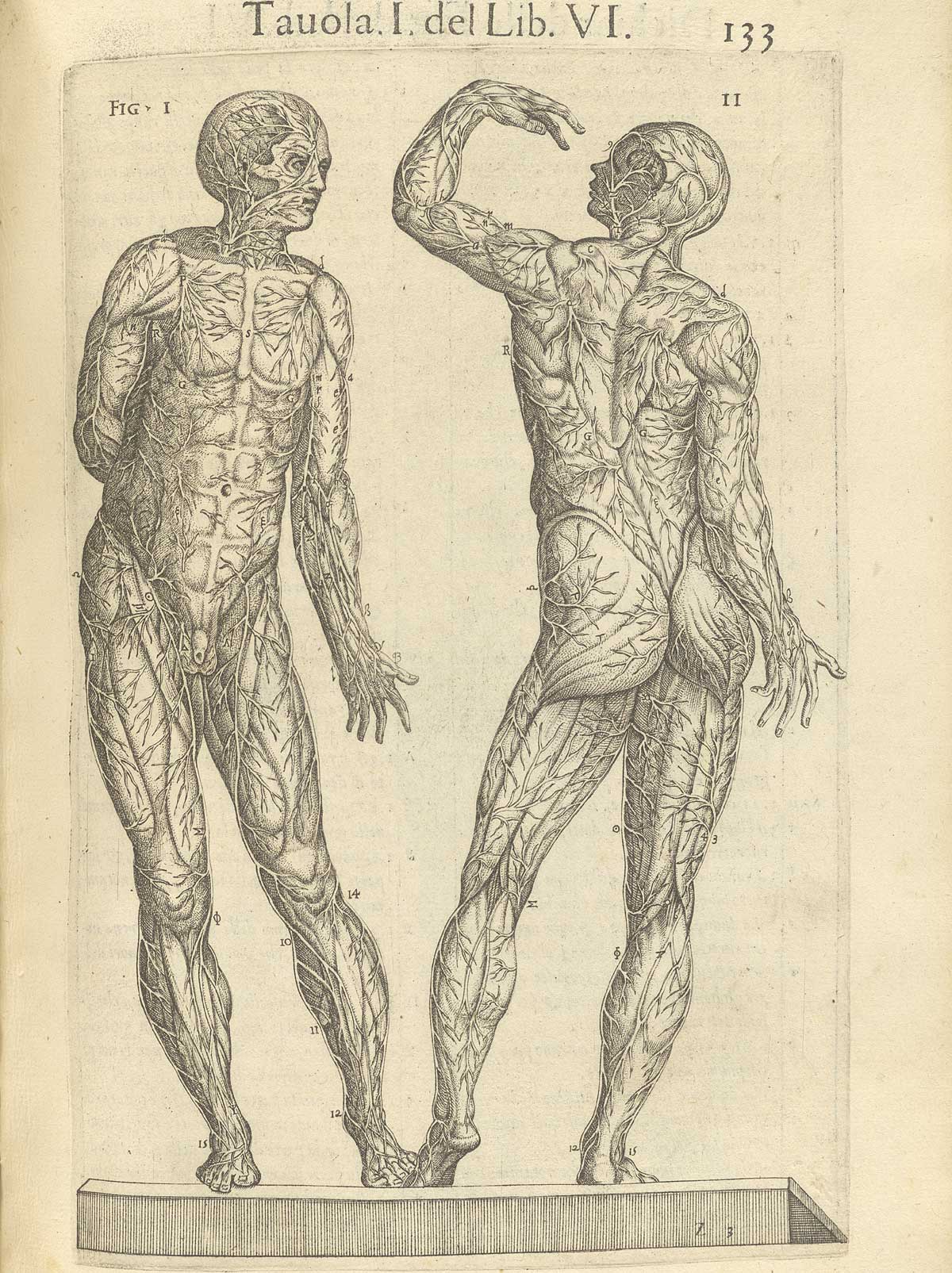
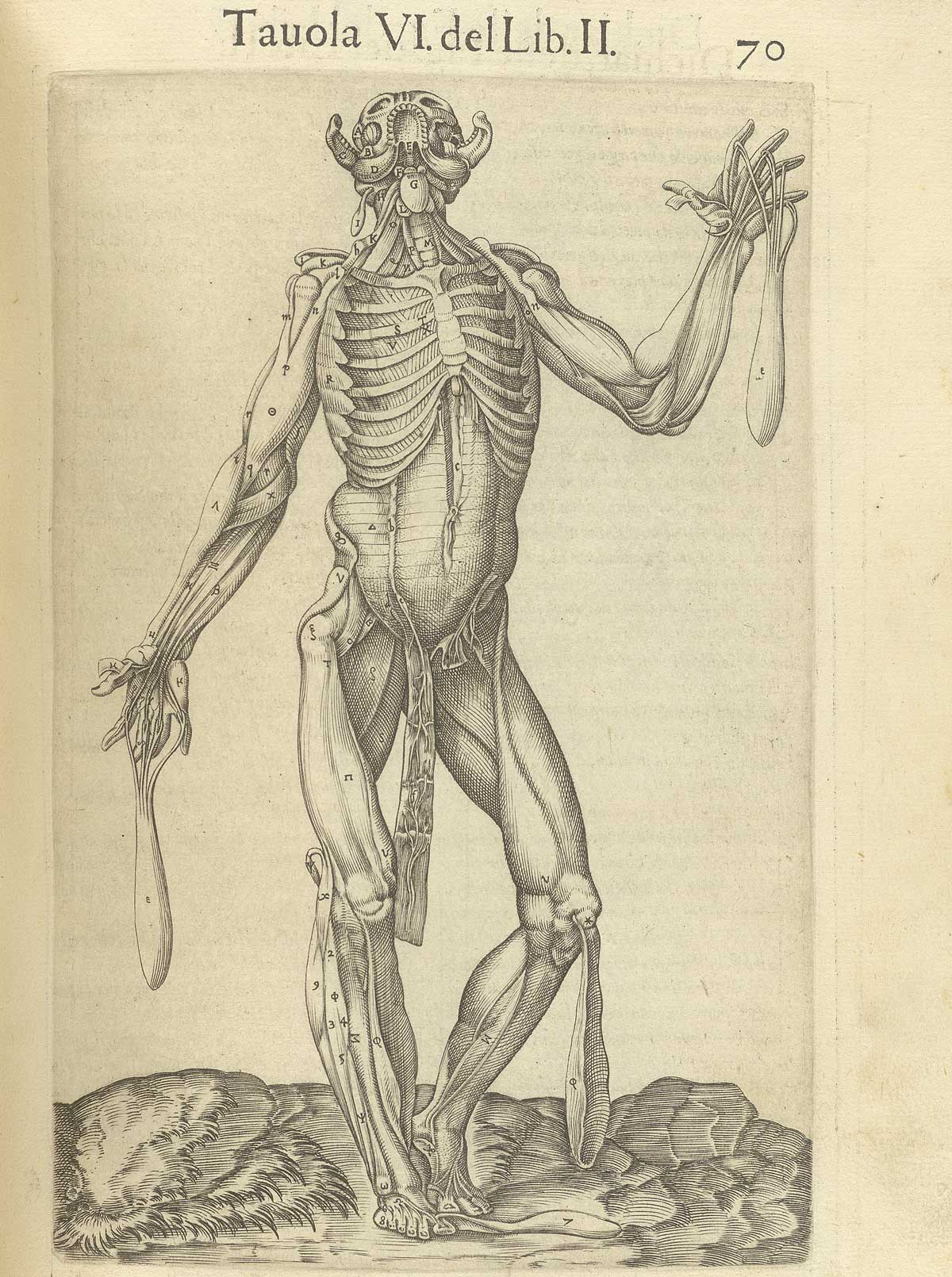
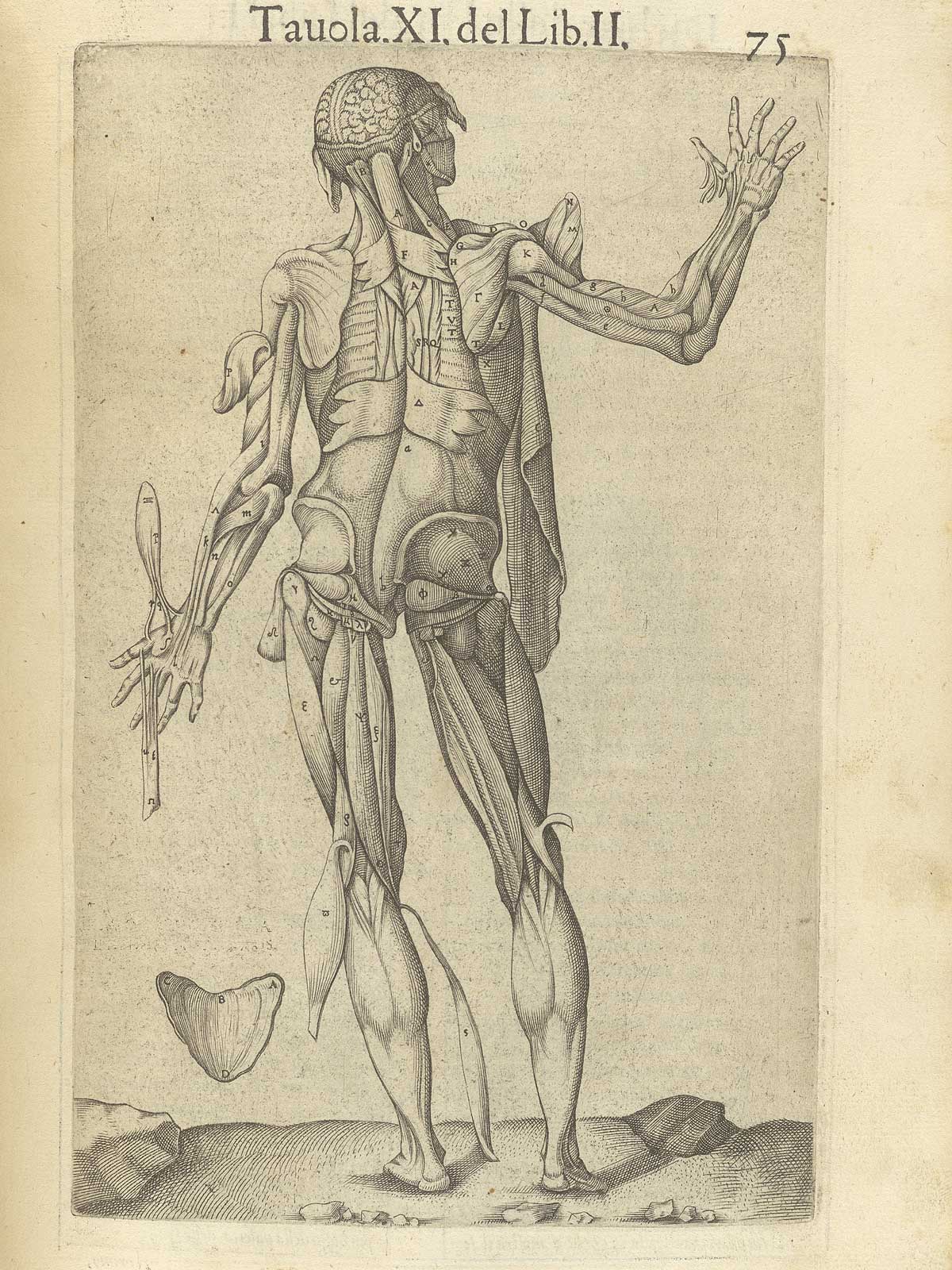
Several Illustrations from: Juan Valverde de Amusco. Anatomia
del corpo humano.
(Rome: Ant. Salamanca and Antonio Lafrery, 1560).
The original illustrations were probably drawn by Gaspar Becerra
(1520?-1568?), a contemporary of Michelangelo, and the copperplate engravings
are thought to have been carried out by Nicolas Beatrizet (1507?-1570?), whose
initials "NB" appear on several of the plates.
___________________________

Écorché figure.
Engraving
Phillip Galle (1537 - 1612).
____________________________________________
Bronze Écorché figure.

A bronze Écorché figure.
His foot on a skull.
Anonymous
First half of the 16th Century.
30.3 cms
From the Collection Mr and Mrs J Tomilson Hill .
Frick Collection
30.3 cms
_______________________________
Another version of the above bronze Écorché figure.

Bronze Écorché
34.9 cms.
Minneapolis Institute of Art.
This version is attributed to Pietro Francavilla of Florence c. 1600.
____________________________

Bronze Écorché
Willem Danielsz Van Tetrode
c.1562 -7
48.2 cms.
Lot 71 Christie's New York, 27 Jan 2015.