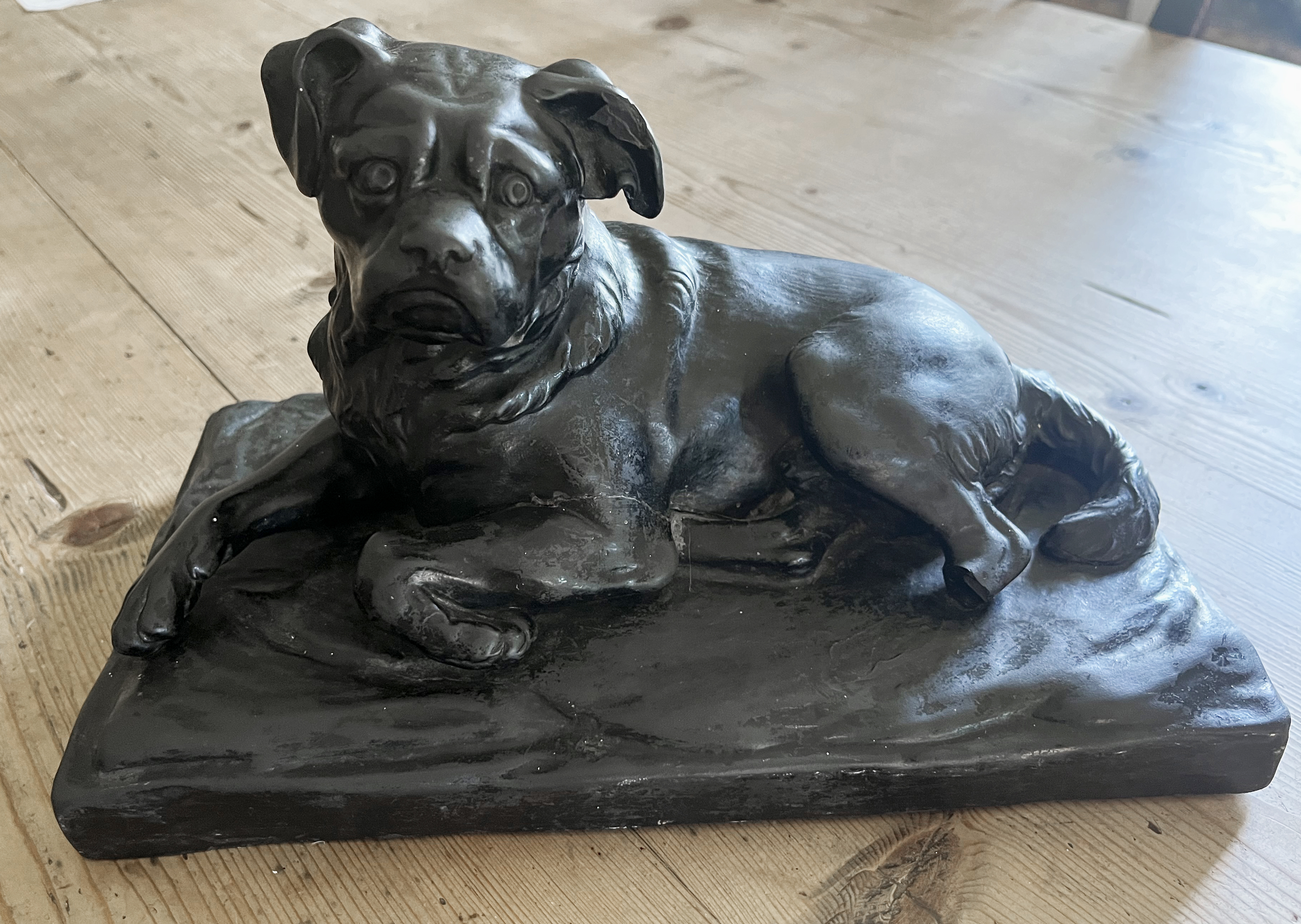
Trump the Favourite Dog of Hogarth.
A Recent Discovery in Wedgwood Basalt.
Post updated 14 February 2026 with images of the very fine bronze version at the Huguenot Museum, Rochester.
and again 19 February 2026 with more on the Hogarth portraits and the Strode conversation piece.
..............................
Hogarth is known to have had at least three dogs, Trump, Crab, and Pugg.
Hogarth's dog 'Pugg' was reported missing on 5 December 1730 in The Craftsman newspaper when its owner advertised a description and offered a reward - 'a light colour'd Dutch DOG, with a black Muzzle'.
.............................
The models of Trump have always in the past been described as Pugs but they are probably Dutch Mastiffs.
The Pug in the 18th century had a similar flat muzzle to the modern Pug (see images of English Porcelain pugs below). The Dutch Mastiff has a longer snout.
...................
Trump the "Pug" modelled by Louis Francois Roubiliac.
An original terracotta by Louis Francois Roubiliac remained with Hogarth's widow Jane until her death in 1790. It was sold by Mr Greenwood at The Golden Head, Leicester Square in the Hogarth auction sale of 24 April 1790. The total achieved was £255 10 shillings
A copy was at the British Museum
Lot 57. Mr Hogarth by Roubiliac.
Lot 58. "A Cast of the favourite dog".
Sold in the same sale was the bust of Hogarth by Roubiliac bought by Mr S Ireland for 7 guineas and purchased afterwards by George Baker FRS, (Physician to the King and President of the Royal College of Physicians - died 1809) - it was after his death in the possession of his brother Richard.
The bust was in the Collection of the engraver Nathaniel Smith (father of JT Smith) bought for £1 5 shillings and sold at his posthumous sale by Mr Dodd of 101 St Martins Lane.
The bust reappears later at the James Bindley sale in 1819, Lot 238 - bought by "Triphook"
The model of Trump appeared again at the Watson Taylor Sale at Erlestoke Park, Wiltshire, Lot 71. July 1832.
This original terra cotta of Trump is now lost, but the Wedgwood Trump is probably the closest to the original. The Chelsea Trumps are very fine but much detail is lost because of the application of a thick glaze.
Update - the surface treatment of the bronze currently on loan to the Hueguenot Museum at Rochester Kent is considerably finer than than other versions.(see below)
...........................
The Earliest Representation of the Roubiliac Model of Trump.
Samuel Ireland, the bust of Hogarth and the Model of Trump.
Below is the illustration of Roubiliac's model of Trump from 1799.
Note the rectangular base.


Image above from Graphic Illustrations of Hogarth, London, 1799. by Samuel Ireland.
Ireland says "It had been jocularly observed by him, that there was a close resemblance between his own countenance and that of his favorite [sic] dog, who was his faithful friend and companion for many years, and for whom he had conceived a greater share of attachment than is usually bestowed on these domestic animals"
Lettered with title
and production detail, "Phillips Sct / from a bust by Roubilliac / Pub for
S. Ireland May 1. 1799".
Size - Height: 237 millimetres Width: 165 millimetres trimmed.
Images above courtesy British Museum website.
https://www.britishmuseum.org/collection/object/P_Ee-4-136
For Samuel Ireland see -
https://babel.hathitrust.org/cgi/pt?id=gri.ark:/13960/t3mw6c75j&seq=161&view=thumb
...........................
Hogarth's Trump and JT Smith (1766 - 1833).
Smith was obviously very familiar with the model of Trump and frequently included him in his engravings.
Hogarth sitting to Roubiliac.
Pen and wash drawings
1817?
John Thomas Smith (1766 - 1833).
From 20 Original Drawings projected work (unpublished) Illustrating the Life of Hogarth by J. T. Smith 1817.
Yale Centre for British Art.
https://collections.britishart.yale.edu/catalog/tms:12533
Sheet: 12 7/8 × 9 3/4
inches (32.7 × 24.8 cm), Image: 7 3/16 × 5 3/8 inches (18.3 × 13.7 cm)
Inscription(s)/Marks/Lettering:
Inscribed in
graphite, verso, centre: "No 17 | Hogarth sitting to Roubiliac for | his
Bust"
John Thomas Smith, was also known as Antiquity Smith, who we have already met several times in this blog, he was an English painter, engraver and antiquarian.
He wrote a warts and all life of the sculptor Joseph Nollekens, Nollekens and his Times, pub. 1828, that was noted
for its "malicious candour", and was a keeper of prints for the
British Museum from 1815.
His father Nathaniel
Smith (c1741 - 1800?) had been placed as an apprentice in the studio of Roubiliac on 7 August 1755, after the death of Roubiliac in 1762, he became an assistant to Joseph Wilton, by 1779 he was working for the sculptor Joseph Nollekens, but later
became a very successful print seller.
He lived and worked at May's Building off St Martin's Lane.
JT Smith had also worked for the sculptor Nollekens, but after a brief apprenticeship, he went on to study under the engraver and history painter John Keyse Sherwin from 1781- 4, before working as a drawing master and draughtsman for his longstanding patrons John Charles Crowle and Sir James Winter Lake.
Nathaniel Smith had owned the bust of Hogarth by Roubiliac and probably a model of Trump - the bust was sold by the auctioneer Dodd (1771 - 1850) of 101 St Martin's Lane - 26 April 1809 (see the image below).
....................................
The Unpublished Illustrated Hogarth.
JT Smith.
1817.

Note - The model (terracotta?) of Trump at the feet of Hogarth.
The bust of Hogarth being sculpted by Roubuiliac on the right and what appears to be the bust of Joshua Reynolds by Cerracci on the left.
In this drawing trump is facing right.
For the complete set of drawings at Yale see -
https://bathartandarchitecture.blogspot.com/2024/06/john-thomas-smith-illustrated-hogarth.html

This is one of twenty drawings in a portfolio measuring 13 3/16 × 10 3/16 inches (33.5 × 25.9 cm)
...................
Some more drawings from the same series at YCBA including the dog Trump.
Hogarth and Trump at Old Slaughters along with Joseph Highmore the Painter.

..................
Hogarth Drinking the
First Glass of Wine with His Wife - Their Dogs Keeping Respectful Distances,
1817.
Hogarth's dog next to him on the chair.

Rembrandt looking down at the scene.
..................
For a Book for a Rainy Day by JT Smith pub. posthumously in 1845 see
https://www.gutenberg.org/cache/epub/54693/pg54693-images.html
.................
The Hogarth Pug model used in an etching from Vagabondiana of 1817 by JT Smith.

Vagabondiana.
JT Smith.
The Collected Version of this Series was First Published in 1817.
Published JT Smith. 4 Chandos Street, Covent Garden.
For the 1874 Edition see -
...................
For The Dissertation for an MA at the Courtauld Institute of Art 2016 by Fraser Short
(99+) An Analysis of J.T. Smith's Vagabondiana | Fraser Short - Academia.edu
.......
For Smiths Ancient Topography of London pub 1815 see
https://archive.org/details/b3045671x/page/n7/mode/2up?view=theater
More on Smith to come in this blog in the near future.
https://bathartandarchitecture.blogspot.com/2024/06/john-thomas-smith-illustrated-hogarth.html
..........................
The Plaster Casts and Moulds of Trump sold at the Roubiliac Posthumous Sale.
May 1762.
The only copy of the Roubiliac sale catalogue so far discovered is that in the Finberg Collection at the British Museum.
Plaster casts of the dogs were sold among Roubiliac's effects, at the posthumous sale over four days at the Roubiliac studio in St Martin's Lane on 12 May 1762 and the following three days.
Third day
Under the heading of Sundries in Plaister.
Lot 25. A laughing fawn, a saints head, a laughing boy and a pug dog.
Lot 34. Two dogs.
Fourth day.
Under the heading of Sundries in Plaister.
Lot 31. The academy figures, two plaister ornaments, 2 sketches of busts, a clay bracket and a pug dog.
Under the heading of MOULDS in Plaister.
Lot 59. A pug dog.
Given that both left and right handed versions of Trump exist it is not unreasonable to suggest that both versions were sold at the Roubiliac sale.
It is possible that two sizes of dogs were offered at this sale the originals for both versions of the Chelsea Trump and the Wedgwood dogs.
..........................
Another Roubiliac Dog at Auction in 1805.
In a sale catalogue of Christie's on 29 March 1805 'of ... Vases, Marbles, etc collected by a Man of Fashion during a recent visit to Rome and Naples', also included 'original models in Terra Cotta, by the celebrated Roubiliac, &c, &c.'
Referring to models in terracotta by Roubiliac.
Lot 121. - described as ditto a small female figure and ditto of a dog.
Lot 22. the figures of Painting and Sculpture were models for the parlour chimneypiece at Twickenham of the painter Thomas Hudson. According to JT Smith in Nollekens and his Times pub. 1828 these models were purchased by Nollekens at a sale by Christie's of the artists possessions 25th and 26th February 1785.
Presumably this is where Nathaniel Smith obtained his model of the dog Trump.
According to JT Smith in Nollekens... his father 'Nat' Smith bought lot 37, the model of Handel's figure at Vauxhall Gardens at this sale.
Through Mr Belcher - was this a pseudonym??

Lot 121. A small female figure and a dog?
...............................
Josiah Wedgwood and the Black Basalt model of Hogarth's dog Trump.
Josiah Wedgwood (1730-1795) made versions in Black Basalt. He based these on a cast bought 10 February 1774 from the London plaster shop in the Strand of Richard Parker. - see Life of Josiah Wedgwood Vol II Eliza Meteyard pub 1866 - page 326. see -
https://archive.org/details/lifeofjosiahwedg00mete/page/326/mode/1up?q=Parker&view=theate
Parker was almost certainly in possession of the piece mould purchased at the posthumous Roubiliac sale of May 1762.
For Parker and his partner and successor Charles Harris at the Alfred's Head see my blog post. -
https://english18thcenturyportraitsculpture.blogspot.com/2016/01/charles-harris-catalogue.html
....................................
The Roubiliac Terracotta Bust of Hogarth now in the NPG.
and the "companion" terracotta model of his pug dog Trump.
The terra cotta bust is now in the NPG Collections: it was purchased, 1861, from W. Baker of 37 Southampton Row, (originally) from the collection of the sitter.
Nichols, in 1781, refers to it when seen at the Hogarth house in Chiswick: 'His widow has an excellent bust of him by Roubilliac, a strong resemblance',
The Bust was was lot 57 ‘. . . Mr. Hogarth, by Roubiliac' in the posthumous sale of Mrs Hogarth's goods (she died 1789) from the Golden Head in Leicester Fields, Greenwood's, 24 April 1790. Lot 58, also a bust 'terra coto', described as 'A ditto of the favourite dog, and cast of Mr. Hogarth's hand', was bought by Mr Bindley of the Stamp Office.
The Terracotta Model of Trump.
Known through the Chelsea porcelain version (Victoria and Albert Museum), it was last heard of in the Watson Taylor sale at Erlestoke Park, Wiltshire, 25 July (15th day) 1832, lot 71. The purchaser of lot 57 is given in some copies of the catalogue as 'Finlay', possibly a misreading or the name of an intermediary.
The accepted purchaser, as noted in the catalogue owned in 1944 by Martin B. Asscher, was 'Dr. Hunter', presumably the surgeon John Hunter, a near neighbour of the Hogarth’s at 28 Leicester Square since 1783.
In the posthumous sale of Mrs Hogarth of his property, Christie's, 29 January 1794, it was presumably lot 62 (3rd day), a terracotta bust of 'Mr. Hogarth', bought by Samuel Ireland who had it engraved for the Graphic Illustrations of Hogarth.
The bust passed into the hands of Nathaniel Smith father of JT Smith (see illustration of the catalogue entry below) and was sold at his sale (see the Catalogue below) 26 April 1809.
This catalogue seems to have been missed by recent historians.
After the Nathaniel Smith sale in 1809 the bust passed into the possession of George Baker (1747 - 1811) Lace man and collector of 2 St Paul's Churchyard. B After his death it was inherited by his brother Richard.
The bust was in turn inherited by his great-nephew Frederick Herbert Hemming, the sale of Baker's collection 16 June 1825. The bust next passed to the latter's sister Frances Hemming of St John's Wood who sold it, 4 February 1861, to W. Baker.
.......................................
Wedgwood Basalt Wares.
The material is a high fired stoneware, which Wedgwood
describes in a letter to Bentley as being ‘fired ‘till they become almost
glass.’ While extremely popular, he did have to concede that it was unusually
expensive, saying that not ‘one in 6 [was] good’.
He also had problems with the finish of his black basalts,
saying ‘it is impossible to make the surface of the black vases always alike’,
but produced a solution achieved by burnishing the pieces. He is also said to
have polished his wares and is known to have used a variety of finishes to
achieve different effects.
...........................
The Recently Discovered Wedgwood Basalt Model of Hogarth's Pug Trump.
Currently in a private collection.
This version facing left.
Not marked.
Size - Width:11 inches x 6.25 inches x 5.75 inches tall.
By shear coincidence another Wedgwood Basalt Trump, the pair to the model below will be appearing at Christie's London this Autumn - to be announced (2024) (see the photographs below).


By shear coincidence another Wedgwood Basalt Trump, the pair to the model below will be appearing at Christie's London this Autumn (2024) (see the photographs below).
.................................
This is the pair to the recently discovered Trump which faces left.


...................................
The Origins of The Wedgwood and Bentley Model of Trump.
Invoice/bill from Theodore Parker to Mess. Wedgwood.
Dated 18 December 1769.
Including 3 Doggs?
This perhaps refers to the smaller dog as manufactured by the Chelsea pottery and later in Basalt by Wedgwood.

.
Supplied to Wedgwood 3 statues Flora, Ceres and Spencer and an openwork bracket on 31 September 1769 for £1 19shillings.
Supplied to Messrs Wedgwood 7 statues and 3 doggs 7th October 1769, Total £3. 3s
I am very grateful to Lucy Lead of the Wedgwood archives for supplying this image.
............................
Richard Parker of the Strand and Trump.
Wedgwood and Bentley purchased a plaster version of Trump from Richard Parker (fl. 1768 - 84) of the Strand on 10 February 1774.
Invoice below -
Busts - Zingara, Vestal at 16 shillings - £2 12s.
Pug Dog at 10s 6d.
See catalogue entry (above) of Charles Harris at the Alfred's Head, 162 the Strand of 1777 (formerly Parker and Harris).
Note that various moulds and bas reliefs from Joseph Wilton (1722 - 1803)

I am very grateful to Lucy Lead of the Wedgwood archives for supplying this image.
On the bill is the
printed heading.
‘Scagliola;/or Plaster casts of Elegant subjects/ proper to introduce into the decoration of rooms, staircases, halls etc/ Richard Parker/ Opposite the new church in the Strand/ having obtained from Joseph Wilton Esq. statuary to his majesty,/ various moulds of bas reliefs and bustos, made upon his original models / has the honour to acquaint the nobility and gentry, that they may be accommodated with casts at the shortest notice, Sundry samples of which with/ their prices may be seen at the above RICHARD PARKER’S /
N.B. These original casts can be
had at no other place; and although it may happen/ that some figure makers may
clandestinely make moulds of any of those casts, they can / produce at best but
an impression void of every original touch’.
The reference to the various moulds .... Joseph Wilton is instructive. This might have include moulds etc purchased at the posthumous Roubiliac sale at St Martin's Lane in May of 1762.
His partner and successor Harris was still trading from the Strand address in 1794
Richard Parker specialized in making casts. There was a set
of busts by him at Ashburnham Place, Sussex, - Locke, Milton, Congreve, Prior,
See Biographical Dictionary of Sculptors .Roscoe. 2009) Parker is mentioned as
Statuary of The Strand, bankrupt in The Gentleman’s Magazine and The Town and
Country Magazine in October, 1776.
Theodore Parker, father of Richard supplied Wedgwood in 1769 with a figure of Shakespeare.
The Trade Card of Messrs Parker and Harris.

...............
In 1785 in Biographical Anecdotes of William Hogarth: with a catalogue of his works by John Nichols ... - Page 20 mentions, very much in passing - a catalogue of the Statues, Bustos, etc of Richard Parker Statuary in the Strand is Hogarth’s Pug Dog.

The Extract from the Catalogue of Charles Harris of the Strand.
(Successor to Richard Parker).
The Catalogue in French is dated 1777.

Interestingly Hogarth's favourite dog here is described as a Dutch dog (de race Hollandaise) and not as a pug.
I believe that it refers to the dogs known as a sort of pug described as Dutch mastiffs.
In the undated English version in the National Arts Library at the V and A it is described as "Hogarth's Pug Dog" 10s 6d.
.
.................................
For the purchase of a plaster "pug dog" from Richard Parker see The Life of Josiah Wedgwood from his Private Correspondence ......Eliza Meteyard, 1866, Vol II Page 326. Extract below.

https://books.google.co.uk/books?id=-AkqAAAAYAAJ&printsec=frontcover#v=onepage&q&f=true
...................
The Wedgwood Catalogue of 1774.
The Second Edition. (the first Edition was published in 1773).
Page 63, no. 28 - A Pug Dog (nb. singular).
I am extremely grateful to Lucy Lead of the V and A Wedgwood Collection for providing me with this lead and the link to the online Second Edition Wedgwood Catalogue of 1774.
Whilst not conclusive this extract suggests that the smaller of the Basalt Trumps was one of the "dogges" provided by Theodore Parker 31 September 1769 (see the image of the Theo. Parker Invoice above).
The cast of the larger dog provided by Richard Parker 10 February 1774 is unlikely to be that mentioned in this catalogue given the length of time to prepare the mould for casting and firing and the time taken to prepare the catalogue for printing.
The lack of the dogs in the 1779 Catalogue but inclusion the pair in the catalogue of 1787


no mention of Pug Dogs.
............................
There is no mention of Pugs or Dogs in the Wedgwood and Bentley Catalogue of 1779.
This catalogue is available on line to members of The Wellcome Library but the later 1787 catalogue now includes 2 pug dogs (extract below).
The 1787 Wedgwood Catalogue.
No 22. Two Pug Dogs.
https://library.si.edu/digital-library/book/catalogofcameosi00wedg


Note 22. Two pug dogs.
This entry suggests to me that they were made as a pair as were the Chelsea pugs.
........................
The Chelsea Roubiliac Models of Hogarth's Dog Trump.
It should be noted that to produce such large scale models was a considerable technical achievement.
For more on Roubiliac, Sprimont and the Chelsea bust of the Laughing Child see -
https://bathartandarchitecture.blogspot.com/2015_06_03_archive.html
The Victoria and Albert Museum Chelsea Trump.
Soft Paste Porcelain figure of
Hogarth's dog 'Trump', Chelsea Porcelain factory, 1747-1750.
Width: 26.5cm approx. height:
13.2cm.
Sold Christie's London, Lot 2, 24 October 1966.
Bought by Winifred Williams on behalf of the Victoria and Albert Museum.


They say "The Chelsea factory perhaps also based its version on a "commercially available plaster" from Roubiliac who produced many plaster casts of his sculptures" - given the date of c.1747 I think that this is unlikely unless Roubiliac produced plaster version for sale - He is known to have produced plaster busts from early in his career, eg Georg Frederick Handel for the Harris's in 1741, see my post
https://bathartandarchitecture.blogspot.com/2014/01/asummary-of-researches-into-bust-of.html
The manager of the Chelsea porcelain factory, the silversmith Nicholas Sprimont (1716- Jun 1771), was a friend of both Hogarth and Roubiliac.
Sprimont was the godfather of Sophie Roubiliac who was born 25 August 1744 and baptised 23 Sept 1744 at the Huguenot Church in Spring Gardens by M Isac Lesturgeon. It should be noted that Matthew Maty was also a parishioner.
Nicholas Sprimont was a Huguenot born in Liege where he was baptised on 23 January 1716. After serving an apprenticeship as a silversmith, he emigrated to London registering his mark with the Worshipful Company of Goldsmiths on 25 January 1742/3.
He set
up the Chelsea Porcelain Factory in around 1743 / 4, initially in
partnership with the jeweller Charles Gouyn until about 1748 and then took full
control until ill health forced Sprimont to sell the factory in 1769.
"Sprimont is a rare instance of an English porcelain entrepreneur with design skills. A visitor to England around 1750 commented that 'an able French artist' supplied 'or directs the models' of everything made at Chelsea.
According to his widow, Sprimont
had 'by his superior skill and taste in the arts of drawing and modelling and
painting instructed and perfected several apprentices, workmen and servants'
The factory was at
the corner of Lawrence Street and Justice Walk, and part of the works was in
Cheyne Row West, where large quantities of broken figures and bases were found
during excavations in 1843. The factory produced
ceramics to a very high standard, and the V and A's collection includes many
fine examples.
In 18th century English porcelain figures, 1745–1795. Peter Bradshaw (1981); many pieces have been attributed to Roubiliac; see An illustrated catalogue of fifty-eight pieces of fine Chelsea porcelain many modelled by Louis François Roubiliac (circa 1755–1760) in the collection of Henry Edwards Huntington at San Marino, California. 1925. but only Hogarth's pug "Trump" is securely known to be by Roubiliac (J. V. G. Mallet, "Hogarth's pug in porcelain", Victoria & Albert Bulletin (1967:45).
For an overview see - https://en.wikipedia.org/wiki/Chelsea_porcelain_factory
For Sprimont's works in the Royal Collection see -
https://www.rct.uk/collection/people/nicholas-sprimont-1716-71
............................
Another Early Chelsea piece linked with Roubiliac.
.jpg)
https://bathartandarchitecture.blogspot.com/2015_06_03_archive.html
...............................
The Christie's Pair of Chelsea Soft Paste Porcelain Pugs.
TWO CHELSEA MODELS OF
HOGARTH'S DOG 'TRUMP'
CIRCA 1747-50, AFTER
THE MODEL BY LOUIS-FRANÇOIS ROUBILIAC.
Lot 7. 31 October 1996. Christie's New York
https://www.christies.com/en/lot/lot-1098035
No illustrations available on the website.

Sold Price realised USD 81,700.
31 Oct 1996.
10 5/8in. (27cm.) wide.
Lot Essay -
The present lot is
the only known pair to be offered at auction. While mirror images have been
found over the last half century, this find should reinforce the theory that
this model and its opposing example were modelled by Chelsea as a pair.
There are only three other single models known. The first example was sold by Christie's London, October 24, 1966, lot 2 and was acquired by Winifred Williams on behalf of the Victoria and Albert Museum.
The second example was from the Rous Lench Collection, sold at Sotheby's London, July 1, 1986, lot 198 and is the only known coloured model.
(This is probably the version currently in the Stanley F. Goldfien collection which is due to appear at a Christies Auction in the Autumn - October of 2024 - my italics).
The third is most probably the example from the collection of Mr. Lionel
Geneen, mentioned in J.V.G. Mallet's article in Apollo, 1969, vol. 90, no. 90,
pp. 100-111, titled 'Rococo English Porcelain: a study in style, and later
offered anonymously at Sotheby's London, November 19, 1991, lot 208.
(This is the version now at Colonial Williamsburg Museum - my italics).
A clear link has been established between William Hogarth and a fairly tight circle of artists which was centred around the St. Martin's Lane Academy and Old Slaughter's Coffee House.
Louis François Roubiliac, a member of this group, immortalized Hogarth's favorite pug, Trump, in a now lost terra-cotta model.
This model and the
well-known (terracotta - National Portrait Gallery) bust of Hogarth can be identified by the first plate found in Samuel
Ireland's, Graphic Illustrations of Hogarth, published May 1, 1799. The same
model was also listed in the effects of Hogarth's widow in 1789. In addition,
Nicholas Sprimont, the director of the Chelsea factory, kept his premises on
Compton Street around the corner. A fellow emigré, Sprimont also stood as
Godfather to Roubiliac's daughter, Sophie.
For a comprehensive
discussion of these models see J.V.G. Mallet's article in the Victoria and
Albert Museum Bulletin, April 1967, vol. III, no. 2, titled 'Hogarth's pug in
porcelain', pp. 45 - 54.
(see below)
...................
The Colonial Williamsburg Chelsea Soft Paste Porcelain Model of Trump.
OH: 5 1/8in (13cm);
L: 11 5/8in. (29.5cm); W: 6in. (15.2cm).
Note that it faces in the opposite direction to the V and A version.
Thus making it one of a pair.
The Museum acquired the figure at the 19 November 1991, offered in the British Ceramics and Glass sale at Sotheby's, London.
It was lot number 208 in that sale.
I am very grateful to Angelica Kuettner curator of Ceramics at Williamsburg for her assistance in adding information about the Williamsburg example.
https://emuseum.history.org/objects/704/trump-hogarths-dog
They say -
"The technical
difficulties of firing such a large ceramic mass, combined with the endearing
expression of the dog's face, make this figure a master piece of the potter's
art".
This can be seen in the number of firing cracks obvious from the photographs .
"Only three examples of Trump are known to survive today (1993). Of the other two, one is considered the highlight of the Victoria and Albert Museum's porcelain collections (illustrated here above - that version faces in the opposite direction)) and the other is still in private hands.
They were not aware of the Christies New York pair when the Museum catalogue entry was written
With its direct associations to Roubilliac, Sprimont, and William Hogarth, this object ranks high among the significant porcelain works in English ceramic history. (From CWF MUSEUM musings, Vol. II, no. l, March 1993, by Robert R. Hunter, Jr. Assistant Curator, Ceramics.)
This is the example from the collection of Mr. Lionel Geneen, mentioned in
J.V.G. Mallet's article in Apollo, 1969, vol 90, no. 90, pp. 100-111, titled
'Rococo English Porcelain: a study in style, and later offered anonymously at
Sotheby's London, November 19, 1991, lot 208.


...........................
Another Chelsea Soft Paste Porcelain model of Hogarth’s dog ‘Trump’ circa 1747.
This is the only known coloured version.
At Christie's Forthcoming Sale - Autumn / October 2024.
The Stanley F. Goldfein Collection.
No size given.
https://www.christies.com/en/events/the-stanley-goldfein-collection
Stanley F. Goldfein was a member of The Wedgwood Society of New York. He was instrumental in seeing that The Buten Collection of Wedgwood was placed with The Birmingham Museum of Art, joining the Beeson Collection to make the museum’s holdings in that category one of the best in the world.
Having given pieces to museums during his
lifetime, it was his wish that the bulk of his collection be sold on the open
market, allowing a new generation of collectors to discover the same joy he
found in owning and learning about these extraordinary works.
Highlights from the collection which will be offered by Christie’s London in the Autumn of 2024 include a Chelsea Porcelain model of Hogarth’s dog ‘Trump’, circa 1745-1747, after the model by L.F. Roubiliac (estimate: £30,000-50,000), a Chelsea Porcelain model of an owl, circa 1745-1749 (estimate: £20,000-30,000), and a Chelsea Porcelain bust of a young boy, circa 1750 (estimate: £15,000-20,000).
Further details
will be available closer to the sale.
This example is certainly that from the famous Rous Lench / TG Burns Collection, sold at Sotheby's London, July 1, 1986, lot 198 and is so far the only known coloured model.

....................
The two images below very kindly provided by Matilda Burn of Christie's.
There is a crack at the front which was disguised by the flower.
This was very probably a "second", the flowers could have been added later.


Note the Rous Lench label.
Pronounced firing crack from the front edge almost to the back of the
.........................
The Smaller Models of Trump.
The Chorley's Auction / TG Burns / Rous Lench Chelsea model, the small Wedgwood basalt and the Hogarth House Marble and their relationship.
The Chorley's Auction / TG Burns / Rous Lench small Chelsea model of Trump.
Sold 21 Sept 2021.
Catalogued as Chelsea. (JVC Mallet suggests circa 1745 - 47).
From the TG Burns Rous Lench Collection.
Width 11 cms -
If the date suggested by Mallet is correct it follows that it was modelled prior to the larger Chelsea models of Trump.
I can find no other versions of this porcelain dog.
Malcolm Baker, in his paper to the English Ceramic Circle (Baker 1997), drew attention to a letter (in the William Salt Library in Stafford) written by Sir Theophilus Biddolph on 7 May 1745 (possibly to a relative John Byrche) which discussed the Bishop Hough monument in Worcester Cathedral at some length. An important feature of the commission was a bas relief panel to be incorporated within the monument. Biddolph had visited Roubiliac's workshop to check on progress and in his letter he mentions 'The Basso Relievo is to be in Chelsea China'.
.................................
This little version is perhaps related to the small "Wedgwood" model pictured below and the marble version also pictured below.
They say "possibly the only coloured version of an existing handful of this smaller model?
Where are the others??
Once a companion to the lauded larger 'Trump' version (also the only coloured version) which was offered from the collection in the Sotheby's sale of 1986./Literature:
For a comprehensive discussion of these models see J.V.G. Mallet's article in the Victoria and Albert Museum Bulletin, April 1967, vol. III, no. 2, titled 'Hogarth's pug in porcelain', pp. 45 - 54/ (see blow)
Provenance: Rous Lench Collection and
by descent to the current owner"

Image Courtesy Dog News.
https://dognews.com/mixed-bag-dog-auctions-from-maud-earl-labrador-retrievers-to-cartier-dachshund.
..................
The Small "Wedgwood" Trump.
c. 1775/80.
Extract from Wedgwood by Robin Reilley, pub 1989.
Plate 670b.
Called a Pug Dog Height 10.5 cms.
unmarked. (early Wedgwood was not marked).
In the Dictionary of Wedgwood , Antique Collectors Club, pub. 1980 page 343 suggested as Wedgwood. described as exceedingly rare
Sold Sotheby's Autumn 1973.
Reilly dismisses it as an inferior version but if the little coloured version below is a Chelsea model then I can see no reason why this little dog might not also be by Wedgwood.
It lacks the fine detail of the larger Wedgwood Models but the modelling of the eyes are very similar.

Image above from Wedgwood by Robin Reilly. pub 1989.
for what I believe is the marble original see below.
........................
Extracts below from The Wedgwood Handbook: A Manual for Collectors. Treating of the Marks By Eliza Meteyard. Pub 1875.
The 1781 Christie's Wedgwood Sale.


276. Two Pug Dogs from Hogarth.

535. A Pair of Large Grecian shinxes, a pair of pug dogs, from a favourite dog of Hogarth's.
536. A suite of five chimney ornaments: a chased tripod, a pair of pug dogs etc....
........................
The Hogarth House Marble Sculpture of Trump.
Slightly larger in size than the Wedgwood Basalt Pug illustrated in Wedgwood by Reilley and the 1745/47 Rous Lench Chelsea small coloured porcelain pug.
It is my current belief that this little marble came from the St Martin's Lane Studio of Louis Francois Roubiliac. The Rous Lench / Chorleys Chelsea Porcelain Trump was taken from this version as was the little Wedgwood Basalt version.
H 7.5 x W 14 x D 10 cm;
Plinth: H 2.5 x W 16.5 x D 12.5 cm.
This is a much smaller version of the Roubiliac models of Trump reproduced in Chelsea Porcelain and Wedgwood Basalt.
This version in Marble is now on view in the Hogarth House Museum at Chiswick, West London.
Images here from the art uk website. it suggests late 18th century but I see no reason to believe that it isn't earlier.
https://artuk.org/discover/artworks/trump-259595
Previously I believe on loan to the Foundling Museum.
Formerly in the Collection of the author Richard Adams (Watership Down).


In the absence of any provenance but given the obvious quality of its modelling and close resemblance to the Chorley's/ Rous Lench 1745 Chelsea model then I believe it could quite possibly be a version from the Roubiliac workshop.
....................................
Two Mysterious Stoneware Trumps.
11.9 and 12cm wide
Sold by Bonham's 29 September 2020.
Two London stoneware models of the pug dog 'Trump', dated
1815 and 1816.
by William Murray after the lost terracotta by Roubiliac,
Hogarth's famous dog modelled recumbent upon an octagonal base, moulded and
finished by hand with undercutting and incised decoration, 11.9 and 12cm wide,
one signed 'W Murray London Nov 9th 1815', the other impressed 'WILLIAM MURRAY
1816 LONDON'.
The identity of William Murray has not been established - I can as yet find no other mention of him and his wares - possible related to the Murrays potters of Glasgow.

....................................
J.V.G. Mallet's article in the Victoria and Albert Museum Bulletin, April 1967, vol. III, no. 2, titled 'Hogarth's pug in porcelain', pp. 45 - 54/


Height 46.5 cms.
Photograph here courtesy Sotheby's, Bond Street, London.
For the 1740 Marble version of this bust see -
http://bathartandarchitecture.blogspot.co.uk/2014/01/4-themilton-fitzwilliam-bust-of.html


25.7 cm high, 16.2 cm wide
From the Website of E &H Manners.
Kensington Church Street, London.


https://www.rare-ceramics.com/past-sales/a-chelsea-group-of-britannia/
...........................
Hogarth and Trump.
The Engraved Portraits.
Hogarth was not fond of the poet Churchill.
The pug urinating on the Epistle to Hogarth by Churchill.
This engraving used the original plate of 1747 which was re engraved and published in 1763.


Ths is a re-working of Hogarth's self-portrait engraving of 1749 (Paulson
181); the artist has been replaced by a bear representing Charles Churchill
wearing preaching bands and holding a tankard of beer in one paw and a knotty
club in the other; the dog Trump is urinating on a copy of Churchill's
"Epistle to Hogarth". 1763.
1080 x 875 x 78 mm.
Inscribed ‘The LINE OF BEAUTY|And GRACE|W.H. 1745’ on the palette bottom left, and ‘SHAKE|SPEARE’, ‘SWIFT|WORKS’ and ‘MIL
[TON]|P[ARAD]|LOST’ on the back of the three volumes, reading from top to bottom
PROVENANCE Mrs Hogarth, from whom inherited by her cousin Mary Lewis 1789, sold Greenwood's 24 April 1790 (47) £47 5s od bt Alderman John Boydell; still in the collection of John and Josiah Boydell when engraved by B. Smith 1795.
The 1947 exhibition of restored paintings at the National Gallery first noted the presence of numerous pentimenti, in particular the fact that the sitter originally depicted himself wearing a wig.
Later x-rays confirmed that the painting was begun as a much more conventional and gentlemanly representation of the artist in which he wore a full wig, a white cravat and a coat and waistcoat with gilt buttons.
It also shows that a bunch of long brushes had been originally stuck through the thumb hole of the palette, and that the bust portrait was placed in a much smaller oval. A very exact impression of what this smaller oval originally looked like can be had from an enamel miniature, now in the National Portrait Gallery, which can be dated to c.1735 , and which looks as if was copied from the portrait when it was at this stage.
From this one can deduce that the
Tate portrait must have been in hand by about 1735 (???) ; certainly the energetic
handling of the wig seen in the x-ray is very close to that in the
Self-portrait at Yale which has always been considered an early work.
Just to muddy the waters a little further -
A number of copies are known to exist. Samuel Palmer had a ‘replica’ of this portrait in the Rectory at Ecton Northants. John Cole records it in the collection of John Palmer’s kinsman and successor Thomas Whalley at Ecton in his History and Antiquities of Ecton, Northamptonshire, Scarborough 1825, p.39. This could be the picture sold from the Anderson collection, American Art Association, New York, 6 April 1916 (54) as ‘Selfportrait, 35 x 27 in.’ and described as a replica ‘made for his intimate friend Thomas Whalley [John Palmer is meant] of Ecton…Inscribed on palette W. H. 1745. From the collection of C. Wylie, Esq, Chelsea, London.’ $200 bought by ‘Chester’.
More recent sales included:
Thomas Lyon Thurlow Esq, dec’d., of Baynard’s Park, Surrey,
was sold Christie’s, 9 July 1904 (16) as ‘W. Hogarth. Portrait of the Artist in
red coat and fur cap, with a palette and books. Dated 1763, 30 x 25 in’, 19 gn.
......................
In his final, self - portrait (1758) Hogarth included his final pug, he then changed his mind.
An X-ray shows the dog cocking its leg against his Master's chair.
Perhaps feeling this might be regarded as a royal insult (Hogarth had only lately been appointed Serjeant Painter to the King) Hogarth seems to have lost his nerve and painted out the dog - but it remains there beneath the paint.
After Hogarth's death in 1764 his dog-and-master double-portrait stayed with his widow until her death twenty-five years later in 1789 it was sold in the sale by Greenwood. sold the publishers Boydell and thence it changed hands, eventually entering the Angerstein Collection which in 1824, inaugurated the newly founded National Gallery.


I have lifted the Tate website essay which is worth reproducing here -
PROVENANCE Mrs Hogarth, from whom inherited by her cousin Mary Lewis 1789.
Sold Greenwood's 24 April 1790 (47) £47 5s od bt Alderman John Boydell;
It was still in the collection of John and Josiah Boydell when engraved by B.
Smith 1795; probably sold by the Boydells as uncatalogued addition to the sale
of Hogarth's ‘Marriage A-la-Mode’, Christie's 10 February 1797, whose
master-copy is inscribed by hand ‘1. The Portrait of Hogarth - £47 3s od
Angerstein’; according to J. Nichols certainly in Angerstein collection by
March 1798; sold with Angerstein collection to the National Gallery.
EXHIBITED BI 1814 (94); National Portrait Exhibition, South
Kensington 1867 (352); Exhibition of Cleaned Pictures, National Gallery 1947
(78); Tate Gallery 1951 (59); Manchester 1954 (32, repr. as frontispiece); BC
tour 1957 (34, repr. p.73); Tate Gallery 1971 (135, repr. in col. p.73); Rococo
Art and Design in Hogarth's England, Victoria and Albert Museum 1984 (p.66, E3,
repr. pl.v in col.)
ENGRAVED 1. Line engraving by Hogarth, with inscription `Gulielmus Hogarth|Se ipse Pinxit et Sculpsil 1749 and pub. by himself March 1749
2. Mezzotint copy of above by Charles Spooner of Dublin, 1749
LITERATURE J. Ireland 1798, p.351; S. Ireland 1799, pp.2–3;
Nichols & Steevens, I, 1808, p.170, III 1817, p.169; Nichols 1833, p.382;
G. Redford, Art Sales, 1888, I, p.61, II, p.53; Dobson 1902, pp.129, 173, repr.
as frontispiece; A. Graves, Art Sales, 1921, II, p.34; Dobson 1907, pp.146,
203, repr. as frontispiece; Davies 1946, pp.67–8; Beckett 1949, p.55, pl.155;
Antal 1962, pp.12, 14, 118, 25 n.31, pl.96(b); Baldini & Mandel 1967,
p.109, no.160, pl.XLVIII (col.); J.V.G. Mallet, ‘Hogarth's Pug in Porcelain’,
Victoria and Albert Museum Bulletin, III, no.2, April 1967, pp.45–54, fig.2;
Paulson 1970, I, pp.204–5, no.181, II, pl.193 and frontispiece; Paulson 1971,
I, p.450, II, pp.3, 4, 83, 284–5, 425 n.2, pl.190; Kerslake 1977, I, p.148, II,
pl.391; Webster 1979, pp.126–7, 186, no.153, repr. in col. (details) pp.137–9;
Bindman 1981, pp.109, 151, 195, 203, fig.119 (col.)
This portrait, which developed over several years, is also
Hogarth's public statement of his artistic beliefs. It represents the artist in
a still-life assemblage, as if painted on an unframed oval canvas which rests
on volumes of the three authors he admired most - Shakespeare, Swift and
Milton. The implication is not only that he took his inspiration from drama,
contemporary satire and epic poetry, but also that he saw the art of painting
as their equal. In the left foreground lies his palette, bearing a representation
of the three-dimensional serpentine ‘Line of Beauty and Grace’ (‘and Grace’ has
been painted out, but is now clearly visible through the transparent
overpaint), which Hogarth considered to be the fundamental principle of all
artistic harmony and beauty. In the opposite corner, as if to contrast the
reality of nature with theoretical abstraction, sits one of Hogarth's
successive favourite pugs. In this case it is probably Trump, who, according to
Samuel Ireland, was modelled, like his master, by Roubiliac in the early 1740s,
‘and for whom he had conceived a greater share of attachment than is usually
bestowed on these domestic animals’. Hogarth was apparently fond of remarking
on the resemblance between himself and his dog and probably saw in it something
suggestive of his own notoriously pugnacious nature. Roubiliac's terracotta
bust of Hogarth is now in the National Portrait Gallery; the model of Trump has
been lost, but survives in Chelsea porcelain reproductions, including one in
the Victoria and Albert Museum.
The portrait was clearly painted with engraving in mind, and
Hogarth used the engraving he made from it in 1749 as the frontispiece to bound
copies of his engraved works. In the print the image is reversed, except for
the scar on the forehead - reputedly received in youth and displayed with pride
- which the artist has adjusted to remain on the correct side, over his right
eyebrow. Also included in the foreground of the engraving is a burin to
represent Hogarth's work as a graphic artist; this is absent in the painting,
but X-rays show that originally a graving-tool, larger than that in the
engraving, lay in front of the portrait on top of the pile of books.
Another noticeable difference in the engraving are the blobs
of paint on the palette, carefully graded from light to dark, of which there
seems to be no trace in the original painting. These hark back to the similarly
impastoed blobs of paint, shaded from white to bright red, on the palette of
the unfinished self-portrait now in the Mellon collection at Yale, which is
probably an abandoned earlier treatment of the same face-mask (the best, though
incomplete, colour reproduction of this is in Webster 1979, frontispiece; also
Beckett 1949, fig.40, and Paulson 1971, fig.170). As Hogarth was to explain
later in his Analysis of Beauty, published in 1753 (Burke 1955, p.128) he saw
the brilliant, clear colours represented by ‘firm red’ and white (because
‘nearest to light’) as equal in ‘value as to beauty’, and used a painter's
palette of shaded blobs in plate 2 of the Analysis to expound his theories on
tone and shade.
The catalogue of the exhibition of restored paintings at the
National Gallery in 1947 first noted the presence of numerous pentimenti, and
in particular the wig which shows through the cap and the cheek near the ear.
Recent X-rays carried out by the Courtauld Institute confirm that the painting
began life as a much more conventional and gentlemanly representation of the
artist, in which he wore a full wig, a flowing white cravat, and a coat and
waistcoat with gold buttons. It also shows that a bunch of long brushes had
originally been stuck through the thumbhole of the palette. The oval of the
self-portrait had at one time been much smaller and drawn closer to the head:
the sweeping zigzag brush-stroke with which Hogarth attempted to obliterate its
upper right edge is clearly visible in raking light. A very exact picture of
what this original smaller oval looked like can be had from an enamel miniature
now in the National Portrait Gallery, which seems to coincide with the X-ray
image in every particular. This miniature, of which two versions are known
(another is with Edwin Bucher of Trogen, Switzerland), may be by Hogarth's
friend and collaborator, the Swiss enameller André Rouquet (1701–58), and looks
as if it may well have been copied from this portrait as it was in its earlier
stage of development. The miniatures are neither signed nor dated, but the one
in the Bucher collection is in a contemporary silver-gilt case which is
engraved on the back ‘Wm. Hogarth|Painted by Zincke|1735’. Expert opinion on the
whole now doubts the attribution to Zincke, and J.V. Murrell of the Victoria
and Albert Museum has kindly suggested that the inscription looks stylistically
later than 1735. However, he considers that the date could be an accurate
record of the date the miniature was painted, and Rouquet, who worked in the
style of Zincke, as a possible attribution. This would suggest that the Tate
Gallery portrait could have been begun around this date: certainly the
energetic handling of the wig as shown in the X-ray is very close to that of
the unfinished self-portrait at Yale, which has always been considered an early
work.
One can only speculate as to the reasons why Hogarth changed
his image in so radical a manner by 1745. One possibility is that his trip to
Paris in May 1743 to recruit French engravers to work on the ‘Marriage
A-la-Mode’ series confronted him with an artistic community that had a much
better self-image than that in Britain. The confident pride of the French
artists in their own status shows itself most clearly in the magnificent
artists' portraits presented by engravers as diploma works for their reception into
the French Académie. From 1704 these had to submit to the oeil-de-boeuf format,
in which the engraver gave the portrait an elaborate three-dimensionally
conceived surround that usually incorporated emblematic items like the artist's
tools in the foreground. In the majority of cases the artists presented
themselves not in conventional dress, but in casual artist's attire. While
Hogarth may have been familiar with such morceaux de réception early in his
career (and indeed the whole concept of his self-portrait suggests that he
was), the trip may have given him the necessary jolt to prefer a more artistic
image of himself over a gentlemanly one.
Hogarth's conception of the ‘Line of Beauty’ was less firm
at this stage than might appear from the portrait. When he elaborated the idea
in his Analysis of Beauty a few years later, he defined the ‘Line of Beauty’ as
a gently waving line in two dimensions, and the ‘Line of Grace’ as a
three-dimensional serpentine line. In this portrait, as in the engraving after
it, the line is clearly three-dimensional, but labelled the ‘Line of Beauty’.
The fact that ‘and Grace’ has been painted out also suggests that Hogarth's
ideas on this were still changing. He may have even included the line at this
stage in order to provoke discussion, for in his preface to the Analysis he
writes (apparently giving the wrong date) that ‘In the year 1745 [I] published
a Frontispiece to my engraved Works, in which I drew a serpentine line lying on
a Painter's pallet, with these words under it, “THE LINE OF BEAUTY”. The bait
soon took; and no Egyptian Hieroglyphic ever amused more than it did for a
time. Painters and Sculptors came to me, to know the meaning of it, being as
much puzzled with it as other people, till it came to have some explanation.’
Clearly, like his image of himself, his theoretical views also shifted ground
in later years, leaving a complex record of their development on this canvas.
Published in:
Elizabeth Einberg and Judy Egerton, The Age of Hogarth:
British Painters Born 1675-1709, Tate Gallery Collections, II, London 1988
Self Portrait. with Dog.
The Engraving.
Pub. 1749.
This image from the Royal Collection website.


..........................................................
The Strode Conversation Piece by Hogarth.
The Tate website suggests c. 1738.
Dimensions: frame: 1126 x 1175 x 98 mm
Provenance: Bequeathed by Rev. William Finch 1880.
Posted here to show the pose of the dog which if the dating is correct would mean that it predates the Hogarth self portrait by perhaps 7 or 8 years.
William Strode, was a wealthy London businessman, next to him is his tutor Dr Arthur Smyth, later Archbishop of Dublin.
Also depicted is his wife Lady Anne Cecil, and his relative Col. Strode.
On the floor is a tea caddy. Strode’s family made its money through trading shares in the South Sea Company.
The painting is first described by John Nichols in 1782 as ‘A Breakfast-piece, preserved in Hill-Street, Berkeley-Square, in the possession of William Strode, Esq. of Northaw, Herts. It contains portraits of his father the late William Strode, Esq., his mother Lady Anne (who was sister to the late Earl of Salisbury), Colonel Strode, and Dr Arthur Smyth (afterwards Archbishop of Dublin).
Two dogs are introduced, one belonging to Mr. Strode, the other (a pug?) to the Colonel's’ (sic).
Nichols & Steevens call the Colonel
‘Mr. Samuel Strode’ and add the name of Jonathan Powell, the butler. As the
information clearly came from the sitter's son, it can be regarded as reliable.
PROVENANCE Presumably painted for the sitter, and first
recorded in the possession of his son William 1782; on his death 21 July 1809
(d.s.p.) inherited by his widow Mary (née Brouckner, widow of Admiral William
Clement Finch), and on her death 6 October 1813 by the eldest son of her first
marriage, the Revd William Finch; bequeathed by him to the National Gallery
1880, with life interest to his sister Charlotte (d.1883); entered the National
Gallery 1884.
EXHIBITED RA Winter 1884 (38); AC tour 1946 (1); Tate
Gallery 1951 (40); Manchester 1954 (18); BC tour 1957 (32, repr.p.79); BC tour
1960 (5); Tate Gallery 1971 (104).
LITERATURE Nichols 1782, p.362; Nichols & Steevens, I,
1808, pp.424–5: Nichols 1833, pp.375–6; H. Cotton, Fasti Ecclesiae Hibernicae,
Dublin 1848, II, pp.25–6 (for biography of Arthur Smyth); Dobson 1907, p.207;
S. Sitwell, Conversation Pieces, 1936, p.12, pl.20; Davies 1946, pp.68–9;
Beckett 1949, p.46, no.93, repr.; Baldini & Mandel 1967, p.100, no.88,
pl.XXVII (col.); Antal 1962, pp.40, 51, 204, pl.62a; T. Pignatti, Pietro
Longhi, 1969, p.44, fig.15; Paulson 1971, I, pp.205, 455, 458, fig.175, II,
p.3; Webster 1979, pp.81–2, 97, 127, repr. in col. p.90.
As usual the low resolution Tate image makes comparisons very difficult but the pose of the dog should be noted.
https://www.tate.org.uk/art/artworks/hogarth-the-strode-family-n01153

_-_The_Strode_Family_-_N01153_-_National_Gallery%20crop.jpg)

..........................................
The Sworders Portrait of a Dog.
Size - 58.5 x 46cm.
Oil on canvas which has been lined.? The picture is generally in plane and the paint layers are stable. Drying cracks have formed in the paint of the dog.
Localised areas of retouching are present beneath the varnish and well matched to the original. The varnish is even but semi-matte and slightly yellowed. The surface has a slightly smeary appearance, probably due to a layer of surface dirt present.
Offered for sale at Sworders Auctioneers Lot 277, 29 June 2021.
https://www.sworder.co.uk/auction/lot/277-follower-of-william-hogarth/?lot=406314#
https://www.sworder.co.uk/news/a-roadshow-trump/
Bought from a Knightsbridge antiques dealer several years previously, the owners of this painting wanted to know more about their dog.
They took him along to a BBC Antiques Roadshow in July 2014 where it was instantly recognised as a copy of the dog in Hogarth’s “Manifesto” self-portrait painted in 1745.
I think that it could be a copy / study for the dog in the Strode conversation piece (see very poor images from ther Tate website below)
In a broadcast follow-up TV programme, and after discussions with several Hogarth authorities including Robin Simon and Elizabeth Einberg, the owners were informed that their own dog was deemed to be a good 19th century copy, possibly executed in the National Gallery where, in the 19th century, artists were given out-of-hours access to copy any chosen work on public view.
The Portrait Trump at Sworders in 2021.


....................................
These images were taken at the Antiques Road Show program of 2014.
The portrait was purchased in the 1970s from an Antique shop in Knightsbridge for about £800 - a not inconsiderable sum at the time
They certainly give an idea of how the corners of the frame have been mangled.


Here is an image of the current state of the painting.
in the Bonio frame.
What was the owner thinking??
I am still hoping to find and get sight of the original frame.


............................
For Good Measure here illustrated is Roubiliac's bust of Hogarth.
c. 1741.
Presumably the bust
described by Vertue and seen between 2 June and October 1741: ‘Mr. Rubbilac Sculptor of
Marble—besides several works in Marble—moddels in Clay. had Modelld from the
Life several Busts or portraits extreamly like .. . Mr. Hogarth very like'.
https://www.npg.org.uk/collections/search/portrait/mw03177/William-Hogarth

Authors Photographs Autumn 2025.
Taken with iphone 16.

.......................
Clipping from the World newspaper - 13 March 1790.
The Greenwood sale at the Golden Head (Leicester Square) after the death of Mrs Hogarth.

.....................
The Nathaniel Smith Sale of 26 April 1809.
Lot 125, The Bust of Hogarth.
Nathaniel Smith was a former assistant to Roubiliac and father of JT Smith engraver and author of Nollekens and his Times pub 1828..
No obvious sign of the pug here at this sale!
This sale seems to have been missed by most writers and historians of Hogarth.


........................
.
A couple of English mid 18th Century Porcelain Pugs for Comparison.
A Porcelain Pug (not a Dutch Dog or Dutch Mastiff)!
The short upright tail and squashed muzzle are definitely similar to the modern day Pug.
Bow Porcelain.
Circa 1752.
8.8 cm high, 14.4 cm across.
References:
For the pendant figure see: Albert Amor Ltd, Catalogue, ‘Rarities from The John Hewett Collection of Early 18th Century English Porcelain’, 15 May, 1997, no. 5.


.......................
A Derby Soft Paste Porcelain Pug.
Victoria and Albert Museum.
Height 8.3 cms.
https://collections.vam.ac.uk/item/O165884/pug-dog-figure-william-duesbury/

.............................
More of Tangential Interest.
Pug's reply to Parson Bruin. Or a polemical conference
occasioned by an Epistle to William Hogarth, Esq; by C. Churchill
1763.
Publisher: Printed for J. Cooke, at Shakespear's-Head, in
Pater-Noster-Row (London).


................................................
Nicholas Sprimont with his wife Anne nee Protin and his sister in law Susannah Protin.
with six Chelsea Gold Anchor period vases.
Victoria and Albert Museum

https://collections.vam.ac.uk/item/O1650711/painting-of-nicholas-sprimont-ann-portrait/
https://www.persee.fr/doc/camar_0776-1317_1993_num_24_1_1111.

