The Busts of Isaac Ware (1704 - 66).
by Louis Francois Roubiliac.
A Plaster bust at Kenwood House.
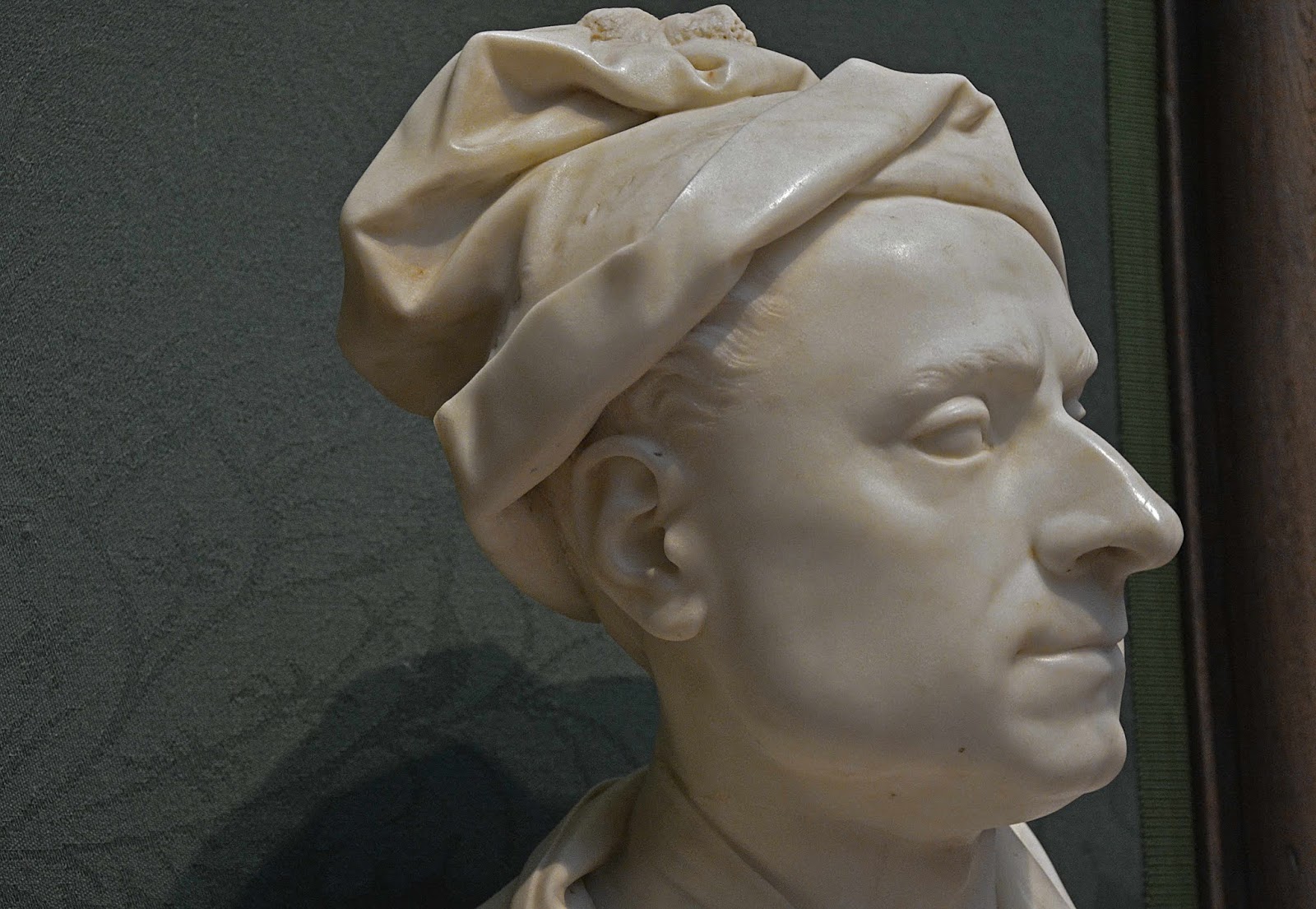
The Marble Bust at the National Portrait Gallery
The Marble bust at the Detroit Institute of Art
I have, in my amateurish way already posted on the two marble busts of Isaac Ware but given the recent appearence of the plaster bust at Kenwood House on the Art UK website and the new photographs of the bust at the Detroit Institute of Art I thought it time to update my previous post see -
http://bathartandarchitecture.blogspot.com/2015/04/bust-of-architect-isaac-ware-1704-66-by.html
______________
A remarkable feature of this bust is the similarity in dress of the bust of Ware to that of the Roubiliac Handel - one is the reverse of the other.
Why did Roubiliac do this - was it showing off? - it cannot have been easy - he or an assistant must have used some sort of pointing system and reversed all the measurements.

The photograph above depicts the marble bust of Handel in the Royal Collection with on the left the Detroit Handel and in the centre the NPG bust of Ware.
Constructed by the author using Adobe Photoshop.
The photograph of the Handel bust courtesey the Royal Collection.
Provenance -
1739
From the composer
1739
From the composer
Given by the sitter to John Christopher Smith (1683-1763);
his son, also John Christopher Smith (1712-1795); by whom given to George III,
c.1772-4
https://www.rct.uk/collection/35255/george-frederick-handel-1685-1759
________________
The Plaster Bust of Isaac Ware at Kenwood House.
I don't currently know the origin of this bust. It was, as far as I am aware not on display when I visited in May 2015.
Lot 55, 2nd day of the Roubiliac Posthumous sale 12 - 16th May 1762 was a mould of Mr Isaac Ware.
see -
http://bathartandarchitecture.blogspot.com/2015/05/a-catalogue-of-posthumous-auction-sale.html


Images Courtesey Art UK website.
No size given and the Art UK website does not make it clear if this is a cast taken from the NPG bust (see below), but the detail of the socles would suggest that this is the case although when taken is currently unknown to me.
________________
Isaac Ware (1704 -66).
Louis Francois Roubiliac
National Portrait Gallery
Photographs by the Author.



____________

The NPG bust of Isaac Ware.
50.5 cms
The eyes are blank
Damage and restorations to the nose and drapery.
Purchased 1974 from dealer Cyril Humphris with a provenance of Major Richard Wellesley with funds provided by Government Art Fund.
see -
https://www.artfund.org/supporting-museums/art-weve-helped-buy/artwork/4052/bust-of-isaac-ware
Entry below from the NPG website.
2) Information kindly communicated by Major
Wellesley, 1 May 1974
National Portrait Gallery.
50.5 cms
The eyes are blank
Damage and restorations to the nose and drapery.
Purchased 1974 from dealer Cyril Humphris with a provenance of Major Richard Wellesley with funds provided by Government Art Fund.
see -
https://www.artfund.org/supporting-museums/art-weve-helped-buy/artwork/4052/bust-of-isaac-ware
Entry below from the NPG website.
Bought 1974 with the help of the National Art Collections
Fund; from the collection of Major Richard Wellesley, of Buckland House,
Berkshire, Christie's, 4 December 1973, lot 159, bought Cyril Humphris, and
according to the sale catalogue, previously in the collection of Lady
Fitzgerald. A marble bust of Isaac Ware is mentioned in an 1861 [1] inventory
of Buckland House and in 1912 under the heading 'Staircase and Hall'. Major
Wellesley's grandmother, Lady Fitzgerald, wife of Sir Maurice Fitzgerald, 20th
Knight of Kerry, acquired Buckland House and some furniture from the
Throckmortons in 1908; [2] NPG 4982 may thus have descended in the Throckmorton
family.
An expensive object like a marble bust is not likely to have been commissioned by the sitter. The obvious patron is Chesterfield, or perhaps Byng. However there seems to be no record of NPG 4982 in such ownership, and a connection with the Throckmortons is not apparent.
An expensive object like a marble bust is not likely to have been commissioned by the sitter. The obvious patron is Chesterfield, or perhaps Byng. However there seems to be no record of NPG 4982 in such ownership, and a connection with the Throckmortons is not apparent.
1) Information kindly supplied by Miss Thompson, archivist
at Coughton Court.
National Portrait Gallery.
This text below was lifted from NPG Website - Originally
published in John Kerslake, Early Georgian Portraits, Her Majesty's Stationery
Office, 1977 (and now out of print).
The information is out of date - it was
written before the purchase of a similar bust by the Detroit Institute of Art which was originally described in an inventory of 1773 of Sir John Ingilby at Ripley
Castle, Yorkshire and by descent with the family of Sir Thomas Ingilby, Ripley
Castle until 1987.
Isaac Ware (d.1766).
Architect; of humble origin, sent to Italy to study; on his
return closely connected with Lord Burlington's circle; from 1728 Ware held
several posts in the office of works, and from 1736 was secretary to the board;
built Chesterfield House, 1748-49 (destroyed 1934) and Wrotham Park, Middlesex,
1754, built for the unfortunate Admiral Byng; published The Complete Body of
Architecture, 1735, and the translation of Palladio, 1738, dedicated to
Burlington; he was a member of the St Martin's Lane Academy. Ware married (1)
Elizabeth Richards, by whom he had a son Walter James, and (2) Mary Bolton, by
whom there were two daughters. [1]
4982 By Louis François Roubiliac, c.1741.
White marble bust, 27 in. (675 mm) high, including grey
veined marble socle; head turned to right and tilted slightly, own short hair,
pupils not incised, concave cheeks, dimpled chin, square jaw; large cap with
tassel, shirt open at the collar, loose coat buttoned at the top.
Incised on the front of the socle in gold capitals: ISAAC
WARE.
George Vertue notes, probably after a visit to the
sculptor's studio, between 2 June and October 1741: 'Mr. Rubbilac Sculptor of
Marble—besides several works in Marble—moddels in Clay. had Modelld from the
Life several Busts or portraits extreamly like Mr. Pope. more like than any
other Sculptor has done I think Mr. Hogarth very like.—Mr. Isaac Ware Architect, Mr Handel—&c and several others. being very exact Imitations of Nature—'.
[1] Both terra cotta and marble busts of Pope (q.v.) and Handel (q.v.) survive,
but of Hogarth only a terra cotta (q.v.) is known. Vertue does not specify what
he saw of Ware, but the wording strongly suggests a sitting. Roubiliac would
first have taken a clay or clays ad vivum which was probably fired subsequently.
A mould was in Roubiliac's sale, possibly indicating the production of a
plaster cast, but no clay or terra cotta is now known. The NPG portrait is the
only extant version. On stylistic grounds it is unlikely to have been made late
in Roubiliac's career.
The situation is complicated by a reference found in Smith's
Life of Nollekens, which could imply a date not earlier than 1755. The author
refers to Ware's account of his own humble beginnings as the son of a chimney
sweep which 'narrative my father heard the Architect himself relate, while he
was sitting to Mr. Roubiliac for his bust'. [3] Later Smith again mentions the
work: 'Early in life, I engraved a very indifferent plate of Ware's bust, which
was one of Roubiliac's best performances'. [4]
Unfortunately he gives no location for the bust which he
engraved, and while the engraving is similar in some respects to NPG 4982, it
is not absolutely certain that it is the same bust. There are some small
differences. In the engraving the pupils are incised, there are two buttons on
the neckband of the shirt, the cap and coat are shaded, and the shirt is left
white. This led Mrs Esdaile to conclude that the engraving was of a coloured
bust, like that of Colley Cibber (q.v.), now attributed to the Cheere workshop,
but which she believed to be by Roubiliac. Noting that it was not until 1755
that Smith's father became Roubiliac's apprentice, Mrs Esdaile also concluded
that Vertue's reference of 1741 must apply to some other bust now lost, [5] but
both on stylistic grounds and on apparent age—the sitter looks a little younger
than in the portrait by Soldi of c.1754 (see Iconography)—there is nothing
against a date of c.1741 for NPG 4982.
Smith's reference seems too circumstantial to be dismissed
as a mistake. If correct, it must either predicate a full second sitting, or
the touching up from the sitter of a marble based on an earlier model. It is a
matter of opinion, but NPG 4982 may be thought to contain a smaller element of
realism than persists in Roubiliac's marbles of Pope and Handel in relation to
their terra cottas. This suggests that it may have been produced without direct
reference to the sitter and may not be the bust mentioned by the elder Smith.
Condition: the head, the tip of the nose, and the fold in
the coat on the sitter's right shoulder had been broken and skilfully repaired
prior to acquisition; the socle is modern.
Collections: bought 1974 with the help of the National Art
Collections Fund; from the collection of Major Richard Wellesley, of Buckland
House, Berkshire, Christie's, 4 December 1973, lot 159, bought Cyril Humphris,
and according to the sale catalogue, previously in the collection of Lady
Fitzgerald.
A marble bust of Isaac Ware is mentioned in an 1861 [6]
inventory of Buckland House and in 1912 under the heading 'Staircase and Hall'.
Major Wellesley's grandmother, Lady Fitzgerald, wife of Sir Maurice Fitzgerald,
20th Knight of Kerry, acquired Buckland House and some furniture from the
Throckmortons in 1908; [7] NPG 4982 may thus have descended in the Throckmorton
family. An expensive object like a marble bust is not likely to have been
commissioned by the sitter. The obvious patron is Chesterfield, or perhaps
Byng. However there seems to be no record of NPG 4982 in such ownership, and a
connection with the Throckmortons is not apparent.
Engraved: the type was engraved by J.T. Smith (unsigned),
published J. Richardson, 1802, 'From a Bust by Roubylliac' and issued in
Illustrations for the Rev. Mr. Lyson's Environs of London, 1811 (pl.88).
Exhibited: 'English Taste in the Eighteenth Century', RA,
1955-56 (147).
Literature: H.M. Colvin, 'Roubiliac's Bust of Isaac Ware',
Burlington Magazine, XCVII, 1955; J.T. Smith, Nollekens and His Times, ed. W.
Whitten, 1920.
Iconography
The only other portrait is the oil attributed to Soldi in
the RIBA. This probably dates from c.1754 as it shows an elevation of Wrotham
Park, which is seen in construction in the background. It includes one of the
sitter's two daughters or possibly his second wife. [8]
Notes
1. Colvin, pp.649-51; Sir John Summerson, unpublished
information.
2. Vertue, III, p.105.
3. Smith, II, p.143.
4. Ibid.
5. Esdaile, pp.51, 108.
6. Information kindly supplied by Miss Thompson, archivist
at Coughton Court.
7. Information kindly communicated by Major Wellesley, 1 May
1974.
8. Connoisseur, vol.186, 1974, pp.180-81.
Buckland House was designed by Bath Architect John Wood
senior, it was substantially altered by
his son John Wood Junior and appears in Vitruvius Britannicus of 1767.
By coincidence the marble bust of Alexander Pope which was
owned by Burford antiques dealer Roger Warner (currently April 2015, with London
Historic portrait dealer Phillip Mould) was bought at the same Christie's sale of the contents of Buckland.
______________________
The Detroit Institute of Art Marble Bust of Isaac Ware
Louis Francois Roubiliac.
NB the round socle has recently been replaced with a more appropriate version.
Originally described in an inventory of 1773 of Sir John Ingilby at Ripley Castle, Yorkshire and by descent to the family of Sir Thomas Ingilby, Ripley Castle until 1987.


The pupils of the eyes are incised
__________________

Stipple and line engraving
225 x 175 cms
Lettered below image with title, 'from a Bust by
Roulylliac.'
and 'Published Decr. 1. 1802, by Wm. Richardson, York House, No.
31. Strand.'
This mysterious engraving suggests the possible existence of another bust of Isaac Ware - the toning in the engraving also suggests that it was coloured or painted perhapd in the same fashion as the bust of Colley Cibber now in the NPG (see below).
NB buttons on the shirt collar and incised or painted eyes.

Isaac Ware
Andrea Soldi (1703 - 71).
Portrait c.1754.
110 x 93 cms.
Purchased from a Mrs Batt in 1947.
Royal Institute of British Architects
Image and text from Art UK
https://artuk.org/discover/artworks/isaac-ware-17041766-and-his-daughter-mary-216445
Isaac Ware (1704–1766) was a protégé of Lord Burlington and
a leading member of the second generation of Palladian architects who combined
elements of the rococo in their work. The architect holds his design for
Wrotham Park, Middlesex, made for Admiral John Byng. The girl is almost
certainly his youngest daughter Mary, who stayed with him until his death.
Isaac Ware's principal works included Chesterfield House, Mayfair (1748–1749)
and Wrotham Park, Hertfordshire (1754), while he is most remembered for his
publication 'The Complete Body of Architecture' (1756) and his scholarly
translation into English of Andrea Palladio’s 'Four Books of Architecture'
(1738).
Andrea Soldi, though originally from Florence, began his career as a
portrait painter working for British merchants in Turkey. He arrived in London
in 1736 and was an immediate success but an extravagant lifestyle led to the
debtors’ prison in 1744 and his career never really recovered.
Soldi painted a portrait of Roubiliac in 1751
____________The Plaster Bust of Colley Cibber
'The King of the Dunces' (Alexander Pope).
remarkably lifelike.
Variously attributed to Henry Cheere, Roubiliac and recently suggested Benjamin Rackstrow of the Strand on rather flimsy evidence
(none at all as far as I can see).
Personally I lean towards Roubiliac.
Painted Plaster, the turban removes.
673 mm tall.
Purchased 1896
National Portrait Gallery.

Photograph by the author

The Gentleman's Magazine in 1842 reports - lot 106 on the
17th day of the Strawberry Hill sale;
'A bust of Colley Cibber poet laureate when old in a cap,
coloured from life ...... £2 5s, Russell,
Cibber gave it to Mrs (Kitty) Clive the actress and her
brother Mr Radnor presented it after her death to Walpole'
Extract from the Strawberry Hill Auction Catalogue 13 May
1842.
Sold to Buckley Bolton Esq.
Most likely Dr George Buckley Bolton surgeon of 9 Pall Mall
(d. July 1847).
see my previous post


