As most of my posts this is a work in progress and acts as an aide memoire and on line filing system and will need updating as more information becomes available.
This posts was updated August 2025.
Sculpture at The Former Codrington Library, All Souls College. Oxford University.
The Library is now referred to as All Souls College Library.
Part 1.
The Set of 24 Life Size Plaster Busts of Former Fellows of 1750.
Part 1.
John Cheere.
The 25 plaster urns were also supplied by John Cheere are repeated in the 7 urns at Lydiard Park near Swindon supplied along with a series of busts in 1743 (check this date).
by John Cheere of Stone Bridge by Hyde Park Corner.
Commissioned by William Blackstone in 1749.
Some notes about All Souls and a General Overview.
My intention here is to list the busts, provide photographs of them and where possible attempt to determine the sources of the facial features of the busts provided by John Cheere and his workshop.
My intention here is to list the busts, provide photographs of them and where possible attempt to determine the sources of the facial features of the busts provided by John Cheere and his workshop.
It is not clear who was the sculptor/s of the All Soul's busts within the workshop of John Cheere - possibly John Cheere himself although I believe that he had some sort of collaboration with his brother Henry (1703 - 81) before setting up business on his own account (with his older brother's assistance) at Hyde Park Corner in 1738 and also had a relationship with Roubiliac.
The Cheere brothers were both consummate business men and able to adapt with the changing times - both died very rich men.
These 24 busts whilst competent are not great works of art and cannot be by Roubiliac.
James Hoskins (d.1791) was apprenticed to John Cheere in 1747 by 1753 he was described in a Newspaper report in the London Evening Post as foreman to Mr Cheere. In 1774 He went into partnership with Benjamin Grant (d. 1809) in 1769 at the Golden Head in St Martins Lane. This was possibly in Duke's Court on the west side of the lane the former residence and business address of Francis Pitsala. (d.1769) figure maker - but the sign of the Golden Head was not uncommon.
Grant was also an apprentice to Roubiliac and in the London Evening Press 10 - 12 December 1751 it states that he was one of 4 apprentices employed by John Cheere.
.
Louis Francois Roubiliac who had arrived in England in 1730 was almost certainly involved with the brothers Cheere either in the workshop at Old Palace Yard, Westminster or as a subcontractor -
the lead portrait busts which have in the past been attributed to Henry Cheere were almost certainly modelled by Roubiliac.
It is also not clear whether Roubiliac actually had a workshop at the St Martin's Lane Academy in Peter's Court off St Martin's Lane - he had set up at the North end on the East side of St Martin's Lane by late 1740.
I have written at some length on all the men mentioned in this post - the search box in the top left corner will take the reader to much more.
___________________________________
I am very grateful to Gaye Morgan, Librarian in Charge and Conservator in Charge at the Codrington Library for allowing me access to the Library and for facilitating the photography.
I am also very grateful to Gaye Morgan for providing the black and white photographs of the Codrington Library busts (below) taken in the early 2000's when the busts were taken down for cleaning.
____________________________
The payment for the busts is recorded in Acta in Capitulis - All Souls Records, 17 Jan 1750.
___________________________
For more on the library and All Souls see the Codrington Website
https://codringtonlibrary.wordpress.com/about-the-codrington-library/
For a very useful short history of the library see - https://www.asc.ox.ac.uk/library-history
For a good, general history of All Souls see -
All Souls College by C.Grant Robertson, pub. 1899.
available on line and easily searchable.
see also - https://archive.org/details/allsoulscollege01robe
See also the excellent British History online from the Victoria County History, first pub. 1954.-
http://www.british-history.ac.uk/vch/oxon/vol3/pp173-193#h3-0009
______________________________________________
For much more on Oxford University if one can be bothered to trawl through it! see - The History and Antiquities of the University - of Oxford, by Anthony Wood...... edited from the MS by John Gutch - 1792.
Two Volumes with separate Appendix.
For Volume 1 see - https://books.google.co.uk/books?id=wwYVAAAAQAAJ&printsec=frontcover&source=gbs_ge_summary_r&cad=0#v=onepage&q&f=false
_______________________________________________________________________
For the Painted Portraits and Portrait Sculpture at All Souls see -
Catalogue of the Portraits in Possession of the University, City and County of Oxford, Vol. II, by Mrs Reginald Lane Poole, Pub Oxford at the Clarendon Press, 1925.
Fully searchable on line at
https://archive.org/stream/b22652061_0002#page/n9/mode/2up
____________________
For as good a place as any to commence research into the finances at All Souls -
See - Catalogue of the Archives in the Muniments Room of All Souls College by Charles Trice Martin. F.S.A. - pub. Spottiswood, 1877. Fully searchable online at -
https://archive.org/stream/catalogueofarchi00mart#page/n7/mode/2up
_________________________________________________________________
For the most up to date architectural history see - All Souls..... by Howard Colvin, pub. 1989.
see also British History on line -
http://www.british-history.ac.uk/vch/oxon/vol3/pp173-193
extract below.
The
general idea of the library was adopted with extraordinary promptitude, though
Hawksmoor's original design, which included a huge 'Turret' or 'Gothick
lantern' in the centre of the building, balancing a similar turret to be built
over the junction of chapel and hall, was radically simplified.
On 19 Feb.
1714/5 it was agreed 'that the library of Col. Codrington should be built as ye
Coll. Chappell was according to ye model that was then shown to ye society and
that Dr. Clarke and Sir Nat. Lloyd be desired to be inspectors and take care of
ye sayd buildings'.
The exterior of the library is on the west and south sides
almost an exact replica of the chapel and the rebuilt hall. Even the irregular
plan of antechapel and the stair turret are reproduced. The north windows of
antechapel were blocked to match the corresponding blank wall of the library.
It was even proposed to remove the mullions from the chapel windows and remodel
the tracery of the west window in order to make the correspondence complete.
Inside, the spaces corresponding to the aisles of antechapel housed
each a staircase and three small rooms. The rest of the building forms one vast
gallery, broken in the centre by a bay projecting north.
The site for the
library was acquired from the parishioners of St. Mary's in 1714, and
work was begun, according to Gutch, in May 1715. This was presumably clearance
only, for a scale of prices was not agreed with Townesend till 12 Mar. 1715/6, and the foundation stone was laid on 30 June 1716.
Hawksmoor
personally supervised the work.
In 1721 'Townsend and Peisley ye Masons were
abated in their great bill by Mr. Hawksmoor ye sum of £245 10s.', and Hawksmoor
was paid £100 'for his trouble about Cod. buildings' (this sum is entered in
the accounts 'for the surveys').
In 1734 the marble statue of
Codrington 'habited in the Roman sagum' by Sir Henry Cheere was erected in the
bay, but the library was far from finished. The bookcases were
probably not begun till some years later. Hawksmoor had designed them in three
stories with two galleries, but in 1740 the college felt some doubts about this
arrangement and consulted Gibbs (Hawksmoor having died in 1736). His advice to
scrap 'the Attick and its gallery' was accepted. The work still
lagged and on 28 Aug. 1748 it was agreed 'that proper Workmen be employed to
finish ye Library with all Expedition'. John Franklyn, the dilatory carpenter,
was discharged, and a contract made with Richard Tawney to finish the shelves
(9 Dec. 1748).
In 1750, twenty-five bronze vases and twenty-four
bronze 'bustoes' of college worthies were ordered from Cheere to decorate the
top of the shelves. (fn. 191)
On 19 Apr. 1750 a contract was signed with Mr.
Roberts of Oxford for the stucco work. He made the ceiling 'with the same
mouldings and guilloche as are expressed in his drawings and specimens', the
keystones of the windows and the founder's arms in the recess. He also designed
and executed ornamental panels in the ceiling, between the windows and over the
bookcases; these, though greatly admired in the 18th century, were swept away
early in the 19th.
Finally in 1751 a marble bust of the founder by
Roubiliac was placed over the main door 3 Nov 1750 the bust was moved to the hall in 1815 and the library was painted a
'bright olive colour'.
The Codrington account was closed in 1756, by
which time £12,101 0s. 5d. had been spent.
_____________________________________________________
The
North range of North Quadrangle. Begun 1716; Dr Clarke and Sir Nathaniel Lloyd
as "inspectors", Hawksmoor supervised and Townesend and Peisley were
the masons.
Alterations and additions made 1838 and1866. Sundial of 1659
(originally on South of chapel) reset on South elevation. Rebuilding of store
on North-East, 1949.
Interior includes platerwork by Roberts, fittings by
Richard Tawney, carpenter.
_______________________________________

Birds eye view of All Souls College, Oxford, looking North
Prior to the construction of the Codrington Library began in 1716.
from Oxonia Illustrata.
David Loggan.
Engraving.
1675.
Image from Victoria and Albert Museum.
Clearly showing the statues of Archbishop Henry Chichele and King Henry VI in the niches above the main gate.
These statues are now in the Chapel at All Souls - they are in remarkably good condition.
I will post photographs of these statues shortly.
Excerpt below adapted from British History online -
http://www.british-history.ac.uk/vch/oxon/vol3/pp173-193#h3-0009
On the south face there are three niches. The history of the
figures which filled these niches is mysterious. In the Typus the niches appear
empty, but in 1633 'the three statues over our gates of our Saviour, of King
Henry the sixt and our founder were … polished, smothed and renewed with
varnishe and guilt as formerly they had beene'.
How the medieval figures survived the Reformation is
suggested by the following entry in the Computus Roll of 1548 (rep. infra),
'pro clavi et reparacione sere ostii domus in qua imagines reponebantur'.
In 1642 the
Parliamentarian soldiers 'discharged at the image of our Saviour over All
Soules gate and would have defaced all the worke there had it not byn for some
townesmen who entreated them to forbeare'. Loggan shows the big central niche,
where our Saviour had stood, empty save for the souls at its foot, but the two
lower niches filled by statues.
The 18th-and early-19th-century views do the same. The angel
and souls in the upper niche were 'reworked in Bath stone' in the restoration
of 1826–7, and the two lower figures were 'repaired and cleaned' at the same
time.
The niches were recarved and the statues replaced by modern
sculptures by Mr. W. C. H. King in 1939–40
Oxonia Illustrata is available on line from Stanford Library at -
http://www.rarebookroom.org/Control/logoxo/index.html
and also at -
https://luna.folger.edu/luna/servlet/view/search/what/Oxonia%2BIllustrata...?q=%3d%22Loggan%2c+David%2c+1635-1700%3f%22&sort=Call_Number%2CAuthor%2CCD_Title%2CImprint
__________________________________
and also at -
https://luna.folger.edu/luna/servlet/view/search/what/Oxonia%2BIllustrata...?q=%3d%22Loggan%2c+David%2c+1635-1700%3f%22&sort=Call_Number%2CAuthor%2CCD_Title%2CImprint
__________________________________

Extract above from the Universal Magazine, September 1755.
Listing the busts and their original positions.
For convenience sake I have used this list to catalogue the busts.

1. Sir Anthony Sherley.
Fellow of All Souls, 1582.
_________________________________________

2. Sir William Petre.
Fellow of All Souls, 1523.
____________________________________________

3. George Clarke (1661 - 1736).
__________________________________

4. Sir Daniel Dunn (d. 1617).
______________________________________

5. Henry Coventry (1619 - 1628).
___________________________________________

6. Sir Robert Weston.
_______________________________________________

7. Sir William Trumbull. (1639 - 1716).
_______________________________________

8. Charles Talbot (1685 - 1737).
___________________________________

9. Sir Christopher Wren (1632 - 1723).
____________________________________________________

10. Richard Steward (1593 - 1651).
__________________________________________________

11. Bishop Thomas Tanner (1674 - 1735) .
_______________________________________

12. James Goldwell (d. 1499).
__________________________________________

13. Gilbert Sheldon (1598 - 1677).
_____________________________________

14. Brian Duppa (1588 - 1652) Bishop of Winchester.
__________________________________________

15. David Pole (d. 1658).
_______________________________________

16. Jeremy Taylor (1613 - 67).
____________________________________

17. John Norris (1657 - 1712).
_________________________________________

18. Thomas Sydenham (1624 - 89).
This is the only bust that has been duplicated - the other is in the Wren Library, Trinity College Cambridge.
___________________________________________

19. Thomas Linaker (1460 - 1524)..
________________________________________

20. Sir Clement Edmonds (1568 - 1622).
____________________________________________

21. Sir William Bird (1540's - 1623).
_______________________________________

22. Sir Nathaniel Lloyd (1669 - 1741).
______________________________________

23. Robert Hovenden (1544 - 1614).
_________________________________________

24. Sir John Mason (1503 - 66).
____________________________________


Birds eye view of All Souls College, Oxford.
1598.
____________________________________
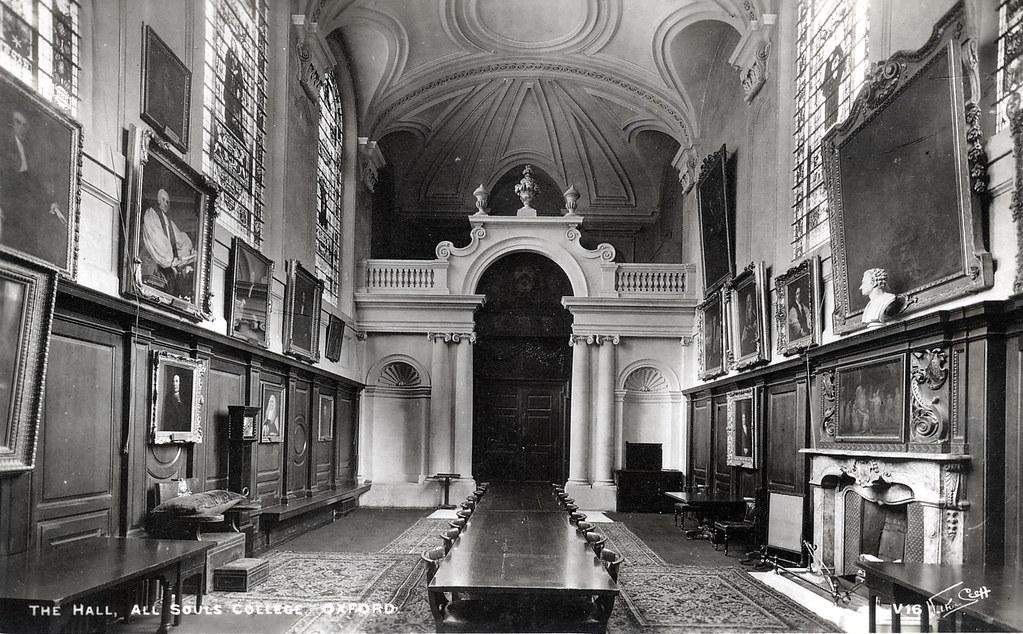
Bust of Reginald Heber (1783 - 1826) over the Chimneypiece.
____________________________

____________________________________




.jpg)