Friday, 7 March 2025

Part 12. The Sulham statue of Cain and Abel.


Part 12.

 The Lead Statue of Samson slaying the Philistine / Cain and Abel. 


Hercules and Anteaus.

Lead Statue.

Rupert Gunnis states by Andries Carpentier (Andrew Carpenter d.1737).

By Mosshall Woods, Sulham, Purley on Thames, Berkshire.

This attribution seems very reasonable given that production of lead statuary by John Cheere did not commence until after 1738.

I have posted the image here so that there is no confusion with the statues of Samson and the Philistine.

The statue of Hercules and Anteus was stolen c. 1969.

Presumed melted down for the value of the lead.

The first reference to the statuary at Purley Hall is in 1720. Francis Hawes, one of the Directors of the South Seas company, had just purchased Purley Hall and asked Charles Bridgeman to lay out the gardens. Bridgeman, who in 1728 was to become Royal Gardener to George II, prepared a plan, in the bottom right hand corner of which there is the following note: 

Entrance of the Wood above the ground floor of the House 58 feet. Centre of the Wood at the Hercules & Antaeus above the Entrance of the Wood 34 feet...........


see -

https://project-purley.net/R200220.pdf

https://project-purley.net/R200209.pdf


Image here from Reading Local Studies Library.

.................

Paintings of Purley Hall with the statue of Samson and the Philistine.

It occurs to me that the YCBA Samson slaying the Philistine (provenance a "private collection") could be the same statue as that illustrated in the paintings.

 That saying I'm sure that there are further examples that havn't been accounted for!

The composition relates closely to an equally primitive oil on canvas (66 x 86cm), in a private collection which is illustrated in John Harris, 'The Artist and Country House', London 1979, No. 417, P.363. The Reverend Dr Henry Wilder purchased Purley Hall in 1778 and let it to Warren Hastings, a former Governor of India, while he awaited trial. Hastings is said to have spent the three years here fattening prize cattle, riding Arab horses, rearing Tibetan goats and cattle of Bhutan.

https://www.bonhams.com/auctions/11166/lot/284/


.......................

Purley Hall with the statue of Samson and the Philistine.

Watercolour drawing at the Victoria and Albert Museum.

by Francis James Sarjent.

c.1800.

https://collections.vam.ac.uk/item/O767428/purley-hall-watercolour-drawing-sarjent-francis-james/


The crop below clearly shows Samson with the jaw bone.


.....................

Another view of Purley Hall.

Francis Cotes .

V and A.


https://collections.vam.ac.uk/item/O56628/purley-hall-berkshire-watercolour-cotes-francis/


Francis Hyde built Purley Hall (formerly known as Hyde Hall) in 1609. The estate was sold c 1720 for £14,000 by Hyde's grandson, also Francis, to Francis Hawes, a Director of the South SeaCompany and Cashier to the Customs. 

Hawes employed Charles Bridgeman (d 1738) c 1720-1 to produce a design for the garden, and a record dated March 1721 exists for `Mr Bridgeman his bill for laying out the gardens at Purley, £122 11s 0d', together with his design (Bodleian Library), and records of substantial payments for plants, and ornamental and fruit trees (CL 1970). 

Bridgeman's plan was carried out, although seemingly in modified form (Ballard, 1758). 

In 1720 the `South Sea Bubble' burst. Hawes, as one of the responsible directors, had his assets seized early in 1721, and the Purley Hall estate was put up for sale, to be bought back by his younger brother, Thomas, probably for the low price of £1080. 

The garden retained its formal layout during the mid C18 (Ballard, 1758; Rocque, 1761), remaining in the Hawes family until c 1770 when it was sold to the Wilder family.

The Government rented the Hall for Warren Hastings during his impeachment by Parliament in the1780s, a painting of c 1785 (Harris 1979) depicting the Hall and its environs, populated with the Indian livestock which Hastings kept at Purley. 

During the C20 the Hall was leased, remaining empty during the Second World War, and was sold by the descendants of the Wilders in 1961. 

A period of restoration in the garden took place during the 1980s, under the auspices of the ownersMajor and Mrs Bradley. At this time the east arm of the canal was restored, having been filled in c 1818 (CL 1970), and the gateway arch was rebuilt. 

The Hall remains (1998) in private ownership, separate from the park and majority of the walled garden, which are also in private hands.


................


Lawrence Weaver in English Leadwork pub.1909 states there was a kneeling slave sundial in the garden at Purley Hall. Another attributed to Carpenter was supplied to Dunham Massey.

The original is that made by John Nost I.

https://ia801600.us.archive.org/15/items/englishleadworki00weav/englishleadworki00weav.pdf


I will return to the subject in due course.

The Kneeling Slave.

c. 1708.

John van Nost I made the first of these figures for King William III’s Privy Garden at Hampton Court.

This sundial is believed to have stood on Elihu Yale’s estate, Plas Grono, near Wrexham, in Wales. The bronze dial, which bears Yale’s coat of arms.

Provenance.

Commissioned by Elihu Yale (1649–1721), Wrexham, Wrexham County Borough, Wales, probably about 1708 [see note 1]; by descent to his daughter, Catherine Yale, Lady Guilford of Glemham Hall (1685–1715), and his son-in-law, Dudley North, Lord Guilford of Glemham Hall (1684–1730), Little Glemham, Suffolk, England, by 1721; probably by descent within the family to Charlotte Maria Dickson, Lady North of Glemham Hall (née Charlotte Maria Eden, 1831–1909), Little Glemham, Suffolk, England [see note 2]; by descent to her son, Reginald Eden Dickson, Esquire of Eden Lodge (1862–1931), Woodbridge, Suffolk, England, 1909; partially sold through Brick Row Book Shop, New Haven, Conn., to Clarence Winthrop Bowen (1852–1935), Ganson Goodyear Depew (1866–1934), Edmond Byrne Hackett (1879–1953), and Henry King Smith (1877–1948), New Haven, Conn., 1922 [see note 3]; given to Yale University, New Haven, Conn., 1922


Note 1: The date of 1708 inscribed on the face of the sundial suggests this object was commissioned around or just before then.


The Yale Daily News (1937) reports that the object “had been sought by alumni for fifteen years, and it was only when the Yale estate at Wrexham passed by inheritance into a different branch of the distinguished Welsh family that the heirs could be induced to part with it.” The Yale Alumni Weekly (1922), in announcing the gift of the sundial, identifies Reginald Eden Dickson, the son of Charlotte Maria Dickson and her second husband, Alexander George Dickson (1834–1889), as having sold the sundial and, at the same time, as “himself one of the donors.”

Examination of the plate would be very useful


The Kneeling Slave.


Tuesday, 4 March 2025

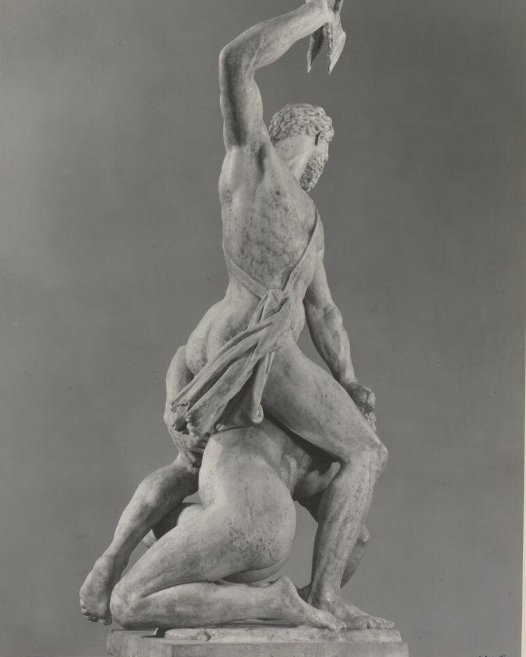
Part 11. Samson slaying the Philistine by Giambologna in The V and A.


Part 11.


 The Victoria and Albert Musem Marble Group of Samson slaying the Philistine.

by Giambologna.

1562.


Created around 1562 by Giambologna, the earliest of his marble groups which was originally commissioned by Francesco de' Medici Duke of Tuscany for a fountain in Florence, it was later gifted to Spain's Duke of Lerma and displayed in the gardens of the Palacio de la Ribera, Valladolid. Perhaps symbolizing the political power of the Medici through a dramatic biblical scene.

Giambologna’s Samson Group was gifted to the Prince of Wales, later King Charles I in 1623.

Samson Slaying a Philistine had served twice as a diplomatic gift. In 1601 it was sent to Spain as a present from the Medici to the Duke of Lerma, Philip III’s chief-minister, and then, in 1623, given by Philip IV to the Prince of Wales (later Charles I) who was visiting Spain in prospect of marriage.

As a contemporary Spanish account published in England in translation soon after puts it: “hee was much delighted with…the Alabaster Fountaine, which the Illustrious great Duke of Tuscan gave to my Lord Cardinall, the Duke of Lerma; he was served [presented] with it: It is the portraiture of Cain and Abel.”

 Thus it is clear that the statue still at this time formed the centrepiece of a fountain, and not an item to be viewed in isolation. Moreover, from this we know it had already become identified with the wrong Old Testament story. It cost the Privy Purse £40 to have the statue – less the fountain base which remained in Spain and is now in Aranjuez – carted to Santander.

Charles, in turn, gave the statue to his favourite George Villiers, the Duke of Buckingham, who had accompanied him in Spain and who subsequently installed it at York House, London, by June the following year.

In June 1624 Sir Thomas Wentworth, the future Lord Strafford, described it in a letter: “a goodly Statue of Stone set up in the Garden before the new Building, bigger than the Life, of a Sampson with a Philistine betwixt his Legs, knocking his Brains out with the Jaw-Bone of an Ass.”  Wentworth was perceptive enough to recognise the true subject of the statue.

By 1714 Villiers had the group moved to Buckingham House which was acquired by George III in 1762, and was finally given as a gift by the Hanoverian king to his Surveyor-General, Thomas Worsley (1710-78) of Hovingham Hall. It remained in Yorkshire until 1954, when it was purchased by the V&A.

In 1883 it was still at Hovingham Hall, Yorks, the Country seat Sir William Worseley to whose grandfather it had been presented by George III (info from Historical Handbook of Italian Sculpture by Charles Callahan Perkins – pub 1883) - Page 339.

 The marble is mentioned again in English Leadwork by Lawrence Weaver pub 1909 (page 166) –

Available online at –

https://babel.hathitrust.org/cgi/pt?id=uc2.ark:/13960/t7fr05c48&seq=11

or https://archive.org/details/b3136665x

Weaver goes on to mention lead versions of Samson slaying the Philistine at Chiswick (this is the Osgood version subsequently moved to Chatsworth), Harrowden Hall, Wimpole Hall and Drayton House, but he erroneously suggests that the Drayton group was modelled by Peter Scheemakers. As far as I am aware Scheemakers did not work in lead except for providing the Equestrian statue at Hull which would have been probably made in collaboration.

https://collections.vam.ac.uk/item/O14761/samson-slaying-a-philistine-figure-group-bologna-giovanni/


.............................

Drawing of the Samson Slaying the Philistine attributed to Giambologna in the Prado, Madrid.

The original concept.

https://www.museodelprado.es/en/the-collection/art-work/fountain-with-hercules-striking-cacus-with-his/20edcee4-b6f1-407f-95b0-dca21f218a37?searchid=e78ec251-55a3-0e4e-0aa2-221d4a2b4961


........................................


Pietro Francavilla (1548 - 1612).

The 3 Drawings at the V and A.


https://collections.vam.ac.uk/item/O38982/record-drawings-of-giambolognas-terracotta-drawing-francavilla-pietro/


10. Samson slaying the Philistine at Queluz.


Part 10.

 The Lead Group of Samson slaying the Philistine / Cain and Abel. 

at the Royal Palace, Queluz, Portugal.

John Cheere.

One of 90 Groups, Figures and Urns supplied in two tranches in 1755 - 57.

Photographs taken by the author.

I will in due course post photographs and details of all the Cheere statues at Queluz.


Information on the Cheere statuary at Queluz (below) culled from -  John Cheere's lead garden statues.... by Maria Joaon Neto and Fernando Grilo. Sculpture Journal Vol. 15.1, 2006.


The Gardens of the National Palace of Queluz, Ana Duarte Rodrigues, Denise Pereira da Silva and Gerald Luckhurst, pub. 2011.


For a not very satisfactory introduction to the works of John Cheere - see John Cheere, the Eminent Statuary ..... Moira Fulton, Sculpture Journal, Volume X, 2003.


______________________________


Details of the purchases are contained in Correspondence between the Portuguese Ambassador in London Don Louis da Cnha Manuel and the Foreign Secretary in Lisbon Sebasteao Jose de Carvalho e Melo (future Marquis of Pombal).

 A stipulation by Dom Pedro was that the statues not be embarrassingly naked and an assurance from the sculptor that they were "girdled".


The sculptures exported from England to Queluz consisted in total of 9 Sculptural Groups, 57 individual figures and 72 lead vases.


 The first Collection sent in May? 1755 in 36 crates on board the ship Camberwell consisted of -

 Meleager and Atalanta (as Diana and Endymion at Wrest Park).

Vertumnus and Pomona.

23 statues of Mythological figures -

Neptune, Meleager, Mercury, Fame, Apollo, Diana, Bacchus, Venus, Ceres and Flora.

A Gladiator and 4 Seasons,

4 Commedia dell' Arte figures, - (Pierrot, Harlequin, Scaramouche and Columbine)

4 Picturesque figures - Shepherd and Shepherdess a man with a flute and drum and a woman with a rake.

24 Vases.


Cost £290.5s. 2d including shipping - £340.18s. 6d.


......................................


The second lot of sculptures were sent in 58 crates on the ship Nossa Senhora do Socorro in September 1755.

The speed with which these sculptures were ordered suggests that John Cheere already had these objects in stock at his premises at Hyde Park Corner..


7 Sculptural Groups -
Rape of Proserpine.
Aeneas Carrying his father Anchises.
Rape of the Sabine Women (another at Wrest Park).
David and Goliath
Cain and Abel actually Samson Slaying the Philistine from the Giambologa original then at Buckingham House (another lead version at Harrowden Hall, Northants).
Venus and Adonis (another at Wrest Park),
Bacchus and Ariadne.

and 6 individual figures -
Hercules.
Meleager.
Atalanta.
Justice.
Mars.
and Minerva.

and 16 animals -
4 Monkeys.
4 Lions.
4 Tigers.
2 Foxes a Harpy and an Eagle.

4 Groups with holes for the large tanks and water spouts?
8 Boys to decorate the waterfalls.
48 Painted Bronze and gold vases.


Cost with 10% discount £853.14s.1d.


Links.


______________________________


This links to the first page of the Sculpture Journal piece, John Cheere's lead garden statues.... by Maria Joaon Neto and Fernando Grilo on the Cheere lead sculpture at Queluz and offers the rest of the article for the bargain price of £25. 
Contact me if anyone is interested in the contents of this article. I will, in due course, be publishing my own photographs (samples above) and a more up to date look at the works of John Cheere which were supplied to Queluz.

.................

Two invaluable general works on the subject of Lead Statuary are English Leadwork, ..... by Lawrence Weaver, pub. 1909 and available on line at -

https://archive.org/stream/englishleadworki00weav#page/n9/mode/2up

and Antique Garden Ornament by John Davies, pub Antique Collectors Club, 1999.

_____________________________


The website of Rupert Harris

__________________________________


Part 9. The Southill Park lead group of Samson and the Philistine.


Part 9.

Samson and the Philistine/Cain and Abel. 

at Southill Park, Bedfordshire.

John Cheere.


One of a collection of lead statuary by John Cheere, bought in 1812 by Samuel Whitbread II. 

It lacks the incised decoration on the strap across his back seen on the Queluz Portugal version of 1755 / 57. 

The other statues included Ceres, Minerva, the Farnese Flora, two of priests, Winter (after Girardon ), A Priestess of  Isis, Apollino, the Rape of Proserpine, Diana and four more for a total of £975.


The image below from the Paul Mellon Photograph archive.


https://photoarchive.paul-mellon-centre.ac.uk/objects/408353/samson-slaying-the-philistine


I have contacted Southill Park and hope to obtain further photographs in due course.


8. The Yale Centre for British Art Samson and the Philistine/Cain and Abel.


Part  8. 

The Yale Centre for British Art Samson and the Philistine/Cain and Abel. 

Attributed to John Cheere.

Height 203 cms.


The Statue was sold to YCBA by Messrs Tomasso of Leeds and London.