Sunday, 11 December 2016

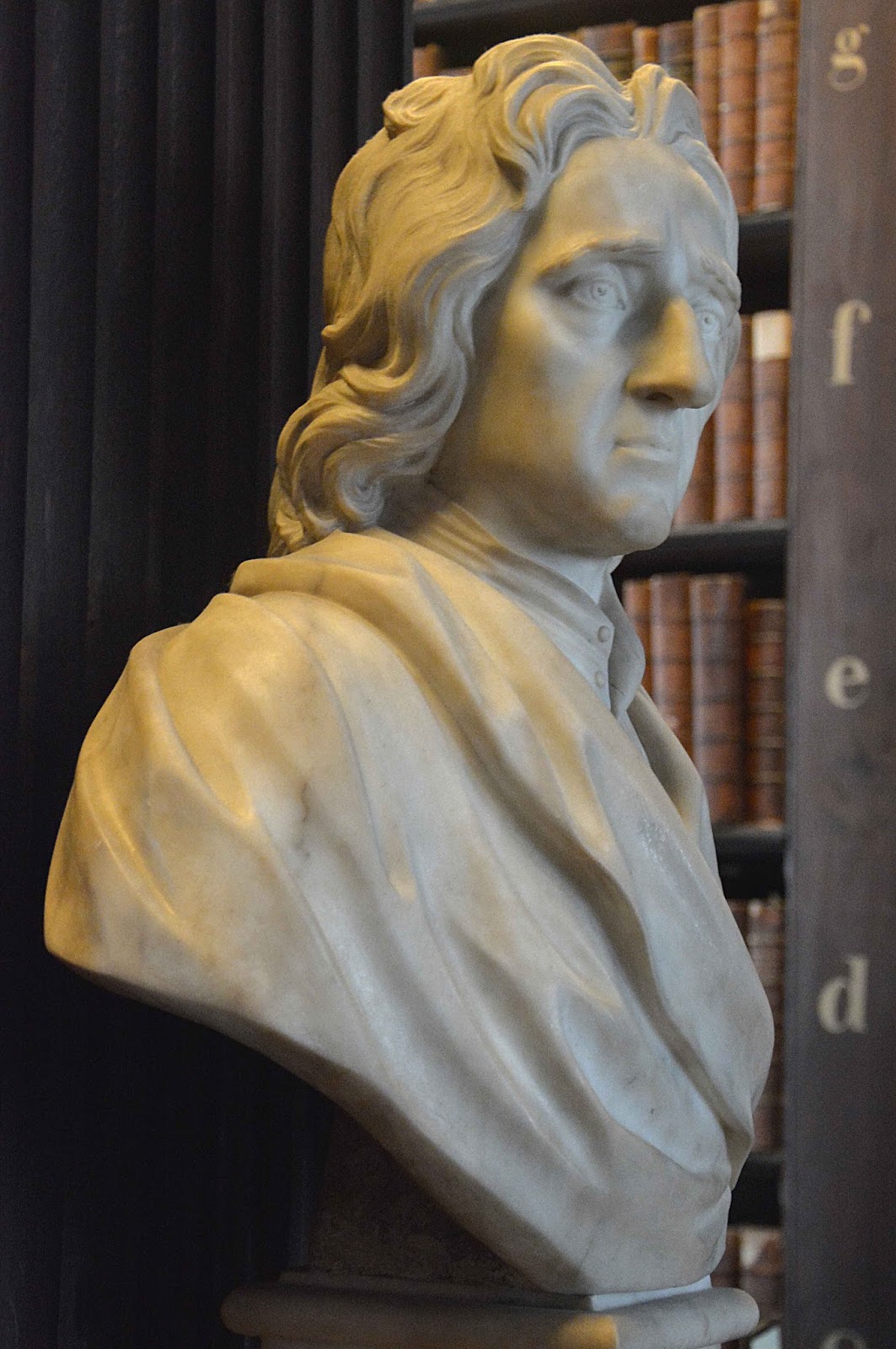
Bust of Francis Willoughby in the Wren Library Trinity College, Cambridge


The Marble Bust of Francis Willoughby (1635 - 1672).

in the Wren Library at Trinity College, Cambridge.

Louis Francois Roubiliac.

Signed and dated 1751.

This bust was the gift to Trinity of Edmund Garforth. 

Garforth, was an undergraduate at Trinity from 1720 and Fellow of the college from 1726, who then moved to a living in York, married Elizabeth Willoughby, a descendant of the naturalist, in 1750.

Francis Willoughby of Middleton Hall, Warwickshire, to Sir Francis Willoughby and Cassandra Ridgway. 
 . 
 He studied at Bishop Vesey's Grammar School, Sutton Coldfield and Trinity College, Cambridge. 

In 1656 he was admitted Bachelor of Arts at Trinity College, Cambridge, and Master of Arts in 1659

He was elected a Fellow of the Royal Society in 1663 after accompanying his tutor John Ray on a botanical journey through the Midlands and North Wales the previous year. He traveled with Ray and other companions to Europe in 1663-6, ending his tour alone with a visit to Spain. 

In 1667 he married Emma Barnard, daughter of Sir Henry Barnard of Bridgnorth and London. 

They had three children. The first child, Francis, died at the age of nineteen, while his daughter Cassandra Willoughby married the Duke of Chandos, who was a patron of Mark Catesby. His second son was Thomas, who was created Baron Middleton by Queen Anne.

At Cambridge Francis Willughby was taught by the naturalist John Ray see the following entry on this blog. In 1662 they travelled to the west coast of England to study the breeding seabirds. Between 1663 and 1666 they toured Europe together, travelling through the Netherlands, Germany, Switzerland and Italy. They separated at Naples and Willughby returned home via Spain. 

On returning to England they made plans to publish the results of their studies. Willughby died from pleurisy during the preparation of this work, but Ray published Willughby's Ornithologiae libri tres in 1676, with an English edition two years later. This is considered the beginning of scientific ornithology in Europe, revolutionizing ornithological taxonomy by organizing species according to their physical characteristics. 

Willughby and Ray were among the first to dismiss the older inaccuracies of Aristotle. Aristotle had claimed that swallows hibernated but Willughby and Ray (1678:212, quoted in Raven 1942:328) wrote: "To us it seems more probable that they fly away into hot countries, viz. Egypt, Ethiopia etc."Ray also published Willughby's De Historia piscium (1686).

His 'Account of Francis Willoughby Esq., his voyage through a great part of Spain' was published in 1673; 'Ornithologiae libri tres' and 'De Historia Piscium' appeared in 1676 and 1686 respectively, all edited, as were other works by him, by John Ray.

For a very useful view of the life of Willughby see - 
Virtuoso by Nature The Scientific Worlds of Francis Willughby FRS, Tim Birkhead, 2016.


All images above copyright the Master and Fellows of Trinity College, Cambridge.

I am very grateful to Sandy Paul, Sub Librarian at Trinity College Library for arranging for me to receive these photographs.
see -
__________________________


Francis Willughby.

The Middleton  Portrait.

Noted in the hall at Woolaton in Rambles around Nottingham, 1856.

This is possibly the portrait mentioned in The Antiquary by Sir Walter Scott 1873 edition and The Naturalists Library, 1835 Vol 2, as at Woolaton Hall, Nottinghamshire.

This is very obviously the source for the Roubiliac Bust - It does not appear to have ever been engraved which suggests that Roubiliac would have had access to the portrait either at Woollaton Hall or had been lent it at his studio in St Martin's Lane.

_________________________________________

The British Museum Terracotta Bust of Francis Willoughby

Height 59 cms - Width 53.5 cms.

Bought by Matthew Maty at the posthumous sale of Roubiliac 
Lot 78, Third day - 14 May 1762.

Very minor differences to the marble bust particularly the embroidery on the waistcoat.


'The slight turn of the head to the proper right is typical of Roubiliac; the parted lips emphasize the realism of the portrait, in which the sitter is shown with his own, rather straggly, hair. The high collar and long hair hide the join of the head, which is hollow, to the body. Like the bust of John Ray (registration no. 1762,0528.14), this bust retains some traces of a grey surface coating, perhaps originally disguising the barely distinguishable brushmarks in the terracotta'.

Text and all images below from British Museum.


_______________________________________


Francis Willoughby.

Stipple engraving.

Probably early 19th century.

Image from the Welcome Library.

Bust of Thomas Herbert 8th Earl of Pembroke and The Busts in the Long Room of the Library at Trinity College Dublin.


The Marble Bust of Thomas Herbert (1656 - 1733)

 8th Earl of Pembroke.
Attorney General 
in the Long Room, Trinity College Library, Dublin.

Peter Scheemakers.

Signed P.S. Ft.


Thomas Herbert, 8th Earl of Pembroke.

Photographed by the Author.

4 October 2016.

President of the Royal Society 1689 - 90.

Lord Lieutenant of Ireland 1707 - 8.

_______________________________________


Thomas Herbert, Earl of Pembroke.

Mezzotint - John Smith.

After Willem Wissing.

346 x 252 mm.

1708.

British Museum.

__________________________


The Marble Busts in the Long Room of the Library at Trinity College, Dublin.

For the Trinity website see - http://www.tcd.ie/library/exhibitions/choicebooks/newlibrary.php

Literature -


Anne Crookshank & David Webb. Paintings and sculptures in Trinity College Dublin. Dublin: Trinity College Dublin Press. 1990. [Includes pictures of all busts and brief biographies of the subjects]

W. G. Strickland. A descriptive catalogue of the pictures, busts and sculptures in Trinity College Dublin and in the Provost’s House.Dublin: The University Press. 1916. [Brief biographies of subjects, but no illustrations]
see - https://www.tcd.ie/library/old-library/long-room/


Image courtesy of the Trinity College Art Collections


The Long Room.

Trinity College Library.

Thomas Malton.


_________________________________


Photograph by the Author 4 October 2016.

Wednesday, 7 December 2016

Bust of Boyle in the Long Room at Trinity College Library, Dublin.


The Marble Bust of Robert Boyle (1627 - 91). 
in the Long Room 
at Trinity College Library, 
Dublin.
Unsigned.
Workshop of Louis Francois Roubiliac.


This portrait is probably derived from the engravings of the original oil portrait by Kerseboom
(see below).

For much more on Boyle see -


Photographs taken by the Author - 4 October 2016.

________________________


Robert Boyle, by William Faithorne, 1664 - NPG D22648 - © National Portrait Gallery, London

Robert Boyle.

Engraving by William Faithorne.

299 x 224 mm.

1664.

NPG

Portrait of Robert Boyle; half length, head turned to the right, wearing long wig and lace collar, in oval frame on pedestal.  Engraving


Robert Boyle.
Engraving. 
Robert White.
After Kerseboom.
154 x 100 mm.
1670 - 1690.
British Museum.

_______________


Robert Boyle, by John Smith, after  Johann Kerseboom, 1689 (1689) - NPG D781 - © National Portrait Gallery, London


Robert Boyle.
after Kerseboom.
J Smith.
Mezzotint.
1689.
275 x 207 mm.
NPG.

_________________________

 Portrait, HLdirected slightly to right, looking away over right shoulder, holding a rolled print against his chest in right hand, wearing a pale coat, plain white cravat and shoulder-length pale wig; after van der Vaart.  1724  Mezzotint


Robert Boyle.
Mezzotint.
after Johannes Kerseboom.
Pieter Schenk - Amsterdam
248 x 180 mm
Early 18th Century.
British Museum

________________________________


Robert Boyle

Bust in Queen Caroline's Hermitage, Richmond.

Mezzotint

347 x 244 mm.


The  Marble bust of Boyle by Guelfi.

From Queen Carolines Hermitage Richmond,

For full details see -

.........................


Another version of the Guelfi bust of Boyle.

At the Royal Socciety of Chemistry,

Burlington House, Piccadilly.

A marble bust of Boyle made by the Italian sculptor, Giovanni Battista Guelfi (fl. 1714-34), for Boyle’s distant relative, the 3rd Earl of Burlington, has recently come to light and is currently for sale at the Chelminski Gallery, 616 King’s Road, London, SW6. The bust, which was originally displayed at Lord Burlington’s Palladian villa, Chiswick House, and is believed to date from about 1723, is virtually identical to that commissioned by Queen Caroline for her grotto at Richmond in 1732-3. The latter survives in the royal collection at Kensington Palace and has long been well-known (it is discussed by R.E.W.Maddison in his exhaustive account of Boyle’s portraiture, and is reproduced as the frontispiece to the 2nd edition of J.F.Fulton’s Bibliography of Boyle, though in both places it is misattributed to J.M.Rysbrack).


_______________________________


Robert Boyle, by George Vertue, after  Johann Kerseboom, 1739 - NPG D32052 - © National Portrait Gallery, London
Engraving by George Vertue
after the original by Kerseboom in the collection of Richard Mead
1739.
424 x 289 mm.
NPG.

Portrait, bust in an oval directed to left, head turned to right, looking towards the viewer, wearing a fringed cravat and long pale wig, with a palm, books, dividers, an air-pump, papers and other scientific artefacts at the base of the oval, a coat of arms on the plinth to left and light striking from between clouds in upper right corner; after Kerseboom.  1744  Mezzotint

Robert Boyle
Mezzotint
after Johannes Kerseboom
Andrew Miller
pub. Dublin
348 x 250 mm
1744
British Museum

Portrait of Robert Boyle; three-quarters length seated to right, head turned to left and glancing towards the viewer, right elbow resting on the arm of his upholstered chair and gesturing towards a book on a table to right, turning a page with his other hand, wearing a dark cloak, fringed white cravat and long brown wig; with a curtain and pillar behind; after Kerseboom; unlettered proof.  1744  Etching and engraving


Robert Boyle
engraving - unlettered proof
Frontispiece to 'Works of the Honourable Robert Boyle'.
after Johannes Kerseboom.
Bernard Baron
301 x 200 mm.
1744

British Museum


Robert Boyle, after Johann Kerseboom, (circa 1689-1690) - NPG 734 - © National Portrait Gallery, London
Robert Boyle
The original portrait
Oil on Canvas.
Johann Kerseboom d.1708.
756 x 622 mm.
NPG.


Robert Boyle
by John Riley.
oil on canvas.
762 x 635 mm.
1689
Image Courtesy Royal Society
___________________________

Robert Boyle
Johann Kerseboom
Oil on Canvas.
1270 x 1035 mm
NPG
______________________________


Robert Boyle.

Royal Society.


Robert Boyle by Kerseboom
with dealer Philip Mould - Historical Portraits in 2001.
see

http://www.bbk.ac.uk/boyle/Issue4.html

____________________________


Four oval portraits with names, dates of death and age on scrolls under the upper pair and on inscription space under the lower pair; portrait of Boyle: directed to right, looking to front; portrait of Newton: directed towards right, looking to front, wig; portrait of Flamstead: directed towards right, looking to front, black gown, bands; portrait of Halley: directed towards left, looking to front; before division into separate portraits and letters erased  Mezzotint


The Honble Robert Boyl, Sr Isaac Newton, Mr John Flamsteed, Mr Edmund Hatley 
Poets and Philosophers of 
Mezzotint
one of a set of six plates.
by John Simon
352 x 250 mm
c.1730 - 40
British Museum

This mezzotint portrait of Boyle is obviously derived from the painted portrait below attribute to Jonathan Richardson.

.................................


Low resolution portrait attrib. to Jonathan Richardson.
internet.

Royal Society of Chemistry.

Information very gratefully received from Michael Hunter.
Emeritus Professor Michael Hunter, Department of History, Classics and Archaeology, Birkbeck College, University of London.

For an introduction to the Life and Works of Boyle one can do no better than visit

http://www.bbk.ac.uk/Boyle/intro.htm

Professor Hunter also pointed me to the medallion below -

Image result for Cavalier Medallion Robert Boyle


Cast brass medal.

Bronze or Brass Medallion cast by Carl Reinhold Berch from an ivory by Jean Cavalier 1690.

British Museum.


Bust of Locke in the Long Room Trinity College Library, Dublin.


The Marble Bust of Locke 
in the Long Room Trinity College Library, 
Dublin.
Peter Scheemakers
Signed PS. Ft

All of the busts of Locke are based on the original portrait by Godfrey Kneller


Portrait of John Locke, half-length to front, with head turned to look towards right; wearing a loose gown over shirt with high collar; in an oval frame decorated with Acanthus leaves on top, placed on a pedestal, with coat of arms in front; after Kneller.  1713  Engraving


John Locke
after Godfrey Kneller
George Vertue
251 x 162 mm.
1713

© The Trustees of the British Museum

_____________________________


.Portrait of John Locke, half-length to front, with head turned to look towards right; wearing a loose gown over shirt with high collar; in an oval frame decorated with Acanthus leaves on top, placed on a pedestal, with coat of arms in front; after Kneller

John Locke
Engraving after Godfrey Kneller
by George Vertue
178 x 101 mm. 
1720.

© The Trustees of the British Museum 

_________________________


Portrait, half length in an oval frame, open collar and gown. 1721  Mezzotint

John Locke

Mezzotint after Kneller 
John Smith
346 x 250 mm.
1721.


© The Trustees of the British Museum 

_____________________________


Portrait, half length, statue in an oval niche, facing front, directed towards right, with a cape draped around his shoulders and an open collar; one of five plates; state published by C Bowles.  Mezzotint


Marble Bust of John Locke.

from the bust by Guelfi in Queen Carolines Hermitage at Richmond.
Mezzotint John Faber the Younger
354 x 253 mm
c.1740
© The Trustees of the British Museum 


For an in depth article on Queen Carolines Hermitage and the sculpture

see my blog entries - http://http://bathartandarchitecture.blogspot.co.uk/2015/08/queen-carolines-hermitage-at-richmond.html

_____________________________


John Locke, portrait, almost half-length in ovals formed of palm branches, directed to right, looking towards the viewer, wearing loose gown over an open shirt, own hair; from a set of six.  Mezzotint
John Locke 
Mezzotint Francis Kyte
from Worthies of Britain
cut from the larger plate of four worthies
(see below)

174 x 123 mm


Worthies of Britain, by Francis Kyte, after 1725 - NPG D1443 - © National Portrait Gallery, London


Mezzotint Francis Kyte

350 x 250 mm.
National Portrait Gallery


Portrait of John Locke; half length, head turned towards  right; wearing a loose gown over shirt with high open collar; with short hair; in oval frame with books, branches, and title on cartuoche below.  Etching and engraving

John Locke
Engraving after Kneller
Anon.
167 x 105 mm.
c 1750.

© The Trustees of the British Museum 

______________________


John Locke

The original oil on canvas
now in the Hermitage
1697
From the Collection of Sir Robert Walpole
 at Houghton Hall, Norfolk.


76 x 64 cms

_____________________________________


John Locke 
Oil on Canvas 
after the original by Kneller of 1704
749 x 622 mm.
on display at Westminster School

National Portrait Gallery.

___________________________


John Locke
Medallion by Dassier
43 mm
NPG.

see my previous blog post on Dassier's British Worthies of c. 1733. 

- http://bathartandarchitecture.blogspot.co.uk/search?q=Dassier+Locke